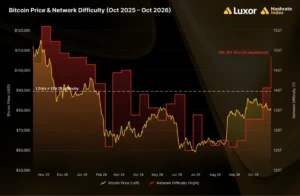
The global cryptocurrency mining sector stands at a critical juncture, characterized by rapid technological advancement, shifting energy regulatory frameworks, and increasing institutional oversight. As the industry matures, stakeholders—ranging from individual retail miners to large-scale public mining corporations—require high-fidelity data and analytical rigor to navigate the complexities of Bitcoin’s proof-of-work consensus mechanism. The Hashrate Index Newsletter serves as a focal point for this dissemination, offering a comprehensive view of the metrics that define the health and trajectory of the Bitcoin network’s computational power.
The Architecture of Hashrate and Network Security
At its core, Bitcoin mining is the process by which transactions are verified and added to the public ledger. The "hashrate" refers to the total combined computational power being used to mine and process transactions on a blockchain. In recent years, the industry has seen an exponential rise in total network hashrate, reflecting a global trend toward more efficient hardware deployment and the industrialization of mining operations.
Understanding the fluctuations in hashrate is essential for investors, energy companies, and policy analysts. When the hashrate increases, the network becomes more secure, as it requires a greater amount of energy and computational power to attempt a 51% attack. However, it also increases the "mining difficulty," an automated adjustment mechanism within the Bitcoin protocol that ensures blocks are produced at an average interval of ten minutes, regardless of how many miners are active.
Chronology of Mining Industrialization
The evolution of Bitcoin mining can be categorized into four distinct eras. In the early days, spanning from 2009 to 2012, mining was primarily conducted on consumer-grade CPUs and later GPUs. This was a hobbyist-driven phase where participation was decentralized and low-cost.
The second phase, from 2013 to 2016, marked the emergence of Application-Specific Integrated Circuits (ASICs). These specialized hardware units, designed solely for mining Bitcoin, drastically increased the efficiency of operations, effectively rendering CPU and GPU mining obsolete for Bitcoin.
The third phase, 2017 to 2020, saw the rise of large-scale mining facilities, particularly in regions with abundant and inexpensive hydroelectric power. This period also witnessed the first major geopolitical shifts in mining, as companies sought stable jurisdictions that provided regulatory clarity.
The current phase, beginning in 2021, is defined by the public listing of major mining companies on traditional stock exchanges, the geographic diversification of operations—following the 2021 ban on mining in China—and a heavy emphasis on sustainable energy integration. The industry is no longer a peripheral tech movement but a sophisticated component of the global financial and energy markets.
Data-Driven Insights and Market Metrics
For professional market participants, granular data is non-negotiable. Key metrics tracked by industry-leading indices include the "Hashprice," which denotes the expected revenue per unit of hashrate. This metric is influenced by three primary variables: the price of Bitcoin, the total network difficulty, and transaction fees.
Supporting data from the past 24 months suggests that while Bitcoin’s price volatility remains a significant factor, the efficiency of mining rigs—measured in Joules per Terahash (J/TH)—has become the primary determinant of long-term profitability. As mining hardware becomes more powerful, older generation units are decommissioned, leading to a constant cycle of capital expenditure (CapEx) for major mining firms.
Furthermore, the integration of Bitcoin mining with energy grids has become a major talking point. Many mining operations now function as "demand response" assets. In periods of high grid demand, miners can curtail their operations, providing a buffer for utility companies and stabilizing energy prices. This synergy between Bitcoin mining and renewable energy development—such as wind and solar—is expected to be a dominant theme through the end of the decade.
Regulatory Landscapes and Global Reactions
The regulatory environment remains fragmented. In North America, mining companies have largely welcomed the focus on ESG (Environmental, Social, and Governance) reporting, viewing it as a pathway to legitimacy. In contrast, several jurisdictions in Europe and Asia have expressed skepticism regarding the environmental impact of proof-of-work mining, leading to periodic discussions about taxation or potential bans.
Industry bodies, such as the Bitcoin Mining Council, have taken an active role in responding to these concerns. By publishing quarterly reports on the industry’s energy mix and sustainable power usage, these organizations seek to provide objective data to policymakers. Statements from these groups often emphasize that Bitcoin mining is uniquely positioned to monetize stranded energy—energy that is produced in remote locations where it cannot be efficiently transported to population centers.
Broader Economic Implications
The implications of a robust, well-monitored hashrate ecosystem extend far beyond the crypto-asset market. As mining operations grow in scale, they contribute significantly to local economies by creating high-tech jobs and tax revenue in rural areas. Moreover, the hardware manufacturing supply chain has become a significant sector of the global semiconductor market.
The professionalization of the sector means that the days of "garage mining" are largely over for those seeking to generate significant profit. Today, mining is an exercise in infrastructure management, power procurement, and hardware lifecycle logistics. Investors who monitor these indices are not merely looking at the price of a coin; they are evaluating the physical infrastructure of the future of digital finance.
Strategies for Navigating Volatility
For participants looking to stay informed, the Hashrate Index Newsletter provides a synthesis of these complex variables. By aggregating data on hardware pricing, energy costs, and difficulty adjustments, the newsletter allows stakeholders to perform "sensitivity analysis." This is the practice of determining how a change in one variable—such as a 10% increase in electricity costs—will impact the overall break-even point for an operation.
The importance of such analysis cannot be overstated. With the periodic "halving" of Bitcoin—an event that reduces the block reward by 50% every four years—miners must constantly optimize for efficiency. If a miner’s operating costs exceed the revenue generated by the reduced block reward, they must either upgrade their hardware or exit the market. This cycle of creative destruction ensures that only the most efficient and well-capitalized miners remain, which, in turn, maintains the overall stability of the Bitcoin network.
The Role of Analytical Newsletters
In an information-dense environment, the primary challenge is not the lack of data, but the lack of synthesis. The Hashrate Index Newsletter aims to bridge this gap by providing objective, factual, and timely updates. By subscribing to such services, market participants ensure they are receiving vetted information rather than hearsay or speculative noise.
The process of staying informed begins with the systematic collection of data points: block times, transaction throughput, hardware efficiency benchmarks, and power purchase agreements (PPAs). When these points are connected, a clearer picture emerges of the network’s health. For instance, a sudden drop in the network hashrate might suggest that a large cluster of miners has been forced offline, perhaps due to a localized weather event or a sudden change in energy policy. By identifying these patterns early, analysts can adjust their forecasts accordingly.
Future Outlook: 2025 and Beyond
As the industry moves toward 2025, the focus will likely shift from pure growth to operational excellence. We are entering an era of "Institutional Mining," where the balance sheet strength of the operator is as important as the efficiency of their machines. The integration of mining into broader energy markets will likely continue, with Bitcoin miners acting as a primary driver for investment in new, clean energy generation capacity.
Furthermore, the development of modular, containerized mining units allows for unprecedented flexibility in deployment. These units can be moved to locations where energy is most abundant, further decoupling mining from traditional industrial centers. This mobility is a defining feature of the modern mining landscape and presents both opportunities and risks for operators.
Conclusion
The Hashrate Index Newsletter represents more than just a source of news; it is a repository of the metrics that define the Bitcoin network’s operational reality. As the sector continues to evolve, the distinction between successful operations and those that struggle will be dictated by the ability to interpret and act upon data. Whether for energy producers, institutional investors, or mining hardware manufacturers, maintaining a consistent stream of high-quality information is the only way to effectively navigate the complexities of the digital asset mining sector. By fostering a culture of transparency and analytical rigor, the industry moves closer to its goal of providing a secure, decentralized, and sustainable financial infrastructure for the global economy.