In the evolving landscape of digital warfare and cybercrime, threat actors are continually searching for structural advantages that render their malicious operations immune to law enforcement intervention. As traditional web hosting providers, content delivery networks, and domain registrars grow increasingly aggressive in taking down illicit infrastructure, a surging faction of cybercriminals and state-sponsored hacking groups has pivoted toward an unlikely sanctuary: public blockchains. By embedding command-and-control (C2) instructions, configuration pointers, and malware payloads directly into decentralized ledgers, malicious actors are creating virtually indestructible coordination layers designed to outlive traditional web-based disruptions.
According to extensive research released by blockchain intelligence firm Chainalysis, this emerging methodology—collectively designated as "blockchain dead drops" (BDDs)—has witnessed an astronomical surge. Over the past twelve months, on-chain malicious writes have escalated by 420%, with a staggering 440% increase directly following the proliferation of open-source artificial intelligence coding tools. These generative AI models have effectively lowered the technical barrier to entry, empowering sophisticated syndicates and amateur cybercriminals alike to orchestrate decentralized, censorship-resistant attack campaigns across multiple blockchain ecosystems.

Mechanics and Anatomy of Blockchain Dead Drops
To understand the gravity of the BDD phenomenon, security professionals must examine how traditional malware infrastructure operates and why public ledgers represent such a paradigm shift in offensive cyber tactics. Historically, compromised endpoints—whether infected by ransomware, banking trojans, or remote access trojans (RATs)—rely on centralized command-and-control servers to receive instructions, exfiltrate stolen data, and download secondary payloads. These traditional C2 servers depend on conventional web infrastructure (Web2), making them highly susceptible to domain seizures, hosting provider blacklisting, cloud-flare countermeasures, and law enforcement takedowns.
When defenders successfully neutralize a C2 server, the operational network collapses, severing the attacker’s connection to the botnet or compromised machine fleet. Blockchain dead drops fundamentally neutralize this vulnerability. Operating under principles reminiscent of Cold War-era dead drops—where operatives left physical materials at a pre-arranged location for retrieval—BDDs utilize the immutable and decentralized nature of public blockchains as permanent, public lookup points.
Chainalysis categorizes these decentralized attack vectors into primary operational frameworks:

Transaction-Based Storage: Threat actors embed encoded C2 routing data, infrastructure pointers, or cryptographic keys directly into standard blockchain transaction fields. This includes data spaces such as Bitcoin’s OP_RETURN function or input data fields native to Ethereum Virtual Machine (EVM) compatible networks. Infected endpoints on victim machines are programmed to parse specific blockchain transactions, decode the embedded instructions, and connect to active off-chain infrastructure without ever relying on a static, centralized domain name.
Contract-Based Storage: Commonly associated with exploits such as "EtherHiding," attackers deploy and manipulate smart contracts on high-throughput or low-fee public networks like Binance Smart Chain (BSC) or Polygon. Rather than hardcoding a fragile IP address into malware code, developers store dynamic C2 configuration pointers inside smart contract state variables. Because smart contracts on public chains cannot be centrally deleted or taken offline, attackers can seamlessly update the pointer value as infrastructure rotates, allowing every infected device in a compromised fleet to automatically pivot to new servers upon querying the contract.
Phantom Wallet Routing: In even more streamlined variations, malicious actors utilize phantom wallets—cryptographic addresses devoid of a private key-pair—to encode C2 IP addresses directly into the byte values of the destination address itself. Malware variants execute zero-value transactions targeting these specific addresses, extracting the embedded server coordinates locally before establishing communications.

A Decadelong Chronology of On-Chain Evolution
While the massive spike in BDD activity is a recent phenomenon, the conceptual marriage of malware and blockchain technology spans more than a decade. The earliest documented iterations date back to 2013, when variants of the Necurs botnet utilized Namecoin—an early Bitcoin fork—to store resilient C2 domain pointers. As blockchain technology matured, threat actors adapted their methodologies.
By 2019, operators behind banking malware and crypto-mining botnets like Glupteba began encoding malicious IP addresses into Satoshi transfer amounts and utilizing Bitcoin’s OP_RETURN function to broadcast coordination data. However, these early campaigns were largely experimental, constrained by the technical friction of interacting programmatically with early ledgers and the specialized programming expertise required to build resilient loops.
A significant turning point occurred in mid-2023 with the emergence of "EtherHiding" on the Binance Smart Chain. Following aggressive clampdowns by infrastructure providers like Cloudflare on conventional servers utilized by ClearFake infostealer operators, cybercriminals successfully migrated their delivery mechanisms into smart contracts. The resilience of BSC ensured continuous campaign longevity, quickly inspiring a wave of unrelated threat actors to experiment with decentralized hosting for distributed denial-of-service (DDoS) botnets such as Smargaft.

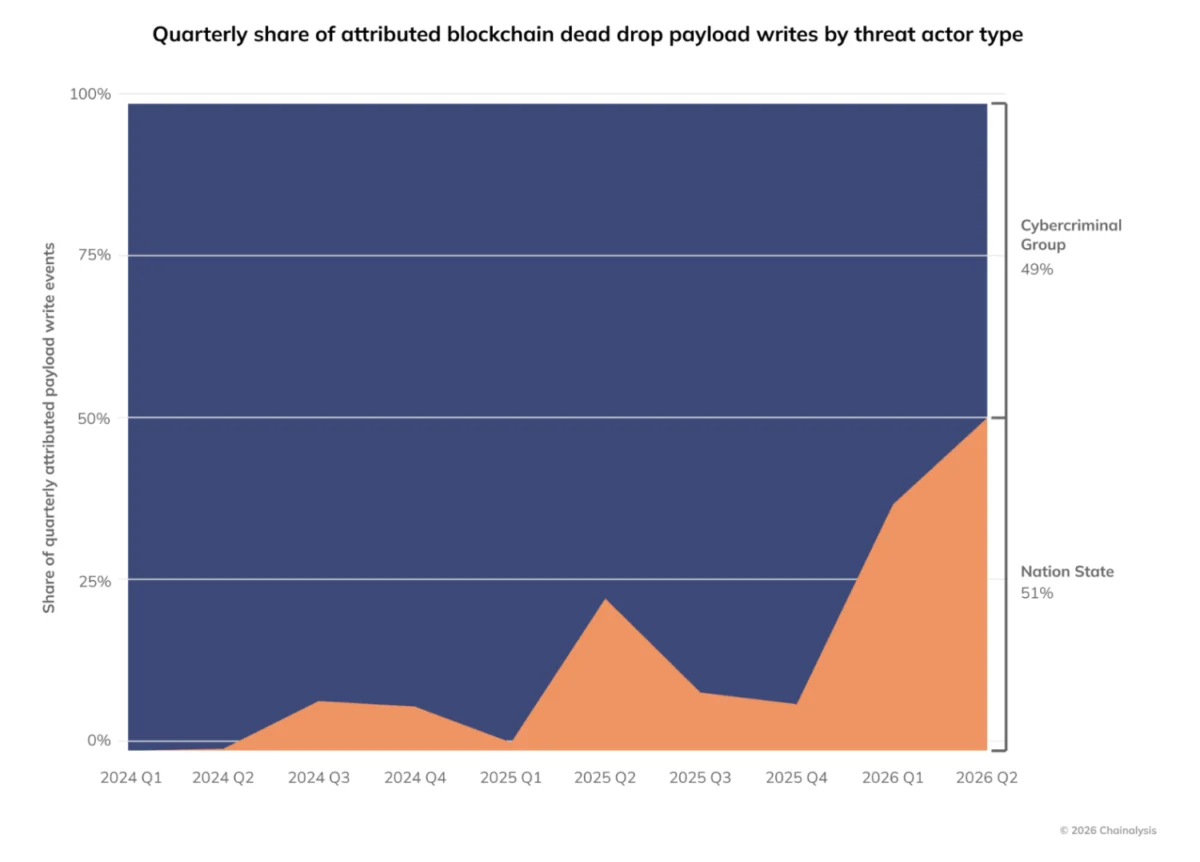
The landscape shifted dramatically between late 2024 and early 2025. Recognizing the absolute permanence and obscurity afforded by public ledgers, nation-state intelligence services and advanced persistent threat (APT) groups formally integrated BDDs into their operational playbooks. Iranian threat actors tied to the Ministry of Intelligence began embedding C2 data within Bitcoin transactions, while North Korean state-backed groups incorporated EtherHiding methodologies into their elaborate, multi-tiered cryptocurrency theft and fraudulent employment ruses targeting IT workers globally.
Case Studies: State-Sponsored Adoption and Cybercriminal Syndicates
The utilization of blockchain dead drops is no longer isolated to decentralized testing grounds; it is a preferred operational doctrine for some of the world’s most active and dangerous state-sponsored cyber units and organized criminal syndicates.
The Democratic People’s Republic of Korea (DPRK): Multi-Chain Redundancy
In early 2025, security researchers from the Google Threat Intelligence Group (GTIG), including Mandiant, tracked a North Korean-linked cluster designated as UNC5342. This group utilized smart contract-based BDDs on public networks to deliver credential-stealing payloads to job-seeking cryptocurrency developers. Subsequent on-chain investigations conducted by Chainalysis revealed an even more sophisticated, multi-chain redundant architecture deployed by the same threat actor nexus.

UNC5342 established a cross-chain relay mechanism spanning the TRON, Aptos, and Binance Smart Chain networks. Infected victim endpoints first execute an on-chain query on the TRON network; if unreachable, the malware queries Aptos. Both chains resolve to encoded pointers that direct the compromised machine to a specific transaction on BSC. This BSC transaction contains encrypted C2 instructions, configuration data, and subsequent stage references. By distributing routing instructions across three distinct blockchain architectures, the DPRK ensured that disrupting the campaign would require simultaneous, coordinated takedown actions across three separate protocol ecosystems—an operational impossibility given their decentralized nature.
Iranian State-Linked Operators: Exploiting Bitcoin’s Immutable Record
Intelligence alignment studies have similarly tied Iranian state-sponsored cyber operations to the Bitcoin blockchain. Operating via specialized malware families with distinct timing and infrastructural footprints, these actors employ a unique transaction-based storage model. Rather than utilizing attacker-owned nodes exclusively, malicious wallets broadcast micro-transactions to historically significant public addresses, including those tied contextually to Bitcoin’s pseudonymous creator, Satoshi Nakamoto.
The financial transfer value is irrelevant; the critical asset is the transaction data payload. The malware deployed on target networks is hardcoded to monitor these specific archival addresses, decode the accompanying transaction data, and retrieve the current operational server coordinates. This tactic minimizes the attacker’s distinct footprint by piggybacking on high-traffic, permanent public ledger landmarks while maintaining instantaneous global update capabilities.

Russian-Language Cybercriminals and Malware-as-a-Service (MaaS)
Beyond nation-state actors, Russian-language criminal ecosystems have industrialized blockchain dead drops through Malware-as-a-Service frameworks. Documented extensively by cybersecurity firms such as Securonix, Trinity Cyber, and LevelBlue, these frameworks—often associated with toolkits like the errTraffic and ClickFix frameworks—are actively rented or sold on underground Russian cybercrime forums.
Operating primarily on the Polygon and Binance Smart Chain networks, these MaaS operators utilize a centralized deployer wallet architecture to manage fleets of resolver contracts. Affiliates and downstream customers rent access to these resilient smart contracts, updating operational C2 pointers as defensive security teams block legacy infrastructure. Through comprehensive wallet-level attribution, blockchain intelligence can tie these disparate customer campaigns back to a single overarching deployer, mapping out large-scale fraudulent token operations, clipboard-hijacking malware, and automated phishing networks that traditional endpoint investigations might otherwise view as isolated incidents.
The AI Factor: Lowering the Barrier to Entry
A primary driver behind the exponential 440% growth in malicious on-chain writes is the explosive rise of open-source and open-weight artificial intelligence models—particularly those originating without strict guardrails regarding the generation of offensive software. Historically, implementing a robust blockchain dead drop required deep, specialized fluency in both low-level systems cybersecurity and smart contract development (Solidity, Rust, or similar blockchain-specific languages).

The emergence of unrestricted, high-capacity large language models has democratized the creation of these advanced evasion techniques. Less-experienced cybercriminals can now prompt AI models to write custom smart contract resolvers, encode transaction payloads, and automate multi-chain failover scripts within minutes. Consequently, the threat landscape has transitioned from a small elite circle of advanced actors to a broad spectrum of criminal enterprises capable of deploying resilient, institutional-grade infrastructure.
Implications and Defensive Challenges
The institutionalization of blockchain dead drops presents severe structural challenges for enterprise cybersecurity teams, national security agencies, and incident responders. Traditional perimeter defenses and threat intelligence platforms are inherently designed to monitor Web2 environments—domain names, IP reputations, autonomous system numbers (ASNs), and centralized hosting repositories. When C2 infrastructure is abstracted onto decentralized ledgers, conventional signature-based detection mechanisms frequently experience critical visibility gaps.
Crucially, defenders cannot mitigate BDD threats by simply blocking public blockchain traffic or RPC endpoints. Restricting access to major public blockchain infrastructure providers—such as Infura, Alchemy, or Cloudflare—would inadvertently cripple legitimate financial applications, decentralized finance (DeFi) protocols, and web3 enterprises, while failing to stop a determined adversary from querying local or private blockchain nodes directly.

Despite these hurdles, cybersecurity experts emphasize that the immutable nature of public ledgers is a double-edged sword. Every transaction, contract deployment, and state update executed by a threat actor is permanently recorded, timestamped, and publicly accessible.
Moving Forward: The Role of Blockchain Intelligence
Mitigating the risks posed by blockchain dead drops requires a fundamental paradigm shift in how defenders conceptualize threat intelligence. Security operations centers (SOCs) and financial crime investigators are increasingly integrating blockchain analytics tools alongside traditional endpoint detection and response (EDR) platforms.
By utilizing advanced infrastructure identification tools to monitor outbound JSON-RPC calls, analyze smart contract bytecodes, and trace the funding histories of deployer wallets, defenders can map out the entire operational footprint of an adversary. Wallet-level attribution allows investigators to pierce the veil of anonymity, connecting seemingly unrelated malware variants to centralized criminal operators and nation-state syndicates.

As threat actors continue to innovate at the intersection of decentralized technology and malicious code, the cybersecurity community must respond with equal ingenuity. Integrating on-chain visibility into mainstream defense strategies remains one of the most effective methods to neutralize the durability of blockchain dead drops and restore accountability to the digital frontier.