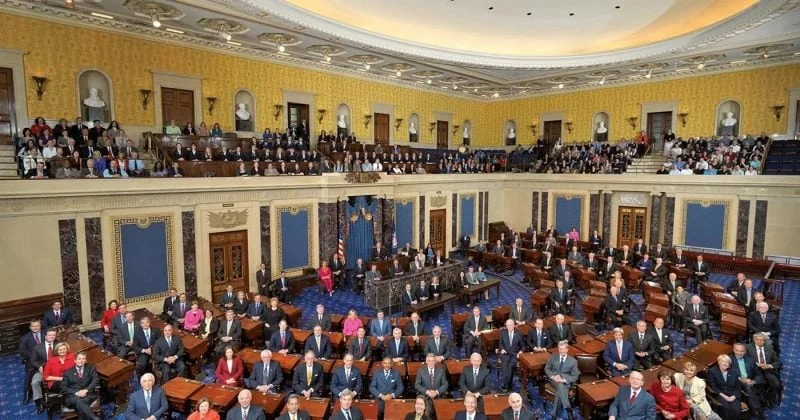
The United States Senate is currently navigating a narrow legislative window as it weighs the future of the Digital Asset Market Clarity Act, a comprehensive piece of legislation designed to provide a definitive regulatory framework for the burgeoning cryptocurrency industry. While Senate Majority Leader John Thune has expressed a desire to initiate the floor process before the upcoming summer recess, industry analysts and congressional aides suggest that the likelihood of passing the bill by the industry-favored August 7 deadline is rapidly diminishing. The pressure to act is mounting as the legislative calendar shrinks, with the shadow of the November midterm elections casting doubt on the possibility of significant bipartisan breakthroughs in the latter half of the year.
Speaking to reporters on Thursday, Senator Thune indicated that while he remains committed to moving the bill forward, the path to a final vote is fraught with procedural and political hurdles. "I would like to at least get Clarity started," Thune remarked, referring to the act by its common shorthand. "We’ll see where the votes are." This cautious optimism reflects the reality of a Senate floor currently occupied by a backlog of high-priority items, including the confirmation of judicial nominees, an Iran war powers resolution, and the perennially complex annual defense authorization bill. As these items consume the chamber’s limited time, the window for a robust debate on digital asset market structure is closing.
The Legislative Calendar and the Race Against Recess
The timing of the current legislative session is a critical factor in the bill’s potential success or failure. The Senate is scheduled to begin its summer state work period on August 10, with lawmakers not expected to return to Washington until September 14. For the digital asset industry, which has lobbied heavily for regulatory certainty, the August 7 date was viewed as a "practical deadline." Passing the bill before this break would have allowed the Senate to clear its plate before the political focus shifts entirely toward the midterm elections, where legislative productivity typically slows in favor of campaign activities.
If the Senate can at least begin the floor process—such as a motion to proceed—before August 10, it could preserve a procedural path for the bill to be resumed immediately upon the return of lawmakers in mid-September. However, the September session is notoriously brief and often dominated by government funding and appropriations debates. Furthermore, any version of the bill passed by the Senate that contains amendments would need to be reconciled with the House of Representatives. Given that the House approved its version of the crypto market structure bill in July 2025, a lengthy conference committee or a series of "ping-pong" amendments could push the final signing well into the lame-duck session or even into the next Congress.
Origins and Structure of the Digital Asset Market Clarity Act
The Digital Asset Market Clarity Act represents the culmination of months of negotiation between the Senate Banking Committee and the Senate Agriculture Committee. Historically, these two bodies have competed for jurisdiction over digital assets, with the Banking Committee overseeing the Securities and Exchange Commission (SEC) and the Agriculture Committee overseeing the Commodity Futures Trading Commission (CFTC). The current draft bill attempts to resolve this jurisdictional tug-of-war by clearly defining which digital assets qualify as securities and which should be treated as commodities.
Under the proposed framework, the bill sets forth rigorous rules for digital asset exchanges, intermediaries, and issuers. It aims to eliminate the "regulation by enforcement" approach that has characterized the SEC’s relationship with the crypto industry over the past several years. By establishing a federal oversight regime, the act seeks to provide a "safe harbor" for decentralized projects while ensuring that centralized platforms adhere to strict consumer protection, anti-money laundering (AML), and "know your customer" (KYC) standards.
The bill’s structure is divided into several key pillars:
- Jurisdictional Clarity: Differentiating between investment contracts (securities) and functional digital commodities.
- Exchange Registration: Requiring platforms to register with either the SEC or CFTC depending on the assets they list.
- Stablecoin Regulation: Establishing a federal framework for the issuance of payment stablecoins, including reserve requirements.
- Consumer Protection: Mandating the segregation of customer funds and prohibiting the commingling of assets, a direct response to the failures seen in previous high-profile exchange collapses.
Partisan Divisions and Key Points of Contention
Despite the bipartisan desire for a safer market, the Digital Asset Market Clarity Act remains stalled due to several contentious provisions. The most significant rift exists between Democrats and Republicans regarding the treatment of stablecoin rewards and the enforcement of ethics restrictions on senior government officials transitioning into the private sector.
Democrats have expressed strong reservations about the enforcement mechanisms within the bill. Specifically, many have objected to a provision that would give the Department of Justice (DOJ) the primary responsibility for enforcing ethics rules related to digital asset oversight. Some Democratic lawmakers argue that this role should remain with the independent regulatory agencies to prevent the politicization of enforcement. On the other side of the aisle, some Republicans have voiced opposition to the proposed treatment of stablecoin rewards. They argue that overly stringent regulations on how issuers distribute yields to holders could stifle innovation and drive stablecoin activity away from the United States toward more permissive jurisdictions like the European Union or the United Arab Emirates.
Senator Cynthia Lummis, a prominent advocate for the bill and a member of the Senate Banking Committee, acknowledged that the most disputed sections remain open to revision. "We are still looking for that sweet spot that secures enough Democratic support to reach the 60-vote threshold," Lummis said. The 60-vote requirement for cloture in the Senate means that the bill must have broad bipartisan backing to overcome a potential filibuster, a tall order in an increasingly polarized political environment.
Industry Implications and Economic Stakes
The stakes for the Digital Asset Market Clarity Act extend beyond the halls of Congress. The U.S. digital asset market currently involves millions of retail investors and billions of dollars in institutional capital. According to data from various industry trackers, the global market capitalization of digital assets fluctuates between $2 trillion and $2.5 trillion, with a significant portion of that liquidity tied to U.S.-based entities.
Industry representatives argue that without the "Clarity" provided by this act, the U.S. risks a "brain drain" of developers and capital. The House’s passage of its version in July 2025 sent a signal of intent, but the Senate’s delay is creating a vacuum. Market participants are particularly concerned about the lack of a clear pathway for "decentralization"–the point at which a project becomes sufficiently decentralized to no longer be considered a security.
Furthermore, the bill addresses the oversight of stablecoins, which have become the backbone of the crypto economy. With over $150 billion in stablecoins currently in circulation, the lack of a unified federal framework is seen as a systemic risk. Proponents of the bill argue that by bringing stablecoin issuers into the federal fold, the U.S. can ensure the primacy of the dollar in the digital age.
Analysis of Potential Outcomes
As the August 7 deadline nears, several scenarios are likely to unfold:
Scenario A: The "Placeholder" Start. The Senate leadership initiates a motion to proceed before the recess. This would be a symbolic victory for the industry, signaling that the bill is a priority for the fall. It would allow for floor speeches and the filing of amendments, but a final vote would be deferred until late September.
Scenario B: The Midterm Stagnation. If the Senate fails to begin consideration before August 10, the bill may fall victim to the "election year freeze." As lawmakers head home to campaign, the appetite for complex, controversial financial legislation typically wanes. In this scenario, the bill might not see significant action until a post-election lame-duck session, or it may be reintroduced in the next Congress, essentially resetting the legislative clock.
Scenario C: Last-Minute Compromise. Negotiators like Senator Lummis and her Democratic counterparts could reach a "grand bargain" on stablecoin rewards and DOJ enforcement in the coming days. While unlikely given the current floor schedule, such a breakthrough could see the bill fast-tracked via "unanimous consent" for certain procedural steps, though this requires the cooperation of all 100 senators.
Conclusion and Broader Global Context
The struggle to pass the Digital Asset Market Clarity Act highlights the difficulty of regulating a rapidly evolving technology through traditional legislative processes. While the U.S. deliberates, other jurisdictions are moving forward. The European Union’s Markets in Crypto-Assets (MiCA) regulation has already begun its phased implementation, providing a clear roadmap for firms operating in the 27-member bloc. Similarly, the United Kingdom and Hong Kong have made significant strides in establishing themselves as regulated hubs for digital finance.
The failure to meet the August window would leave the Digital Asset Market Clarity Act with less floor time and greater political pressure. For the U.S. to maintain its position as a global financial leader, the consensus among industry experts is that the Senate must find a way to bridge the partisan divide. The coming weeks will determine whether the "Clarity Act" becomes a landmark law or another entry in the long list of legislative "what-ifs" in the lead-up to a major election. For now, the digital asset industry remains in a state of watchful waiting, hoping that the Senate can, as Majority Leader Thune suggested, at least get the process started.