Rarible has announced the beta release of its groundbreaking Model Context Protocol (MCP) Server, a new developer tool designed to radically simplify the retrieval and utilization of Non-Fungible Token (NFT) data. This innovative solution leverages the power of Large Language Models (LLMs) to translate natural language queries into structured data requests, effectively breaking down the technical barriers that have historically made accessing critical NFT market information a complex and time-consuming endeavor for developers.
For years, developers and enthusiasts seeking to glean insights such as floor prices, ownership histories, trending collections, or market sentiment from the burgeoning NFT ecosystem have faced a steep learning curve. The traditional pathways involved either building comprehensive front-end applications from scratch or mastering intricate API query languages, a process that often demanded significant technical expertise and development resources. This friction has inadvertently stifled innovation and limited the broader accessibility of rich NFT data, hindering the development of sophisticated tools and applications.
The Rarible MCP Server directly addresses these challenges by acting as an intelligent intermediary. It seamlessly integrates with leading LLMs, including OpenAI’s GPT models (though the article specifically mentions Claude and Cursor as examples), and connects them to the robust Rarible Protocol. This allows developers to query vast datasets of NFT and marketplace information using simple, conversational language, bypassing the need for extensive backend development or in-depth knowledge of the Rarible Protocol’s underlying API structure. The MCP Server promises to be a pivotal tool in making NFT data more accessible and actionable through the application of modern, AI-driven interfaces.
"Getting NFT data is still too complicated," the Rarible team stated in their announcement. "If you want to find floor prices, see who owns what, or check what’s trending, you usually have to build a full frontend or write complex API queries. This makes it hard for developers to access that information quickly. The new Rarible MCP Server solves this by letting you ask questions in plain language and turning them into real, structured queries."
A New Era of NFT Data Interrogation
The core innovation of the Rarible MCP Server lies in its ability to bridge the gap between human language and programmatic data access. By harnessing LLMs, developers can now formulate queries in a manner akin to speaking with a knowledgeable assistant. For instance, instead of writing lines of code to fetch specific data points, a developer could simply ask, "What are the top NFT collections on Base Chain by trading volume in the last 24 hours?" or "Show me the current floor price for the Bored Ape Yacht Club collection on Ethereum." The MCP Server then intelligently interprets these natural language prompts, translates them into precise, safe, and structured queries for the Rarible Protocol, and returns the requested data in a format readily usable by applications, dashboards, or AI agents.
This paradigm shift is particularly significant for the rapid development of AI-powered tools within the Web3 space. As LLMs continue to evolve and demonstrate enhanced capabilities in interacting with external APIs, the Rarible MCP Server provides a direct conduit for them to access and leverage the dynamic world of NFT data. This facilitates the creation of more intelligent and context-aware applications, from advanced market analysis tools and personalized NFT recommendation engines to sophisticated portfolio management systems and automated trading bots.
Key Features and Technical Architecture
The Model Context Protocol (MCP) SDK, which powers the MCP Server, is engineered as a production-grade, type-safe TypeScript SDK. This ensures reliability and maintainability for developers building with the tool. It provides structured access to a comprehensive range of NFT data, including:
- NFT Items: Detailed information about individual NFTs, such as their metadata, attributes, and token IDs.
- Collections: Data pertaining to entire NFT collections, including their historical performance, creator information, and community engagement metrics.
- Ownership: Comprehensive insights into who owns specific NFTs or collections, enabling detailed analysis of holder distributions and influential wallets.
- Marketplace Data: Real-time information on sales, bids, listings, and overall trading activity across various NFT marketplaces.
- Pricing Information: Access to floor prices, average sale prices, and price trends for individual NFTs and entire collections.
The SDK is designed for versatility, functioning seamlessly in both browser-based and server-side environments. It supports CommonJS and ES Modules, catering to diverse project structures and build processes. Furthermore, its modular design allows developers to integrate only the necessary components, which is particularly beneficial for projects with stringent bundle size requirements or those requiring custom hook development.
Target Audience and Use Cases

The Rarible MCP Server is poised to become an indispensable tool for a wide array of Web3 developers. Its primary benefit is the significant reduction in development time and complexity for anyone working with NFT data. This includes:
- Marketplace Builders: Creating more dynamic and responsive NFT marketplaces with enhanced search, filtering, and data visualization capabilities.
- Analytics Platform Developers: Building sophisticated dashboards and analytical tools that provide deep insights into NFT market trends, performance, and user behavior.
- Wallet and Portfolio Managers: Integrating real-time NFT portfolio tracking and performance analysis directly into user wallets.
- AI and Bot Developers: Creating intelligent agents that can autonomously analyze NFT markets, identify opportunities, and execute trades or other actions.
- Game Developers: Incorporating NFT data and functionalities into blockchain-based games, such as in-game item management or player-driven economies.
- Researchers and Analysts: Streamlining the process of data collection and analysis for academic research or market intelligence reports.
Moreover, the SDK is particularly valuable for developers looking to rapidly prototype and experiment with LLMs and NFT data without the overhead of building and maintaining complex API infrastructure. This democratizes access to powerful data retrieval capabilities, enabling faster iteration and innovation.
Broadening Blockchain Support
The Rarible MCP Server is currently available in beta and offers support for a growing number of blockchain ecosystems. Initially, it provides robust integration with:
- EVM-compatible Chains: This includes major networks like Ethereum, Polygon, Binance Smart Chain, and Optimism, among others.
- Eclipse: A Layer 2 scaling solution.
- Flow: A blockchain designed for NFTs and consumer-friendly applications.
Rarible has indicated plans to expand support to additional blockchain networks in the future, further solidifying its commitment to becoming a comprehensive data provider for the entire Web3 landscape.
Integrating with Leading LLMs: A Practical Example with Claude Pro

The documentation highlights a practical integration scenario with Claude Pro, demonstrating how developers can enable natural language access to NFT data directly within their LLM interfaces. This specific integration focuses on using Claude Desktop with a claude_desktop_config.json file.
The process involves obtaining an API key from Rarible, which is essential for authenticating requests to the Rarible Protocol. Users can request API keys through the Rarible website, ensuring that all interactions are secure and authorized.
Once the API key is secured, it needs to be incorporated into the claude_desktop_config.json file. The configuration snippet provided outlines how to register the RaribleProtocolMcp server, specifying the command to execute the MCP package and passing the API key as an authentication parameter.
  "mcpServers":
    "RaribleProtocolMcp":
      "command": "npx",
      "args": [
        "-y", "--package", "@rarible/protocol-mcp",
        "--",
        "mcp", "start",
        "--api-key-auth", "your-api-key-here"
      ]
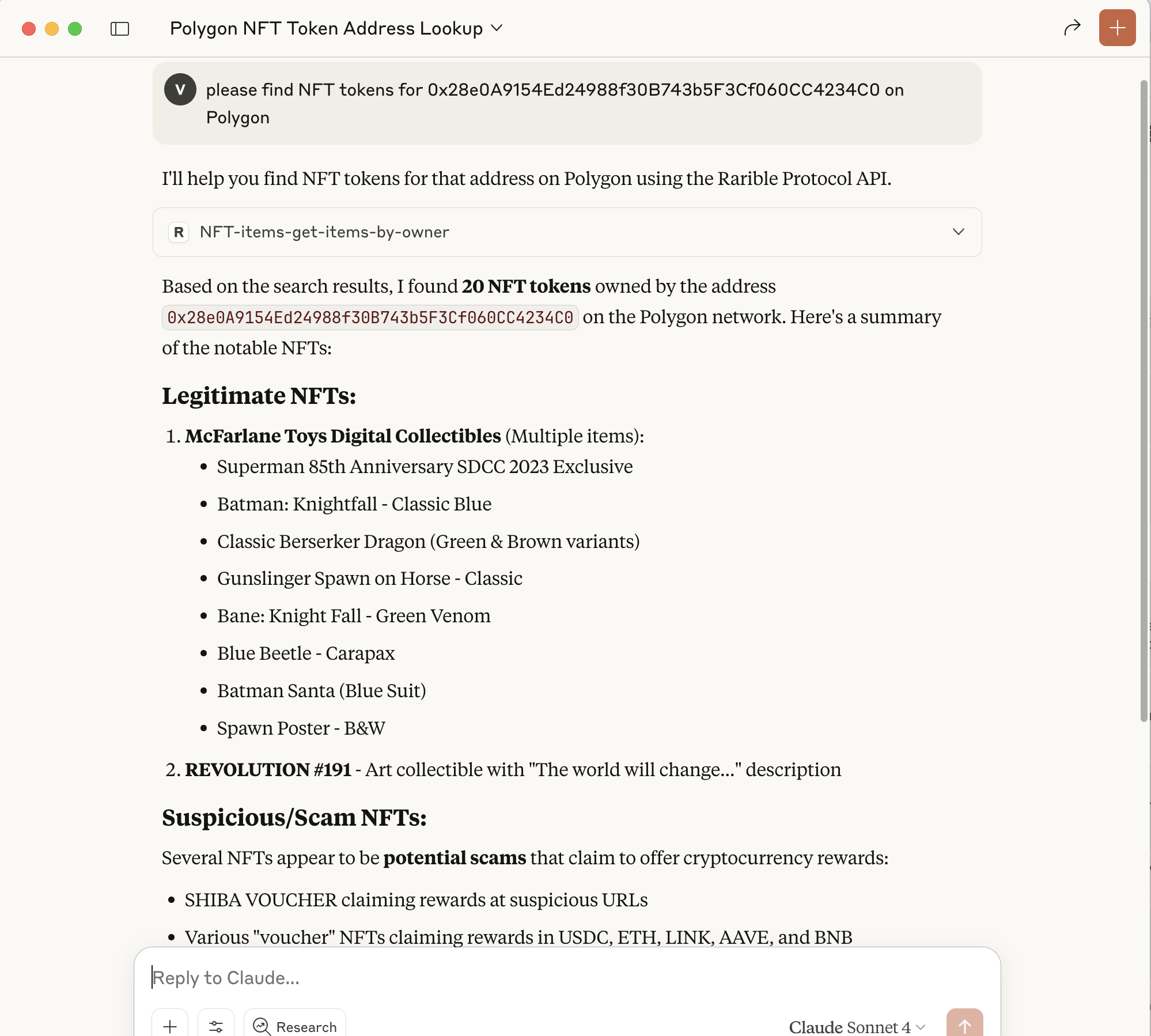
This setup ensures that the MCP Server is launched automatically when Claude starts, exposing all its supported SDK methods as tools within the Claude Desktop environment. Users can then interact with Claude, posing questions like:
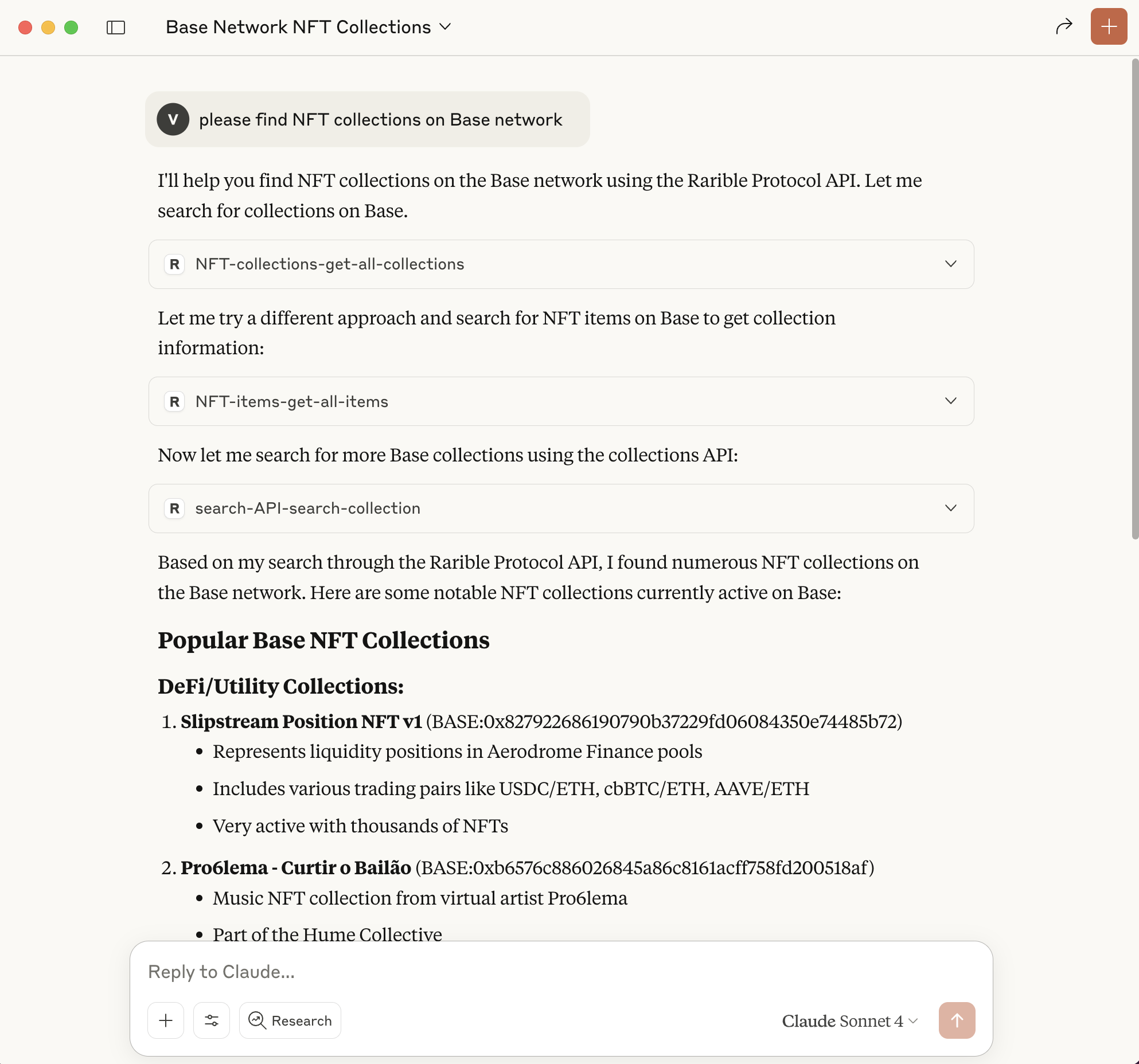
- "What are the top collections on Base Chain right now?"
- "Show me collection rankings by floor price on Ethereum."
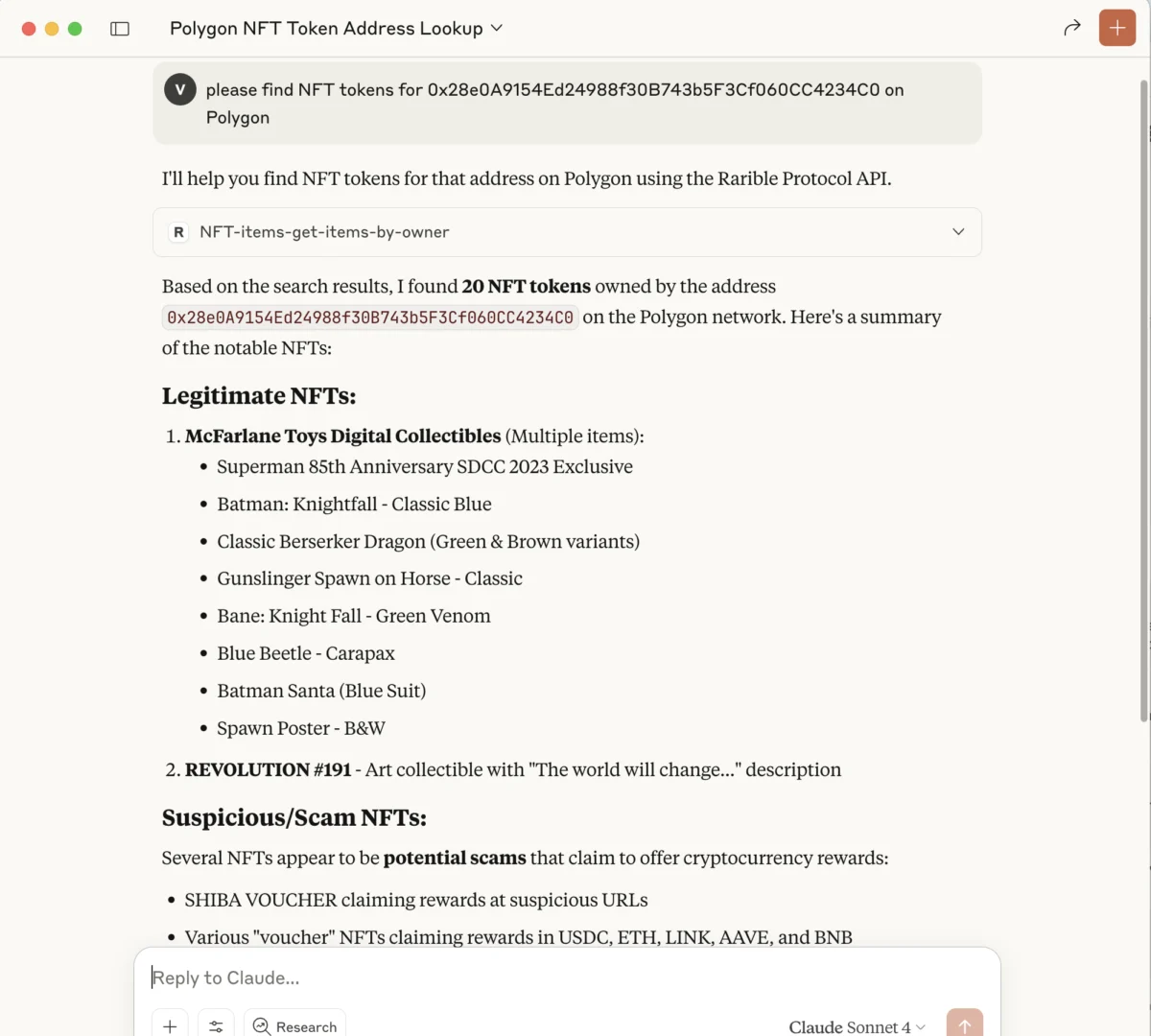
- "Find me all NFTs owned by the wallet address 0x…"
- "What was the last sale price for this specific NFT (0x…:123)?"
Claude, empowered by the MCP Server, translates these natural language queries into executable SDK calls, fetches the relevant data from the Rarible Protocol, and presents it in a structured, machine-readable format. This significantly enhances the utility of LLMs for tasks involving complex data retrieval from the NFT space.
Developer Experience and Code Examples
The MCP SDK provides strongly typed access to the full spectrum of NFT and marketplace data points. For developers who prefer direct coding, the SDK offers a clear and efficient way to interact with the Rarible Protocol. An example provided illustrates how to retrieve detailed information about a specific NFT item:
import  RaribleProtocolMcp  from "@rarible/protocol-mcp";

const raribleProtocolMcp = new RaribleProtocolMcp(
  apiKeyAuth: process.env["RARIBLE_API_KEY"] ?? "",
);

async function run()
  const result = await raribleProtocolMcp.nftItems.getItemById(
    itemId: "ETHEREUM:0x...:123", // Replace with actual item ID
  );
  console.log(result);


run();
This code snippet demonstrates the ease with which developers can instantiate the MCP client, authenticate with their API key, and make a specific call to fetch an NFT item by its unique identifier. The result object would then contain comprehensive, structured data about the requested NFT.
Feedback and Community Engagement
Rarible is actively seeking feedback on the MCP Server during its beta phase. Developers are encouraged to share their experiences, report any issues, and suggest improvements through the official Rarible Discord and Telegram channels. This collaborative approach aims to refine the tool and ensure it meets the evolving needs of the developer community. The Rarible Dev Telegram group, in particular, serves as a hub for developers to connect, share insights, and receive support.
Looking Ahead: The Future of NFT Data Accessibility
The launch of the Rarible MCP Server marks a significant step towards democratizing access to NFT data. By abstracting away the complexities of API interactions and enabling natural language querying, Rarible is empowering a new generation of developers to build more innovative and user-friendly applications within the Web3 ecosystem. As the NFT market continues to mature and expand, tools like the MCP Server will be crucial in unlocking its full potential and driving mainstream adoption. Developers are invited to explore the possibilities, get started with the SDK, and contribute to shaping the future of how we interact with digital assets.
The availability of the MCP SDK on npm, coupled with extensive documentation and community support channels, ensures that developers have all the resources they need to integrate this powerful new tool into their projects. The promise of speaking directly to NFT data, rather than wrestling with complex code, represents a tangible leap forward in making the decentralized web more accessible and intuitive for creators and users alike.