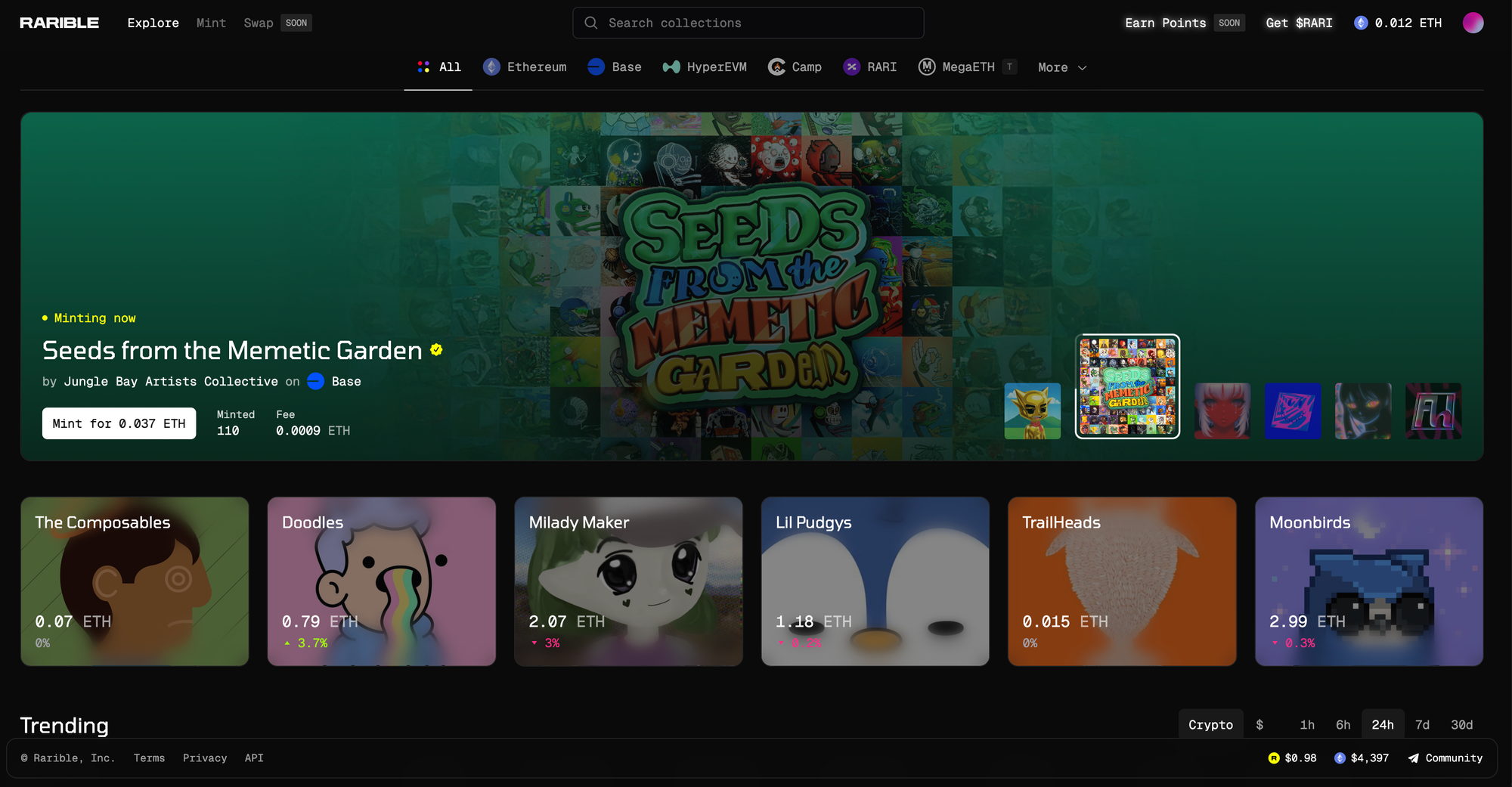
After six months of rigorous internal development and public-facing beta testing, the non-fungible token (NFT) marketplace Rarible has officially launched its overhauled platform, Rarible.com. This transition marks a significant pivot for the long-standing digital asset exchange, moving away from its legacy infrastructure toward a high-performance, multichain environment designed to handle the complexities of modern decentralized commerce. The launch is accompanied by an innovative cross-chain rewards program, signaling a strategic effort by the RARI Foundation to incentivize deep liquidity and sustainable trading behavior rather than the high-frequency wash trading that has historically plagued the NFT sector.
A Chronology of Transformation: From Beta to Alpha
The roots of this redesign can be traced back to the deployment of "RaribleFUN," a beta marketplace that served as a sandbox for the company’s new infrastructure. Launched in April 2025, the beta platform acted as a stress test for the team’s new technical stack. Over the subsequent five months, the platform processed more than 62 million mints and onboarded over 19 million users, providing the engineers with a wealth of real-time data regarding user behavior, transaction latency, and network congestion.
By iterating in public—a common practice in the Web3 space—Rarible was able to refine its core engine based on genuine user feedback. This period of rapid experimentation culminated on September 2, 2025, when the legacy platform began redirecting all traffic to the new interface. While the "OG" version of Rarible remains accessible for the time being, the company has confirmed its eventual deprecation, solidifying the new, faster marketplace as the permanent home for all future ecosystem activity.
Technical Performance and Market Positioning
The cornerstone of the new Rarible is its focus on speed. In an era where transaction finality is a key competitive differentiator, Rarible has optimized its architecture to deliver performance gains of up to 30% over its primary competitors on specific chains. On the most efficient networks, transactions now achieve sub-second settlement times, a significant improvement over the latency issues that often frustrate collectors during high-demand mints or flash sales.
This speed is not merely a convenience; it is a prerequisite for the platform’s broader ambitions in the multichain ecosystem. At launch, the marketplace supports 11 distinct chains, including Ethereum, Base, HyperEVM, LightLink, Somnia, RARI Chain, Camp Network, and Arena-Z. By providing early access to these ecosystems—some of which, like MegaETH and Camp, are currently exclusive to Rarible—the company is positioning itself as a primary gateway for collectors looking to scout emerging digital assets before they reach the wider market.
The RARI Foundation and the New Incentive Architecture
Perhaps the most significant departure from traditional marketplace models is the introduction of a new rewards program managed by the RARI Foundation. Historically, NFT marketplaces have struggled with the "incentive problem," where reward programs inadvertently encourage wash trading—a practice where users buy and sell assets between their own wallets to artificially inflate volume and claim rewards.
Rarible’s new system attempts to disrupt this cycle through a "liquidity-first" distribution mechanism. Instead of rewarding the direct participants of a specific trade (the buyer and the seller), the program distributes points to the 20 closest orders in the order book. This shifts the focus from transaction volume to order quality. By rewarding users for providing deep liquidity and placing competitive bids, the platform effectively incentivizes market makers and serious traders to support the ecosystem, rather than rewarding those who merely churn assets.

The program is funded through a percentage of the marketplace fees, creating a self-sustaining cycle where platform revenue is directly redistributed to the most active participants. These points are tracked via a centralized, cross-chain leaderboard, allowing users to monitor their standing and progress. Eventually, these points are converted into $RARI tokens, which can be claimed on the Base chain. This integration with Base, a layer-2 network built by Coinbase, highlights a strategic move toward lower-cost, high-throughput claiming processes.
Strategic Growth: The Acquisition of Flipp
The release of the new marketplace coincides with a period of aggressive expansion for the company. In August 2025, shortly before the official launch of the new platform, Rarible announced the acquisition of Flipp, a mobile-first crypto trading application. The acquisition provides the company with a sophisticated mobile user experience (UX) and rapid onboarding capabilities that were previously absent from the desktop-centric Rarible platform.
Industry analysts suggest that this move is a clear attempt to bridge the gap between "power users" who trade on desktop and the next generation of mobile-first digital asset collectors. By integrating Flipp’s infrastructure into the new Rarible ecosystem, the company is effectively building a "full-stack" commerce solution that covers everything from primary mints and mobile discovery to secondary market trading and rewards.
Implications for the NFT Marketplace Landscape
The shift in Rarible’s business model reflects broader trends in the decentralized finance (DeFi) and NFT space. As the market matures, platforms are moving away from the "all-in-one" generalist approach toward specialized infrastructure that emphasizes utility, speed, and long-term retention.
For the broader market, the success of this new rewards model will be a critical case study. If Rarible can successfully mitigate wash trading while maintaining high volume, it could set a new industry standard for how marketplaces incentivize activity. Furthermore, the emphasis on cross-chain interoperability suggests that the "siloed" era of NFTs—where specific chains held exclusive rights to certain asset classes—is nearing an end. As users become more chain-agnostic, marketplaces that offer a seamless experience across multiple ecosystems will likely capture the majority of the market share.
Official Stance and Future Outlook
While Rarible has not issued a formal "white paper" for this transition, leadership has consistently described this phase as the foundation for the "future of onchain commerce." The company’s roadmap suggests that this is only the first of several planned upgrades. In addition to adding support for more chains, the focus remains on enhancing the discovery of digital assets and improving the efficiency of the bidding process.
For existing users, the transition is largely automated, though the migration of the platform to a new architecture necessitates a period of adjustment. The company has encouraged users to engage with the new leaderboard and participate in the rewards program, emphasizing that the points system is designed to favor long-term consistency over short-term volatility.
As of September 2025, the market landscape for NFT trading remains highly competitive, with established players and new entrants vying for dominance. Rarible’s attempt to combine a high-speed, multichain marketplace with a non-inflationary, liquidity-focused reward system is a bold strategy. Whether it can effectively capture the interest of the broader crypto-native audience will depend on the platform’s ability to maintain its speed advantage as user volume scales and its capacity to attract high-quality liquidity providers to its new order book system.
For now, the transition to the new Rarible represents a calculated bet: that the future of digital asset trading lies not in the volume of transactions, but in the efficiency and depth of the market itself. As the company continues to roll out features and integrate the Flipp acquisition, the industry will be watching to see if this "onchain playground" can sustain its momentum in an increasingly fragmented digital economy.