In the delicate ecosystem of organ transplantation, time is measured not in hours, but in heartbeats. When a viable organ becomes available, a complex, high-stakes logistical ballet begins. Medical teams, regional coordinators, and national agencies must execute dozens of precise steps in a flawless sequence. Every medical record, donor consent form, and administrative authorization must be validated instantly and immutably. A single administrative error, a lost document, or a fraudulent signature can mean the difference between life and death. Recognizing these vulnerabilities, Argentina has taken a pioneering leap in public sector digitalization by anchoring its national organ transplant framework to a public blockchain network.
The Instituto Nacional Central Único Coordinador de Ablación e Implante (INCUCAI), Argentina’s central authority for organ, tissue, and cell procurement and transplantation, has officially integrated decentralized digital identity and notarization infrastructure into its national operations. Developed in collaboration with Latin American decentralized-identity firm Extrimian and powered by the IOTA mainnet, the system successfully places the administrative and regulatory processes of INCUCAI and its 24 provincial jurisdictional agencies onto a publicly verifiable, tamper-proof digital ledger.
This historic deployment marks a transformative milestone for healthcare administration. By merging self-sovereign identity (SSI) principles with national health infrastructure, Argentina is establishing a new global standard for transparency, security, and traceability in life-saving public services.
The Operational Challenges of National Organ Procurement
To understand the magnitude of this technological upgrade, one must examine the operational framework of Argentina’s transplant network. INCUCAI operates as the centralized governing body overseeing the national waiting list. However, the actual execution of organ procurement and transplantation is decentralized across 24 jurisdictional agencies—representing every individual province alongside the Autonomous City of Buenos Aires—in addition to a vast network of public and private hospitals and specialized transplant centers.
Historically, coordinating this intricate web of stakeholders relied on traditional digital databases and physical documentation. While effective, centralized databases inherently carry vulnerabilities: they are susceptible to single points of failure, administrative bottlenecks, and challenges regarding cross-jurisdictional verification. When transporting an organ across provincial lines under strict time constraints—such as a heart, which typically remains viable outside the body for only four to six hours—delays in verifying medical authorization or donor consent can jeopardize the entire procedure.
Furthermore, public trust is the cornerstone of any donation system. Grieving families must have absolute confidence that their consent is honored transparently, and medical professionals must be certain that the credentials and authorizations they receive are authentic. INCUCAI’s leadership recognized that a traditional database alone could not provide the absolute neutrality, cryptographic verifiability, and interoperability required for a mission of this gravity.
Technological Architecture: Privacy-Preserving Decentralization
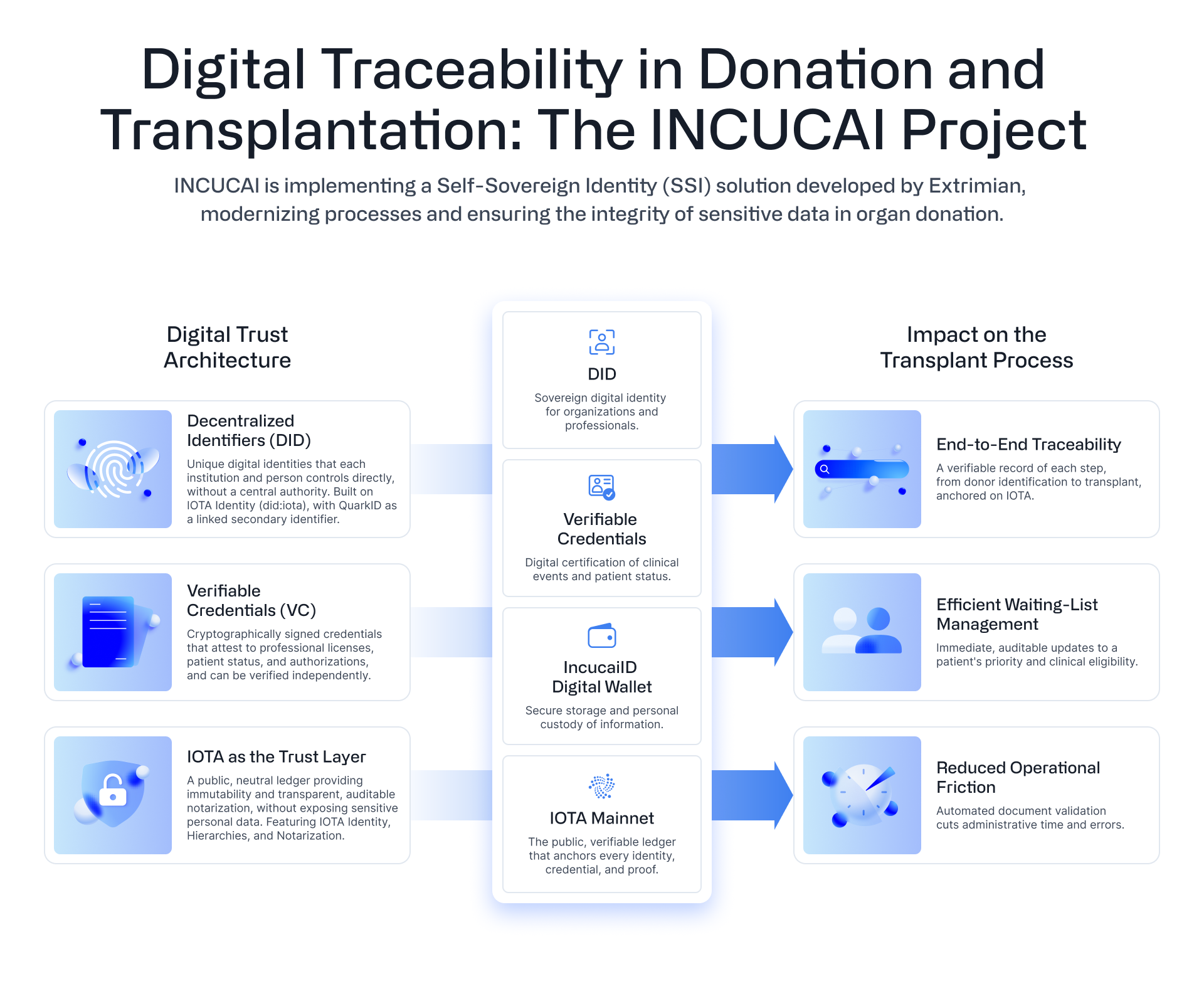
To solve these challenges, Extrimian engineered a robust decentralized infrastructure built on top of the IOTA mainnet. Extrimian specializes in self-sovereign identity solutions, a framework that empowers individuals, organizations, and institutions with direct, cryptographic control over their digital identities and the data they choose to share.
For the INCUCAI integration, the architectural design prioritized an absolute commitment to patient privacy. Crucially, no personally identifiable information (PII) or sensitive medical data is ever stored on the public blockchain. Instead, the system utilizes cryptographic proofs—specifically, secure hashes of documents and administrative process steps—anchored directly to the IOTA ledger.
This mechanism ensures mathematical integrity without exposing underlying data. Doctors, provincial agencies, and auditors can independently verify that an authorization or certification occurred exactly as recorded in the system, while the deeply personal and sensitive details of patients and donors remain strictly confidential and protected.
The deployment leverages several core building blocks of the IOTA ecosystem:
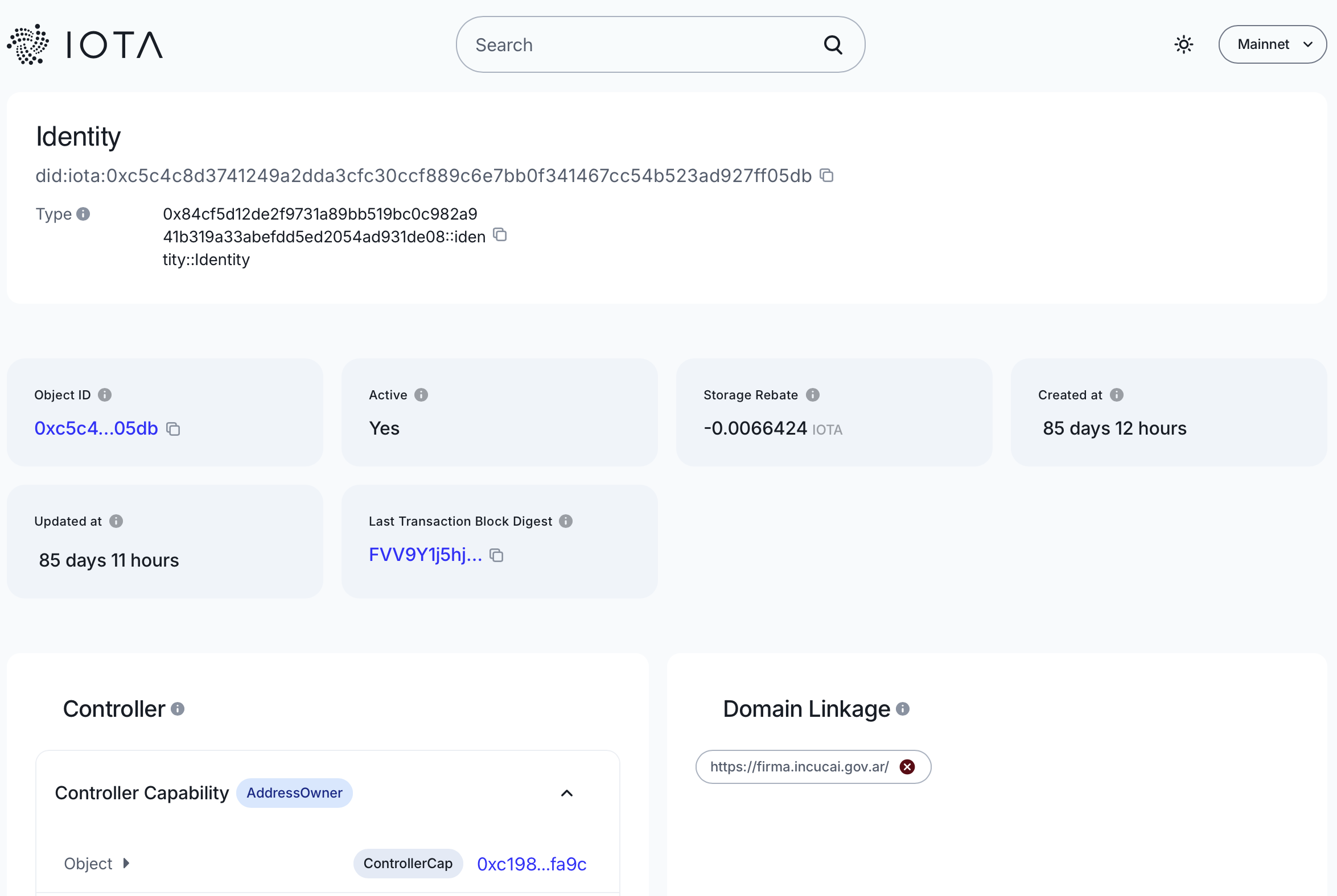
- Decentralized Identifiers (DIDs): Institutional identities for INCUCAI and all 24 provincial procurement agencies are established using W3C-compliant standards. These DIDs are cryptographically linked directly to official government domains, ensuring that any user can instantly confirm they are interacting with genuine state entities rather than malicious actors.
- Verifiable Credentials: Secure, tamper-proof digital credentials are issued to authorized medical personnel and patients, streamlining authentication across hospitals and regional offices.
- Onchain Notarization: Administrative steps and document signatures generate immutable proofs anchored on the ledger, requiring minimal gas fees while creating an unbreakable audit trail.
- National Infrastructure Integration: Portions of the technical stack operate in conjunction with ARSAT, Argentina’s state-owned telecommunications and satellite solutions company, ensuring that critical data handling remains anchored under national sovereignty and control.
Chronology of Implementation and Resolution 199/2026
The path toward a fully onchain transplant system culminated in mid-2026, backed by formal regulatory changes within the Argentine government.
In June 2026, the technological framework officially went live on the IOTA Mainnet. This rollout was formally codified through Resolution 199/2026, published in the national Official Gazette (Boletín Oficial). The resolution mandated the implementation of electronic signatures across every process managed within SINTRA (Sistema Nacional Procuración y Trasplante de la República Argentina), the nation’s centralized procurement and transplant information system.
The phased adoption strategy began with the management of the waiting-list registration process, prioritizing critical organs such as hearts and lungs before expanding to other organ lists and administrative workflows. To facilitate user interaction with the new infrastructure, Extrimian and INCUCAI launched IncucaiID, an official digital wallet application available for download on major mobile platforms. Through IncucaiID, patients, healthcare professionals, and administrative officers securely receive verifiable credentials, manage authentication, and digitally sign documents tied to the donation and transplantation lifecycle.
Independent Verification and Technical Audit
Adhering to the foundational blockchain philosophy of "don’t trust, verify," the deployment underwent rigorous independent validation. Following the June launch, the IOTA Foundation conducted a comprehensive audit working exclusively from public endpoints and the public IOTA Explorer.
The technical audit confirmed flawless execution: all 24 provincial institutional identities successfully resolved onchain, all block explorer links matched anticipated parameters, and direct queries confirmed that the entities controlling each identity precisely aligned with the accredited state federation. Furthermore, onchain activity logs demonstrated consistent, highly efficient notarization transactions handled by INCUCAI’s root authority address on the IOTA network.
Institutional Perspectives and Leadership Commentary
The successful integration of blockchain technology into Argentina’s healthcare framework has drawn praise from technology and public health leaders alike, highlighting the tangible intersection of decentralized innovation and humanitarian impact.
Daniela Hansen Krogh, Director of Information Technology and Information Systems at INCUCAI, emphasized the human element driving the digital transformation: "Trust is at the heart of every organ donation and transplantation process. Our responsibility is to ensure that every decision is supported by reliable, secure, and verifiable information. By incorporating decentralized identity and cryptographic verification into our national systems, we are strengthening the integrity, traceability, and legal certainty of every critical stage, while safeguarding sensitive patient information. This initiative reflects INCUCAI’s ongoing commitment to modernizing Argentina’s transplant system through secure, transparent, and citizen-centered digital innovation."
Echoing this sentiment, Esteban Musso, Professional Services Manager and Partner at Extrimian, pointed to the broader maturation of decentralized technologies: "At Extrimian, we believe that trust is the foundation of every digital transformation. By combining open standards with privacy-preserving technologies, we’ve helped build a solution that enhances traceability, security, and interoperability while respecting the privacy of every participant. Projects like this demonstrate that decentralized technologies are no longer a vision for the future—they are delivering tangible value today in critical public services."
Dominik Schiener, Co-Founder and Chairman of the IOTA Foundation, summarized the national significance of the deployment: "This is what IOTA’s open technology can do for critical public services at national scale: real infrastructure, already coordinating decisions that save lives."
Broader Implications and Future Outlook
The integration of INCUCAI and Extrimian’s decentralized architecture represents a watershed moment for the adoption of blockchain technology in Latin America and global public administration. For years, critics of blockchain technology have pointed to a lack of real-world utility beyond speculative financial markets. Projects like Argentina’s onchain transplant system dismantle that narrative, demonstrating that distributed ledgers can serve as vital public infrastructure capable of enhancing efficiency, eliminating bureaucratic friction, and safeguarding human life.
By establishing an immutable, transparent, and decentralized audit trail for organ procurement, Argentina has minimized the risk of administrative malpractice, accelerated cross-jurisdictional coordination, and reinforced public confidence in a life-saving medical apparatus. As SINTRA transitions further into a fully paperless, cryptographically secured workflow, the framework provides a blueprint that other nations and healthcare sectors can study and replicate.
Ultimately, the collaboration between INCUCAI, Extrimian, and IOTA proves that the most profound applications of modern technology are those that fade into the background, operating seamlessly to protect privacy, secure data, and ensure that when a patient is waiting for a second chance at life, the systems supporting them never falter.