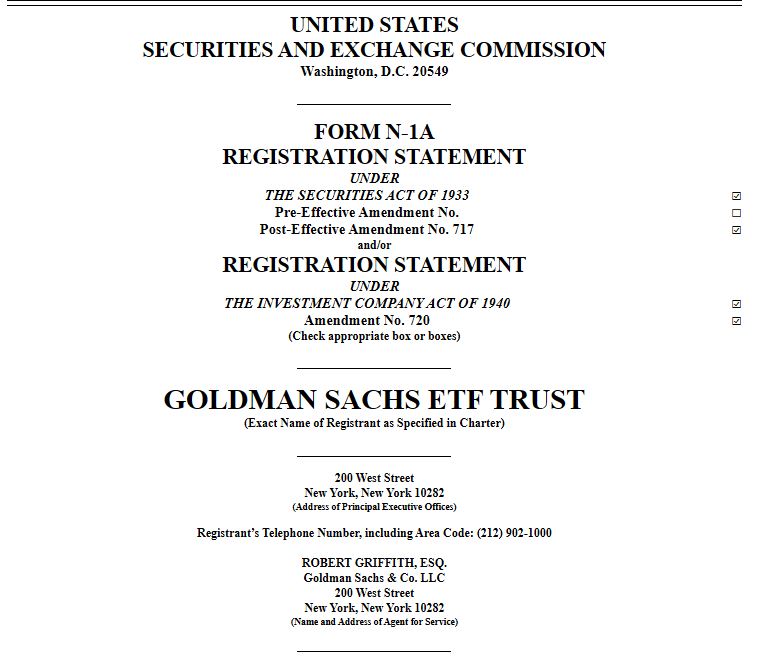
Goldman Sachs, one of Wall Street’s most formidable financial institutions, has taken a significant step into the digital asset landscape, filing paperwork with the U.S. Securities and Exchange Commission (SEC) for a Bitcoin Premium Income ETF. This move underscores a nuanced yet powerful shift in how traditional finance giants are approaching the cryptocurrency market, aiming to capitalize on Bitcoin’s appeal without directly owning the volatile digital asset. Unlike a straightforward spot Bitcoin ETF, Goldman Sachs’ proposed fund is engineered to provide investors with exposure to Bitcoin’s price movements while simultaneously generating regular income through sophisticated options trading strategies. This strategic filing, dated April 14, 2026, marks a pivotal moment, following closely on the heels of similar institutional forays and highlighting the accelerating integration of cryptocurrencies into mainstream investment portfolios.
The core of Goldman Sachs’ strategy for the Bitcoin Premium Income ETF lies in its distinctive asset allocation and income generation mechanism. According to the SEC filing, the fund intends to allocate at least 80% of its assets to products directly tied to Bitcoin’s price. This includes shares of existing spot Bitcoin exchange-traded funds (ETFs) and options on those funds. Crucially, the bank will not directly purchase and hold Bitcoin. Instead, the fund plans to generate income by employing a covered call strategy, selling call options on its Bitcoin ETF holdings. This method allows the fund to collect premiums from options buyers, providing a consistent income stream. The trade-off for this income generation, however, is a cap on the potential upside investors can capture if Bitcoin’s price experiences a substantial surge, as the sold call options would limit gains beyond a certain strike price. This approach caters to a segment of investors seeking yield and managed exposure to Bitcoin’s volatility, distinguishing it from direct investment in spot Bitcoin or traditional growth-oriented funds.
This latest development from Goldman Sachs is not an isolated event but rather a continuation of a broader trend of institutional adoption that has gained considerable momentum. The journey of major financial players, particularly Wall Street banks, into the cryptocurrency realm has been characterized by initial skepticism, cautious exploration, and, more recently, an enthusiastic embrace. For years, Bitcoin was largely dismissed by many traditional finance stalwarts as a speculative, unregulated asset with dubious utility. Famously, in 2017, JPMorgan Chase CEO Jamie Dimon referred to Bitcoin as a "fraud" and "rat poison." While Goldman Sachs maintained a more measured stance, its involvement in crypto was initially limited to exploratory research and client interest surveys.

The turning point for widespread institutional involvement began to crystallize with the launch of Bitcoin futures contracts on regulated exchanges like the CME Group in late 2017. This provided the first regulated avenue for institutional investors to gain exposure to Bitcoin’s price movements without directly holding the asset. Subsequently, private trusts like Grayscale Bitcoin Trust (GBTC) emerged, offering another structured way for qualified investors to access Bitcoin. However, the true floodgates for institutional capital began to open in January 2024, when the U.S. SEC approved nearly a dozen spot Bitcoin ETFs. This landmark decision provided unprecedented access to Bitcoin for retail and institutional investors alike through familiar, regulated investment vehicles, marking a profound legitimization of the asset class. The approval of spot Bitcoin ETFs was the culmination of a decade-long struggle by various asset managers and signaled a definitive shift in regulatory and institutional perception.
Following the success and significant inflows into the newly launched spot Bitcoin ETFs, major banks began to re-evaluate their positions and strategies. Morgan Stanley, another titan of American finance, made headlines by launching its own spot Bitcoin ETF shortly before Goldman Sachs’ filing. This made Morgan Stanley the first major bank to issue a Bitcoin ETF, providing direct spot exposure to its clients. Goldman Sachs’ subsequent filing, while different in its approach, signifies a competitive and strategic response, underscoring the perceived demand for diversified Bitcoin-linked products. Morgan Stanley opted for a direct spot fund, appealing to investors seeking pure price appreciation, while Goldman Sachs is venturing into the more complex, income-generating structured product space, leveraging its extensive expertise in derivatives.
The chronology of these events paints a clear picture of an accelerating institutional pivot. The foundational approvals for spot Bitcoin ETFs in early 2024 laid the groundwork, demonstrating both regulatory acceptance and strong market demand, with these funds quickly accumulating tens of billions of dollars in assets under management (AUM). This success spurred other financial giants to action. Morgan Stanley’s entry, reported just last week prior to Goldman Sachs’ filing, set a precedent for direct bank involvement. Goldman Sachs’ filing on April 14, 2026, then diversified the institutional offerings, introducing a strategy familiar in traditional finance but novel in the context of Bitcoin. This sequence of events illustrates not just a gradual acceptance but an active embrace and innovation within the digital asset investment landscape.
Coinciding with Goldman Sachs’ filing, the Bitcoin market experienced notable activity. On the day the registration statement was submitted to the SEC, Bitcoin’s price climbed as high as $76,000, before settling back to approximately $75,000. This upward momentum in Bitcoin’s value around significant institutional announcements is often observed, reflecting market optimism about increased liquidity, adoption, and legitimization. While the exact causal link between the filing and the price movement is complex, the confluence of events suggests that institutional actions continue to be a significant driver of market sentiment and price discovery in the cryptocurrency space.

The strategic choice of a premium income fund structure for Bitcoin reflects a sophisticated understanding of both market demand and risk management. Covered call strategies are well-established in traditional equity markets, offering a way for investors to generate income from their holdings, particularly in range-bound or moderately bullish markets. By applying this structure to Bitcoin, Goldman Sachs is catering to investors who are interested in the digital asset’s growth potential but also seek to mitigate its inherent volatility and generate regular yield. This strategy could appeal to conservative institutional investors, pension funds, or high-net-worth individuals who prioritize income and capital preservation over maximum speculative gains. It allows them to participate in the Bitcoin ecosystem with a potentially lower risk profile compared to direct spot investment, albeit with capped upside.
Supporting data from the broader market reinforces the rationale behind such institutional moves. Since their launch, spot Bitcoin ETFs have collectively amassed over $60 billion in AUM, demonstrating robust investor appetite. These funds have consistently seen significant trading volumes, indicating strong market liquidity and active participation from various investor classes. Bitcoin itself, with a market capitalization often exceeding $1 trillion, has cemented its position as a major global asset. For a financial powerhouse like Goldman Sachs, which manages an astounding $3.6 trillion in assets across its operations, entering this rapidly expanding market with a differentiated product is a logical strategic step. It allows them to tap into a new revenue stream, expand their product offerings, and solidify their competitive position in the evolving financial landscape.
Industry analysts and experts have largely viewed Goldman Sachs’ filing as another strong validation for the cryptocurrency market. Eric Balchunas, a senior ETF analyst, highlighted the significance of the filing, noting the increasing institutional interest. Experts suggest that such sophisticated products from reputable institutions like Goldman Sachs will not only attract traditional investors who were previously hesitant about direct crypto exposure but also push the boundaries of financial innovation within the digital asset space. The move signifies that Wall Street is moving beyond mere acceptance to active product development and market shaping, leveraging its expertise in complex financial instruments. While Goldman Sachs has not yet disclosed fee details or a specific launch date, the SEC’s approval process will involve rigorous scrutiny, focusing on investor protection and the fund’s operational integrity, especially given the novel application of covered call strategies to a volatile asset like Bitcoin.
The broader implications of Goldman Sachs’ entry into the Bitcoin ETF arena are far-reaching. Firstly, it further blurs the lines between traditional finance (TradFi) and the nascent cryptocurrency sector. As more mainstream institutions offer crypto-linked products, the digital asset market becomes increasingly integrated into the global financial system, fostering greater liquidity, transparency, and regulatory oversight. Secondly, it signals an escalation in the competitive landscape among major financial institutions. With Morgan Stanley leading the charge and Goldman Sachs following with an innovative alternative, other major banks and asset managers are likely to explore similar or even more novel Bitcoin-linked investment vehicles. This competition is beneficial for investors, leading to a wider array of choices, potentially lower fees, and more tailored financial solutions.
Furthermore, this development contributes to the ongoing evolution of the regulatory framework for digital assets. As complex products like premium income ETFs enter the market, regulators like the SEC will face new challenges in defining appropriate guidelines for derivatives involving cryptocurrencies. This iterative process of innovation and regulation is crucial for the long-term maturation and stability of the digital asset market. For investors, the availability of such diversified products means they can tailor their Bitcoin exposure to their specific risk tolerance and financial goals, whether seeking direct growth, income generation, or risk-managed exposure.
However, challenges and considerations remain. The SEC’s approval process for a novel product like a Bitcoin Premium Income ETF can be lengthy and meticulous, with no guarantee of immediate approval. The fund’s performance will also be subject to Bitcoin’s inherent price volatility. While covered calls aim to generate income and mitigate some downside, significant market downturns could still impact the fund’s net asset value. Conversely, in a strong bull market, the capped upside might mean underperformance compared to a direct spot Bitcoin investment. Educating investors about the intricacies of options strategies and the specific risk-reward profile of such a fund will be paramount.
In conclusion, Goldman Sachs’ filing for a Bitcoin Premium Income ETF represents a sophisticated and strategic expansion into the digital asset market. By offering an income-generating product that provides Bitcoin exposure without direct ownership, the bank is catering to a growing demand for diversified and risk-managed investment vehicles in the crypto space. This move, alongside Morgan Stanley’s prior entry, solidifies the trend of Wall Street’s increasing embrace of digital assets, signaling a profound and irreversible shift in the landscape of global finance. As more institutions leverage their expertise to innovate within this sector, the integration of Bitcoin and other cryptocurrencies into mainstream investment strategies is set to accelerate, redefining investment opportunities for a new era.