The Ethereum ecosystem is currently experiencing a significant surge, marked by an explosive growth in its staking market capitalization, which has now reached an unprecedented $85.2 billion. This remarkable milestone coincides with a broader market recovery and a renewed bullish momentum for Ethereum’s native cryptocurrency, ETH, signaling a profound shift in the network’s economic model and investor confidence. The substantial increase in staked ETH, driven by both retail and institutional participants, is transforming the network into an unassailable fortress of security, according to leading industry experts.
The Evolution of Ethereum’s Staking Landscape
Ethereum’s journey to a proof-of-stake (PoS) consensus mechanism has been a multi-year endeavor, culminating in "The Merge" in September 2022. This pivotal upgrade transitioned the network from its energy-intensive proof-of-work (PoW) model, which relied on miners, to a more sustainable PoS system where network security is maintained by validators staking ETH. Validators commit a minimum of 32 ETH to secure the network, process transactions, and propose new blocks, in return for staking rewards. This fundamental change was designed to enhance scalability, security, and energy efficiency.
Initially, following The Merge, staked ETH remained locked, which deterred some potential stakers due to liquidity concerns. However, the subsequent "Shapella" upgrade (Shanghai + Capella) in April 2023 was a game-changer. Shapella enabled validators to withdraw their staked ETH and accumulated rewards, significantly de-risking the staking process and boosting investor confidence. This upgrade proved instrumental in accelerating the adoption of ETH staking, as it provided participants with greater control and flexibility over their assets. The ability to withdraw funds removed a major barrier, signaling the full maturity and reliability of Ethereum’s PoS architecture.
Explosive Growth in Staking Market Capitalization
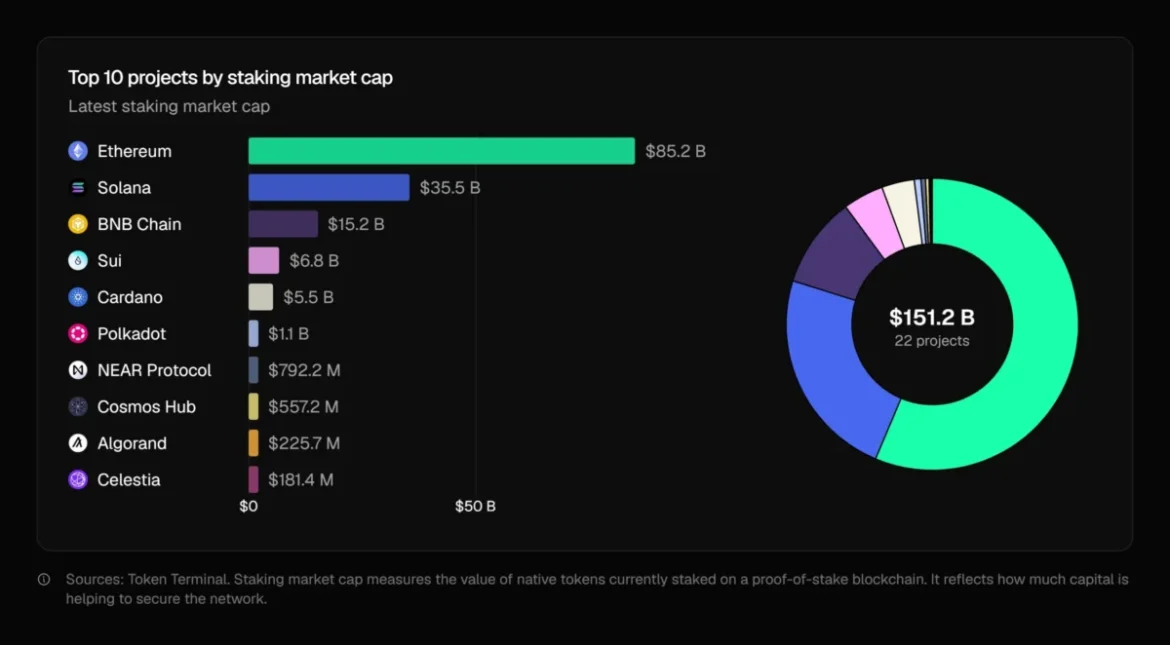
The latest data, highlighted by Everstake, one of the largest global non-custodial staking infrastructure providers, confirms that the ETH staking market cap has soared to an impressive $85.2 billion. This figure represents not just a numerical increase but a fundamental strengthening of the network’s security budget and a testament to the collective trust placed in Ethereum. Everstake emphasized the sheer scale of this growth, describing it as "absolutely mind-blowing," indicating a paradigm shift in how market participants view and interact with the Ethereum network.
This sharp rise is a direct reflection of intensified involvement from a diverse range of investors. Individual holders, seeking to earn passive income through staking rewards, have been steadily increasing their participation. Simultaneously, institutional players, including investment funds, wealth managers, and corporate treasuries, are increasingly allocating capital to ETH staking. Their entry signifies a growing recognition of Ethereum as a legitimate, yield-generating asset within the broader financial landscape. For institutions, the predictable returns, combined with Ethereum’s foundational role in the decentralized economy, make staking an attractive proposition.

The increasing lock-up of ETH in staking contracts has profound implications for Ethereum’s economic model. It is transitioning into a more yield-driven and capital-efficient economy, where the native asset, ETH, serves not only as gas for transactions but also as a productive asset that generates returns for its holders. This mechanism reduces the circulating supply of ETH, potentially contributing to deflationary pressures, especially when combined with EIP-1559’s fee-burning mechanism. The shift positions Ethereum as a more mature and appealing investment vehicle, capable of competing with traditional financial instruments in terms of yield generation and capital appreciation.
Ethereum’s Dominance in the Staking Arena
A comparative analysis of staking market caps across major blockchain networks underscores Ethereum’s unparalleled dominance. The chart provided by Everstake reveals that Ethereum currently commands more locked capital in staking than the rest of the leading networks combined. With its $85.2 billion market cap, ETH significantly outpaces its closest competitors. Solana, for instance, ranks second with approximately $35.5 billion in staked value, followed by BNB Chain with $15.2 billion. This disparity highlights Ethereum’s leading position not just in terms of technological innovation or developer activity, but crucially, in securing substantial economic value through its consensus mechanism.
This leadership position translates into what Everstake terms the "largest decentralized security budget in history." The immense value locked in staking makes a 51% attack—where a malicious actor controls a majority of the network’s validators to manipulate transactions—economically unfeasible and astronomically expensive. Such an attack would require acquiring and staking more than half of the total staked ETH, which at current valuations, would cost tens of billions of dollars, making it virtually impossible to execute profitably. This robust security posture reinforces Ethereum’s status as a bulletproof settlement layer, essential for the global on-chain economy.
Furthermore, this massive staking market cap signifies an "unmatched trust or conviction in the ETH network" from a global user base. It demonstrates a deep-seated belief in Ethereum’s long-term viability, its technological superiority, and its critical role as the backbone for decentralized finance (DeFi), non-fungible tokens (NFTs), and various decentralized applications (dApps). This unwavering confidence from both large institutions and individual users solidifies Ethereum’s foundation, making it more resilient to market fluctuations and external pressures.
Chronology of Key Staking Milestones and Market Dynamics
The trajectory of Ethereum staking can be traced through several key periods:
- December 2020: Beacon Chain Launch: The genesis of the PoS chain, allowing users to stake ETH, although withdrawals were not yet enabled. This marked the initial phase of staking adoption.
- September 2022: The Merge: The momentous event where Ethereum fully transitioned to PoS. Staking became the sole mechanism for securing the network, but ETH remained locked.
- April 2023: Shapella Upgrade: Enabling withdrawals of staked ETH and rewards. This was a critical turning point, significantly increasing confidence and catalyzing a new wave of staking activity. Following Shapella, the total amount of staked ETH saw a steady increase, as liquidity concerns were addressed.
- Late 2023 – Early 2024: Gradual Market Recovery: As the broader cryptocurrency market began to show signs of recovery, particularly driven by renewed interest in Bitcoin and the approval of spot Bitcoin ETFs, capital started flowing back into the altcoin market. Ethereum, as the second-largest cryptocurrency, naturally benefited from this upturn.
- Recent Weeks: Explosive Growth: The most recent period has seen an acceleration of staking activity, pushing the market cap to its current record levels. This coincides with ETH reclaiming key price levels and analysts pointing to strong underlying network fundamentals.
The growth in staking has also been facilitated by the emergence and proliferation of liquid staking derivatives (LSDs) such as Lido’s stETH, Rocket Pool’s rETH, and others. These protocols allow users to stake their ETH while receiving a liquid token representing their staked assets. This liquid token can then be used in other DeFi protocols, effectively enabling stakers to earn double yield (staking rewards + DeFi yields) and maintain liquidity. LSDs have significantly lowered the barrier to entry for staking, making it accessible to those with less than 32 ETH and providing greater flexibility. This innovation has played a crucial role in the rapid expansion of the staking ecosystem.

Implications for Network Health and Future Development
The unprecedented growth in ETH staking has several profound implications for the Ethereum network and its future trajectory:
- Enhanced Security: The primary benefit is the significantly enhanced security of the network. A larger pool of staked ETH makes the network more resilient to attacks, ensuring the integrity and immutability of transactions. This "fortress of security" is vital for its role as a global settlement layer.
- Increased Decentralization (with caveats): While the number of individual stakers has grown, concerns about the concentration of staked ETH within a few large liquid staking pools persist. However, the overall increase in participation from diverse entities, including solo stakers, decentralized pools, and institutional players, contributes to a more distributed network, provided that the underlying validator base remains diverse.
- Economic Stability and Attractiveness: The yield-generating nature of ETH through staking enhances its attractiveness as an investment. This, combined with the deflationary pressures from EIP-1559, creates a robust economic model that could appeal to a broader range of investors, further stabilizing its market value.
- Foundation for DApp Ecosystem: A highly secure and stable base layer is critical for the continued growth and innovation within Ethereum’s decentralized application ecosystem. DeFi protocols, NFT marketplaces, and Web3 applications all rely on the underlying security and reliability of the Ethereum blockchain. The strengthened staking mechanism provides a more solid foundation for these applications to thrive.
- Institutional Adoption: The ability to generate yield on a major cryptocurrency like ETH makes it a more compelling asset for institutional portfolios. As regulatory clarity improves and infrastructure for institutional staking matures, this trend is expected to accelerate, bringing more traditional capital into the crypto space via Ethereum.
Analyzing Ethereum’s Price Action
Amidst the robust growth in staking, Ethereum’s price has also shown signs of a newfound uptrend, aligning with a broader market rebound. According to Glassnode, a leading on-chain analytics platform, ETH’s price has successfully reclaimed the 1-3 month holder cost basis, situated around the $2,300 level. This is a significant technical indicator, as reclaiming cost bases often signals that short-to-medium term holders are, on average, no longer at a loss, which can reduce selling pressure and foster positive sentiment.
However, Glassnode’s report also offers a cautious perspective, noting that "this structure so far is consistent with a bear market relief rally, similar to the bounces seen in Q3–Q4 2022, rather than a structural trend reversal." A relief rally typically occurs during a prolonged bear market, offering temporary price increases that do not fundamentally alter the overall downward trend. A structural trend reversal, conversely, would involve more sustained price appreciation, higher lows, and higher highs, indicating a fundamental shift in market sentiment and demand. This distinction is crucial for investors, suggesting that while current momentum is positive, a definitive break into a full-fledged bull market might require more sustained catalysts and price action.
At the time of writing, ETH’s price was hovering around $2,319, reflecting a modest decrease of approximately 3% over the past 24 hours. This slight pullback after recent gains is not uncommon in volatile markets. Furthermore, its trading volume has shown a bearish turn, falling by over 13% during the same period. Decreased trading volume during a price dip can sometimes indicate a lack of strong selling pressure, but it can also signal a temporary waning of buying interest. Investors will be closely watching for a rebound in volume to confirm any sustained bullish momentum.
Looking ahead, several factors could influence ETH’s price trajectory. The approval of a spot Ethereum ETF in the United States, similar to the Bitcoin ETFs, could unleash a wave of institutional capital, providing a significant upward catalyst. Ongoing network upgrades, such as the Dencun upgrade which aimed to reduce transaction costs on Layer 2 networks, continue to improve Ethereum’s scalability and user experience, enhancing its utility and value proposition. Macroeconomic factors, including interest rate policies and global liquidity, will also play a crucial role in shaping the broader cryptocurrency market sentiment, which inevitably impacts ETH’s performance.
Statements and Expert Commentary

Industry analysts widely interpret the surge in ETH staking as a strong indicator of Ethereum’s growing maturity and institutional acceptance. "The dramatic increase in staked ETH underscores the network’s foundational strength and its evolution into a truly productive asset," remarked a blockchain research analyst, preferring anonymity for corporate policy reasons. "It’s not just about speculation anymore; investors are looking for sustainable yield, and Ethereum’s PoS model delivers that."
Representatives from staking providers often highlight the increasing demand from institutional clients. "We’ve seen a significant uptick in inquiries from funds and corporations looking to participate in ETH staking," stated a spokesperson from a major staking service. "They recognize the security benefits and the potential for consistent returns, positioning Ethereum as a cornerstone of their digital asset strategies."
Market observers also suggest that the resilience demonstrated by Ethereum through various market cycles, coupled with continuous development and upgrades, has built a deep reservoir of trust. "The foundation has never been stronger," as Everstake succinctly put it, encapsulating the sentiment that Ethereum is solidifying its position as a critical piece of the global digital infrastructure.
Broader Market Context
Ethereum’s recent performance cannot be entirely separated from the broader cryptocurrency market dynamics. The approval of spot Bitcoin ETFs in early 2024 injected significant optimism and institutional capital into the crypto space, often leading to a "capital rotation" phenomenon where gains in Bitcoin eventually flow into large-cap altcoins like Ethereum. This rotation is a common pattern in bull markets, with investors seeking higher-risk, higher-reward opportunities once Bitcoin establishes a strong base.
Furthermore, the overall macroeconomic environment, including inflation rates, central bank policies, and geopolitical stability, continues to influence investor appetite for risk assets like cryptocurrencies. While Ethereum’s fundamentals appear robust, external economic pressures can still exert considerable influence on its price movements.
In conclusion, the exponential growth of Ethereum’s staking market cap to $85.2 billion marks a pivotal moment in its development. It signifies not only enhanced network security and economic robustness but also a profound increase in investor confidence, particularly from institutional players. While its price action shows cautious bullishness, potentially reflecting a bear market relief rally, the underlying strength of the staking ecosystem positions Ethereum as a resilient and increasingly vital component of the global decentralized economy. The network’s "bulletproof settlement layer" and yield-driven economic model are likely to continue attracting capital, solidifying its role as a leading blockchain platform for innovation and value transfer.