Foundry, the digital asset infrastructure provider that operates the world’s largest Bitcoin mining pool, has officially announced its strategic expansion into the privacy-preserving cryptocurrency sector with the development of a Zcash (ZEC) mining pool. This new initiative, scheduled for a formal launch in April 2026, is specifically engineered to meet the rigorous compliance and infrastructure requirements of institutional investors, public corporations, and large-scale enterprise miners. By leveraging its dominant position in the North American mining landscape, Foundry aims to bridge the existing gap between high-level privacy technology and the transparent, regulated needs of the global financial industry.
The announcement marks a significant pivot for Foundry, which currently oversees Foundry USA, a mining pool that consistently commands the largest share of the global Bitcoin hashrate. The decision to enter the Zcash ecosystem comes at a time when the network is experiencing a notable surge in computing power and renewed interest from developers focused on zero-knowledge proofs. According to the company’s leadership, the Zcash mining infrastructure has historically lagged behind the asset’s own technological maturity, creating an opportunity for a sophisticated, US-based operator to provide the stability and oversight required by institutional participants.
Bridging the Gap Between Privacy and Institutional Compliance
For years, the narrative surrounding privacy coins has been a complex interplay between the fundamental right to financial anonymity and the stringent demands of global Anti-Money Laundering (AML) and Know Your Customer (KYC) regulations. Zcash, launched in 2016, was designed to address this by offering "shielded" transactions that utilize zk-SNARKs (Zero-Knowledge Succinct Non-Interactive Arguments of Knowledge). This technology allows parties to verify transactions without revealing the sender, receiver, or transaction amount.
Mike Coyler, the CEO of Foundry, emphasized that Zcash has reached a level of maturity that qualifies it as an institutional-grade asset. However, he noted that the "plumbing" of the network—specifically the mining pools—needs to evolve. The forthcoming Foundry Zcash pool is designed to offer a "shielded-by-default" approach that remains compatible with the transparency requirements of modern financial auditing. This dual-purpose infrastructure is intended to demonstrate that financial privacy and compliant digital infrastructure are not mutually exclusive but can, in fact, coexist within a regulated framework.
The move is particularly significant because Foundry operates under the umbrella of Digital Currency Group (DCG), a venture capital firm with deep ties to the institutional crypto space. By bringing an "enterprise-grade" mining pool to Zcash, Foundry provides a pathway for public companies that may have been hesitant to mine ZEC due to the perceived risks associated with less transparent or offshore mining pools.

Technical Synergy and the Bitcoin-Zcash Connection
Zcash’s codebase is fundamentally rooted in the original Bitcoin protocol, which creates a natural synergy for an organization like Foundry that specializes in Bitcoin infrastructure. Like Bitcoin, Zcash features a fixed total supply of 21 million tokens and utilizes a Proof-of-Work (PoW) consensus mechanism. It also follows a similar "halving" schedule, where the issuance of new coins is reduced by 50% approximately every four years to combat inflation and ensure long-term scarcity.
The economic model of Zcash mirrors the "digital gold" thesis of Bitcoin, but with the added utility of privacy. For miners, this means that the transition from mining Bitcoin to mining Zcash involves familiar economic principles, even if the underlying hashing algorithm (Equihash for Zcash versus SHA-256 for Bitcoin) requires different hardware. Foundry’s entry into this space suggests a long-term bullish outlook on the demand for privacy-centric assets that can operate within the bounds of the law.
Analyzing the Recent Surge in Zcash Hashrate
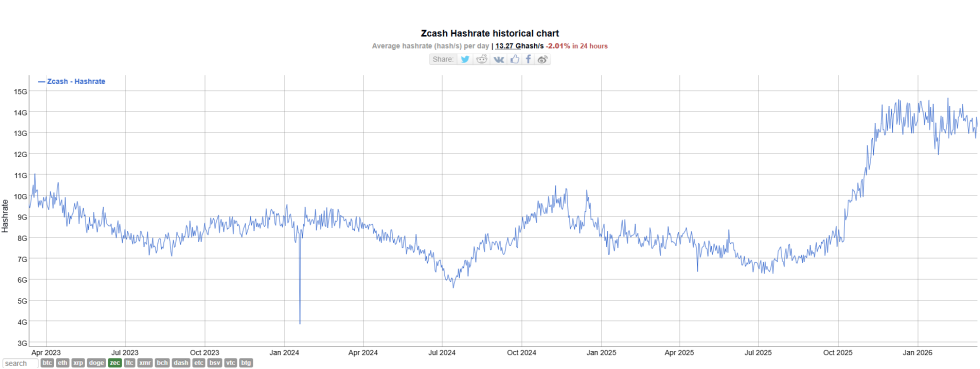
The timing of Foundry’s announcement coincides with a period of rapid expansion for the Zcash network. Data from blockchain analytics platforms, including BitInfoCharts, indicates that the Zcash hashrate has reached levels not seen in years. In October, the network’s total computing power was measured at approximately 8 Gigahashes per second (Ghash/s). By early 2024, that figure had surged to over 13 Ghash/s, representing a nearly 60% increase in just a few months.
A rising hashrate is generally viewed as a sign of network health and security. It indicates that miners are committing more resources—hardware and electricity—to the network, often in anticipation of future price appreciation or in response to more efficient mining hardware entering the market. For Zcash, this influx of hashrate suggests that the mining community is becoming more professionalized, moving away from hobbyist setups toward the industrial-scale operations that Foundry intends to serve.
The increase in hashrate also suggests that the competition for block rewards is intensifying. As more miners join the network, the "difficulty" of finding a block increases. This is where mining pools become essential. By combining the hashrate of thousands of individual machines, a pool like the one Foundry is building ensures that participants receive a steady stream of smaller rewards, rather than waiting months or years for the slim chance of solving a block on their own.
Strategic Partnerships and the Role of Shielded Labs
The development of the new pool is being met with enthusiasm from the core Zcash community. Zooko Wilcox, the founder of Zcash and the current Chief Product Officer at Shielded Labs, hailed the move as a major milestone for the ecosystem. Shielded Labs, an independent support organization based in Switzerland, has been instrumental in fostering the development of the Zcash protocol and ensuring its long-term viability.

Wilcox noted that having a North American-based, institutional-grade pool is vital for the decentralization of the network. Currently, much of the global mining power for various PoW coins is concentrated in regions with less regulatory clarity. By establishing a robust operation in the United States, Foundry provides a "safe harbor" for miners who prioritize legal compliance and operational transparency.
This partnership also highlights the shifting governance of Zcash. While the Electric Coin Co. (ECC) was the primary driver of Zcash development for years, the emergence of organizations like Shielded Labs and the Zcash Foundation shows a maturing, multi-polar ecosystem. Foundry’s involvement adds a heavyweight commercial layer to this structure, potentially attracting more liquidity and investment to the ZEC token.
Market Performance and Economic Outlook
Despite the positive infrastructure news, the price of Zcash has faced the same volatility that has characterized the broader cryptocurrency market. At the time of the announcement, ZEC was trading at approximately $209, reflecting a weekly decline of roughly 11%. This retracement follows a period of recovery and highlights the "risk-off" sentiment that occasionally grips the privacy coin sector during times of regulatory uncertainty or macroeconomic shifts.
However, analysts point out that the long-term value proposition of Zcash remains tied to its utility as a medium of exchange that protects user data. As central bank digital currencies (CBDCs) and more transparent financial systems gain traction, the demand for "opt-in" privacy is expected to grow. Foundry’s investment in a Zcash pool is a bet that the market for privacy-preserving assets will expand as institutional users seek to protect proprietary trade data and sensitive financial movements from public view on transparent ledgers.
The April 2026 launch date provides a significant lead time, during which the Zcash network is expected to undergo further upgrades. There has been ongoing debate within the community regarding a potential transition from Proof-of-Work to Proof-of-Stake (PoS), similar to Ethereum’s "Merge." While no such transition is currently scheduled, Foundry’s commitment to a mining pool suggests that PoW will remain a central component of the Zcash security model for the foreseeable future, or that Foundry is prepared to adapt its infrastructure to whatever consensus model the community adopts.
Broader Implications for the Mining Industry
Foundry’s expansion into Zcash serves as a bellwether for the evolution of the cryptocurrency mining industry. It signals a move away from "monoculture" mining—where firms focus exclusively on Bitcoin—toward a more diversified portfolio approach. For institutional miners, diversification provides a hedge against the volatility of any single asset and allows them to capture value across different technological niches.
Furthermore, the emphasis on a "US-based" operation reflects the growing importance of "jurisdictional alpha." In an era where regulatory crackdowns are common, mining in a jurisdiction with clear legal frameworks and stable energy prices is becoming a competitive advantage. Foundry USA’s success in the Bitcoin space was built on this premise, and the company is now attempting to replicate that success in the privacy sector.
As the April 2026 launch approaches, the industry will be watching closely to see if other major mining pools follow Foundry’s lead. If successful, the Foundry Zcash pool could catalyze a new wave of institutional adoption for ZEC, potentially decoupling its market performance from other privacy coins and establishing it as the standard for compliant, privacy-focused digital finance.
In summary, the launch of an institutional-grade Zcash mining pool by the world’s leading Bitcoin pool operator is more than just a technical expansion; it is a strategic endorsement of Zcash’s underlying technology and its place in a regulated financial future. By providing the necessary infrastructure for public companies and large-scale entities, Foundry is setting the stage for a new era of institutional engagement with the privacy-preserving features of the blockchain.