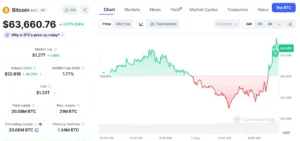
Leading cryptocurrency analysts are forecasting a decisive market bottom for Bitcoin (BTC) in October 2026, with price targets potentially plummeting to $30,000. This bearish outlook, meticulously derived from historical market cycles and technical indicators, suggests a prolonged period of downward pressure for the flagship digital asset, challenging optimistic projections for a rapid recovery. The projections come from prominent figures in the crypto analysis community, notably analyst Bee and Ted Pillows, who assert that even the increasing institutional involvement and the advent of Exchange-Traded Funds (ETFs) will not fundamentally alter Bitcoin’s well-established cyclical patterns. Their analyses point to a significant correction from recent all-time highs, signaling a crucial capitulation phase before any sustainable long-term recovery can commence.
The Historical Bedrock: Bitcoin’s 400-Day Cycle
Central to the bearish thesis presented by crypto market analyst Bee is the recurring 400-day cycle pattern that has demonstrably influenced Bitcoin’s price trajectory for over a decade. This cyclical framework has consistently marked significant market tops and bottoms, providing a reliable historical blueprint for anticipating future price movements. According to Bee’s detailed analysis, shared widely on social media platform X, Bitcoin is currently 252 days into a bear phase that historically spans between 364 and 400 days. This observation implies that the leading cryptocurrency still faces an additional 112 to 148 days of intense downward pressure, a period that could extend into late 2026 before the market finds its definitive floor.
The 400-day cycle is not merely an arbitrary observation; it is a pattern that has shown remarkable consistency across various market conditions, surviving through multiple halvings, regulatory shifts, and technological advancements within the crypto space. For instance, following the 2017 bull run which saw Bitcoin approach $20,000, the subsequent bear market extended well into 2018, characterized by prolonged declines. Similarly, after the 2021 peak, the market experienced a significant downturn throughout 2022, demonstrating a similar cyclical rhythm. Each bear market, while unique in its catalysts and external environment, has adhered to a comparable duration and depth, lending credence to Bee’s reliance on this historical pattern.
Based on the precise timeline dictated by this historical setup, Bee estimates that Bitcoin’s ultimate price bottom for the current cycle could materialize in October 2026. His accompanying charts and calculations indicate a potential decline to as low as $30,000 by the first week of that month. This projected decline would represent a staggering reduction of over 75% from recent all-time highs, which have approached the $126,000 mark in what is considered the preceding bull market phase. Such a sharp correction, while severe, is not unprecedented in Bitcoin’s history, with previous bear markets often witnessing declines of 80% or more from their respective peaks. This deep retracement is typically associated with a ‘capitulation’ event, where even long-term holders succumb to selling pressure, paving the way for a market reset.

Challenging the ‘New Paradigm’ Narrative: ETFs and Institutional Impact
A critical aspect of Bee’s analysis addresses the popular argument that the current market cycle is fundamentally different due to the increased involvement of institutional investors and the introduction of spot Bitcoin Exchange-Traded Funds (ETFs). Since their approval in early 2024, particularly in the United States, these ETFs, offered by financial giants like BlackRock, Fidelity, and others, have been heralded by many as a game-changer for Bitcoin. Proponents argued that ETFs would bring unprecedented levels of liquidity, mainstream adoption, and institutional buying pressure, thereby mitigating the extreme volatility and deep bear markets historically associated with the asset. The BlackRock iShares Bitcoin Trust (IBIT), for example, quickly became one of the fastest-growing ETFs in history, attracting billions in inflows.
However, analyst Bee firmly counters this perspective, noting that every past Bitcoin cycle has had its own set of "unique" factors that market participants believed would alter the established patterns. Whether it was the increasing mainstream media attention in 2017, the rise of decentralized finance (DeFi) in 2020, or the institutional interest post-pandemic, each era presented new narratives that suggested a deviation from historical norms. Yet, the 400-day cyclical structure, according to Bee, has played out consistently without a single major deviation for over a decade. He emphasizes that the underlying market psychology, supply-demand dynamics, and the broader macroeconomic environment continue to exert a more profound influence than specific market access vehicles like ETFs.
While ETFs undoubtedly provide a more accessible and regulated avenue for traditional investors to gain exposure to Bitcoin, their impact on the asset’s inherent cyclical nature might be more nuanced than initially assumed. They can increase demand and provide price support during bullish phases, but they may also amplify selling pressure during downturns if institutional investors decide to de-risk. The argument posits that while the players in the market may change, the fundamental game of market cycles driven by human emotion and supply-demand mechanics remains largely constant. This implies that even with significant institutional backing, Bitcoin remains susceptible to the ebb and flow of its historical patterns, suggesting that a deep correction is a necessary part of its maturation.
Confirmation from Other Analysts: MACD Signals a Similar Bottom
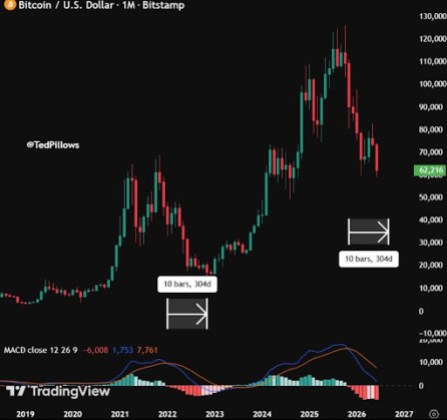
Reinforcing the bearish outlook, another prominent crypto analyst, Ted Pillows, has independently arrived at a strikingly similar timeline for Bitcoin’s bear market bottom. Pillows’ analysis, also shared on X, focuses on a different technical indicator: the Moving Average Convergence Divergence (MACD). The MACD is a momentum indicator that shows the relationship between two moving averages of a security’s price, often used to identify potential buy and sell signals. A "bearish cross" on the monthly MACD chart typically signifies a shift in momentum from bullish to bearish, often preceding significant price declines.

Pillows observed that after the monthly MACD bearish cross emerged in 2022, Bitcoin took approximately 10 months to reach its final price floor. Extrapolating this historical behavior to the current market cycle, Pillows projects that Bitcoin is likely to reach its ultimate price bottom either by the end of the third quarter (Q3) of 2026 or the beginning of the fourth quarter (Q4). His accompanying chart indicates a likely bottom target range between $30,000 and $40,000, aligning closely with Bee’s $30,000 prediction. This convergence of predictions from analysts employing different methodologies (cyclical patterns versus momentum indicators) adds a layer of robustness to the bearish thesis.
Furthermore, Pillows’ analysis emphatically dismisses the widespread hope for a significant long-term rebound or a bullish run back toward the $100,000 mark in 2026. This rejection of immediate bullish recovery echoes Bee’s perspective, suggesting that market participants should temper their expectations for rapid appreciation following the anticipated bear market. The implication is that even after the bottom is reached, the subsequent recovery may be gradual, rather than an immediate V-shaped bounce, requiring patience from investors.
Broader Market Implications and Historical Context
The predictions of a 2026 bottom at $30,000-$40,000 have significant implications for investors and the broader cryptocurrency ecosystem. A decline of 75% or more from a peak of $126,000 would place this bear market among the more severe corrections in Bitcoin’s history. For context, during the 2013-2015 bear market, Bitcoin fell over 80% from its then-all-time high. The 2017-2018 bear market saw a similar drop of over 80%. Even the more recent 2021-2022 downturn witnessed a decline of around 75% from its peak near $69,000 to lows around $15,500. These historical precedents demonstrate that deep corrections are an inherent part of Bitcoin’s market cycles, often clearing out excess speculation and positioning the asset for its next growth phase.
Such a prolonged bear market could trigger a period of "crypto winter," where investor sentiment remains low, trading volumes decrease, and many altcoins experience even steeper declines than Bitcoin. Historically, altcoins tend to be more volatile than Bitcoin, experiencing exaggerated movements in both bull and bear markets. A sustained downturn could also lead to further consolidation within the industry, with weaker projects failing and stronger ones potentially building infrastructure for the next bull run.
For long-term investors, this period could be seen as a strategic accumulation phase. Strategies like Dollar-Cost Averaging (DCA), where investors regularly purchase a fixed amount of an asset regardless of its price, could prove particularly effective in averaging down entry costs ahead of the anticipated recovery. However, the psychological toll of a prolonged bear market can be substantial, often testing the conviction of even seasoned investors.
Several external factors could also play a role in shaping the severity and duration of this projected bear market. Macroeconomic conditions, such as global inflation rates, central bank interest rate policies, and geopolitical stability, often exert significant influence on risk assets like Bitcoin. Regulatory developments, particularly from major economies, could also introduce new uncertainties or opportunities. Furthermore, advancements in blockchain technology, changes in mining difficulty, and shifts in network adoption rates continue to be underlying drivers of Bitcoin’s long-term value proposition.
Navigating the Future: A Call for Prudence
The confluence of technical analysis from respected figures like Bee and Ted Pillows presents a compelling, albeit sobering, outlook for Bitcoin’s near-term future. While the cryptocurrency market is notoriously unpredictable and prone to sudden shifts, the consistency of historical patterns and the alignment of different analytical methodologies suggest that investors should prepare for a potentially challenging period ahead. The rejection of a quick return to $100,000 in 2026 underscores a call for prudence and a realistic assessment of market expectations.
Ultimately, these analyses serve as a reminder that market cycles are an intrinsic feature of financial markets, particularly in nascent and volatile sectors like cryptocurrency. While innovation and institutional adoption continue to shape the industry, the fundamental forces of supply, demand, and human psychology, as reflected in recurring patterns, remain powerful determinants of price action. As the market progresses towards the projected 2026 bottom, investors will likely face a critical test of conviction, with the ultimate recovery paving the way for Bitcoin’s next chapter. The "Trusted Editorial" process that reviews such expert content by leading industry experts and seasoned editors aims to provide thoroughly researched, accurate, and unbiased information, helping readers navigate these complex market dynamics with informed perspectives.