Last week, the IOTA Foundation announced a significant advancement in its distributed ledger technology with the activation of "Starfish" consensus on the IOTA Mainnet. This technical overhaul, introduced with the v1.21.1 Mainnet release and protocol version 24, represents a fundamental rethinking of how decentralized networks achieve agreement, particularly within the Directed Acyclic Graph (DAG) architecture that IOTA employs. While previous consensus mechanisms have often treated information dissemination as a background plumbing issue, Starfish elevates it to a core component of the consensus design, aiming to solve critical synchronization challenges that have long plagued DAG-based Byzantine Fault Tolerant (BFT) protocols.
The core of Starfish’s innovation lies in its approach to dissemination, the process by which network participants share and receive necessary information to maintain consensus. Traditional BFT consensus is framed as an agreement problem: validators must agree on a single, consistent history of transactions, even when faced with network delays and the potential for malicious actors (Byzantine participants). However, the article highlights that beneath this agreement challenge lies a critical synchronization problem: ensuring that the right information reaches the right nodes quickly enough for the protocol to function effectively. A validator cannot vote on or certify data it hasn’t received or reconstructed, nor can it contribute to network progress if essential information is perpetually delayed.
The DAG structure itself, a graph where each new block points to preceding ones, serves as more than just an ordering mechanism. It inherently acts as a record of mutual knowledge among validators. When numerous validators reference the same blocks, it signifies convergence around shared information. Conversely, missing references expose synchronization gaps. Starfish leverages this aspect of the DAG, transforming it into a robust synchronization structure.
The Cordial Dissemination Approach
Starfish adopts a strategy known in academic literature as "cordial dissemination." This approach, formally treated in the "Cordial Miners" paper by Keidar, Naor, and Shapiro, posits that participants should not merely broadcast their own blocks but actively forward information that other honest parties are likely to need to maintain synchronization. This contrasts with traditional methods that rely on separate broadcast layers.
The article outlines two fundamental strategies within dissemination:
-
Pull: In this model, validators only request missing blocks after they identify a deficit. While bandwidth-efficient in a narrow sense (nothing is sent unless explicitly asked for), pull mechanisms introduce significant latency. Each missing block necessitates a request-response round trip. Under heavy network load, this can exacerbate problems, as slow validators issue more requests, consuming the bandwidth of faster ones, leading to network congestion precisely when recovery is most needed.
-
Push: This strategy involves validators proactively forwarding information that others might require. Push is generally superior for latency as the data is often already available when a recipient realizes it’s needed. However, naive push can be prohibitively expensive, with every validator sending full blocks to every other validator, leading to bandwidth consumption that scales rapidly with the size of the validator set.
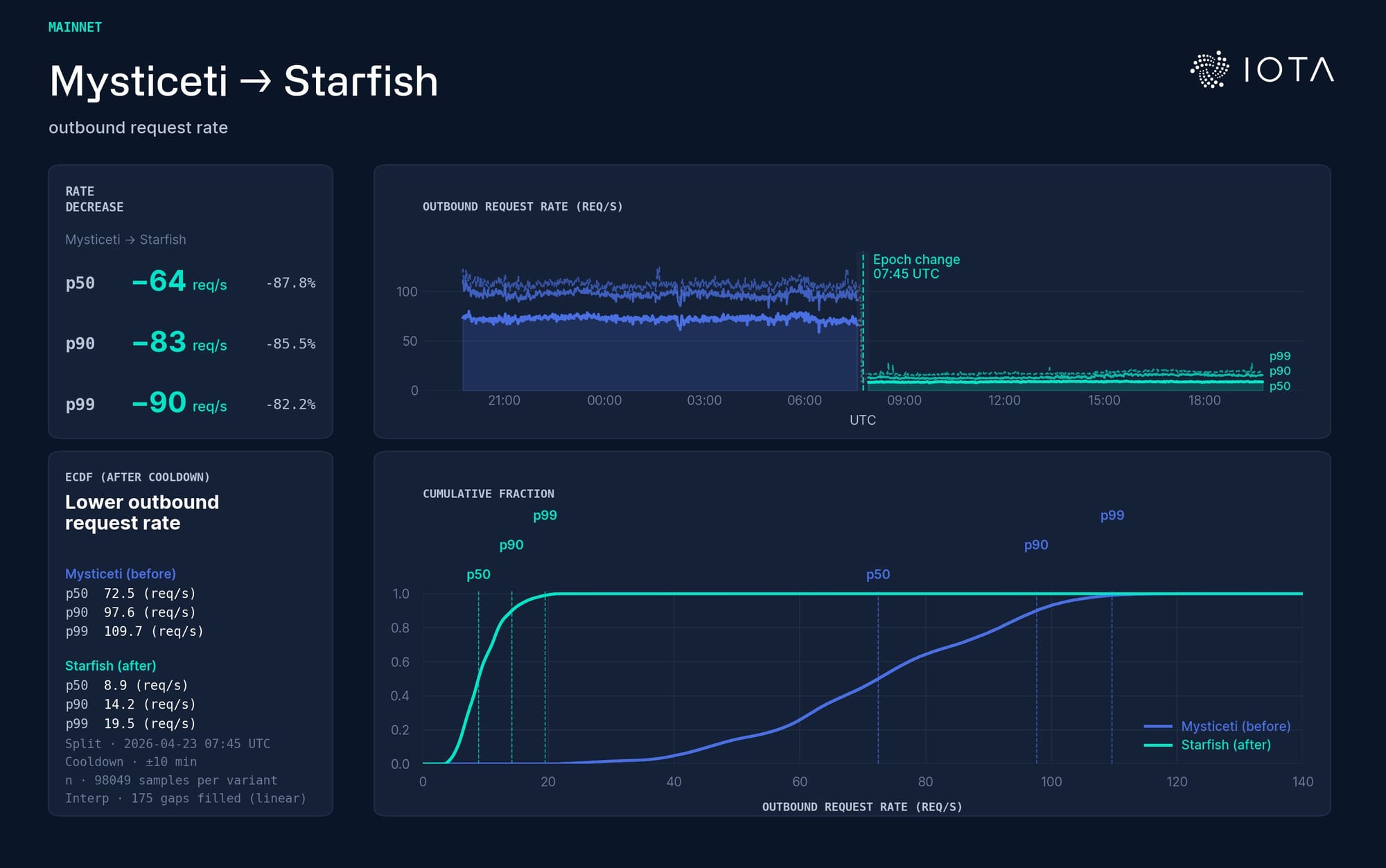
Starfish aims to bridge this gap, moving beyond the "lean but late" nature of pull and the "fast but heavy" nature of push. The research indicates that post-Starfish implementation, outbound request rates, a key indicator of the pull mechanism’s activity, have dropped by approximately an order of magnitude. This suggests validators are spending significantly less time recovering missing history on the critical path, a primary objective of Starfish’s design.
Key Design Innovations of Starfish
Starfish introduces two primary technical innovations to achieve its goals:
-
Separation of Metadata and Payload: Starfish intelligently separates consensus-critical metadata from the actual transaction data (payload). Metadata includes references, votes, acknowledgments, timing information, and commitments – elements that consensus needs immediately. Transaction data, the payload, is handled separately. Previous DAG designs often tightly coupled payload with the consensus path, which worked well in smaller networks but became inefficient as transaction volumes grew. Starfish keeps the consensus path lean by having block headers carry the consensus-relevant structure and a commitment to the payload, while the payload itself is managed distinctly. This allows the protocol to aggressively push the lightweight metadata without overwhelming the network with full payloads.
-
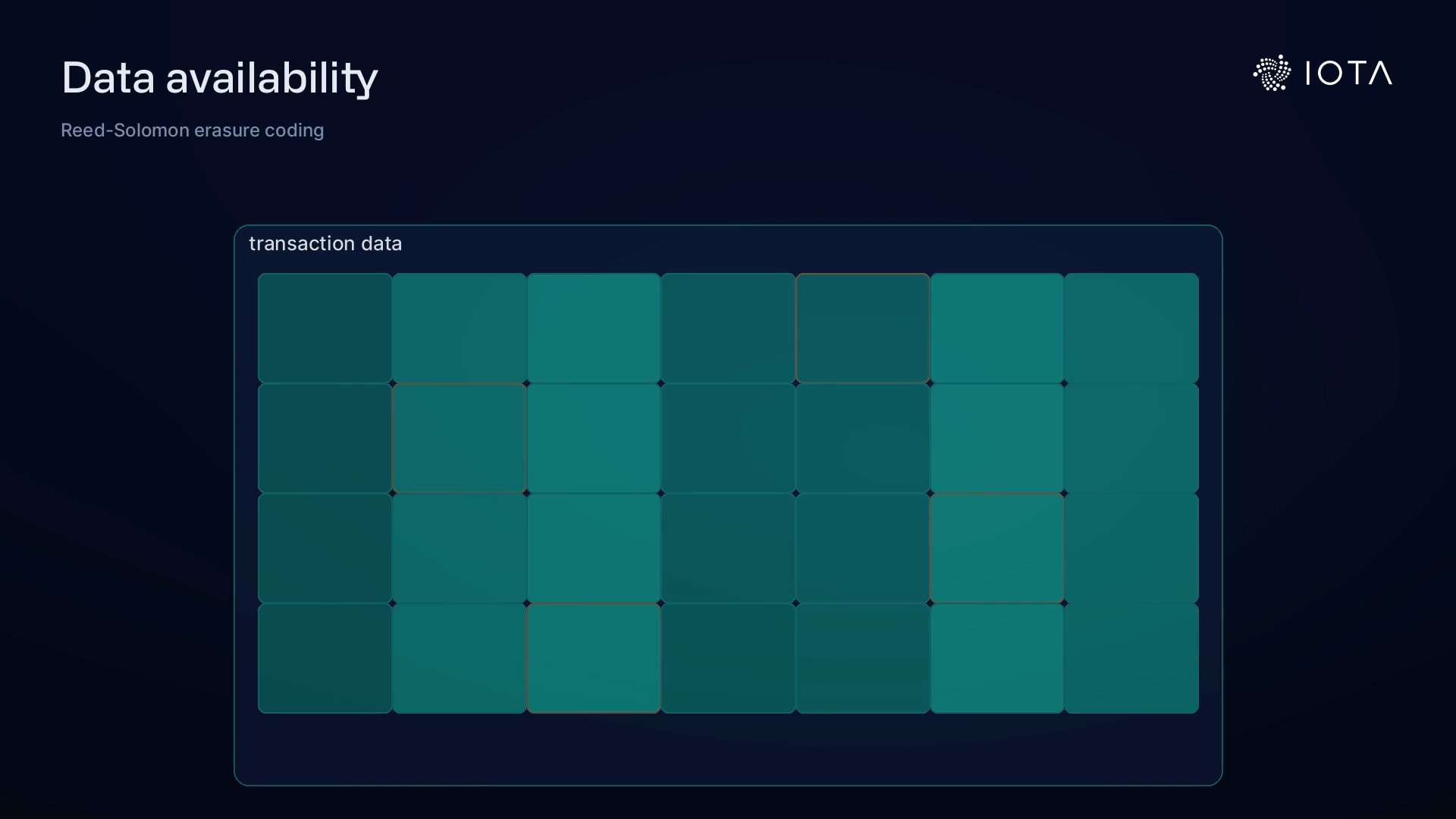
Reed-Solomon Encoding for Data Availability: To ensure that transaction data is ultimately recoverable, Starfish employs Reed-Solomon encoding, a robust error-correction technique. This is analogous to how QR codes can withstand damage or CDs can recover from scratches. Data is broken into fragments, with carefully designed redundancy. Crucially, the original data can be reconstructed from any sufficient subset of these fragments, even if others are lost. In Starfish, a block’s transaction data is fragmented, with each validator receiving a piece. The system is configured such that only f+1 valid fragments are needed to reconstruct the entire payload, where ‘f’ represents the maximum number of Byzantine validators the system can tolerate.
It is vital to distinguish this f+1 reconstruction threshold from the 2f+1 number used in the availability certificate. The 2f+1 figure signifies that if 2f+1 validators acknowledge availability, then even if up to ‘f’ of them are Byzantine, at least f+1 honest validators must possess valid fragments, thus guaranteeing reconstructability. This distinction is critical: availability in Starfish means the network possesses enough verified pieces for honest validators to recover the data, not necessarily that every validator already holds the complete data.
The Data Availability Certificate (DAC)
The Data Availability Certificate (DAC) is a particularly elegant feature of Starfish. A validator explicitly acknowledges in its own block header that it has verified the payload of an earlier block. When 2f+1 such acknowledgments are reachable within the causal history of a later committed block (meaning they can be traced backward through the block’s references), that later block effectively serves as a certificate of availability for the earlier payload. This mechanism eliminates the need for a separate availability round; availability is organically accumulated as the DAG grows.
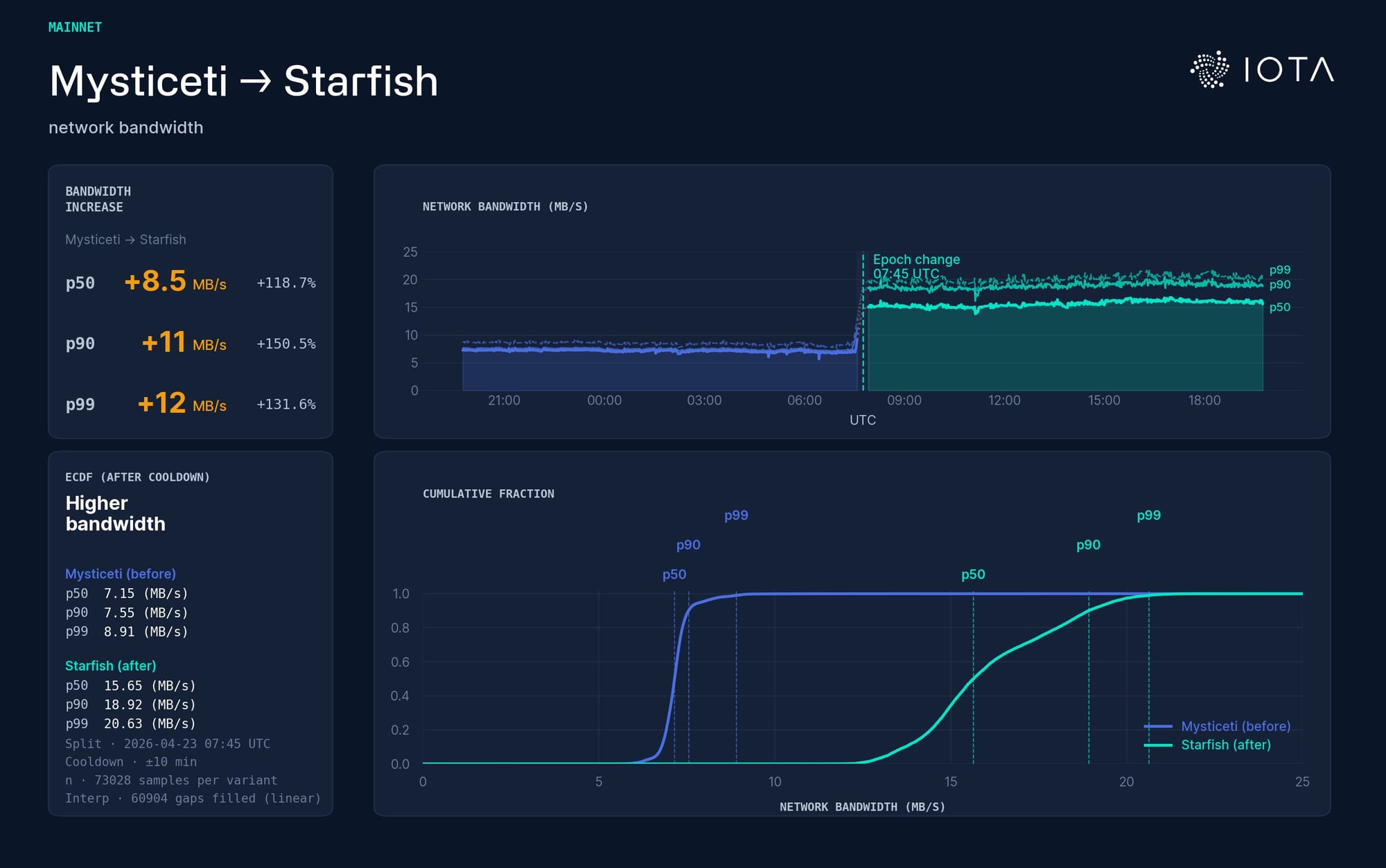
Initial performance data shared by the IOTA Foundation indicates that Starfish utilizes approximately twice the bandwidth compared to previous protocols like Mysticeti within a specific window. However, this increase is attributed to structured communication and upfront investment in disseminating payload fragments, rather than naive full-payload flooding. This structured approach aims to prevent costly recovery operations later in the protocol’s lifecycle. The article emphasizes that the graph recording block ordering also records recoverability, and the communication that advances consensus also carries the evidence for payload reconstruction. This signifies a fundamental shift where dissemination is integrated into the consensus design itself, not treated as an afterthought.
Addressing Liveness and Robustness
Uncertified DAG protocols, while attractive for their potential for low latency (e.g., Mysticeti), have historically struggled with rigorous liveness proofs. Recent research has identified desynchronization attacks where honest parties might fail to commit leaders even after the network has stabilized. This vulnerability arises when honest parties advance rounds without creating their own blocks, leading to "holes" in the DAG. If enough such gaps accumulate, the protocol may lack the necessary structure to commit leaders, even when network conditions improve.
Starfish tackles this through a "Push Pacemaker." The core intuition is simple: progress should not occur without contribution. A validator must create its own block before advancing to a new round. A lagging validator can then catch up once it observes a quorum of blocks from the current round. This prevents validators from "drifting ahead" without contributing the blocks that serve as essential votes and certificates, thereby maintaining the structural integrity of the DAG.
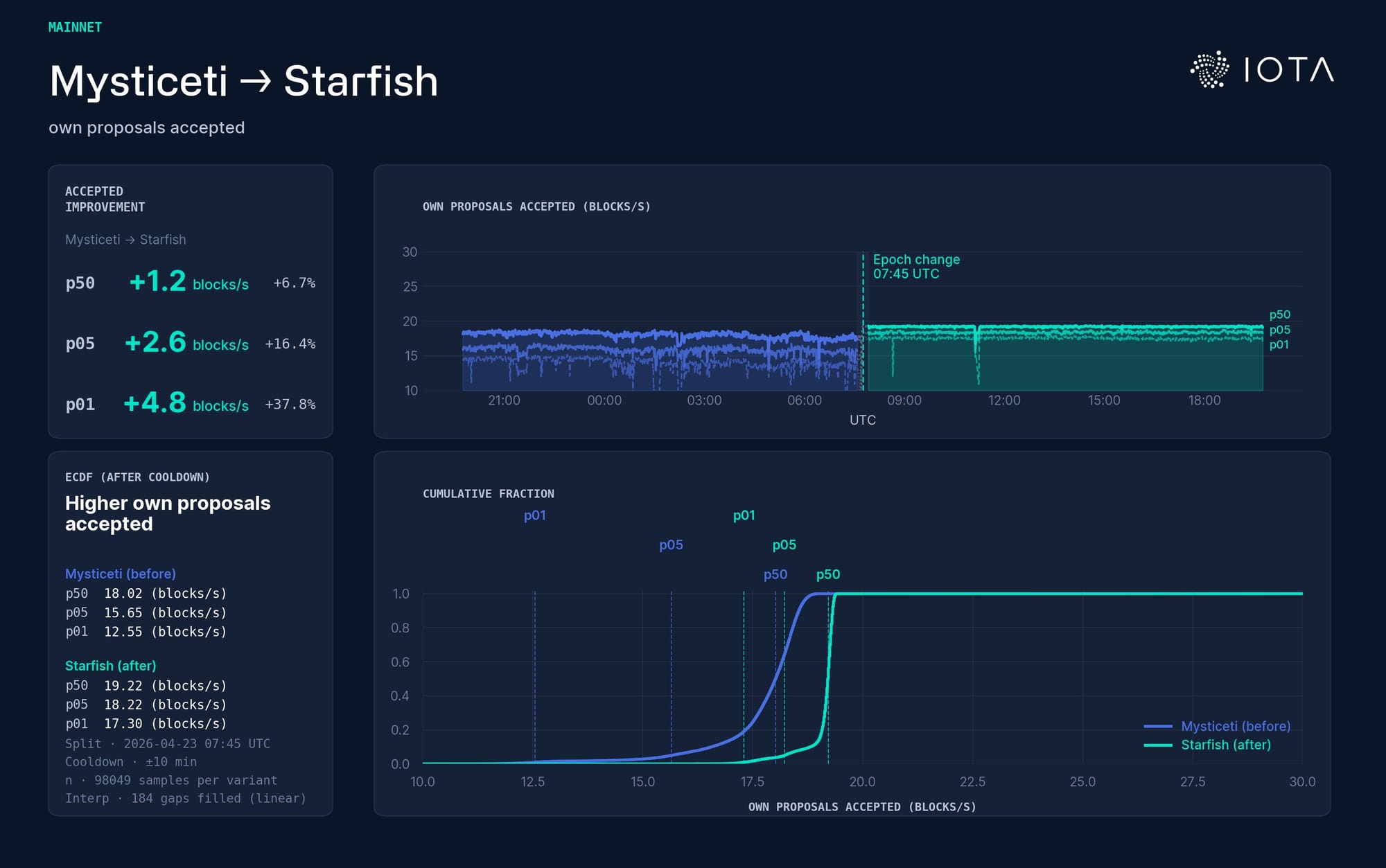
Performance metrics presented in the article illustrate this improvement. Graphs comparing Starfish to Mysticeti show a drastic reduction in the variance of validator proposal acceptance rates, with validators recovering more quickly. This suggests a more consistent and reliable progression of the consensus mechanism. The pacemaker is thus not merely a cosmetic or theoretical change; it is an integral part of the protocol’s liveness guarantee, ensuring that progress is contingent on maintaining a healthy DAG structure.
Performance Beyond Averages: The Importance of Variance
Discussions around consensus performance often focus on peak throughput and median latency. While useful, the IOTA Foundation argues that these metrics are insufficient for real-world deployment. The more critical production question revolves around variance: the width of the latency distribution, the frequency of late commits, and system behavior under stress, including when validators are slow but not faulty, or when the network needs to recover.
Drawing parallels with industrial quality control principles like statistical process control and Six Sigma, the article stresses that controlling variance is paramount for reliability. A factory is considered in control not just for its average output but for its ability to maintain output within a predictable band. Similarly, the true reliability of distributed ledgers lies in understanding their behavior across the entire distribution of outcomes, not just averages and peaks.
The article posits that many consensus benchmarks fail to report critical metrics like tail latency, jitter under load, or commit time distributions during disturbances – precisely the data that reveals real-world performance. Systems optimized solely for average performance can be brittle on the tails. Conversely, systems designed to minimize variance tend to feel more robust, even if their mean latency is slightly higher.
Starfish’s design choices are presented through this lens of variance reduction. The Push Pacemaker aims to stabilize round durations under stress. The DAC-on-DAG construction reduces variance in availability certification. The shard-based payload push aims to mitigate bandwidth variance as the validator set grows. Even an additional commit round is framed as a variance trade-off: a marginal increase in mean latency for a tighter commit distribution under load.
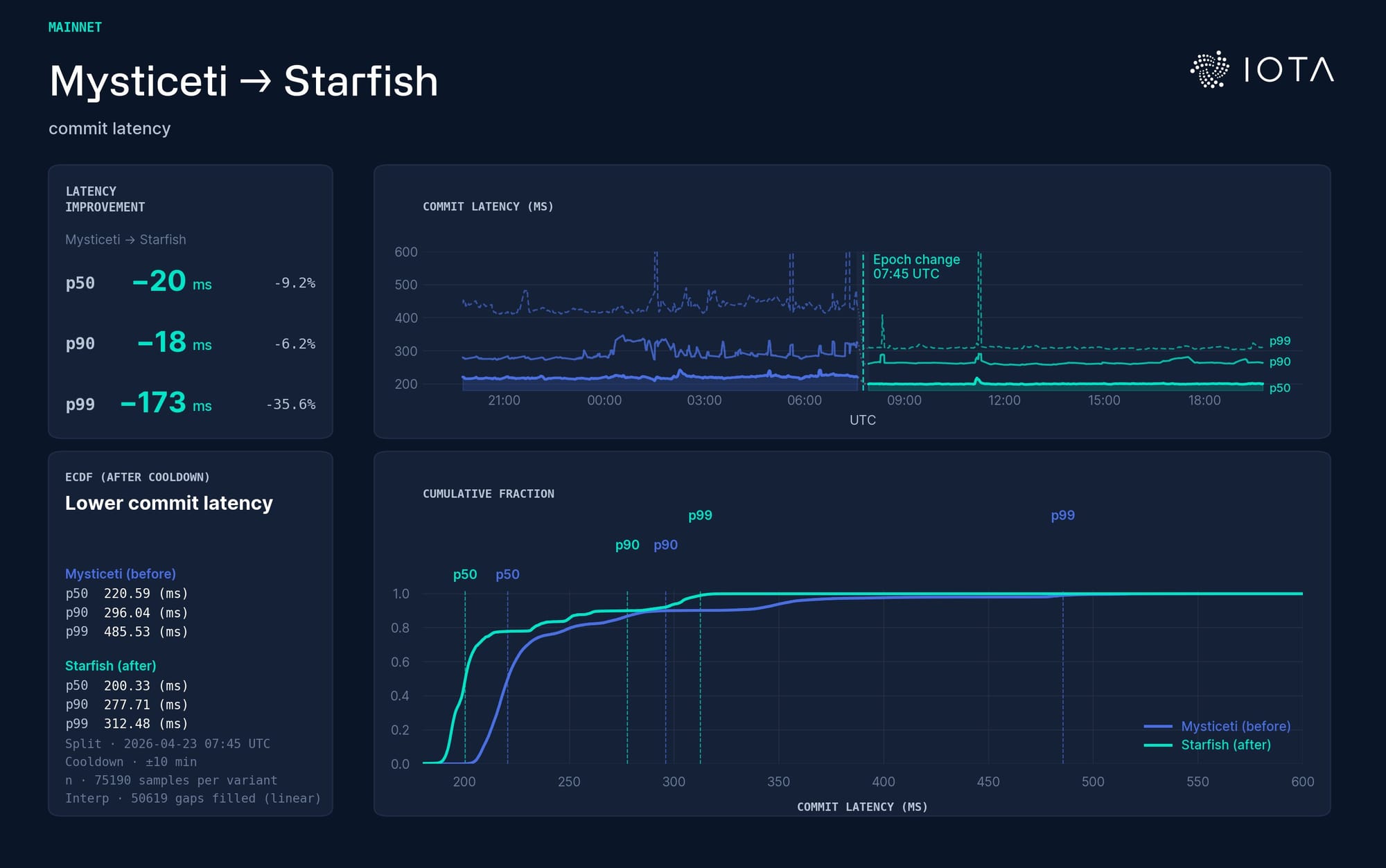
Performance graphs illustrate this. While the median and p90 commit latencies might slightly increase in Starfish, the p99 latency shows a significant improvement, dropping from approximately 486 ms to 312 ms. This indicates fewer instances of extremely slow commits, contributing to a more robust and predictable system. Transaction commit latency also reflects this, with a slight upward movement in median and p90 but a downward trend in p99. This suggests that while the ordinary, clean case might incur a minor additional cost due to the availability step, the system’s performance in slower or more challenging scenarios is demonstrably improved. Low variance, therefore, emerges as a core design goal that underpins Starfish’s robustness.
Continuity with IOTA’s Original Vision
The article draws a line of continuity between Starfish and the original IOTA Tangle’s cooperative intuition. The early Tangle concept emphasized that participation meant actively contributing to the ledger’s growth; a new transaction not only sought acceptance but also approved previous ones. While the mechanisms differ significantly from modern BFT consensus, the underlying principle of honest participation benefiting the network’s advancement remains.
Starfish operationalizes this instinct within a Byzantine-fault-tolerant framework. Validators are not merely proposing their own blocks; they are actively assisting in synchronizing others, acknowledging data availability, and propagating causal evidence crucial for network progress. This is where the DAG’s structural richness becomes paramount. Unlike a linear chain, a DAG’s structure reveals not only the order of events but also what information was known, by whom, and when. Starfish harnesses this information for ordering, availability, and liveness.
Real-World Consensus: Beyond Benchmarks
The launch of Starfish on the Mainnet marks a critical operational milestone, moving the design from theoretical and test environments into the demanding reality of a live network. Real-world validator networks are inherently diverse, characterized by geographical distribution, heterogeneous hardware, variable network links, transient delays, and occasional malicious behavior. Consensus protocols are ultimately judged not solely on their performance in idealized scenarios but on their degradation patterns, recovery capabilities, and their ability to maintain useful work under imperfect conditions.
Starfish is fundamentally designed with this reality in mind. It treats dissemination as a first-class concern, not a secondary implementation detail. It integrates availability directly into the protocol rather than abstracting it away. It acknowledges that synchronization is not a free background condition but a problem that requires explicit solutions.
Ultimately, the significance of Starfish lies not merely in its potential for increased speed, although performance is a crucial factor. Its true importance stems from its elevation of the dissemination challenge to the same level of seriousness as the safety story in distributed systems. In the complex world of distributed ledgers, it is often in these explicitly addressed challenges of dissemination and synchronization that the most profound protocol innovations are found.