In the high-stakes environment of organ transplantation, every second counts. When a donor organ becomes available, a rigid, time-sensitive countdown begins immediately. A human heart remains viable outside the body for only a matter of hours, and within that narrow window, a complex network of medical professionals, provincial health agencies, and national coordinators must act in flawless synchronization. Medical records, legal consents, and logistical authorizations must be flawlessly executed and instantly verifiable. A single misplaced document, an unverified digital signature, or a fraudulent record can disrupt the chain of custody and result in the tragic loss of a life.
To mitigate these systemic vulnerabilities and streamline the nation’s life-saving logistics, Argentina’s national organ donation authority has taken a groundbreaking technological leap. The Instituto Nacional Central Único Coordinador de Ablación e Implante (INCUCAI), operating in strategic partnership with Latin American decentralized identity firm Extrimian and utilizing the IOTA mainnet, has successfully integrated a live, publicly verifiable digital-identity and document-signing framework across its national apparatus. This deployment effectively places Argentina’s entire transplant and organ procurement coordination network onchain, setting a new global benchmark for the intersection of public administration and distributed ledger technology.
The Architecture of a National Lifeline
INCUCAI functions as the central nervous system for organ and tissue donation across Argentina. Operating under the umbrella of the national Ministry of Health, the agency manages the central waiting list and coordinates closely with 24 distinct jurisdictional procurement agencies—encompassing all provinces alongside the Autonomous City of Buenos Aires—as well as a vast network of public and private hospitals and transplant centers.
Coordinating life-or-death decisions across this decentralized geographic and institutional expanse has long presented severe administrative challenges. Traditional paper-based workflows and legacy centralized databases are inherently susceptible to delays, administrative bottlenecks, and vulnerabilities regarding document integrity. Recognizing the urgent need for a modernized digital backbone, INCUCAI initiated a partnership with Extrimian, a regional leader in self-sovereign identity (SSI) solutions.
Extrimian specializes in building architectures that grant individuals and organizations direct control over their digital credentials and shared data. For the INCUCAI deployment, Extrimian selected the IOTA mainnet as the foundational public ledger. IOTA provides a neutral, highly scalable, and cost-efficient layer where institutional identities and document hashes can be checked directly by authorized entities without relying on costly intermediaries or centralized gatekeepers.
Crucially, the architecture prioritizes patient confidentiality. No personally identifiable information (PII) or raw medical records are ever stored on the public ledger. Instead, the system anchors strictly cryptographic proofs—mathematical hashes of documents and critical process milestones—to the IOTA mainnet. This guarantees tamper-proof traceability and process integrity while ensuring that the intensely private and painful details entrusted by patients and grieving families remain strictly confidential. Doctors, oversight bodies, and families can independently cryptographically verify that every step of the procurement and allocation process occurred precisely as recorded, without exposing underlying sensitive medical data.
Chronology and Regulatory Milestones
The integration of blockchain-backed digital identity into Argentina’s medical infrastructure is the culmination of rigorous planning, technical testing, and regulatory reform.
- Early Development and Integration: Extrimian and INCUCAI collaborated extensively to build a decentralized identity stack that adheres to open World Wide Web Consortium (W3C) standards. The system integrates domain-linked decentralized identifiers (DIDs) to ensure that INCUCAI’s official signing platforms are cryptographically tied to legitimate government domains, shielding the network from potential impersonation attacks. Furthermore, critical components of the infrastructure are hosted on ARSAT, Argentina’s state-owned telecommunications and infrastructure company, ensuring that sovereign control over vital public infrastructure is maintained.
- June 10, 2026 – Mainnet Go-Live: The decentralized identity infrastructure officially went live on the IOTA Mainnet, allowing institutional identities and document proofs to be independently verified by external auditors and the public via blockchain explorers.
- Resolution 199/2026 (June 2026): Published formally in the Argentine Official Gazette (Boletín Oficial), Resolution 199/2026 authorized the systematic implementation of electronic signatures across every process managed through SINTRA (Argentina’s National Procurement and Transplant Information System) and its associated institutional frameworks. This legislation provided the necessary legal certainty to transition from legacy paper trails to immutable, blockchain-anchored evidence.
- Rollout of IncucaiID: Alongside the regulatory changes, INCUCAI launched IncucaiID, an official mobile application available via major app stores. Acting as a secure digital wallet, IncucaiID enables patients, authorized medical personnel, and administrative staff to receive verifiable credentials, authenticate their identities, and sign regulatory documents securely. Implementation began with waiting-list registration workflows—prioritizing heart and lung transplant registries—with a phased roadmap designed to encompass all remaining organ lists and SINTRA administrative processes.
Verification, Standards, and Independent Auditing
A defining feature of the INCUCAI-Extrimian deployment is its adherence to the core Web3 principle of absolute verifiability: "Don’t trust, verify." Rather than asking stakeholders to take institutional claims at face value, the entire infrastructure was engineered for radical transparency.
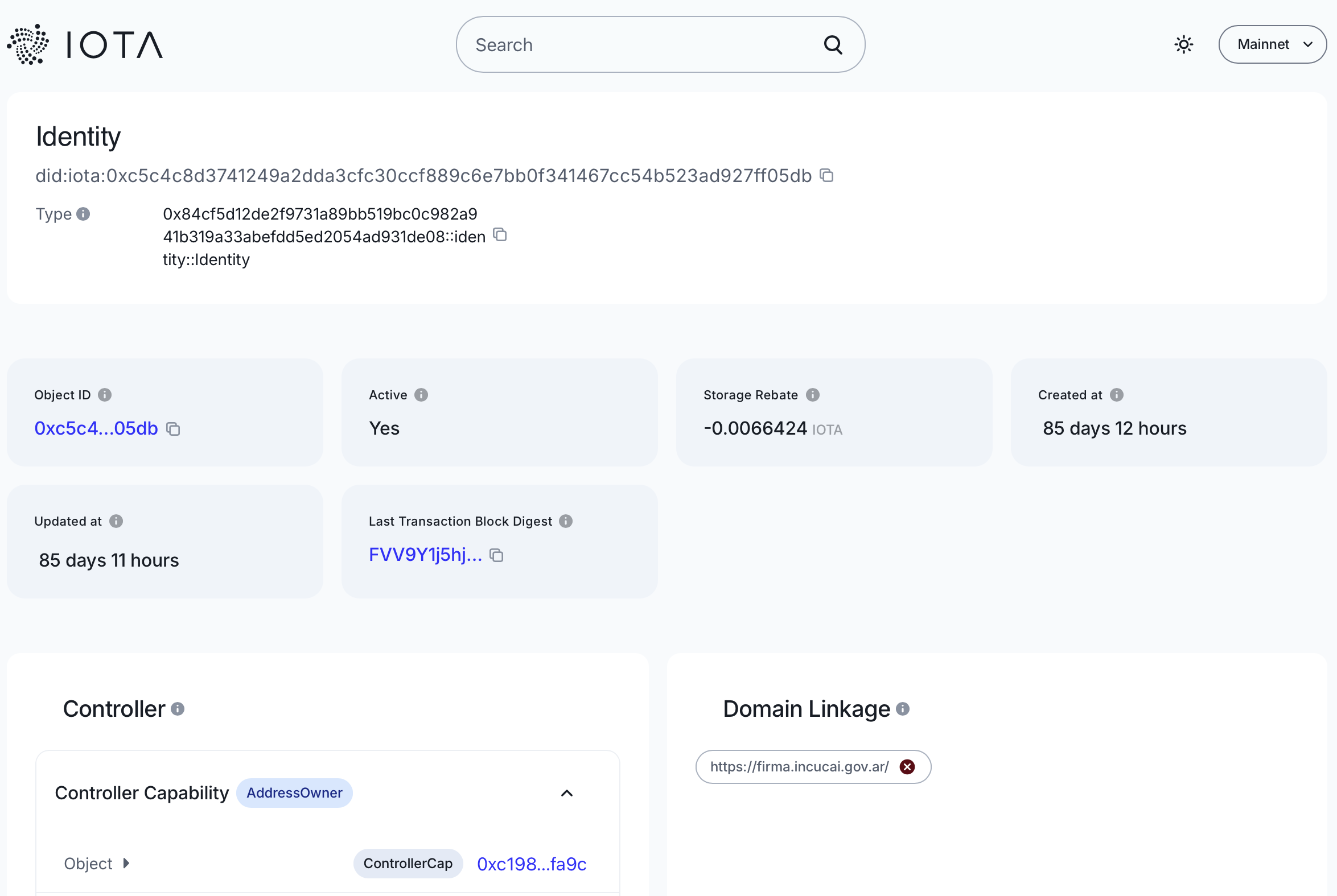
Following the mainnet deployment, independent audits conducted by the IOTA Foundation verified the system’s operational integrity using only public endpoints and the IOTA Explorer. Technicians confirmed that all 24 provincial agency identities successfully resolved onchain, that their respective Explorer links matched institutional records, and that direct ledger queries validated the accredited entities controlling each cryptographic root.
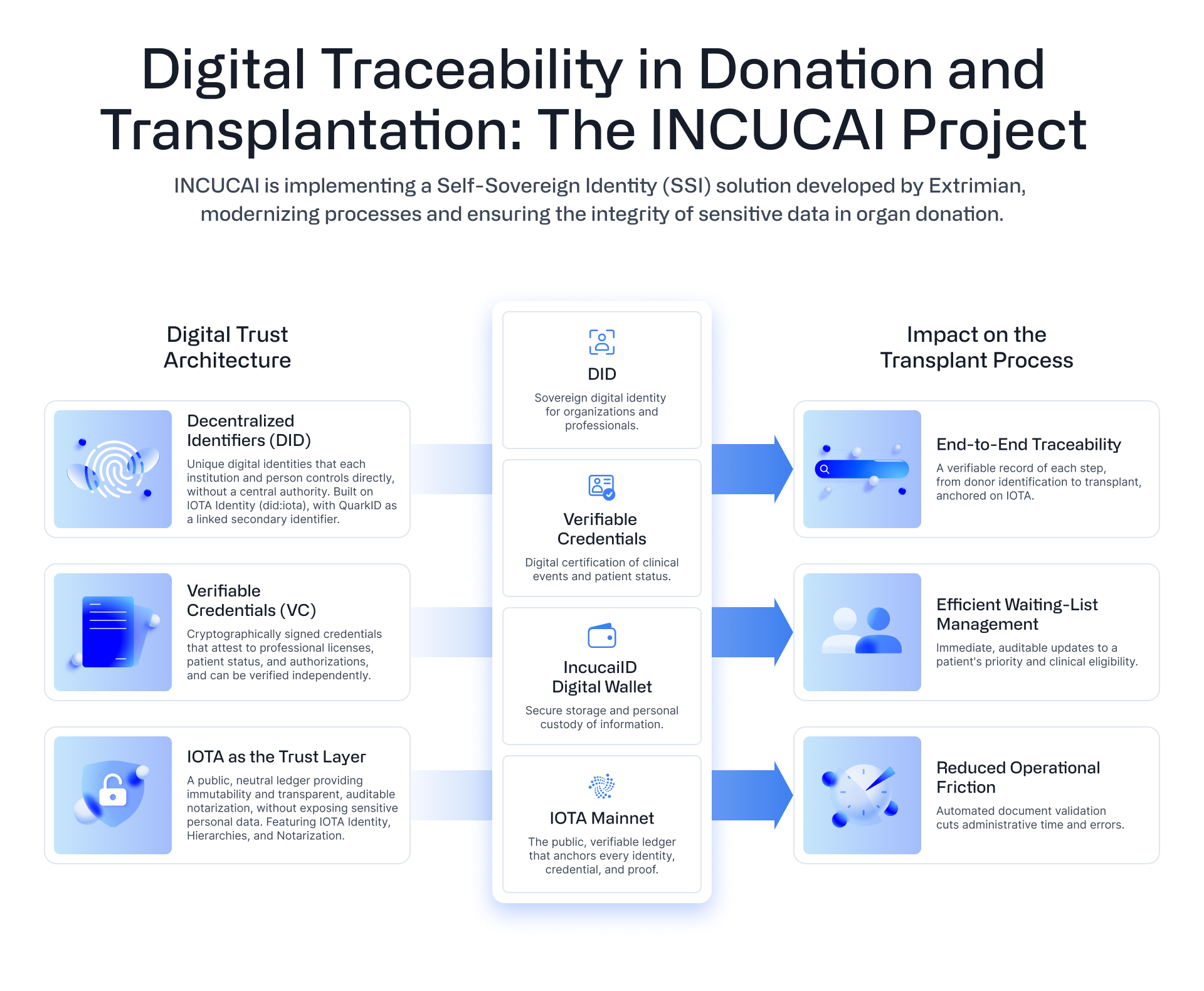
The technical stack heavily leverages native IOTA Identity capabilities. The root authority address for INCUCAI executes document notarizations with minimal gas overhead (approximately 0.006 IOTA per transaction), anchoring transaction hashes that guarantee the provenance of every authorization step. Because the framework relies on open W3C verifiable credentials, it ensures long-term interoperability, preventing vendor lock-in and allowing future integration with other regional or international health networks.
Official Perspectives and Leadership Insights
The successful deployment has drawn widespread praise from institutional leaders, highlighting the practical utility of decentralized technologies in solving real-world civic challenges.
Esteban Musso, Professional Services Manager and Partner at Extrimian, emphasized the foundational role of trust in digital transformation: "At Extrimian, we believe that trust is the foundation of every digital transformation. By combining open standards with privacy-preserving technologies, we’ve helped build a solution that enhances traceability, security, and interoperability while respecting the privacy of every participant. Projects like this demonstrate that decentralized technologies are no longer a vision for the future—they are delivering tangible value today in critical public services."
Echoing this sentiment, Daniela Hansen Krogh, Director of Information Technology and Information Systems at INCUCAI, underscored the humanitarian imperative driving the modernization effort: "Trust is at the heart of every organ donation and transplantation process. Our responsibility is to ensure that every decision is supported by reliable, secure, and verifiable information. By incorporating decentralized identity and cryptographic verification into our national systems, we are strengthening the integrity, traceability, and legal certainty of every critical stage, while safeguarding sensitive patient information. This initiative reflects INCUCAI’s ongoing commitment to modernizing Argentina’s transplant system through secure, transparent, and citizen-centered digital innovation."
Dominik Schiener, Co-Founder and Chairman of the IOTA Foundation, pointed to the broader macro-level implications of the project: "This is what IOTA’s open technology can do for critical public services at a national scale: real infrastructure, already coordinating decisions that save lives."
Broader Implications and Future Outlook
The integration of blockchain-backed digital identity into Argentina’s national health infrastructure marks a watershed moment for the adoption of distributed ledger technology in Latin America. For years, critics of blockchain have pointed to an overabundance of speculative financial assets and a relative scarcity of tangible, real-world utility in foundational public administration. The INCUCAI-Extrimian initiative decisively challenges that narrative.
By transitioning from manual, paper-dependent provincial steps to a streamlined, paperless workflow backed by cryptographic certainty, Argentina has minimized administrative latency in medical logistics. In an arena where hours and minutes dictate patient survival, enhanced traceability and immutable verification remove friction between disparate hospitals and regional coordinators.
Furthermore, the model established by INCUCAI serves as a scalable blueprint for other public sector domains. Identity management, secure document notarization, and verifiable credential exchange are universal administrative challenges. As governments worldwide search for methods to enhance cybersecurity, protect citizen privacy, and eliminate bureaucratic fraud without expanding invasive data surveillance, Argentina’s onchain transplant system demonstrates that privacy-preserving public infrastructure is not only feasible, but actively operational.