In a landmark integration of public administration and distributed ledger technology, Argentina’s national organ, tissue, and cell donation authority, INCUCAI, has overhauled its operational backbone using decentralized digital identity infrastructure. Operating in partnership with Latin American decentralized identity firm Extrimian and anchored directly to the IOTA mainnet, the newly deployed system brings unprecedented levels of transparency, speed, and cryptographic security to a sector where operational friction can carry fatal consequences.
The initiative, which reached a major milestone with its full legal rollout via Resolution 199/2026, connects INCUCAI with 24 provincial procurement agencies and the Autonomous City of Buenos Aires. By embedding self-sovereign identity (SSI) principles and tamper-proof electronic signatures into the national organ procurement workflow, Argentina has established a pioneering framework for public-sector data integrity.
The High-Stakes Logistics of Organ Transplantation
Organ transplantation is fundamentally a race against time. When a donor organ becomes available, a tightly restricted viability window opens—often lasting only a few hours for organs such as the heart and lungs. Within this compressed timeframe, dozens of stakeholders across disparate hospital networks, regional health ministries, and national coordination boards must execute a precise sequence of actions.
Every single step in this life-saving chain requires absolute verification. Authorizations, medical records, logistical consents, and transport logs must be validated instantly and unequivocally. Historically, legacy systems relied on fragmented databases, manual paperwork, and provincial silos. These traditional workflows left room for administrative delays, lost documentation, and verification bottlenecks. In a clinical environment where a single unverified record or administrative ambiguity can halt a transplant procedure, the margin for error is effectively zero.
To address these vulnerabilities, INCUCAI—formally known as the Instituto Nacional Central Único Coordinador de Ablación e Implante—sought a technological solution capable of uniting its nationwide network without centralizing sensitive databases into a single, vulnerable honeypot.
The Architectural Framework: Decentralization Meets Privacy
The core challenge of modernizing a national medical registry lies in balancing absolute transparency with rigorous privacy protection. Patient-identifiable information and deeply personal medical histories cannot—and under data protection laws, must not—be exposed on a public ledger.
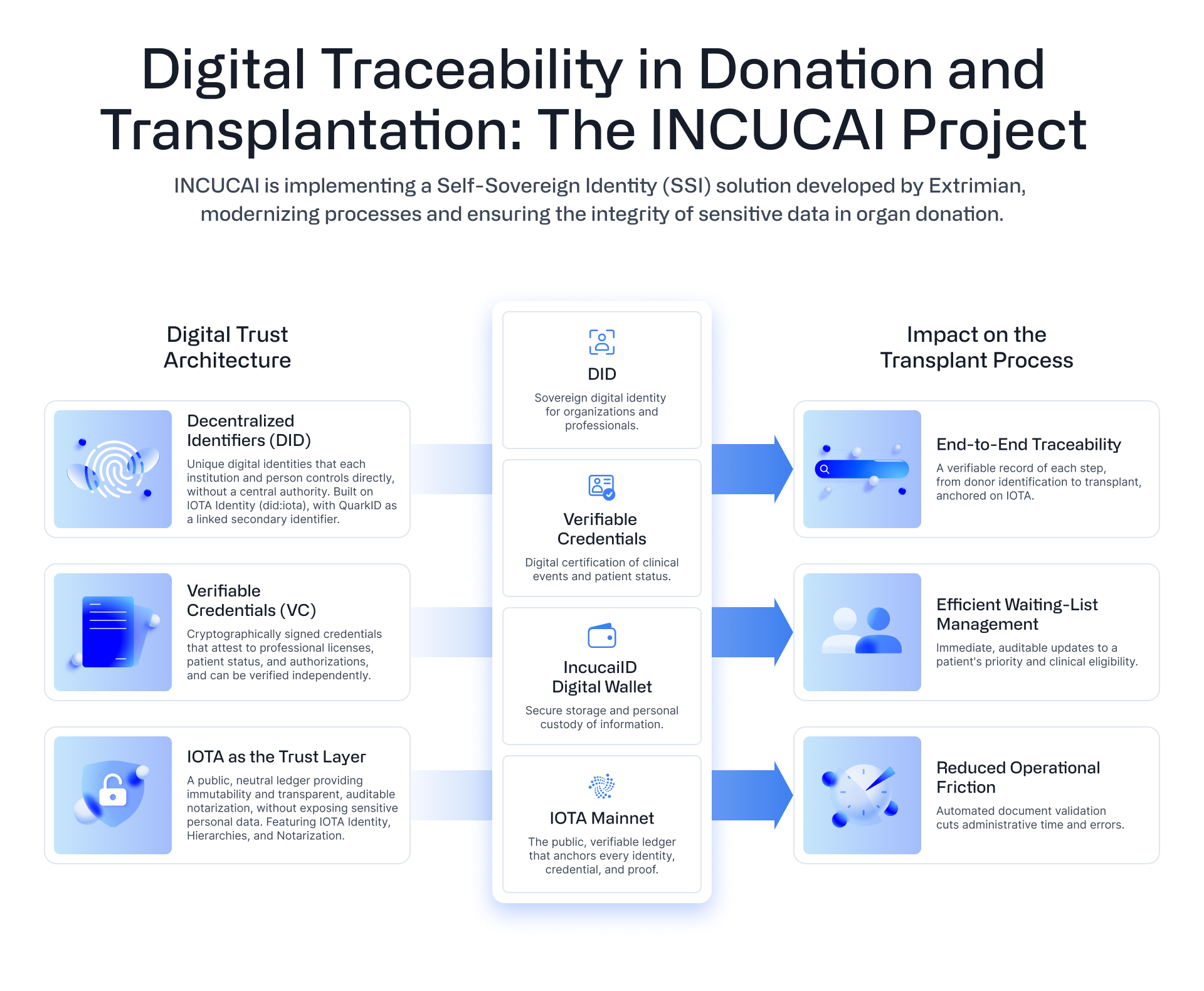
Extrimian resolved this architectural challenge by deploying a system that utilizes cryptographic hashing rather than data storage. No personal health information or patient identities ever touch the IOTA mainnet. Instead, cryptographic proofs, or hashes, of signed documents and critical process steps are anchored permanently to the decentralized ledger.
This mechanism allows doctors, regional coordinators, and oversight bodies to independently verify that a document exists, has not been tampered with, and was signed by an accredited authority at a specific moment in time. However, the underlying data remains securely encrypted off-chain. Utilizing W3C-compliant decentralized identifiers (DIDs) and verifiable credentials, the system establishes a web of trust where institutional identities are mathematically proven rather than implicitly assumed.
Furthermore, critical components of the architecture are hosted on ARSAT, Argentina’s state-owned telecommunications infrastructure provider. This integration ensures that while the verification layer benefits from the global neutrality and public verifiability of the IOTA mainnet, sovereign national infrastructure maintains control over core operational touchpoints.
Chronology of a Digital Transformation
The path toward Argentina’s onchain transplant system represents a methodical transition from policy formulation to technical execution:
- Foundation and Development: INCUCAI and Extrimian collaborate to design a decentralized identity framework tailored to SINTRA (Sistema Nacional Procuración y Trasplante de la República Argentina), the nation’s centralized procurement and transplant information system. The architecture is built using open standards, W3C verifiable credentials, and the IOTA ledger.
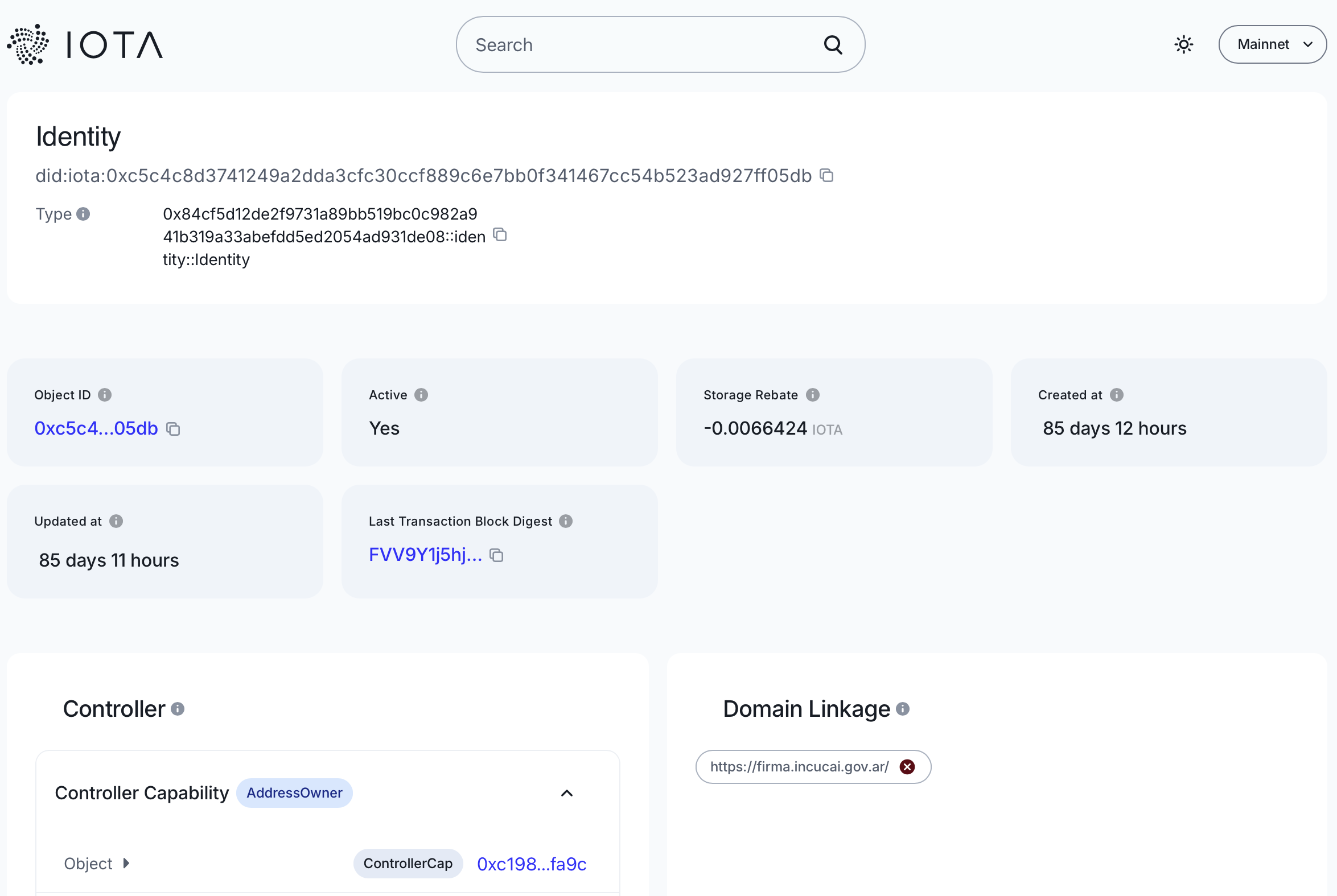
- Mainnet Deployment: On June 10, 2026, the identity and notarization infrastructure goes live on the IOTA Mainnet. Independent verification confirms that all 24 provincial institutional identities successfully resolve onchain with proper domain linkage to official government endpoints.
- Legal Authorization: The Argentine government publishes Resolution 199/2026 in the Official Gazette (Boletín Oficial), formally authorizing the use of electronic signatures backed by blockchain verification across all SINTRA processes.
- Wallet Rollout and Phased Adoption: The official ecosystem application, IncucaiID, is released on the Apple App Store and Google Play. Phased implementation begins with the heart and lung waiting lists, establishing a paperless workflow designed to eventually encompass all organ and tissue categories.
Voices from the Frontlines of Public Innovation
The implementation of blockchain-backed infrastructure within a government health agency marks a significant psychological and operational shift for public administration. Leaders from both the private technology sector and public healthcare governance have emphasized the broader significance of the rollout.
Esteban Musso, Professional Services Manager and Partner at Extrimian, highlighted the practical maturity of decentralized solutions: "At Extrimian, we believe that trust is the foundation of every digital transformation. By combining open standards with privacy-preserving technologies, we’ve helped build a solution that enhances traceability, security, and interoperability while respecting the privacy of every participant. Projects like this demonstrate that decentralized technologies are no longer a vision for the future—they are delivering tangible value today in critical public services."
Daniela Hansen Krogh, Director of Information Technology and Information Systems at INCUCAI, underscored the patient-centric motivation behind the technological upgrade: "Trust is at the heart of every organ donation and transplantation process. Our responsibility is to ensure that every decision is supported by reliable, secure, and verifiable information. By incorporating decentralized identity and cryptographic verification into our national systems, we are strengthening the integrity, traceability, and legal certainty of every critical stage, while safeguarding sensitive patient information. This initiative reflects INCUCAI’s ongoing commitment to modernizing Argentina’s transplant system through secure, transparent, and citizen-centered digital innovation."
Dominik Schiener, Co-Founder and Chairman of the IOTA Foundation, pointed to the scalable utility of public networks: "This is what IOTA’s open technology can do for critical public services at national scale: real infrastructure, already coordinating decisions that save lives."
Broader Implications for Public-Sector Administration
The successful integration of IOTA and Extrimian’s technology into Argentina’s national health apparatus offers a compelling blueprint for other governments seeking to modernize bureaucratic workflows without compromising citizen privacy.
Traditional e-governance solutions often rely on centralized databases managed by specific vendors or single government departments, which can introduce single points of failure, vulnerability to insider tampering, or bureaucratic friction when cross-jurisdictional verification is required. By contrast, a federated trust model anchored to a neutral public ledger allows multiple independent agencies—such as provincial hospitals, regional ministries, and national oversight boards—to interact seamlessly under a unified cryptographic standard.
As the implementation scales beyond initial thoracic organ waiting lists to encompass all facets of SINTRA, the system is expected to eliminate the logistical delays associated with physical paperwork and manual courier services. More importantly, it provides an immutable, transparent audit trail that protects medical professionals, reassures grieving families, and ensures that every organ allocation adheres strictly to medical priority and legal frameworks.
By moving its transplant verification system onchain, Argentina has demonstrated that distributed ledger technology can transition from theoretical enterprise use cases to delivering immediate, life-saving utility in high-stakes public infrastructure.