Decentralized finance (DeFi) protocol Synthetix has officially released its comprehensive 2026 strategic roadmap, charting a course toward high-volume scaling, multi-collateral margin support, and advanced institutional-grade products on Ethereum Mainnet. The release follows a rigorous 12-month overhaul of the protocol’s infrastructure, governance, and organizational culture designed to position Synthetix as a primary destination for decentralized perpetual swap trading.

The unveiling marks a significant milestone for a project that, by late 2024, found itself at a critical strategic crossroads. Following years of stalled growth, outdated operational strategies, and diminishing market momentum, the core contributors initiated a comprehensive structural teardown and rebuild. Throughout 2025, the protocol abandoned various layer-2 automated market maker (AMM) strategies to focus its core operations entirely on a centralized limit order book (CLOB) perpetual DEX built natively on Ethereum Mainnet.
Chronology of the Turnaround: From 2024 Stalemate to 2025 Execution
The transformation of Synthetix unfolded across distinct operational phases. Between 2022 and 2024, the protocol faced mounting competition from high-performance centralized exchanges (CEXs) and emerging app-chain competitors, leading to internal complacency and stagnant metrics. Recognizing the need for systemic change, leadership executed a sweeping operational pivot in 2025.

This restructuring involved consolidating decentralized governance, vertically integrating product offerings, transitioning to delegated staking models, and deprecating redundant layer-2 AMMs. Concurrently, the protocol overhauled its internal personnel, bringing in specialized engineering and product talent to foster a culture of strict accountability and rapid delivery.
To battle-test the newly engineered CLOB perp engine ahead of its broader public rollout, Synthetix hosted two high-profile trading competitions in the final quarter of 2025. Season 1 featured an elite cohort of 100 prominent crypto traders and public figures competing for a prize pool exceeding $1,000,000, while Season 2 scaled the participant base to hundreds of traders. Prominent web3 figures such as gmoney and Mando captured top honors in Seasons 1 and 2, respectively, with industry leaders including Farokh, Larry Cermak, and Evgeny Gaevoy securing positions within the top ten. These events provided essential stress-testing data, allowing developers to optimize latency, matching engine stability, and risk parameters under realistic market conditions.

The 2026 Quarterly Roadmap and Technical Catalysts
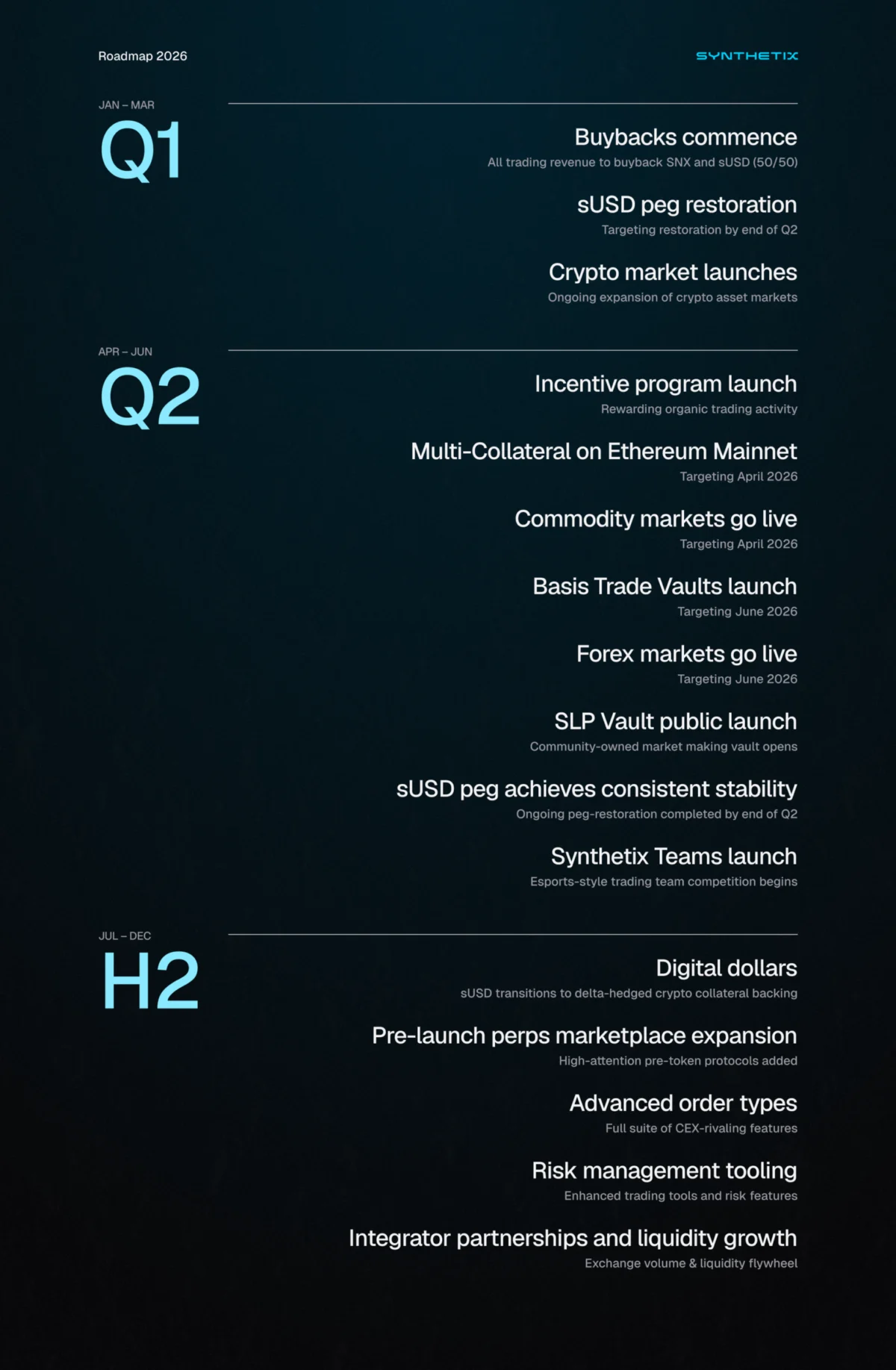
The 2026 roadmap outlines an aggressive schedule aimed at bridging the gap between centralized exchange performance and decentralized security.
Q1 and Q2 Milestones
The first quarter of 2026 focuses heavily on stabilizing core metrics, specifically restoring the peg of the protocol’s native synthetic dollar, sUSD, and laying the groundwork for upcoming product expansions.

Looking ahead to Q2, Synthetix plans to introduce several major growth catalysts:
- Multi-Collateral Margin Support (April): Users will be able to deposit native Ethereum Mainnet assets, such as ETH and cbBTC, directly as margin for perpetual positions. This capability leverages Ethereum’s deep on-chain spot liquidity, enabling billions of dollars in currently idle mainnet capital to become productive without requiring complex asset conversions.
- Basis Trade Vaults: Designed to democratize delta-neutral basis trading, these vaults will allow users to deposit native assets into smart contracts to automatically capture funding rates and spot staking yields, receiving a stablecoin representation of their position in return.
- Sustainable Incentive Program: Eschewing traditional, heavily farmed points models that often disadvantage retail participants, Synthetix plans to roll out an alternative incentive structure designed to reward organic, long-term trading volume.
- Public Launch of the Synthetix Liquidity Provider (SLP) Vault: Following private beta testing, the community-driven market-making vault will open to the public. SLP will act as the primary liquidity provider, exchange liquidator, and multi-collateral exchange facilitator across order books. The protocol has established a target of securing at least $15 million in sUSD within the SLP vault by the end of June 2026, offering participants access to trading profits and fee discounts without management fees.
H2 Focus: Digital Dollars and Market Expansion
During the second half of 2026, Synthetix intends to expand its asset catalog beyond crypto-native tokens to include traditional finance (TradFi) instruments—such as equities, commodities, and foreign exchange—as well as high-attention pre-token perpetual markets.

Furthermore, the protocol will initiate a strategic transition for its native stablecoin, sUSD. Historically backed by the SNX token, sUSD is set to evolve into a fully decentralized, crypto-collateralized synthetic dollar supported by the volume and maturity of the protocol’s Basis Trade Vaults. This transition aims to reduce reliance on traditional banking infrastructure and centralized exchange rails, offering a censorship-resistant medium of exchange native to DeFi.
Tokenomics, Supply Dynamics, and Ecosystem Integrations
The revised economic framework for Synthetix centers on robust value accrual mechanisms tied directly to protocol activity. Initially, all trading revenues generated by the Synthetix perpetual exchange will fund systematic buybacks of sUSD and the native governance token, SNX, split evenly on a 50/50 basis. Once the sUSD market peg achieves sustained stability, 100% of buyback allocations will pivot exclusively toward SNX purchases.

Market observers note that SNX—originally launched in 2018 under the name Havven—benefits from a highly distributed holder base exceeding 125,000 wallets, with very few individual entities holding more than 1% of the circulating supply. Because early venture capital allocations, ecosystem funds, and team token unlocks have largely concluded, the token chart lacks traditional supply overhangs. Protocol developers anticipate that combining active revenue-driven buybacks with growing trading volumes will generate high reflexivity in token supply dynamics.
To drive sustained liquidity and volume, Synthetix is also forging technical integrations with leading Web3 infrastructure providers, wallets, and aggregators, including Infinex. These partnerships utilize developer-facing APIs, WebSockets, and session-key infrastructure to streamline order routing and enhance user experience. Additionally, the protocol is revamping its "Synthetix Teams" program into an esports-style competitive trading format featuring leaderboards and prizes.

Broader Market Implications
The relaunch of Synthetix on Ethereum Mainnet highlights a broader industry shift toward high-performance decentralized derivatives capable of competing directly with centralized venues like Binance and Bybit. By combining the transparency and self-custody guarantees of smart contracts with the capital efficiency of multi-collateral margins and institutional-grade order books, Synthetix aims to capture a substantial share of the growing on-chain derivatives market.
As the protocol executes its milestones through 2026, industry analysts will closely monitor the stabilization of the sUSD peg, the adoption rate of the SLP vault, and the overall volume generated by mainnet perpetuals. With foundational infrastructure established and rigorous testing completed, Synthetix enters the year poised to reassert its standing as a core pillar of the decentralized finance ecosystem.