In an era where modern supply chains, clinical trials, and multinational regulatory frameworks span fragmented digital ecosystems, the fundamental challenge of business operations remains the establishment of trusted, immutable records. Enterprises traditionally rely on localized databases, isolated spreadsheets, and internal server logs to track procedural milestones. However, these systems inherently suffer from vulnerability to backfilling, alteration, deletion, and cross-system discrepancies. When data remains trapped within isolated institutional silos, external stakeholders—such as regulatory bodies, logistics partners, and commercial insurers—cannot verify the authenticity of a workflow without depending on heavily redacted reports or trusting a centralized administrator.
Addressing this critical verification gap, the IOTA Foundation has officially launched IOTA Audit Trails, a comprehensive open-source solution housed within the broader IOTA Notarization toolkit. Designed to bridge fragmented corporate architectures with public ledger security, the alpha release introduces a robust framework for anchoring ordered, governed histories directly onto an onchain ledger. By leveraging a Move smart contract package, a strongly typed Rust Software Development Kit (SDK), and WebAssembly (Wasm) bindings for JavaScript and TypeScript applications, developers now possess the technological apparatus to embed immutable verification protocols into enterprise web and backend environments.
The Architectural Evolution of Onchain Notarization
The release of IOTA Audit Trails represents a significant evolution from traditional blockchain notarization protocols. Historically, ledger notarization allowed applications to anchor individual records—such as a single document hash or a static data point—onto a public network to prove existence at a given timestamp. While effective for basic point-in-time validation, isolated notarization fails to capture the dynamic, sequential nature of complex business processes. A true enterprise workflow requires more than a collection of isolated proofs; it demands an ordered chronology backed by strict governance models, lifecycle rules, and role-based permissions.
IOTA Audit Trails addresses this architectural limitation by treating an audit trail as a shared, dynamic onchain object capable of storing structured records in chronological sequence. Rather than requiring enterprises to migrate proprietary databases or expose sensitive commercial information on a public ledger, the framework relies on a hybrid data visibility model. Confidential documents, personally identifiable information (PII), proprietary research data, and medical files remain securely stored within private off-chain infrastructure. Meanwhile, the ledger records only critical hashes, structural metadata, operational proofs, and sequential markers. This structural design guarantees data integrity and historical availability while preserving strict regulatory compliance and corporate privacy standards.
Core Mechanics and Role-Based Governance
At the heart of IOTA Audit Trails is a sophisticated access control mechanism tailored to multi-party operational environments. In typical cross-organizational workflows, different actors exercise distinct responsibilities. For instance, a pharmaceutical manufacturer generates clinical trial events, an independent auditor inspects study integrity, a quality assurance officer manages retention policies, and a systems operator oversees metadata tags.
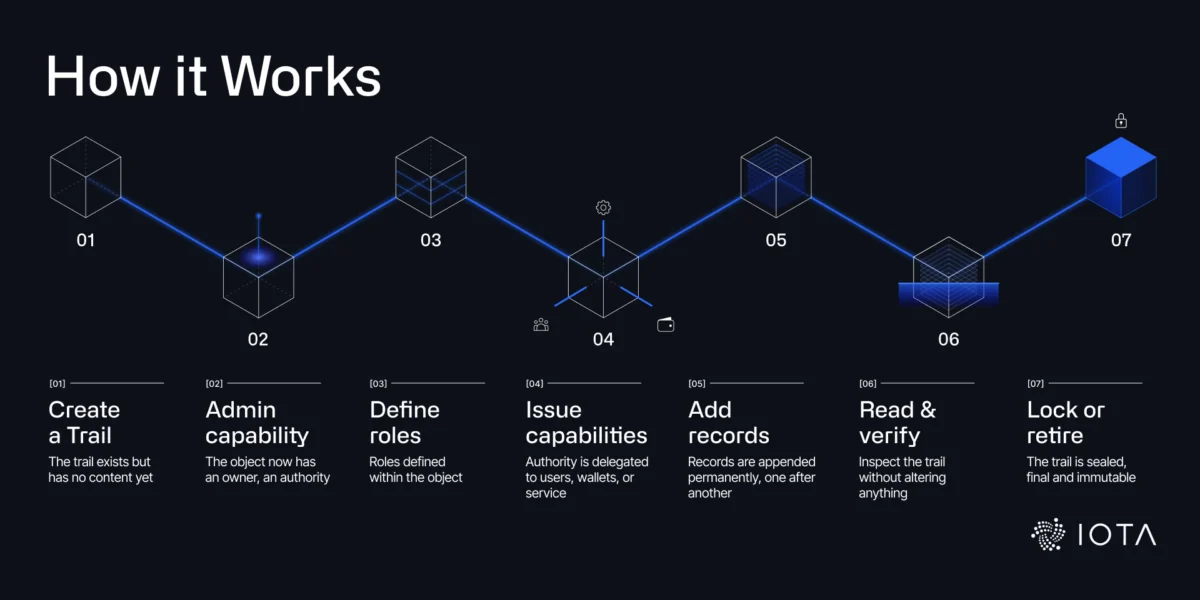
To model these intricate operational relationships without necessitating custom, bespoke smart contracts for every unique business use case, IOTA Audit Trails incorporates granular role-based access control (RBAC). Roles explicitly define authorized actions, capabilities delegate those roles securely to specific cryptographic wallets or microservices, and immutable creation parameters dictate the lifecycle of the trail.
The operational lifecycle of an audit trail proceeds through a predictable sequence:
- Initialization: An authorized actor deploys a new audit trail object on the IOTA ledger, defining initial configuration parameters, locking rules, and administrative roles.
- Record Ingestion: As operational milestones occur, approved participants append structured records containing text, binary data, optional tags, and contextual metadata.
- Sequential Ordering: The ledger anchors the records in a strictly verified chronological sequence, preventing backfilling, deletion, or unauthorized retrospective alterations.
- Independent Verification: External verifiers, including auditors, regulators, and downstream partners, inspect the trail state and record sequence through read-only client interactions without requiring write access or administrative oversight.
- Finalization and Locking: Upon completion of a workflow phase or lifecycle expiration, locking configurations seal the audit trail against further modifications, establishing a permanent, cryptographically sound historical record.
Developer Tooling and Integration Ecosystem
Recognizing that enterprise adoption hinges on frictionless developer onboarding, the IOTA Foundation has rolled out a comprehensive suite of developer tools alongside the alpha release. The solution is distributed across three primary integration pathways, ensuring compatibility with diverse technology stacks.
First, the Move package provides the underlying onchain smart contract logic, guaranteeing secure, trustless execution directly on the IOTA network. Second, the typed Rust SDK enables seamless backend integration for enterprise systems requiring high-throughput data processing and secure server-side transaction construction. Third, WebAssembly (Wasm) bindings deliver native support for JavaScript and TypeScript frameworks, enabling front-end developers to incorporate audit trail verification directly into web applications and decentralized dashboards.

Furthermore, the IOTA Foundation has published a repository of ready-to-run examples addressing real-world vertical use cases, including customs clearance procedures, clinical trial compliance, and digital product passports (DPPs). Crucially, the architecture separates transaction construction from transaction submission. This decoupling allows engineering teams to integrate IOTA Audit Trails seamlessly into existing institutional wallet infrastructures, enterprise signing pipelines, or customized gas-station payment models without disrupting established operational workflows.
Industry Implications Across Key Sectors
The introduction of shared, tamper-resistant audit trails carries profound implications for industries heavily burdened by regulatory oversight and multi-party coordination. By eliminating the friction of post-hoc data reconciliation, IOTA Audit Trails transforms how disparate organizations establish operational trust.
In the realm of supply chains and digital product passports, manufacturers can comprehensively trace the lifecycle of a physical component from raw material extraction through assembly, maintenance, and ultimate recycling. Every quality inspection, transfer of custody, and regulatory certification is permanently logged, providing consumers and regulatory authorities with undeniable proof of provenance and sustainability compliance.
Within legal and compliance operations, enterprises can construct verifiable histories for corporate filings, contractual execution, board resolutions, and mandated regulatory disclosures. Because the audit trail is anchored on a public ledger, multinational corporations can demonstrate immediate, verifiable compliance to auditors across different jurisdictions without exposing underlying trade secrets.
For customs and international trade workflows, where shipments frequently stall due to fragmented paperwork and communication bottlenecks between exporters, shipping lines, port authorities, and customs agents, IOTA Audit Trails offers a synchronized clearance mechanism. All parties interact with a single, ordered history of inspections, duty declarations, and approvals, drastically reducing administrative delays and mitigating fraud risks.
Similarly, IoT and automated industrial systems can leverage the framework to log machine telemetry, sensor attestations, automated maintenance triggers, and critical system state changes. This ensures an unalterable operational ledger for autonomous machinery, smart infrastructure, and industrial internet-of-things (IIoT) deployments where machine-to-machine accountability is paramount.
Broader Market Analysis and Future Outlook
The launch of IOTA Audit Trails arrives at a critical juncture for enterprise distributed ledger technology (DLT). Over the past decade, enterprise blockchain adoption has frequently struggled with the dichotomy between overly complex, closed permissioned networks that fail to engage external stakeholders and overly exposed public networks that compromise corporate confidentiality. By championing a hybrid model—where private data remains off-chain while verifiable proofs and ordered histories are anchored publicly—IOTA positions its infrastructure as a pragmatic middleware layer for modern enterprise architectures.
Industry analysts note that as global regulatory mandates regarding data provenance, supply chain transparency, and corporate accountability tighten—exemplified by the European Union’s Digital Product Passport initiatives and stringent pharmaceutical traceability laws—the demand for cryptographic auditability will accelerate exponentially. Solutions that minimize integration friction while delivering mathematically verifiable trust mechanics are uniquely positioned to capture significant market share in the enterprise software sector.
Immediate Availability and Next Steps
The alpha release of IOTA Audit Trails is available immediately for development teams, systems architects, and enterprise technology groups seeking to prototype advanced verification workflows and validate their infrastructure designs. Developers can begin experimenting by deploying to the IOTA Testnet to evaluate performance, test role-based access configurations, and model custom audit trails tailored to their specific operational requirements.
As organizations prepare to transition from experimental sandboxes to production-grade deployments, the IOTA Foundation invites community feedback and architectural contributions via its official GitHub repositories and developer channels. By redefining how institutional records are maintained, shared, and independently verified, IOTA Audit Trails establishes a new standard for operational transparency in an increasingly interconnected global economy.