The Middle East and North Africa (MENA) region navigated a treacherous macroeconomic and geopolitical environment between July 2025 and June 2026, operating under a dense cloud of uncertainty that profoundly influenced regional digital asset adoption. Marked by cross-border friction, regional conflict, and sweeping domestic policy shifts, the local crypto economy adapted in ways that reflect both the resilience of retail users and the rapid maturation of institutional frameworks. Despite a broader global bear market that halved total crypto market capitalizations worldwide during the 2026 reporting period, on-chain economic activity across the globe remained remarkably robust. The MENA region mirrored this tenacity, recording a marginal 1.4% dip in its aggregate crypto economy, sliding slightly from $449.6 billion to $443.3 billion.

Beneath this surface stability, however, lay a complex interplay of localized disruptions. Out of 24 MENA markets with measurable data, 16 recorded positive growth. The regional total remained virtually flat primarily because its two juggernauts—Türkiye and the United Arab Emirates, which together account for 56% of the entire regional crypto economy—moved in diametrically opposed directions, effectively neutralizing each other’s momentum. While the overarching bear market set a baseline constraint, it was the layer of regional conflicts, such as the Iran conflict that erupted on February 28, 2026, alongside market-specific shocks like internet crackdowns and stringent licensing transitions, that truly defined the year. Institutional capital increasingly gravitated toward regulated hubs like the UAE, whereas retail users in markets experiencing regulatory bottlenecks bypassed traditional rails in favor of direct peer-to-peer and wallet-to-wallet transactions.
Chronology of Disruption: Key Events Shaping the 2026 Landscape
The reporting period was punctuated by severe macroeconomic and geopolitical flashpoints that directly tested the infrastructure of digital finance across the MENA corridor.

- January 2026: Economic protests erupted in Iran, triggering a violent government suppression accompanied by a 20-day internet blackout that severed regular citizens’ digital links to the global economy. Simultaneously, Türkiye’s Treasury and Finance Ministry announced the Precious Metal Tracking System (KMTS), a regulatory framework banning cash purchases of physical gold at jewelers to combat the informal economy. This announcement instantly catalyzed a massive surge in tokenized gold trading on Turkish exchanges.
- February 28, 2026: A major regional conflict involving Iran began, introducing immediate cross-border financial pressure. In the immediate aftermath, Iranian personal wallets and cross-border stablecoin inflows experienced sharp contractions of up to 80% as secondary internet blackouts—lasting 88 days—took hold.
- March 2026: As Iranian drone and missile strikes began targeting Emirati territory, the UAE witnessed a simultaneous spike in the acquisition of both bitcoin and tokenized gold as traditional safe-haven assets.
- April 7, 2026: A temporary ceasefire was declared in the Iran conflict, serving as a pivotal pivot point where cross-border crypto inflows and domestic wallet activity across the region began recovering and ultimately surpassing their pre-conflict baselines.
- April–May 2026: Türkiye formally enforced its new crypto industry regulatory regime, requiring all Crypto Asset Service Providers (CASPs) to secure licenses from the financial regulator SPK under strict financial institution compliance standards. Simultaneously, the physical cash ban on gold transactions under the KMTS framework went fully online, establishing a permanently higher baseline volume for tokenized gold.
- July 2026: The UAE government issued advanced directives for the regulated trading of digital precious metals, further cementing its institutional crypto infrastructure. Meanwhile, Iranian internet restrictions began lifting, unleashing pent-up transactional volume that drove personal wallet activity to nearly double pre-blackout baselines.
Türkiye’s $144.5 Billion Market in Transition
Remaining the largest crypto economy in the MENA region, Türkiye recorded $144.5 billion in value received during the 2026 period, representing roughly one-third of the entire regional market. Although this figure represents a modest contraction compared to previous years, industry experts emphasize that the decline indicates a structural transition rather than a retreat. Activity systematically migrated away from unverified services toward wallet-to-wallet rails, while institutional engagement from traditional banks and licensed platforms deepened significantly.
The enforcement of the SPK licensing regime at the close of the study period fundamentally transformed the operational landscape. By requiring Crypto Asset Service Providers to adhere to stringent compliance protocols identical to those governing traditional financial institutions, regulatory bodies elevated the operational bar for the entire sector. Burcu Küçüknal, CEO of Turkish exchange Stablex, noted that crypto in the country is actively integrating into traditional finance rather than operating as a parallel system. Similarly, Fatih Günaydın, General Manager at Işık Digital Asset Technologies, observed that capital requirements and compliance rules now align Turkish businesses with international standards, bolstering long-term institutional trust. Salim Karaman, CEO of BtcTurk, highlighted that the primary industry focus over the preceding 12 months shifted from assessing theoretical potential to building regulated institutional products, including offering equity and crypto services within unified financial groups under strict activity separation frameworks.

Grassroots P2P Dynamics and the Tokenized Gold Boom in Türkiye
Despite its formalization and institutionalization, Türkiye maintained a vibrant grassroots crypto economy. Its domestic peer-to-peer (P2P) market expanded fivefold, reaching $3.56 billion—making it by far the largest P2P economy in the MENA region, nearly three times larger than all other MENA markets combined. Nearly all of this explosive expansion was driven by stablecoins.
Because the Central Bank of the Republic of Türkiye strictly prohibits the use of crypto assets for payments of goods and services, this multi-billion-dollar P2P volume does not circulate within the real-world commercial economy. Instead, citizens utilize dollar-pegged stablecoins primarily as a vital savings and transfer mechanism to protect household wealth against persistent domestic lira inflation. Günaydın pointed out that while stablecoins serve as an effective store of value due to low spreads and easy transferability, commercial usage remains limited to international trade within strict legal boundaries. Küçüknal emphasized that introducing a clear legal framework for stablecoin-based payments could unlock massive economic demand beyond mere asset trading.

Concurrently, Turkish society’s centuries-old cultural affinity for gold—exemplified by an estimated 5,000 tons of physical gold hoarded privately under mattresses—manifested heavily on-chain following government interventions. In January 2026, the Ministry of Treasury and Finance rolled out the Precious Metal Tracking System (KMTS), outlawing cash transactions for physical gold jewelry and bars to curb the informal economy. Rather than extinguishing demand, the cash ban diverted it directly onto digital rails. Turkish lira-denominated tokenized gold trading exploded from virtually zero in prior years to $974 million in 2026. Data indicates that Turkish lira became the second most popular currency globally for purchasing tokenized gold—trailing only the U.S. dollar—and represented a larger share of lira trading volume than any other currency with an order book exceeding $100 million. By July 2026, the government formalized this trajectory by issuing directives for regulated digital precious metal trading, cementing a mature ecosystem focused on institutional products.
The UAE’s Strategic Ascent as a Global Crypto Hub
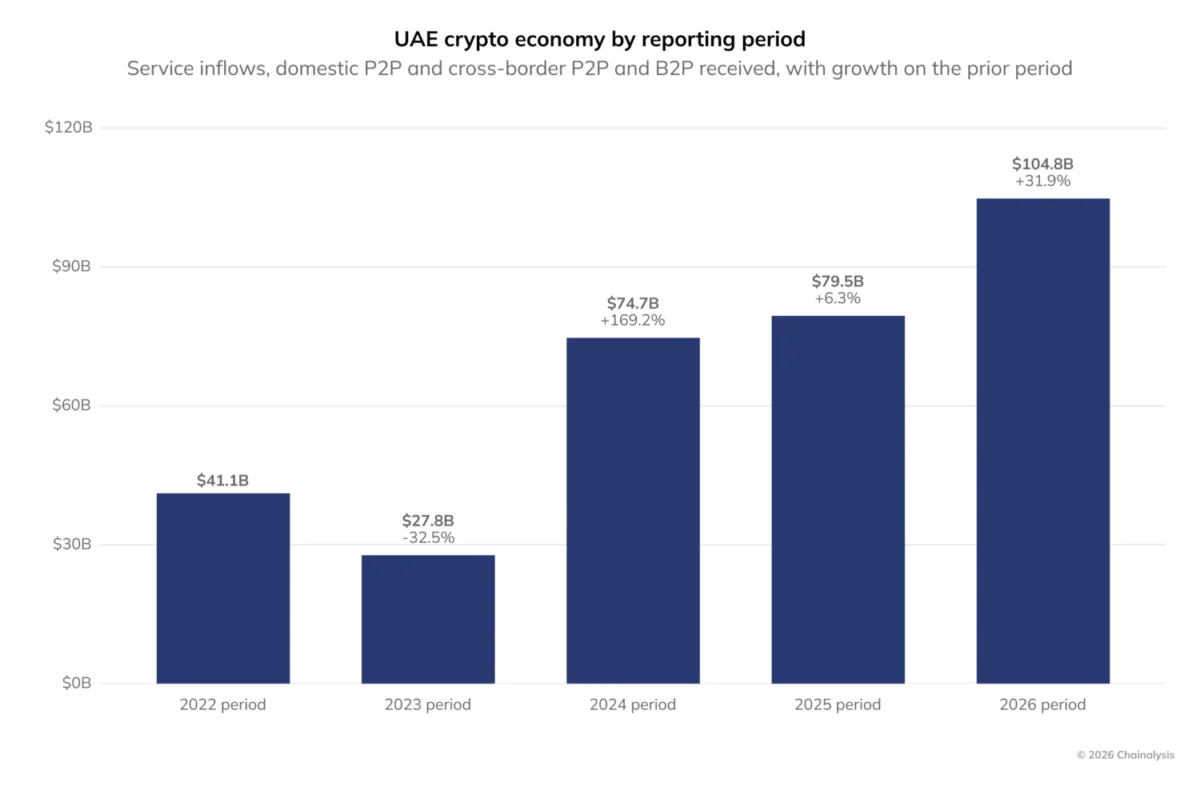
While Türkiye underwent a defensive and regulatory structural transition, the United Arab Emirates pursued an aggressive economic diversification strategy that yielded dramatic growth. Despite the cross-border pressures and macroeconomic headwinds introduced by the regional conflict, the UAE’s crypto economy expanded by 32% year-over-year, reaching $104.8 billion. To contextualize this performance, if the UAE were excluded, the remainder of the MENA crypto economy would have contracted by 8.6% instead of a modest 1.4%.

Henri Arslanian, co-founder of Nine Blocks Capital Management—the first crypto hedge fund licensed by Dubai’s Virtual Assets Regulatory Authority (VARA)—noted that while tourism and hospitality faced localized disruptions from the conflict, the digital asset sector remained largely insulated. Arslanian credited the proactive stance of UAE financial regulators, including VARA, the Financial Services Regulatory Authority (FSRA), and the Dubai Financial Services Authority (DFSA), with dramatically reducing the career risk for corporate executives engaging with digital assets, successfully establishing the Emirates as the primary global hub for crypto operations outside the United States.
Data from the reporting period underscores this institutional maturation. The UAE’s services sector generated $102.3 billion, registering a 29% period-over-period expansion. Centralized exchange inflows grew 22% to $55 billion, while institutional platforms—including specialized custodians and market-makers—surged 75% to hit $11.7 billion, outpacing global growth rates fourfold. Simultaneously, decentralized finance (DeFi) exchanges recorded over $31 billion in inflows, up 31%. Laurent Girouille, Senior Executive Officer at Rain Trading Limited, observed a profound shift in market inquiries, moving away from first-time retail access toward operational compliance, counterparty verification, and institutional custody requested by corporate treasuries, family offices, and regulated intermediaries.

Furthermore, the UAE witnessed staggering growth in its nascent P2P and B2B stablecoin corridors. Domestic P2P payments climbed 786%, cross-border P2P inflows increased 18-fold, and cross-border business payments spiked by nearly 400%, propelled by large-scale stablecoin transfers exceeding $1 million. Arslanian highlighted that the prevalence of regulated OTC brokers offering robust fiat offramps has positioned the UAE as the undisputed global capital for corporate stablecoin settlement, treasury management, and cross-border trade. Industry representatives from Fuze Finance echoed this sentiment, emphasizing that stablecoins are increasingly viewed as foundational financial infrastructure rather than speculative trading assets. On current trajectories, analytical projections indicate the UAE’s crypto economy is on a direct path to surpass Türkiye by 2027.
Conflict and Safe Havens: Divergent Responses in the UAE and Israel
The regional conflict involving Iran in early 2026 exposed fascinating divergences in investor psychology and safe-haven asset accumulation across MENA jurisdictions. In the UAE, where Iranian drone and missile strikes directly impacted physical territory, investor behavior underwent an observable tactical shift. While both bitcoin and tokenized gold experienced initial surges in holder counts at the onset of military engagement in March 2026, these trends decoupled during subsequent relative lulls. As geopolitical tensions fluctuated, the relative share of tokenized gold holders continued its upward trajectory, whereas the number of bitcoin holders systematically contracted as speculators dumped digital assets once immediate pressure eased. Industry experts attribute this stickiness to the deep cultural roots of gold as an accumulated savings instrument in the region, contrasting with bitcoin’s behavior as a reactive trading vehicle during acute crises.

Conversely, Israel’s $37.9 billion crypto economy demonstrated remarkable equilibrium, growing a meager 0.7% period-over-period and effectively decoupling from both regional conflict shocks and the global bear market drag. Unlike the UAE or Türkiye, Israel experienced negligible domestic peer-to-peer activity and minimal cross-border grassroots transfers, with activity overwhelmingly concentrated in retail-driven centralized exchange inflows. Data from the reporting period revealed that 98.4% of Israeli transfers into services were under $10,000, yet large-scale institutional transfers of $1 million or more accounted for 57% ($21.3 billion) of total value. Stablecoins represented a rising share of Israeli service inflows, climbing from 48.1% in 2024 to 57.0% in 2026, serving primarily as a bridge for retail users seeking offshore trading opportunities unavailable domestically. Notably, only 0.06% of Israeli stablecoin inflows were captured by the single domestic exchange tracked, underscoring that Israel’s crypto economy is functionally hosted abroad.
Crucially, neither the early 2026 conflict nor prior regional clashes produced any visible upward spike in Israeli crypto adoption comparable to the extraordinary 96.9% surge in service inflows recorded in the two months immediately following October 7, 2023. Noam Kaplan, a partner at KPMG Israel, and Ilan Sterk, CEO of Horizon (Altshuler Shaham’s crypto wing), noted that the Israeli market had already absorbed its primary structural adjustment following late 2023. Consequently, subsequent military escalations failed to trigger panic-driven market swings, as the local ecosystem settled into a stable state governed by newly expanding regulatory frameworks targeting stablecoins, token offerings, and VASPs designed to bridge digital assets with traditional finance.

Iran: Grassroots Resilience Amid Blackouts and Sanctions
Operating within a uniquely restrictive environment, Iran maintained one of the region’s most robust yet heavily scrutinized crypto economies. While everyday citizens increasingly adopted bitcoin and stablecoins to hedge against chronic domestic inflation, the Iranian regime simultaneously exploited digital assets to evade international sanctions and fund the Islamic Revolutionary Guard Corps (IRGC). Consequently, analytical assessments of grassroots adoption isolate everyday civilian transactions from illicit state-sponsored financial flows.
The year 2026 severely tested Iranian civilian crypto adoption through aggressive government internet blackouts. Following the eruption of domestic economic protests in January, authorities imposed a 20-day digital blackout, causing personal bitcoin wallet transactions to plunge by nearly 90% in the first week. Activity rebounded immediately upon the restoration of connectivity, only to be struck by an 88-day internet blackout initiated alongside the outbreak of the regional war in February, which depressed transaction volumes by roughly 80%.

Despite these severe restrictions, network data highlighted remarkable civilian resilience. Rather than dropping to zero, Iranian bitcoin transaction volumes gradually recovered during the course of the extended blackout as users increasingly bypassed state blockades utilizing decentralized technologies such as satellite internet links. By the time restrictions were lifted in late May, pent-up transactional volume surged to nearly double baseline levels. A parallel pattern emerged in cross-border stablecoin inflows, which initially dropped by 50% during acute conflict phases but systematically rebounded and surpassed historical baselines following the April 7 ceasefire. This demonstrated that while state-enforced blackouts can temporarily bottleneck digital economies, persistent economic necessity drives populations to continuously engineer workarounds against severe infrastructural censorship.
Broader Implications and Outlook for 2027
The 2026 reporting period proved that the trajectory of digital asset adoption in the Middle East and North Africa is inextricably linked to the region’s unique geopolitical volatility and regulatory dynamism. Four distinct strategic responses emerged across the major hubs: the UAE capitalized on progressive regulatory frameworks to cement its status as an institutional financial powerhouse; Türkiye balanced structural institutionalization with an expansive grassroots stablecoin and tokenized gold economy; Israel sustained a steady, retail-focused offshore bridging model that remained insulated from subsequent military shocks; and Iran’s civilian population demonstrated extraordinary resilience by bypassing severe internet blackouts to preserve economic agency.

As the region looks toward 2027, the permanence of these structural shifts will serve as a primary barometer of broader economic stability. The widening institutional lead of the UAE, the formalization of Türkiye’s tokenized commodity and exchange markets, and the continuous evolution of cross-border stablecoin utility ensure that the MENA corridor will remain one of the most innovative and closely watched cryptographic landscapes in the global financial system.