Bitcoin is navigating a complex and precarious market environment, confronting a convergence of bearish technical signals, shifting derivatives trading preferences, and persistent macroeconomic headwinds. Trading near the $80,500 threshold, the world’s leading cryptocurrency is facing skepticism from institutional and retail investors alike over the sustainability of its recent recovery phases. Market analysts are closely scrutinizing whether capital flows, escalating geopolitical and energy pressures, and changing crypto platform utilization patterns will trigger a deeper correction toward a potential liquidity gap near the $74,000 zone, or if buyers can successfully defend foundational support levels to engineer a reliable breakout.
The current market architecture reflects a high degree of caution. While digital asset markets have matured significantly following the widespread adoption of spot exchange-traded funds (ETFs) and integration with traditional financial ecosystems, they remain highly sensitive to broader macroeconomic shocks. The intersection of shifting derivatives volumes, soaring global energy prices, and fragile technical momentum has left market participants weighing multiple conflicting signals. Understanding the full scope of Bitcoin’s current predicament requires a detailed examination of the underlying catalysts, historical precedents, and technical metrics driving the narrative.

Capital Rotation and the Rise of Traditional Assets on Crypto Platforms
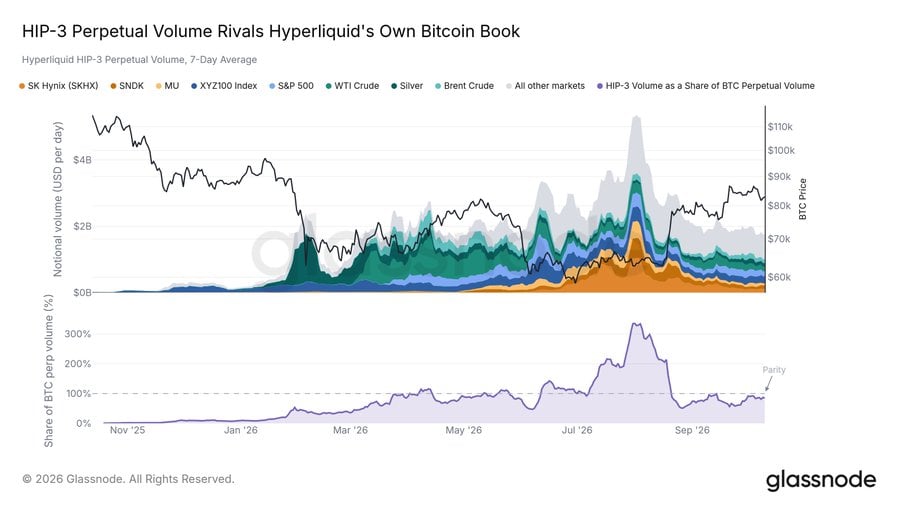
One of the most notable developments captured in recent data from on-chain analytics firm Glassnode and institutional asset manager Fasanara Digital is the evolving composition of trading activity on advanced crypto derivatives venues. Platforms like Hyperliquid have emerged as critical barometers for trader behavior, revealing a pronounced rotation toward traditional asset perpetual futures during periods of subdued native crypto volumes.
According to Glassnode’s Q4 analytics, traditional-finance (TradFi) perpetual volumes—comprising equities, major stock indices, and commodities—surpassed Bitcoin-native perpetual volumes by more than three times during the height of the late-summer consolidation phase. Although trading activity saw a subsequent normalization toward parity by the close of September, the underlying trend points to a structural shift. Traders appear to be increasingly utilizing crypto-native infrastructure to gain synthetic exposure to macro-driven traditional markets.
Market experts emphasize an essential distinction when interpreting these metrics: derivatives volume measures trading turnover and speculative engagement rather than direct capital migration. Consequently, while the data illustrates a clear transformation in trader preferences and operational habits, it does not independently confirm that investors are liquidating their spot Bitcoin holdings en masse to purchase traditional equities or commodities. Nevertheless, the heavy concentration of volume in TradFi derivatives highlights a diversion of speculative attention away from the digital asset ecosystem, leaving BTC with fewer active participants to drive upward price momentum during thin liquidity windows.
Macroeconomic Pressures: Brent Crude and Inflationary Anxieties
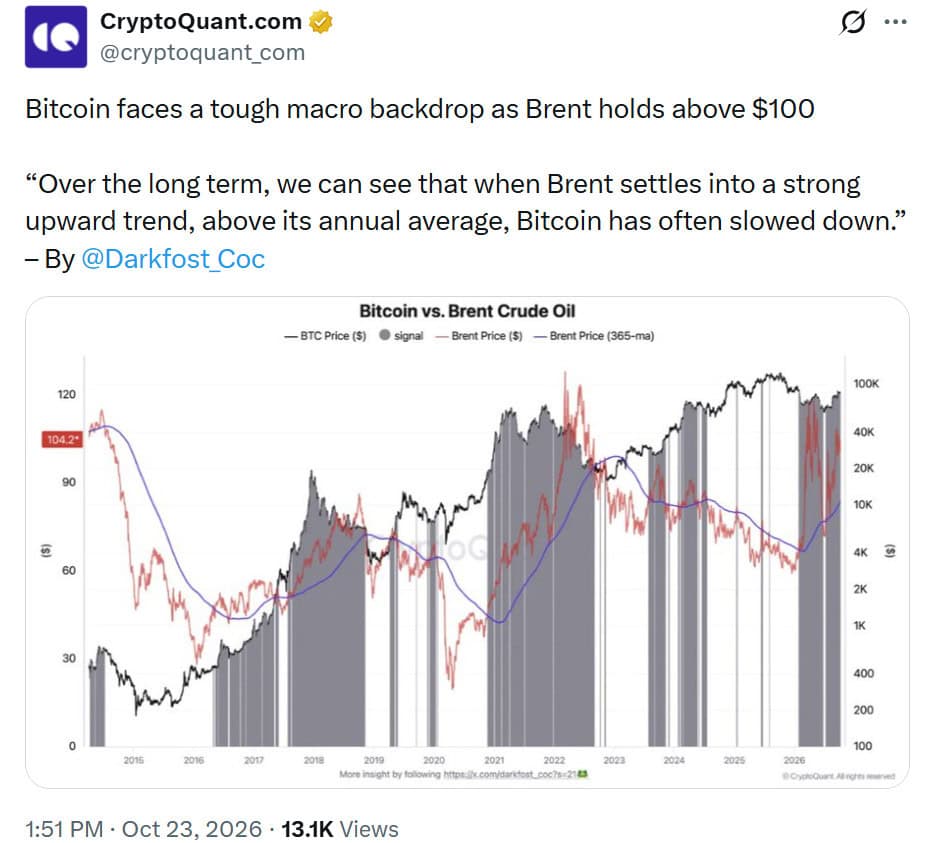
Compounding the psychological and structural strain on Bitcoin is the relentless performance of global energy markets. Recent reports from analytics platform CryptoQuant have drawn renewed attention to the historical correlation between sustained Brent crude oil prices above $100 per barrel and compressed performance metrics for digital assets.
Geopolitical tensions, supply chain constraints, and lingering supply-side anxieties have kept crude oil elevated, pushing it well above its 365-day moving average. Historically, when oil prices maintain an upward trajectory past their annual moving averages, broader inflation concerns intensify. Central banks are consequently forced to maintain higher-for-longer interest rate regimes to combat persistent price pressures. For risk-on assets like Bitcoin, which thrive in environments of expanding global liquidity and low borrowing costs, a strong oil market acts as a formidable macro headwind.
While historical relationships do not guarantee future price action, the economic rationale remains straightforward: expensive energy drives up production and consumer costs, which dampens disposable income, limits speculative capital availability, and prompts institutional portfolio managers to reduce their risk exposure. If Brent crude continues to trade comfortably above the triple-digit mark, macroeconomic overlays could overshadow internal crypto market dynamics, forcing a defensive posture across digital asset portfolios.
Technical Landscape: Subdued Momentum and Critical Price Levels
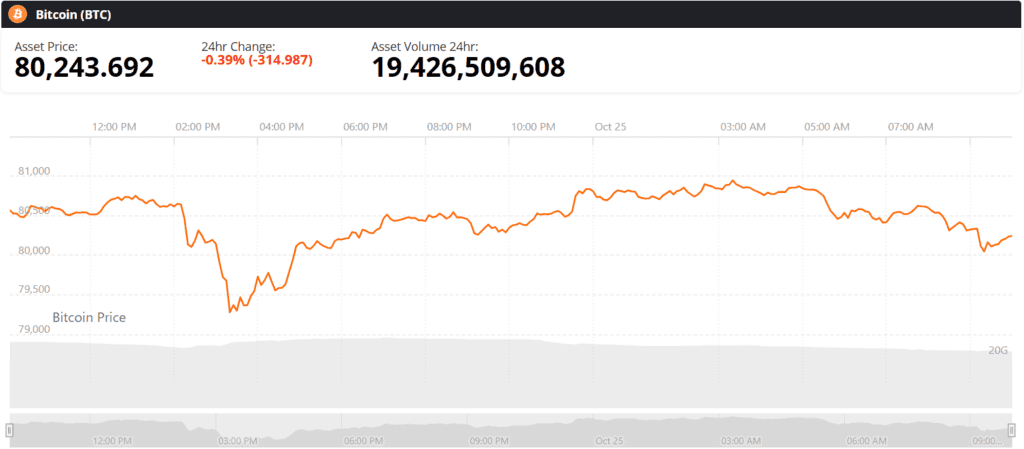
From a technical perspective, Bitcoin’s short-term outlook is characterized by consolidation and hesitation. Live chart analysis from TradingView places BTC hovering near the $80,504 mark, reflecting a predominantly bearish consensus across multiple technical oscillators and moving averages.
The asset is currently trading below key short- and medium-term benchmarks, including the 20-day exponential moving average (EMA) situated near $82,087 and the 50-day simple moving average (SMA) anchored around $81,813. Momentum indicators mirror this subdued posture; the Relative Strength Index (RSI) sits near 43, indicating a lack of conviction from either buyers or sellers, while negative Moving Average Convergence Divergence (MACD) readings reinforce the cautious stance. Interestingly, the Commodity Channel Index (CCI) provides a minor counter-signal at -128, hinting that the asset may be nearing oversold territory and could be primed for a brief technical relief bounce.
The immediate battleground for market participants lies around the central pivot point near $81,950. A decisive, sustained daily close above this threshold would be required to alter the prevailing bearish sentiment, opening a pathway toward Fibonacci resistance near $86,710 and classic overhead resistance around $88,986. Conversely, failure to reclaim this zone leaves downside support levels vulnerable. Initial defense lines sit between $77,190 and $76,526. Should these cushions fail under persistent selling pressure, market makers and algorithmic traders are likely to target a prominent liquidity gap and volume void stretching down toward the $74,249 pivot level.
Market Implications and Institutional Outlook
The interplay between shifting derivatives volume, macroeconomic energy shocks, and fragile technical formations places the broader digital asset market at a definitive crossroads. Institutional sentiment, which has increasingly dictated Bitcoin’s price trajectory via spot ETF inflows and outflows, remains hyper-responsive to external macroeconomic triggers.
While intermittent multi-million-dollar institutional inflows have occasionally demonstrated an ability to reverse short-term monthly outflows—such as previous recovery pushes toward the $90,000 barrier—sustained institutional participation requires a stable macroeconomic backdrop. The combination of restrictive energy prices and a lack of aggressive crypto-native accumulation leaves the market vulnerable to sudden liquidity sweeps.
Industry analysts suggest that while a correction toward the $74,000 liquidity void remains a distinct technical possibility, it is far from predetermined. The depth of any potential pullback will heavily depend on whether macro conditions stabilize and whether spot buyers step in to defend key moving averages. As trading activity adapts to an increasingly interconnected financial landscape—where crypto infrastructure bridges traditional asset derivatives—Bitcoin’s path forward will be dictated as much by global macroeconomic health as it is by internal network fundamentals. Market participants are advised to monitor confirmed volume flows, macroeconomic data releases, and critical technical boundaries closely as the market works to establish a durable price floor.