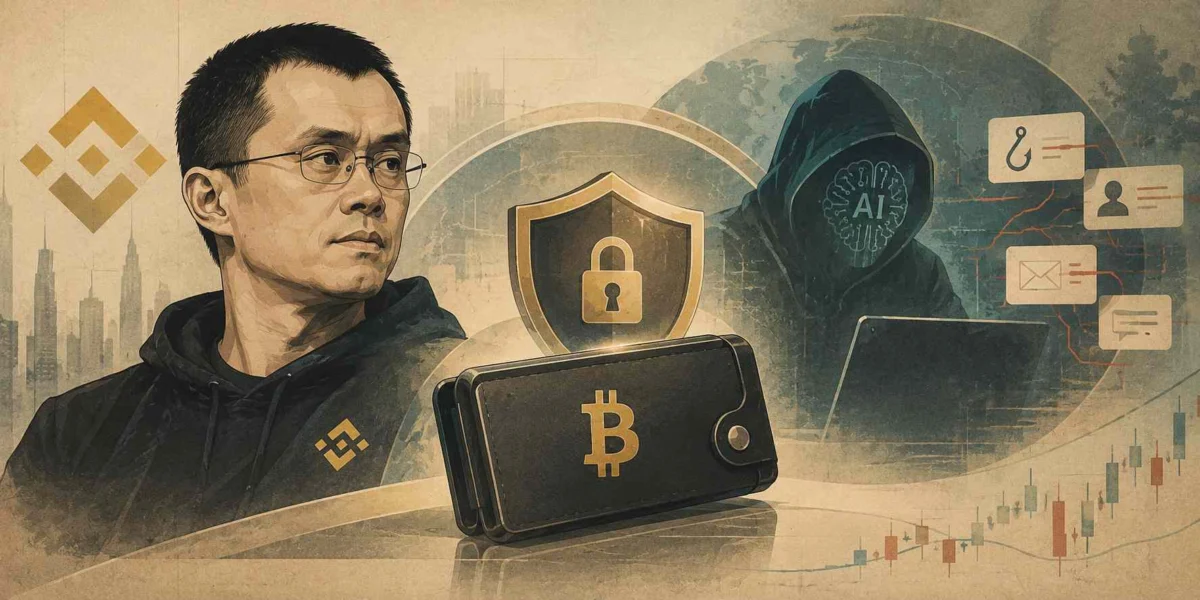
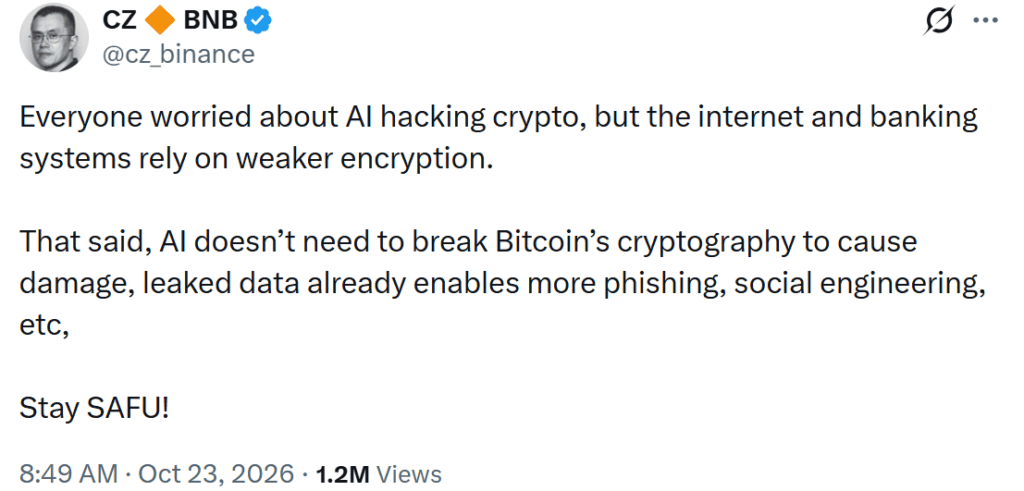
The security paradigm of the digital asset ecosystem is undergoing a fundamental re-evaluation following stark warnings from prominent industry figures regarding the intersection of artificial intelligence and cybersecurity. Changpeng Zhao, co-founder and former CEO of Binance, recently took to social media to caution cryptocurrency participants against placing absolute trust in digital wallets. Rather than focusing on theoretical fears that advanced algorithms will mathematically dismantle the underlying cryptographic architecture of blockchain networks, Zhao emphasized that artificial intelligence will likely serve as a force multiplier for social engineering, phishing, and human error.
The commentary arrives amid a turbulent period for digital asset self-custody. Throughout 2026, high-profile hardware wallet compromises, firmware vulnerabilities, and supply chain exploits have collectively drained tens of millions of dollars from unsuspecting holders. While these incidents have shaken confidence in physical storage devices, cybersecurity experts and industry leaders stress that the core mathematics securing decentralized networks remain uncompromised. Instead, attackers are increasingly weaponizing artificial intelligence to exploit the weakest link in the security chain: the human user.
Anatomy of AI-Driven Social Engineering Threats
The primary concern voiced by Zhao centers on the capability of artificial intelligence to automate and scale deception. Historically, phishing campaigns and social engineering attacks relied on generic messaging, poorly translated emails, and easily identifiable fraudulent portals. However, the maturation of generative artificial intelligence models has dramatically elevated the sophistication of these cyber threats.
Modern AI agents can synthesize vast quantities of leaked personal data stemming from corporate data breaches, dark web leaks, and public social media profiles. By cross-referencing this information, malicious actors can deploy hyper-personalized attacks that mimic trusted contacts, financial institutions, or legitimate customer support representatives. These automated systems can engage targets in real-time, dynamic conversations via chat platforms, voice cloning, or email threads, establishing a false sense of security before tricking the victim into revealing sensitive credentials or authorizing malicious smart contract interactions.
Zhao noted that these threats bypass the need to crack robust encryption standards. While public-key cryptography—such as the ECDSA and Schnorr signatures utilized by Bitcoin and Ethereum—remains computationally secure against current brute-force methods, an attacker who convinces a user to voluntarily surrender their seed phrase or private key bypasses cryptography entirely. The blockchain records the resulting transaction as authentic, leaving victims with virtually no recourse for recovery due to the immutable and decentralized nature of distributed ledgers.
Recent Hardware Wallet Incidents and Supply Chain Vulnerabilities
The warnings articulated by industry executives are substantiated by a series of significant security breaches involving self-custody hardware wallets. These incidents highlight the multifaceted nature of digital asset security, demonstrating that even offline storage solutions are susceptible to manufacturing, logistical, and firmware-level vulnerabilities.
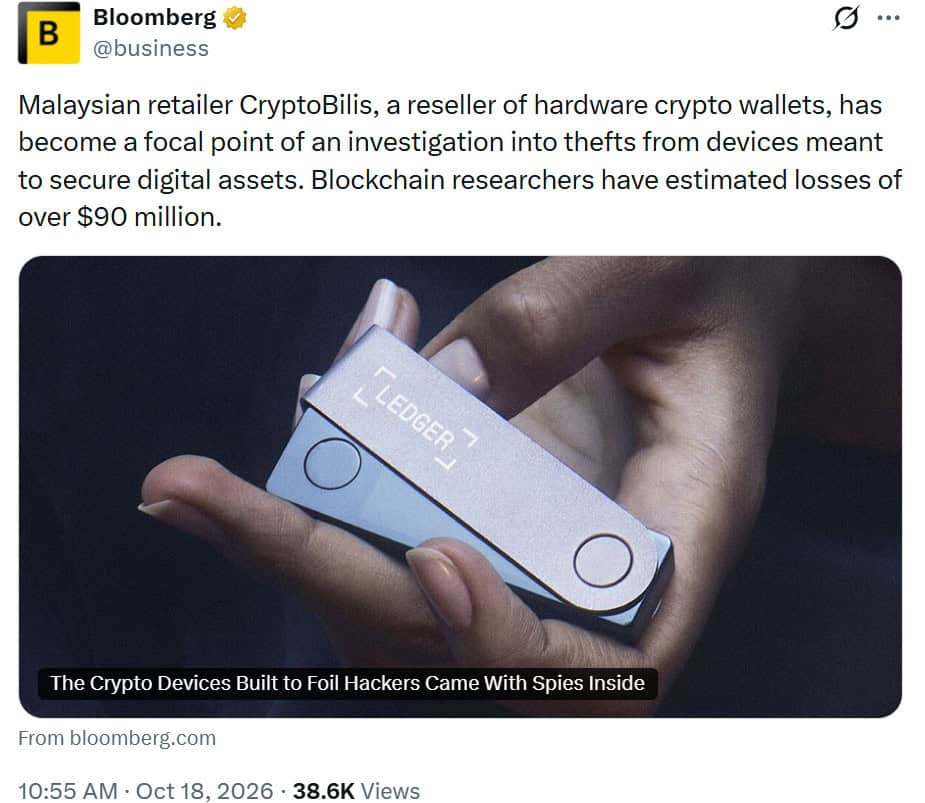
In October 2026, Ledger initiated an intensive investigation into a wave of cryptocurrency thefts associated with hardware wallets distributed through CryptoBilis, a prominent third-party reseller operating in Southeast Asia. Initial estimates from blockchain analytics firms suggested that the security breach resulted in total losses ranging between $93 million and $95 million in various digital assets.
Subsequent technical analysis confirmed the presence of unauthorized hardware implants in at least a subset of the compromised devices. These tampered units were engineered to clandestinely capture users’ recovery phrases during the initial setup procedure and transmit the sensitive data to remote attackers via covert communication channels. In response to the illicit transfers, stablecoin issuer Tether successfully froze approximately $10 million in USDT linked to the incident, demonstrating the collaborative emergency mechanisms present within centralized token ecosystems.
Compounding these supply chain concerns, a separate structural vulnerability impacted Coldcard Bitcoin hardware wallets. Security researchers revealed that a flaw in the device’s seed generation methodology reduced the effective randomness protecting wallet private keys. This entropy weakness rendered affected wallets vulnerable to sophisticated offline brute-force attacks. Blockchain intelligence firm TRM Labs reported in August that the exploit had successfully drained approximately 1,816 Bitcoin—valued at roughly $116 million at the time of the incident—across more than 5,200 unique addresses. Notably, because the vulnerability originated within older firmware versions during the initial key generation phase, installing a routine software update alone was insufficient to secure recovery phrases created under the compromised conditions, necessitating the complete migration of funds to freshly generated, secure addresses.
The Philosophy of Self-Custody and Technological Limitations
The events of 2026 underscore a central tenet of digital finance repeatedly emphasized by Zhao: no technology, software, or cryptographic implementation is completely infallible. In a series of public statements published on October 22 and 23, Zhao reminded the digital asset community that risk is an inherent component of technological interaction, existing in both proactive engagement and passive holding.
The decision to transition from centralized cryptocurrency exchanges to self-custody wallets shifts the burden of security entirely onto the individual. While self-custody eliminates counterparty risk—protecting users from exchange insolvency, regulatory freezes, or platform mismanagement—it simultaneously revokes safety nets. In traditional banking or centralized finance, fraudulent transactions can often be reversed, disputed, or insured. Conversely, blockchain protocols operate on finality; once a transaction is validated and recorded on the ledger, it cannot be undone by an administrator or customer support representative.
Furthermore, hardware wallets, while vastly superior to software hot wallets for long-term storage, remain physical devices subject to the laws of manufacturing physics, supply chain integrity, and software engineering perfection. A vulnerability introduced at any stage of the product lifecycle—from semiconductor fabrication and assembly to firmware development and retail distribution—can compromise the ultimate safety of the stored capital.
Mitigating Risks in an Era of Advanced Automated Threats
As artificial intelligence capabilities continue to expand and threat actors adopt more sophisticated methodologies, security professionals urge digital asset holders to adopt rigorous, multi-layered defensive strategies. Moving beyond blind confidence in a specific brand of hardware or software is paramount.
Experts recommend treating all unsolicited communications, urgent security alerts, and unexpected messages regarding wallet status with extreme skepticism, regardless of how professional or personalized the delivery may appear. Private keys and recovery phrases must be treated as absolute secrets; they should never be entered into web browsers, photographed, stored in cloud-based note applications, or communicated to any individual under any circumstance.
When procuring hardware wallets, users are strongly advised to purchase devices exclusively through official manufacturer channels or verified, authorized distributors, inspecting the physical packaging and device integrity upon arrival. If there is even a remote possibility that a hardware device or seed phrase has been exposed to an untrusted environment, users should not rely solely on software updates. Instead, funds should be systematically transferred to a newly initialized wallet generated on a verified, secure device, provided the migration process is executed safely.
Ultimately, the evolving threat landscape highlights that cryptocurrency security is not a static destination, but an ongoing practice of vigilance, education, and risk management. As artificial intelligence lowers the barrier to entry for cybercriminals, the primary defense for digital asset holders remains critical thinking and disciplined operational security.