
The cryptocurrency exchange-traded fund (ETF) market has experienced a transformative period marked by robust inflows, shifting assets under management, and evolving regulatory landscapes. Recent market data highlights substantial capital accumulation across both Bitcoin (BTC) and Ethereum (ETH) products, reflecting continued institutional participation and shifting macroeconomic factors. Financial analysts and data providers have closely monitored these developments, noting record-setting figures that underscore the growing integration of digital assets into traditional financial portfolios.
Market Overview and Capital Inflows
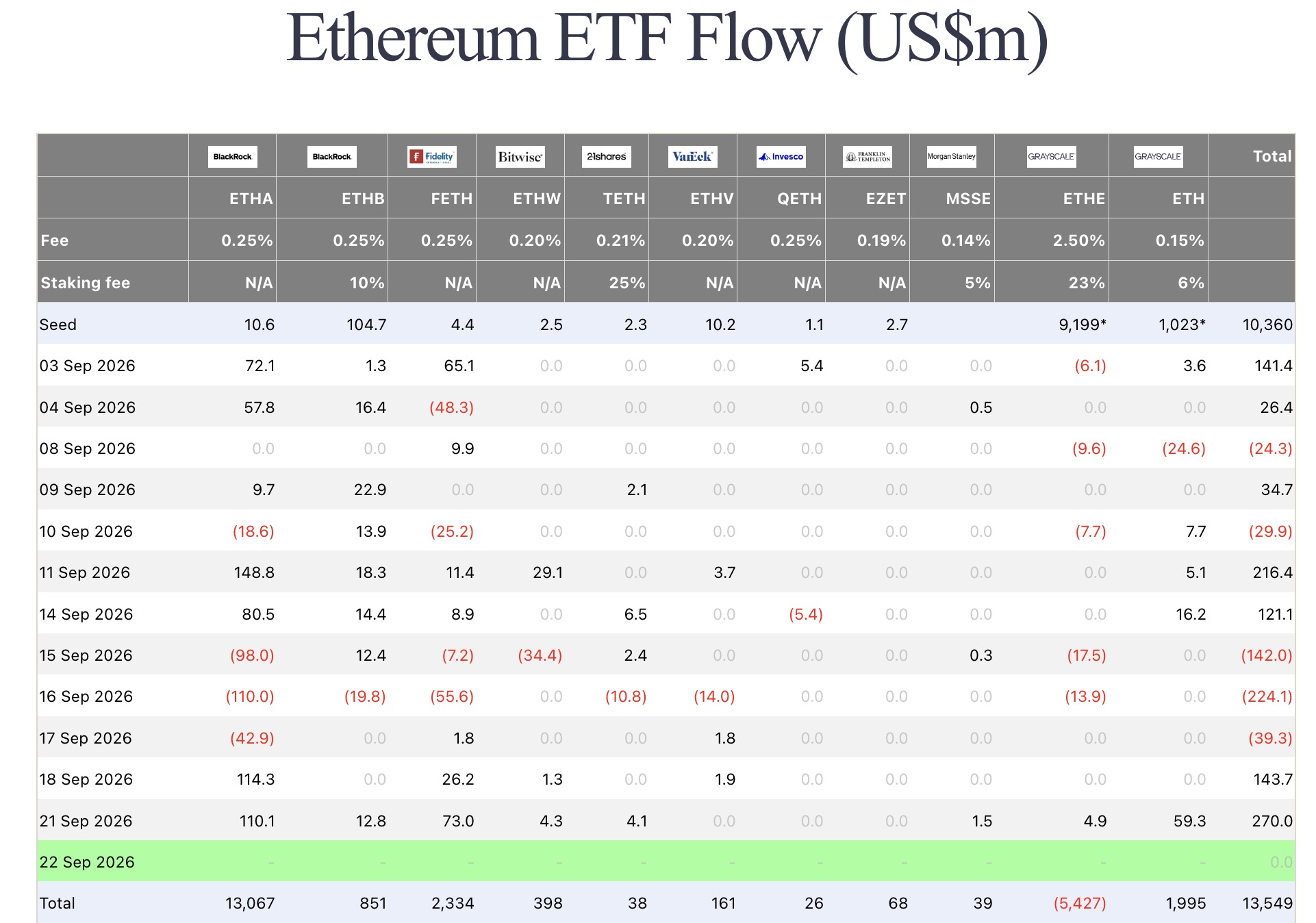
The broader cryptocurrency ETF sector has demonstrated notable resilience, with inflows reaching multi-month highs across major institutional platforms. According to reporting from industry analysts, Ethereum ETFs have attracted cumulative net inflows totaling approximately $270 million, while Bitcoin ETFs have recorded inflows of roughly $999 million within a single reporting cycle. These figures point to sustained investor interest despite broader macroeconomic uncertainties and periodic market corrections.
Eric Balchunas, senior ETF analyst at Bloomberg, noted that the trajectory of crypto ETF inflows has consistently defied earlier conservative projections. The rapid accumulation of capital challenges the notion that institutional demand would plateau following the initial wave of product approvals. Instead, market participants continue to allocate capital through regulated investment vehicles, providing a steady stream of liquidity to the underlying digital asset markets.

Data compiled by Farside UK illustrates the distribution of these inflows among various ETF providers. Ethereum investment products captured significant momentum, with single-day net inflows surpassing $130 million during peak trading sessions. Meanwhile, Bitcoin ETFs maintained a strong upward trajectory, bolstered by consistent daily allocations from institutional allocators and wealth management firms.
Ethereum ETF Growth and Staking Dynamics
Ethereum-based investment products have experienced a notable resurgence, marked by rising asset valuations and expanding market share. On September 21, Ethereum (ETH) prices climbed approximately 5%, testing the $2,800 threshold. Over a broader six-day trading window, the asset appreciated by nearly 20%, outpacing several traditional market benchmarks and drawing renewed attention from institutional investors.
The performance of Ethereum ETFs has been closely tied to broader developments within the decentralized finance (DeFi) ecosystem, including ongoing discussions surrounding staking rewards. Unlike initial product offerings that excluded staking capabilities due to regulatory ambiguities, subsequent proposals and evolving compliance frameworks have allowed some providers to explore yield-generating mechanisms. This shift has enhanced the attractiveness of Ethereum investment products compared to holding the underlying asset directly, as investors can potentially capture both price appreciation and network yields.
Despite these positive developments, the market share of Ethereum exchange-traded products relative to Bitcoin remains constrained. Analysts attribute this disparity to Bitcoin’s established position as a digital reserve asset and its broader adoption among corporate treasuries and sovereign wealth funds. Nevertheless, the recent surge in Ethereum ETF inflows suggests that institutional diversification strategies are gradually expanding to include smart contract platforms with yield-bearing characteristics.

Bitcoin ETF Holdings and Institutional Accumulation
Bitcoin ETFs continue to dominate the digital asset investment landscape, accounting for the vast majority of assets under management within the crypto ETF sector. Data from BitcoinTreasuries indicates that spot Bitcoin ETFs collectively hold approximately 1.4 million BTC, representing roughly 6.97% of the total circulating supply. This concentration of ownership underscores the pivotal role that regulated investment vehicles now play in the price discovery process of the world’s largest cryptocurrency by market capitalization.
Major financial institutions and asset managers have steadily increased their exposure to Bitcoin through these structured products. The institutionalization of Bitcoin has fundamentally altered market dynamics, introducing a new class of long-term holders whose investment horizons differ significantly from traditional retail participants. This structural shift has contributed to reduced volatility during market pullbacks, as institutional allocations tend to be governed by strict risk-management parameters and long-term strategic mandates.
Market analysts have also highlighted the interplay between ETF flows and on-chain metrics. According to insights shared by CryptoQuant CEO Ki Young Ju, the continuous absorption of Bitcoin by ETF issuers has created a persistent supply deficit on centralized exchanges. As regulated funds lock up significant portions of the circulating supply, available liquidity on secondary markets has tightened, creating structural support for asset prices during periods of macroeconomic volatility.
Technical Analysis and Market Implications
Recent price action across Bitcoin and Ethereum has been analyzed using advanced technical indicators, providing further context for the observed ETF inflows. Proprietary market models, such as those developed by AlgoAlpha, track the dynamic relationship between spot prices and ETF accumulation trends. These models suggest that institutional buying often intensifies following periods of consolidation, acting as a catalyst for upward price movement.
For instance, technical indicators for Bitcoin on September 22 placed the moving average cost basis for ETF inflows at approximately $86,104, while spot prices hovered near $79,844. This divergence indicates that recent institutional buyers may be experiencing temporary unrealized losses, yet historical patterns suggest that long-term allocators view such periods as accumulation opportunities rather than exit signals. The persistence of net inflows during price corrections reinforces the thesis that institutional capital is largely sticky, prioritizing long-term portfolio integration over short-term tactical trading.
Furthermore, the expansion of the cryptocurrency ETF market has broader implications for global financial regulation. As central banks and securities regulators continue to refine oversight frameworks for digital assets, the existence of regulated exchange-traded products provides a transparent benchmark for pricing and risk assessment. This integration facilitates greater participation from pension funds, endowments, and advisory practices that were previously restricted from holding digital assets directly due to custody and compliance mandates.
Conclusion and Future Outlook
The milestone achievements of Bitcoin and Ethereum ETFs mark a mature phase in the evolution of digital asset markets. By bridging the gap between traditional finance and blockchain-based assets, ETFs have provided a secure, regulated channel for institutional capital deployment. While challenges remain—including regulatory uncertainties surrounding yield generation and macroeconomic headwinds—the underlying growth trend points toward permanent structural integration.
As market participants continue to evaluate the performance of these financial products, the focus will likely shift toward product innovation, fee structures, and the potential approval of additional altcoin-based ETFs. For now, the sustained momentum of crypto ETFs reinforces their status as a cornerstone of modern portfolio construction, ensuring that digital assets will remain a focal point of global financial markets for years to come.