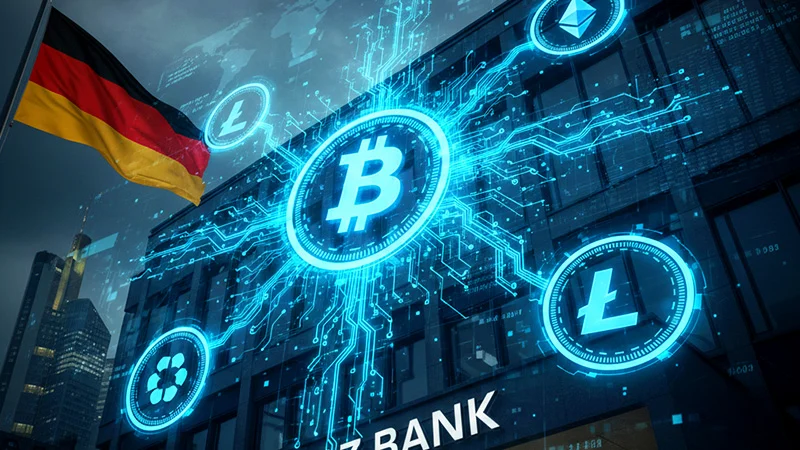
Deutsche Bank has officially announced the launch of its new digital asset custody service, a strategic expansion into the burgeoning field of institutional cryptocurrency management. As of September 16, 2026, the German financial giant is rolling out a robust infrastructure designed to facilitate the secure storage and management of digital assets for corporate and institutional clients. This move marks a significant milestone in the traditional banking sector’s ongoing integration with blockchain technology, signaling a maturing market where digital assets are increasingly viewed as a legitimate asset class by global financial institutions.
The new service is specifically engineered to address the stringent security and compliance requirements of large-scale institutional investors. By leveraging advanced custody architecture, Deutsche Bank aims to bridge the gap between traditional finance and the decentralized digital economy, providing clients with a reliable gateway to engage with digital assets without compromising on the regulatory rigor expected of a Tier-1 financial institution.
The Scope of Supported Digital Assets
At the outset, the platform will provide custody for a curated list of high-liquidity digital assets. The initial offering includes industry stalwarts such as Bitcoin (BTC) and Ethereum (ETH), which continue to dominate the institutional appetite for digital exposure. Furthermore, the bank has integrated support for a selection of stablecoins and tokenized assets, including USDC, EURC, and EURAU.
This selection is not arbitrary; it represents a focus on assets that possess both significant market depth and regulatory clarity. By limiting the initial scope to these specific tokens, Deutsche Bank is prioritizing risk management and operational stability. This approach allows the institution to test its systems under real-world conditions while providing clients with access to the most essential instruments within the digital asset ecosystem.
Strategic Infrastructure and Technological Partnerships
The success of this initiative is heavily dependent on the bank’s robust technological backbone. To ensure the highest level of security, Deutsche Bank has utilized state-of-the-art cold storage solutions and sophisticated multi-signature wallet configurations. These measures are designed to mitigate the risks of unauthorized access and potential security breaches that have historically plagued early crypto-native platforms.
A key pillar of this launch is the partnership with Taurus, a prominent Swiss-based provider of digital asset infrastructure. This collaboration, which was first signaled in 2023, has been instrumental in building the necessary framework for the custody solution. Taurus brings extensive experience in tokenization and digital asset infrastructure, having worked with numerous financial institutions to manage and trade digital assets securely.
By integrating the Taurus technology suite, Deutsche Bank is able to offer its clients a seamless interface for managing digital assets alongside traditional portfolios. This integration is critical for adoption, as it reduces the friction for institutional managers who are accustomed to existing banking software and reporting tools.
Regulatory Compliance and the MiCA Framework
The regulatory landscape has been a primary concern for traditional banks considering entry into the cryptocurrency space. However, the implementation of the Markets in Crypto-Assets (MiCA) regulation within the European Union has provided a clear roadmap for financial institutions. Deutsche Bank has taken a proactive stance, ensuring that its custody operations are fully aligned with the requirements set forth by MiCA.
As of January 2026, the bank has been working to obtain the necessary licenses to operate within the new European regulatory framework. By adhering to these guidelines, the bank not only protects itself from legal risks but also provides a layer of assurance to its clients. MiCA is widely regarded as the most comprehensive regulatory framework for digital assets globally, and its adoption by Deutsche Bank signals to the broader market that the era of "wild west" crypto operations is being rapidly replaced by institutional-grade compliance.
The Rationale Behind Institutional Adoption
The decision by Deutsche Bank to enter the custody market is driven by client demand. Over the past several years, the bank has observed a steady increase in inquiries from corporate and institutional clients regarding digital asset strategies. These clients are seeking ways to diversify their holdings, explore the benefits of tokenization, and gain exposure to decentralized finance (DeFi) protocols, all while maintaining the security of a regulated banking partner.
The demand is not merely for trading, but for the fundamental infrastructure that allows for long-term holding. Custody is the "plumbing" of the digital asset world. Without secure, regulated custodians, institutional capital remains largely on the sidelines. By filling this gap, Deutsche Bank is positioning itself as an essential service provider in the evolving global financial architecture.
Tokenization and the Future of Finance
Beyond simple custody, the launch is a precursor to a wider strategy involving the tokenization of real-world assets. The ability to issue, store, and manage digital tokens that represent traditional securities, such as bonds or equity, is seen by many in the industry as the next frontier of financial innovation.
Tokenization offers the potential for 24/7 settlement, increased transparency, and the reduction of intermediary costs. By positioning its custody solution to support these tokenized assets, Deutsche Bank is preparing for a future where traditional financial instruments are increasingly issued on blockchain ledgers. The current custody solution provides the necessary foundation for this transition, allowing the bank to scale its services as the market for tokenized assets grows.
Comparative Landscape and Market Impact
The entry of a bank of Deutsche Bank’s size into the digital asset space has broader implications for the global financial sector. It puts pressure on other international banking giants to accelerate their own digital asset initiatives. As more institutions build out their custody and trading capabilities, the liquidity and stability of the digital asset market are expected to improve significantly.
The current competitive environment is characterized by a mix of crypto-native custodians, such as Coinbase and BitGo, and traditional financial institutions that are rapidly building in-house capabilities. Deutsche Bank’s competitive advantage lies in its deep institutional relationships and its ability to offer a comprehensive suite of financial services. Clients are unlikely to move their entire treasury to a new, niche provider; however, they are highly likely to add digital assets to their existing account at a trusted, incumbent institution.
Challenges and Risk Management
Despite the positive outlook, the road ahead is not without challenges. The digital asset market remains volatile, and regulatory requirements are subject to change as the technology evolves. Furthermore, the operational risks associated with digital asset management—such as key management and smart contract vulnerabilities—require continuous investment in talent and technology.
Deutsche Bank’s approach to these challenges is one of measured expansion. The bank has emphasized that its primary goal is to provide a safe and stable environment for its clients. By maintaining a conservative stance on which assets it supports and by relying on proven partnerships, the bank is mitigating the potential for systemic risk.
Chronology of Development
- 2023: Deutsche Bank and Taurus enter into a global partnership to develop digital asset custody and tokenization capabilities.
- 2024–2025: Internal development and testing of the digital asset platform, with a focus on compliance with the incoming MiCA regulations.
- January 2026: Deutsche Bank moves to align its operations with the finalized MiCA standards.
- May 2026: MiCA regulations officially begin to take effect across the European Union, setting the stage for wider institutional adoption.
- September 2026: Official launch of the institutional and corporate digital asset custody solution.
Conclusion
The launch of Deutsche Bank’s digital asset custody service is a testament to the ongoing evolution of the financial industry. By successfully navigating the complexities of regulation, security, and technological integration, the bank has demonstrated that digital assets can coexist with traditional banking systems. As the infrastructure for digital assets continues to mature, the role of regulated custodians will become increasingly central to the global economy. This development serves as a clear indicator that the integration of blockchain technology into the mainstream financial system is no longer a speculative theory, but a reality being actively built by the world’s leading financial institutions.
Through this initiative, Deutsche Bank is not only meeting the current needs of its clients but is also laying the groundwork for a more efficient, transparent, and digitally integrated financial future. The success of this service will be a key metric to watch as the financial sector continues to bridge the gap between legacy systems and the next generation of financial technology.