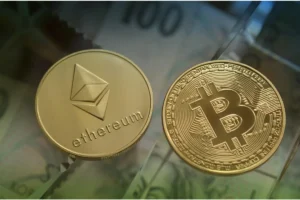
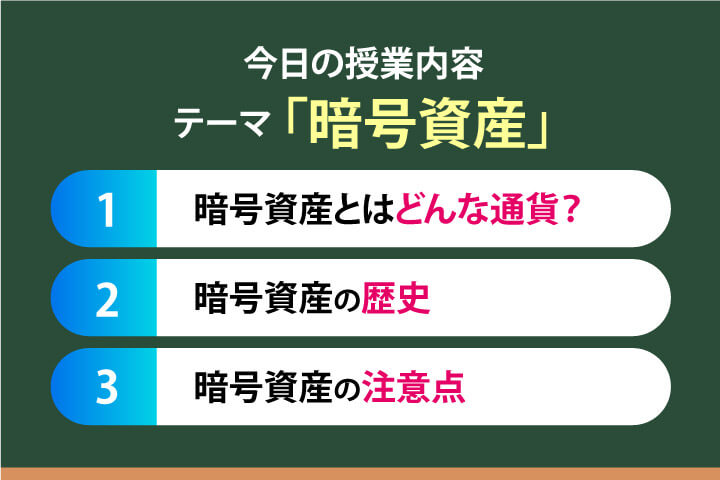
The global financial landscape is currently undergoing a seismic shift as traditional centralized systems converge with the decentralized possibilities offered by Web3.0 technologies, at the heart of which lie crypto assets. Formerly referred to as "virtual currencies," these digital assets have evolved from niche experimental protocols into significant financial instruments that demand a rigorous understanding of their technological foundations, historical milestones, and inherent market risks. In Japan, the transition in legal terminology from "virtual currency" to "crypto assets" (angō shisan) reflects a broader international effort to categorize these instruments not merely as alternatives to legal tender, but as a distinct class of digital property backed by cryptographic security.

The Technological Paradigm: Decentralization and Blockchain Integrity
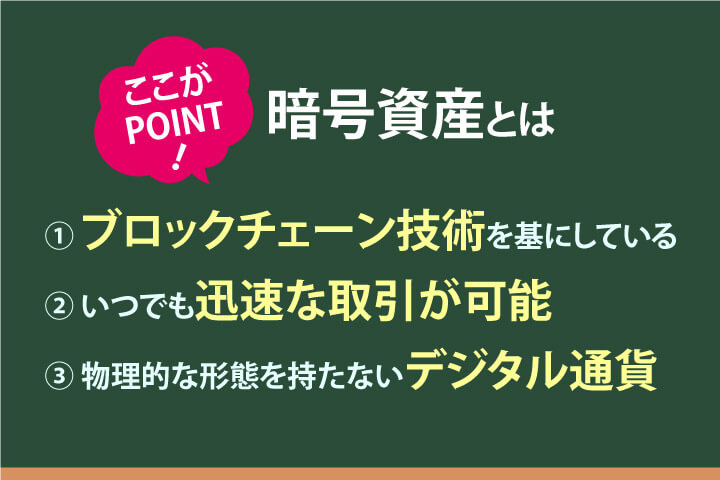
Unlike traditional fiat currencies, which are issued by central banks and managed through commercial financial institutions, crypto assets operate on a decentralized framework. This system removes the necessity for a "trusted third party," such as a bank or a government clearinghouse. The fundamental technology enabling this autonomy is the blockchain—a distributed ledger that records transactions across a vast network of computers.
In a traditional banking environment, transactions are processed during business hours, and the system is susceptible to downtime, maintenance, or centralized failure. Conversely, blockchain-based crypto assets function 24/7, 365 days a year. Because the ledger is distributed, no single entity has the authority to alter or delete transaction history. Once a block of data is verified and added to the chain, it becomes computationally nearly impossible to modify. This transparency ensures that every transaction is publicly verifiable, significantly reducing the risk of fraudulent "double-spending" or unauthorized alterations by a central administrator.

The removal of the middleman does more than just ensure constant uptime; it fundamentally changes the cost structure and speed of global value transfer. However, this independence places the burden of security and accuracy directly on the user, a factor that contributes to the high-risk profile often associated with the sector.
A Chronological History of Crypto Assets
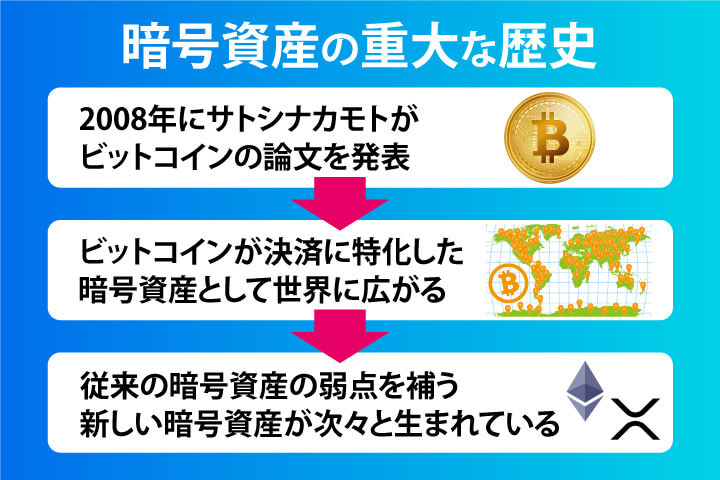
The trajectory of crypto assets is defined by several key eras, beginning with the ideological foundations laid during the 2008 global financial crisis and leading to the diverse ecosystem of "Ethereum killers" and utility tokens seen today.

2008–2009: The Genesis of Bitcoin
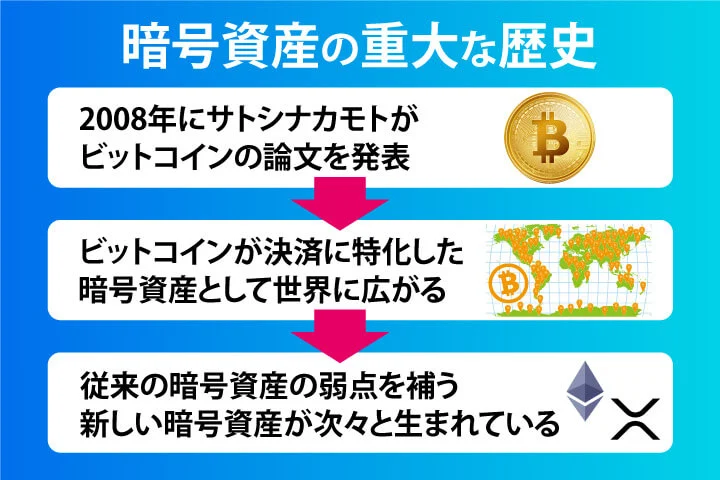
In October 2008, an individual or group operating under the pseudonym Satoshi Nakamoto published a whitepaper titled "Bitcoin: A Peer-to-Peer Electronic Cash System." This document proposed a solution to the "double-spending problem" without relying on a central authority. On January 3, 2009, the Bitcoin network went live with the mining of the "genesis block." Initially, Bitcoin was viewed as a medium of exchange for peer-to-peer transactions, aiming to provide financial sovereignty to individuals.
2015: The Advent of Programmable Money
While Bitcoin proved that digital scarcity and decentralized transfers were possible, its scripting language was intentionally limited for security reasons. In 2015, Vitalik Buterin and a team of developers launched Ethereum. This marked the second generation of crypto assets by introducing "smart contracts"—self-executing contracts with the terms of the agreement directly written into lines of code. Ethereum transformed crypto assets from simple "digital gold" into a programmable platform for decentralized applications (dApps), decentralized finance (DeFi), and non-fungible tokens (NFTs).

2020–Present: The Rise of High-Performance Blockchains
As Ethereum grew in popularity, the network faced significant congestion, leading to slow transaction speeds and exorbitant "gas fees" (transaction costs). This created a market gap for "Layer 1" competitors, often dubbed "Ethereum Killers." Among the most prominent is Solana (SOL), launched in 2020. Solana utilized a unique consensus mechanism called Proof of History (PoH) to achieve speeds of up to 65,000 transactions per second at a fraction of a cent per transaction. However, this era also highlighted the "blockchain trilemma"—the difficulty of achieving decentralization, security, and scalability simultaneously—as high-speed networks like Solana occasionally faced stability and security trade-offs compared to the more battle-tested Ethereum.
Comparative Data: Market Volatility and Performance
One of the most significant barriers to the mainstream adoption of crypto assets as a stable store of value is their extreme price volatility. When compared to traditional stock indices, such as Japan’s Nikkei 225, the price action of crypto assets is characterized by aggressive "boom and bust" cycles.
Data analyzing the five-year period between 2018 and 2023 reveals a stark contrast in market behavior. For instance, Bitcoin experienced a cumulative growth of approximately 498% during certain intervals, characterized by steep, mountain-like peaks and deep valleys. In contrast, the Nikkei 225, while influenced by global events such as the 2020 COVID-19 pandemic, maintained a relatively smoother trajectory. While the Nikkei 225 might fluctuate by 1-2% in a typical day, it is not uncommon for major crypto assets to swing 10-20% within the same timeframe.
This volatility is driven by several factors, including the relatively small market capitalization of crypto assets compared to global equity markets, the influence of speculative retail trading, and the lack of traditional valuation metrics. For investors, this means that while the potential for high returns is substantial, the risk of significant capital loss is equally prevalent, necessitating a strategy that involves only "surplus funds" rather than essential savings.
Critical Risks and Operational Challenges
The decentralized nature of crypto assets necessitates a "self-custody" mindset, which introduces risks that do not exist in the traditional banking sector. Professional analysts and regulatory bodies highlight three primary areas of concern for participants in the Web3 ecosystem.
1. Irreversible Remittance Errors
In a traditional bank transfer, a mistake in the recipient’s account number can often be rectified through a "request for reversal" (kumimodoshi) facilitated by the bank. In the world of crypto assets, transactions are processed via alphanumeric strings known as "addresses." If a user sends funds to an incorrect address or uses the wrong blockchain network (e.g., sending Bitcoin to an Ethereum address), the assets are typically lost forever. There is no central help desk or "undo" button. Industry experts recommend a "copy-paste" approach and performing small "test transactions" before moving significant sums.

2. Systematic Fraud and Social Engineering
The complexity and novelty of crypto assets make them a fertile ground for scams. Regulatory agencies, such as Japan’s Consumer Affairs Agency (CAA), have issued numerous warnings regarding fraudulent schemes. Common tactics include:
- Direct Message (DM) Scams: Fraudsters posing as "successful investors" on social media platforms like X (formerly Twitter) or Instagram, promising guaranteed monthly returns.
- Initial Investment Fraud: Encouraging victims to "invest" large sums in unknown or fake tokens that cannot be liquidated.
- Phishing: Creating fake exchange websites to steal a user’s private keys or "seed phrases."
The CAA emphasizes that there is "no such thing as a guaranteed profit" in crypto assets. Any solicitation promising "absolute" returns is a hallmark of a fraudulent operation.

3. Security vs. Scalability Trade-offs
Investors must also navigate the technical health of the assets they hold. While Ethereum is praised for its high security and decentralization, its high costs make it impractical for micro-transactions. Conversely, while Solana offers low fees and high speed, its history of network outages suggests a higher operational risk. Understanding these trade-offs is essential for anyone looking to utilize crypto assets beyond mere speculation.
Official Responses and Regulatory Frameworks
Governments and financial regulators have moved swiftly to bring order to the crypto market. In Japan, the Financial Services Agency (FSA) requires all crypto asset exchange service providers to be registered and to comply with strict Anti-Money Laundering (AML) and Know Your Customer (KYC) protocols. These regulations are designed to protect consumers from exchange collapses—similar to the Mt. Gox or FTX incidents—by requiring the segregation of customer assets from company assets.
Despite these protections, regulators continue to stress that crypto assets are not legal tender. Their value is not guaranteed by any government or central bank, and they remain subject to the whims of market demand. The official stance of most developed economies is one of "cautious innovation": encouraging the development of blockchain technology while maintaining a rigorous defensive posture against financial crime and consumer exploitation.
Broader Impact and Future Implications
The integration of crypto assets into the global economy extends far beyond simple trading. We are entering a phase of "Tokenization," where real-world assets—such as real estate, fine art, and intellectual property—are represented as digital tokens on a blockchain. This process increases liquidity and allows for fractional ownership, potentially democratizing access to previously exclusive investment classes.

Furthermore, the role of "Tokens" in Web3.0 governance is becoming increasingly important. Decentralized Autonomous Organizations (DAOs) use crypto assets to grant voting rights to community members, allowing for a more democratic form of corporate and project management. As these use cases mature, the focus is likely to shift away from the "price" of Bitcoin and toward the "utility" of the underlying networks.
In conclusion, while the world of crypto assets offers a glimpse into the future of a borderless, 24/7 financial system, it remains a "frontier market" fraught with volatility and technical pitfalls. Education is the most effective tool for risk mitigation. By understanding the history of these assets, the mechanics of blockchain technology, and the stringent warnings issued by regulatory bodies, individuals can navigate the Web3.0 era with a balance of innovation and prudence. The next evolution of this space will likely involve the refinement of "Tokens," a topic that continues to define the boundary between traditional finance and the decentralized future.