

The annual retail phenomenon known as Black Friday may still be weeks away, but the competitive landscape of the consumer electronics and additive manufacturing market has forced early market entries. Leading 3D printing manufacturer Bambu Lab has officially launched its comprehensive holiday sales campaign, bypassing traditional retail constraints by opening its promotional storefront well in advance. The early-bird event, scheduled to run through December 1, offers substantial price reductions across several of the company’s most advanced multicolour 3D printing systems and hardware bundles.
As consumer interest in high-speed, consumer-accessible additive manufacturing continues to grow, manufacturers are increasingly using early promotional windows to capture market share before the traditional November retail rush. Bambu Lab’s proactive strategy places a strong emphasis on its ecosystem-based products, specifically targeting hobbyists, professional designers, and small-scale manufacturing enterprises looking to upgrade their prototyping capabilities without paying full retail price.
Main Facts of the Early Sales Event
At the center of Bambu Lab’s early Black Friday promotions is a series of targeted price cuts on some of the brand’s flagships. The promotional lineup ranges from entry-level consumer models to heavy-duty, professional-grade systems equipped with advanced material handling capabilities.
Among the standout offers is the Bambu Lab P2S bundle, which has seen its price reduced from $749 down to $649. This fully enclosed printing system features a standard build volume of 256 by 256 by 256 millimeters and is packaged alongside the AMS 2 Pro (Automatic Material System) unit. The integrated hardware not only automates the seamless transition between multiple filaments for complex multicolour jobs, but also functions as an active filament dryer, addressing one of the most common challenges in consumer 3D printing: moisture degradation of hygroscopic polymers.
In addition to the P2S, Bambu Lab has applied significant discounts to its more advanced hardware tiers, notably the X2D and the heavy-duty industrial-class H2C systems. These price adjustments are designed to appeal to distinct segments of the user base, ranging from creative professionals requiring specialized material support to high-volume production studios seeking to eliminate traditional manufacturing bottlenecks.
Chronology and Market Context of the Black Friday Shift
The traditional Black Friday timeline—historically confined to the final Friday of November following the American Thanksgiving holiday—has steadily evolved over the past decade. Driven by supply chain shifts, intense e-commerce competition, and changing consumer habits, the retail window has steadily crept backward into early November and late October.
Bambu Lab’s decision to launch its sales campaign well ahead of the traditional shopping peak reflects a broader industry trend. By initiating promotions early, hardware manufacturers can smooth out logistics, ease warehouse fulfillment pressures, and capture early holiday budgets before consumers commit funds to competing consumer electronics, such as gaming consoles, smartphones, and domestic appliances.
The current hardware generation on sale represents a major maturity milestone for desktop additive manufacturing. Only a few years ago, multicolour 3D printing required complex, error-prone multi-extruder setups or manual filament swaps that often resulted in high failure rates and excessive material waste. The introduction of automated spool management systems, artificial intelligence-driven error detection, and rapid nozzle-switching technology has transformed the market, turning what was once a niche enthusiast pursuit into a reliable tool for rapid prototyping and small-batch production.
Detailed Breakdown of Promotional Hardware Tiers
Evaluating the hardware options within Bambu Lab’s discounted lineup requires an understanding of how each machine serves different operational demands, environmental constraints, and material requirements. Industry analysts and product reviewers have categorized the three primary discounted systems based on user capability and intended application.
The Bambu Lab P2S: The Consumer Benchmark
Positioned as the optimal choice for the vast majority of users, the P2S delivers out-of-the-box multicolour capability via the AMS 2 Pro unit. It is engineered to process engineering-grade polymers such as ABS and ASA safely within a fully enclosed chassis. However, industry experts note certain hardware limitations: the machine relies on a single-nozzle architecture and lacks active chamber heating. Despite these constraints, its $140 price advantage over the mid-tier X2D makes it the most cost-effective entry point for enthusiasts transitioning from single-color printing to complex multicolour workflows.
The Bambu Lab X2D: Precision Support and Thermal Control
For users requiring greater material versatility, the X2D introduces key structural enhancements. Maintaining a comparable build volume to the P2S, the X2D incorporates active chamber heating capable of reaching 65 degrees Celsius, alongside a dual-nozzle or secondary auxiliary nozzle system. This configuration makes it particularly effective for prints that utilize dedicated, soluble support materials—such as PVA or HIPS—which must be dissolved post-printing to preserve intricate internal geometries. While the auxiliary nozzle supports a narrower range of filament types compared to the primary extruder, the thermal management improvements offer superior reliability when printing warp-prone engineering plastics.
The Bambu Lab H2C: Industrial-Grade Performance
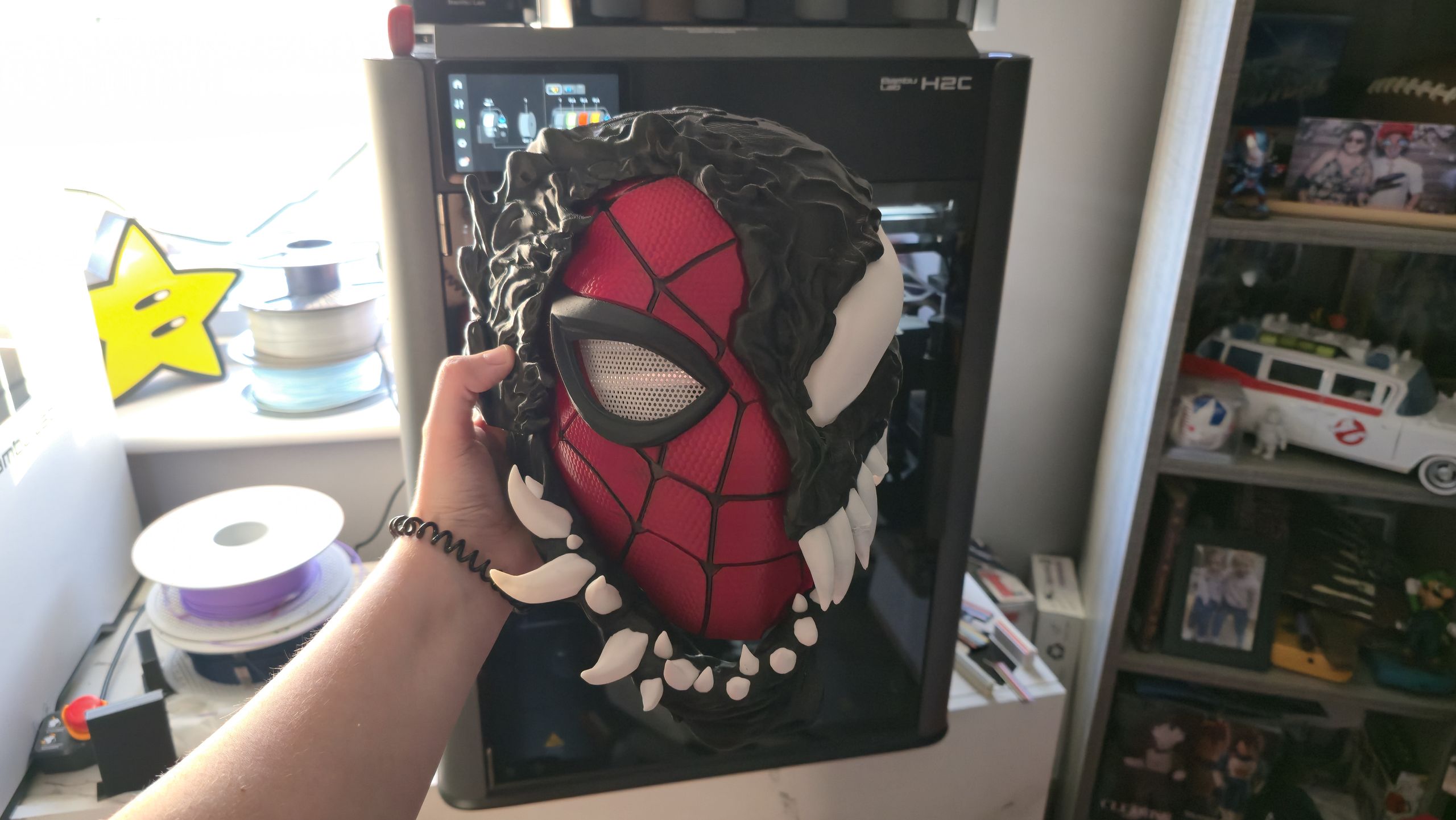
At the pinnacle of the current hardware hierarchy sits the H2C, a machine targeted squarely at commercial enterprises, product design agencies, and small manufacturing bureaus where throughput directly correlates with revenue. Priced significantly higher than consumer models and weighing an imposing 32.5 kilograms—more than double the weight of the P2S—the H2C is built for heavy, continuous operation.
The defining technological advancement of the H2C is its sophisticated hotend-swapping mechanism. Traditional multicolour systems purge substantial amounts of filament during color transitions to prevent cross-contamination in the melt zone, leading to significant material waste and extended print times. The H2C’s mechanical design dramatically reduces purge waste and accelerates transition phases. Independent testing data indicates that complex, multi-day print jobs requiring extensive color changes can have their total production times slashed by upwards of 65 percent when migrated from older-generation hardware to the H2C.
Broader Industry Implications and Economic Analysis
The aggressive discounting of advanced additive manufacturing hardware highlights a broader commoditization of consumer-grade robotics and 3D printing technology. As core mechanics, motion control systems, and slicing software become increasingly standardized, manufacturers must differentiate their products through software integration, material management ecosystems, and post-processing automation.
The inclusion of AI-powered error detection across these discounted models illustrates a vital shift toward autonomous manufacturing. Historically, the high failure rate of long-duration 3D prints—often caused by layer shifting, filament tangles, or adhesion failure hours into a job—served as a primary deterrent for enterprise adoption. By embedding computer vision and real-time diagnostic sensors into mid-tier and high-end machines, manufacturers are successfully lowering the operational risk associated with additive manufacturing.
Furthermore, the integration of active filament drying directly into automated material systems like the AMS 2 Pro points to a growing recognition that hardware reliability depends heavily on environmental control. Filament degradation caused by atmospheric humidity has long been a hidden variable affecting print quality; automating this mitigation process reduces user error and drives higher success rates across both amateur and professional sectors.
Consumer Guidance: Selecting the Right System
For prospective buyers navigating the early Black Friday landscape, decision-making should be guided by specific operational demands rather than raw feature lists. Industry analysts recommend evaluating three primary criteria: frequency of multicolour use, chemical requirements of intended print materials, and production volume.
- Casual Users and Enthusiasts: For those pursuing artistic projects, tabletop gaming miniatures, and general household prototyping, the P2S bundle offers an exceptional balance of capability and cost savings. Its integration with the AMS 2 Pro satisfies the vast majority of multicolour aesthetic requirements without incurring the capital expenditure of industrial machines.
- Advanced Makers and Engineering Prototypers: Users regularly working with industrial thermoplastics that demand stringent thermal control—or those requiring complex geometries supported by dissolvable interfaces—will find the thermal management and auxiliary hardware of the X2D a worthwhile investment.
- Commercial Operations and Production Studios: Businesses where printer downtime translates directly to lost revenue should evaluate the H2C. Despite its higher initial cost and substantial physical footprint, the reduction in material purge waste and the dramatic acceleration of multi-color build times provide a clear return on investment for high-throughput environments.
As the broader retail market edges closer to the traditional November 28 Black Friday date, industry watchers anticipate that competing 3D printing brands—including Creality, Prusa Research, and AnkerMake—will roll out matching or aggressive counter-promotions. However, Bambu Lab’s early entry establishes a high benchmark for hardware value, signaling that the consumer additive manufacturing sector remains highly competitive and primed for consumer-friendly pricing throughout the holiday season.
