Mutsamudu, Comoros — September 28, 2026 — In a significant development for automated and AI-driven trading, digital asset trading platform MEXC announced the global release of MEXC CLI today. The newly introduced command-line interface is engineered to connect users’ proprietary artificial intelligence agents directly to the exchange’s infrastructure. By streamlining the pathway from strategic ideation to market execution, the tool aims to eliminate traditional operational bottlenecks that have historically forced investors to manually bridge the gap between analytical discovery and order placement.
The launch underscores a broader industry shift toward agentic workflows. While artificial intelligence has firmly established its utility in market research, sentiment analysis, and backtested strategy generation, a persistent friction point has remained: the translation of insights into live trades. Previously, investors utilizing AI models for research were required to manually copy parameters, construct API requests, or switch between distinct application interfaces to execute orders. MEXC CLI seeks to resolve this inefficiency by enabling native, natural-language interaction within established AI environments, allowing agents to directly invoke MEXC functionalities while preserving critical risk-management checkpoints.
The Mechanics of MEXC CLI
At its core, MEXC CLI packages complex application programming interface (API) access into a streamlined command-line environment optimized for AI integration. Once installed and configured, users can converse with their AI agents in natural language to perform a wide spectrum of tasks. These include retrieving granular market data, reviewing historical trading performance, auditing account asset balances, and preparing or executing orders.
Despite the high degree of automation facilitated by the tool, MEXC has emphasized security and user control. Key trading actions require explicit confirmation before execution, ensuring that autonomous agents cannot execute unauthorized or unverified market maneuvers. At launch, the command-line utility supports a diverse array of financial instruments and platform features, encompassing spot trading, derivatives futures, wealth management products, and platform activities. This multi-asset compatibility ensures that users operating across different market segments can leverage their AI agents uniformly.
Integration with the Broader MEXC AI Ecosystem
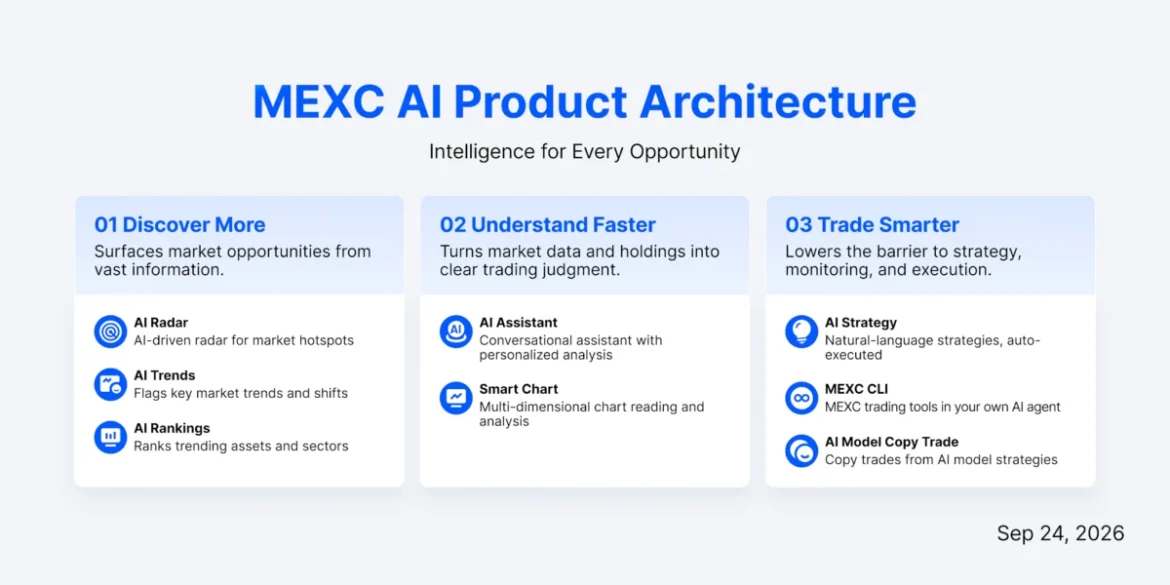
The introduction of MEXC CLI represents a critical milestone in the ongoing expansion of MEXC AI, a suite of intelligent tools governed by the philosophy of providing intelligence for every opportunity. The exchange’s overarching vision positions AI not merely as an isolated analytical dashboard, but as a continuous trading companion that accompanies users through every phase of the financial lifecycle: discovery, understanding, and execution.
Prior to the release of MEXC CLI, the MEXC AI ecosystem focused predominantly on the analytical and discovery phases. Existing platform capabilities include AI Rankings, AI Trends, and Smart Chart tools designed to surface emerging opportunities and decode complex market movements. Additionally, features such as AI Strategy enable users to translate conversational trading hypotheses into operational parameters, subject to manual review and activation, while AI Model Copy Trade allows participants to mirror established algorithmic behaviors.
By introducing MEXC CLI, the platform bridges the divide between these analytical utilities and the execution layer. The tool extends the ecosystem directly into third-party AI environments preferred by advanced traders and developers, transforming passive intelligence into active, agentic engagement.
Contextualizing the Launch: The Rise of Agentic Trading
The deployment of MEXC CLI arrives amid a rapidly accelerating trend toward agentic artificial intelligence within financial markets. Over the past several years, Large Language Models (LLMs) and autonomous agents have transitioned from experimental novelties into core infrastructure for quantitative and retail traders alike. Industry analysts note that while institutional trading desks have long relied on algorithmic execution, retail and semi-professional investors have often been bottlenecked by the technical complexity of connecting custom code to exchange APIs.

By lowering the technical barriers to entry, tools like MEXC CLI democratize access to high-frequency and automated workflows. Users no longer need extensive software engineering backgrounds to construct custom pipelines that feed real-time exchange data into their local AI models or execute programmatic trades based on localized sentiment analysis. This democratization is expected to foster a surge in bespoke, localized trading agents tailored to individual risk appetites and strategic frameworks.
Concurrently, MEXC is reinforcing this technological rollout through targeted marketing and experiential campaigns. The exchange is currently running its Trading Takes Two campaign, which highlights the symbiotic relationship between human decision-making and artificial intelligence across various market cycles. Furthermore, MEXC has announced plans to debut an immersive MEXC AI Experience Zone at the upcoming TOKEN2049 conference in Singapore. The interactive installation is designed to demonstrate how artificial intelligence will govern future trading scenarios, offering attendees a firsthand look at advanced agentic interaction models.
Industry Implications and Market Impact
The intersection of generative AI and cryptocurrency exchanges carries profound implications for market liquidity, execution speed, and retail participation. Historically, retail traders operated at a structural disadvantage compared to institutional entities equipped with proprietary execution algorithms and low-latency API connections. By embedding direct agentic connectivity into a zero-fee trading environment, platforms like MEXC are actively flattening the technological playing field.
However, financial technologists and security experts also highlight the inherent risks associated with increased automation. As AI agents gain the capability to interact directly with financial accounts, robust authentication, strict rate-limiting, and mandatory multi-factor authorization protocols become paramount. MEXC’s implementation of mandatory user confirmations for key trading actions represents an industry-standard safeguard designed to mitigate the risks of "hallucinations" or unintended cascading liquidations driven by autonomous software.
Market observers anticipate that the success of MEXC CLI will prompt competing digital asset exchanges to accelerate their own developer tooling and AI integration roadmaps. As the boundaries between chat-based interfaces and execution terminals continue to dissolve, the future of trading software is increasingly pointing toward conversational, agent-driven ecosystems.
About MEXC
Established in 2018, MEXC operates as a global multi-asset trading platform designed to serve as a gateway to digital and traditional financial markets. Catering to an international user base spanning more than 170 countries and territories, the exchange provides efficient access to a comprehensive suite of financial instruments, including digital assets, equities, tokenized real-world assets, and derivatives through a unified account structure.
Operating under a zero-fee trading model for spot transactions, MEXC combines deep market liquidity with high-performance execution architecture to support retail and professional investors. As the financial landscape undergoes a structural convergence between decentralized crypto markets and traditional financial systems, the platform remains focused on reducing operational friction, enhancing global asset accessibility, and empowering users to capitalize on emerging market opportunities.
Risk Disclaimer
This article is provided for informational purposes only and does not constitute financial, investment, or trading advice. Digital assets, tokenized instruments, and derivatives involve a high degree of market volatility and financial risk. Investors and traders should conduct independent research, evaluate their personal risk tolerance, and consult with qualified financial professionals before engaging in any trading or investment activities.