• Home
Crypto Gohan
keep your memories alive
DeFi (Decentralized Finance)

Referrals Are Live: Refer & Earn on Synthetix

by Nana Muazin July 19, 2026
written by Nana Muazin

Synthetix, a leading decentralized synthetic asset protocol, has officially launched its comprehensive referral program, enabling users to actively participate in the platform’s growth while earning significant rewards. This strategic initiative allows existing users to generate and share unique referral codes, earning a substantial 25% share of the trading fees generated by every new user who signs up using their code. Simultaneously, referred individuals benefit from an immediate 5% discount on all their trading fees, a benefit automatically applied upon account creation. This dual incentive structure is designed to foster community expansion, enhance platform liquidity, and solidify Synthetix’s position as a premier venue for perpetual futures trading on Ethereum Mainnet.

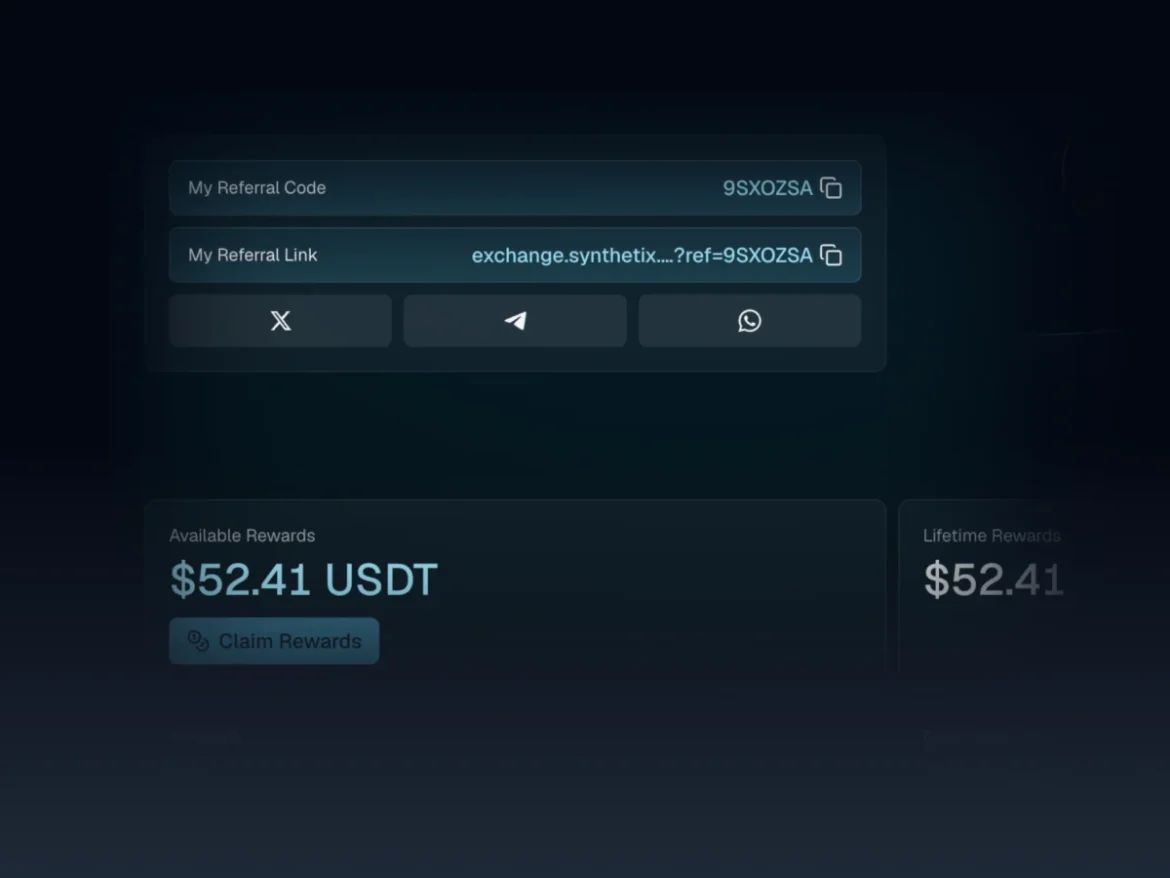
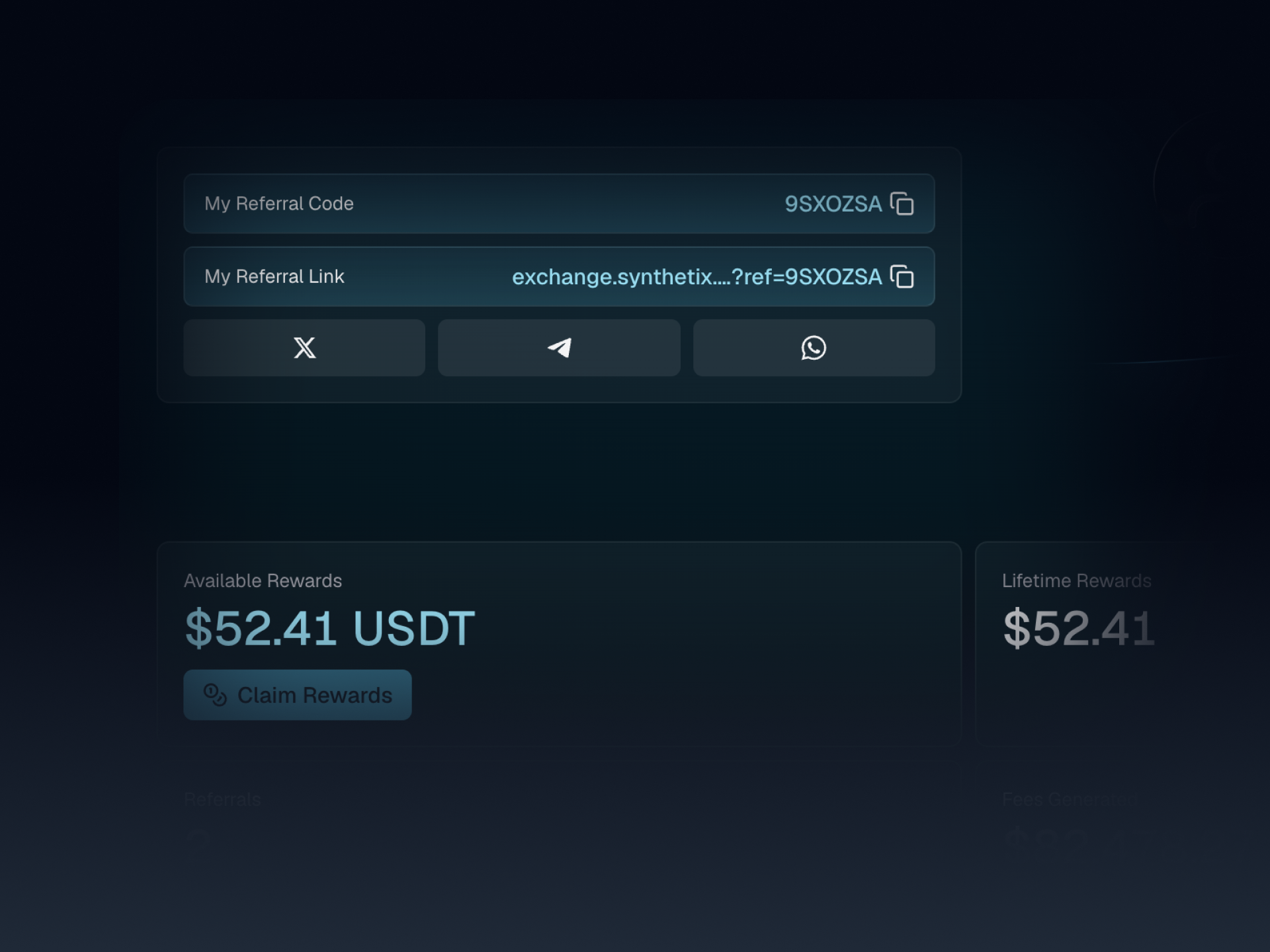
The program’s launch marks a significant step in Synthetix’s ongoing efforts to democratize access to sophisticated financial instruments within the decentralized finance (DeFi) ecosystem. Rewards for referrers are accrued daily, offering a continuous income stream that scales directly with the trading activity of their referred network. This persistent earning potential is a key differentiator, moving beyond one-time bonuses to cultivate long-term engagement and loyalty. The seamless integration of the referral dashboard within the main Synthetix user interface, specifically under the portfolio tab, ensures accessibility and transparency. Users can effortlessly monitor their total available rewards, track the number of active referees, view their lifetime earnings, and assess the aggregate fees generated by their network, providing a comprehensive overview of their referral program performance.

Deep Dive into the Referral Mechanics

At its core, the Synthetix referral program is engineered for simplicity and maximum user benefit. Referrers initiate their participation by navigating to the dedicated referrals page within their Synthetix portfolio. Here, they can generate a unique referral code, which serves as their personalized invitation link. When this link is shared and utilized by a new user during the account creation process, a direct and immutable link is established between the referrer and the referee. It is crucial to note that referral codes are exclusively applicable at the point of account creation and cannot be retroactively added to existing accounts. This requirement underscores the importance of sharing the referral link before potential users complete their signup process, ensuring they can immediately avail themselves of the 5% trading fee discount.

The financial incentive for referrers, set at 25% of all trading fees generated by their referees, is a highly competitive rate within the DeFi space. This percentage is not merely a promotional gimmick but a robust mechanism for distributing protocol value back to its most active community members. As referees engage in trading activities—whether it’s perpetual futures, spot synthetic assets, or other derivatives offered on Synthetix—a portion of their transaction fees is automatically allocated to the referrer. This daily accrual system provides consistent feedback to referrers, illustrating the tangible benefits of their outreach efforts and encouraging ongoing promotion of the platform.

For new users, the immediate 5% reduction on trading fees represents a tangible benefit that lowers the barrier to entry and improves the overall cost-efficiency of their trading operations. In a market where trading fees can significantly impact profitability, especially for frequent traders or those executing larger volumes, a permanent 5% discount offers a distinct advantage. This mutual benefit model—where referrers earn a substantial commission and referees enjoy reduced costs—creates a powerful network effect, encouraging organic growth and widespread adoption.
Referrals Are Live: Refer & Earn on Synthetix

The Strategic Rationale: Why Referrals in DeFi?

The introduction of a robust referral program by Synthetix is not merely a feature update but a strategic move aimed at addressing several critical aspects of growth and sustainability within the competitive decentralized finance landscape. User acquisition remains a paramount challenge for all blockchain protocols, especially those operating in the complex derivatives sector. Referral programs have historically proven to be highly effective, low-cost marketing channels that leverage existing user networks and trust.

In the context of DeFi, where community trust and shared incentives are foundational, a well-designed referral program can:

  1. Amplify User Growth: By incentivizing existing users to onboard new participants, Synthetix taps into a vast, often untapped, network of potential traders who are more likely to trust a recommendation from a peer than traditional advertising.
  2. Enhance Liquidity: More active traders translate directly into increased trading volume and deeper liquidity pools, which are vital for a derivatives platform. Higher liquidity reduces slippage and improves price execution, making the platform more attractive to larger traders.
  3. Strengthen Community Engagement: The program transforms passive users into active promoters, deepening their engagement with the Synthetix ecosystem. Earning passive income through referrals creates a vested interest in the protocol’s success.
  4. Competitive Differentiation: In a crowded market of decentralized exchanges (DEXs) and derivatives platforms, offering compelling incentives like a 25% fee share and a 5% discount can serve as a powerful differentiator, attracting users away from competitors.
  5. Cost-Effective Marketing: Compared to traditional marketing campaigns that can be expensive and yield unpredictable results, referral programs offer a performance-based model where rewards are paid out only when tangible value (new users, trading volume) is generated.

This initiative aligns perfectly with Synthetix’s stated goal of making "Ethereum Mainnet the premier venue for perps." By expanding its user base and fostering a more vibrant trading environment, the protocol reinforces its commitment to providing a robust and accessible platform for decentralized perpetual futures.

Synthetix: A Brief Overview and Its Role in DeFi

To fully appreciate the significance of this referral program, it’s essential to understand Synthetix’s foundational role in the DeFi ecosystem. Launched in 2017, Synthetix is a decentralized protocol built on the Ethereum blockchain that enables the creation and trading of synthetic assets (Synths). These Synths are collateralized by the protocol’s native token, SNX, and track the price of real-world assets like fiat currencies, commodities, cryptocurrencies, and even inverse assets. This allows users to gain exposure to a wide range of assets without actually holding them, leveraging the benefits of blockchain transparency and censorship resistance.

Over time, Synthetix has evolved significantly, particularly in its focus on decentralized perpetual futures (perps). Perpetual futures contracts are a type of derivative that allows traders to speculate on the future price of an asset without an expiration date. Synthetix offers a robust infrastructure for trading these perps, providing deep liquidity and advanced trading features through its integration with various front-end interfaces. The protocol’s architecture, which includes a sophisticated oracle system for price feeds and a robust liquidation mechanism, ensures fair and efficient trading.

The protocol operates under a decentralized governance model, where SNX token holders can propose and vote on significant upgrades and changes, reflecting a commitment to community-driven development. This emphasis on decentralization extends to its operational mechanisms, ensuring that the platform remains permissionless and resilient. The new referral program, therefore, is not just a commercial strategy but also a community-centric initiative that empowers its users to become active participants in its growth and success.

Referrals Are Live: Refer & Earn on Synthetix

The Snaxpot Integration: Amplifying Incentives

Adding another layer of compelling incentive, Synthetix has seamlessly integrated its referral program with the existing Snaxpot lottery system. This innovative feature ensures that all trading fees generated on Synthetix, including those contributed by referred users, automatically convert into Snaxpot Tickets. Each ticket represents one entry into a rolling, weekly draw that boasts a substantial top prize of $500,000.

This integration creates a powerful synergistic effect:

  • For Referrers: Not only do they earn 25% of their referees’ trading fees directly, but those same fees also generate Snaxpot tickets, increasing their chances of winning the weekly lottery. This means their passive income stream is augmented by a chance at a significant windfall.
  • For Referees: Their trading activity, even with the 5% discount, still contributes to Snaxpot tickets, giving them an opportunity to win the $500,000 prize. This adds an element of excitement and potential upside beyond just efficient trading.

The Snaxpot mechanism transforms every trade into a potential lottery entry, injecting an element of gamification into the trading experience. This constant opportunity to win a substantial prize acts as a powerful motivator for sustained trading activity, benefiting both the individual trader and the overall liquidity of the Synthetix protocol. The transparency of a blockchain-based lottery, where ticket generation and prize distribution can be publicly verified, further builds trust in the fairness of the system. This combination of direct financial rewards and a high-stakes lottery creates a multi-faceted incentive package designed to attract and retain a diverse range of traders.

Implementation and User Experience

The user experience for participating in the Synthetix referral program has been designed with simplicity and efficiency in mind. Upon logging into the Synthetix user interface, users can easily locate the "Referrals" section within their "Portfolio" tab. This dedicated dashboard provides a comprehensive overview of their referral activities and earnings.

Key features of the referral dashboard include:

  • Total Rewards Available: A clear display of the current amount of rewards that can be claimed.
  • Number of Referees: A counter showing how many individuals have successfully signed up using the referrer’s code.
  • Lifetime Rewards: A cumulative total of all earnings generated through the referral program since its inception.
  • Total Fees Generated by Referees: A transparent metric indicating the aggregate trading fees contributed by the referrer’s network, from which their 25% share is derived.

The process of generating and sharing a referral code is intuitive, typically involving a single click. The platform provides a shareable link that automatically embeds the referral code, simplifying the onboarding process for new users. This streamlined approach minimizes friction, encouraging wider participation and ensuring that users can focus on trading and earning, rather than navigating complex administrative procedures. The real-time updates on the dashboard provide immediate feedback, reinforcing the value of their referral efforts and fostering a sense of progress.
Referrals Are Live: Refer & Earn on Synthetix

Broader Market Context and Competitive Edge

The launch of Synthetix’s referral program comes at a time of intense competition within the DeFi sector, particularly among platforms offering derivatives trading. Centralized exchanges (CEXs) have long leveraged referral programs to drive user acquisition, often offering similar fee-sharing models. However, Synthetix’s decentralized nature provides a distinct advantage. Users benefit from the transparency, censorship resistance, and self-custody that DeFi offers, combined with competitive incentives typically associated with centralized platforms.

Compared to other decentralized exchanges (DEXs), Synthetix’s program stands out due to the generous 25% fee share for referrers and the perpetual 5% discount for referees. Many DEXs offer either lower percentages or time-limited promotions. Furthermore, the integration with Snaxpot, offering a chance at a $500,000 weekly prize, adds a layer of gamified incentive that is largely unique in the DeFi derivatives space. This multi-pronged approach to incentives positions Synthetix as a highly attractive platform for both experienced traders and newcomers to the decentralized world.

The focus on "perps on Ethereum Mainnet" is also a strategic decision. While many derivatives protocols have migrated to layer-2 solutions or alternative blockchains for scalability, Synthetix’s commitment to Ethereum Mainnet, combined with its ongoing efforts to optimize performance and reduce gas costs, aims to provide a secure and robust trading environment that leverages Ethereum’s unparalleled security and network effects. The referral program is instrumental in drawing more attention and liquidity to this core offering.

Community and Governance Perspective

As a decentralized autonomous organization (DAO), Synthetix places significant emphasis on community involvement and governance. Initiatives like the referral program are often discussed and refined through community proposals (Synthetix Improvement Proposals or SIPs) and forums. While the original article does not detail the governance process for this specific launch, it is implicitly aligned with the DAO’s objective of fostering a self-sustaining and thriving ecosystem.

By empowering its users to become active participants in growth, the referral program reinforces the decentralized ethos of the protocol. It distributes value directly back to the community, rather than solely concentrating it within the protocol’s treasury or core development team. This approach can lead to a more resilient and engaged community, where users feel a greater sense of ownership and shared success. The transparency of rewards and the clear metrics available on the dashboard further build trust and accountability within the ecosystem.

Future Outlook and Implications

The launch of the Synthetix referral program is poised to have several significant implications for the protocol and the broader DeFi landscape. For Synthetix, it is expected to drive a substantial increase in user adoption, leading to higher trading volumes and deeper liquidity for its synthetic assets and perpetual futures. This, in turn, can enhance the protocol’s overall stability and efficiency, making it an even more attractive venue for institutional and sophisticated retail traders. The continuous feedback loop of daily reward accrual is likely to sustain user engagement and foster a loyal community of referrers.
Referrals Are Live: Refer & Earn on Synthetix

For the DeFi ecosystem, Synthetix’s innovative incentive model, combining direct fee sharing with a high-value lottery, could set a new benchmark for user acquisition strategies. Other protocols may look to emulate or adapt similar multi-layered incentive structures to compete for user attention and liquidity. This constant innovation in incentive design is crucial for the continued evolution and mainstream adoption of decentralized finance.

Ultimately, the referral program serves as a testament to Synthetix’s commitment to building a user-centric and growth-oriented platform. By providing compelling reasons for users to not only trade but also to actively promote the protocol, Synthetix aims to solidify its position as a leading innovator in the decentralized derivatives market.

Users interested in leveraging this new opportunity can begin earning today by visiting the referrals section within their Synthetix portfolio: https://exchange.synthetix.io/portfolio/referrals. The Synthetix community encourages active participation and invites all interested parties to join the ongoing conversation and stay updated on platform developments through its official communication channels.

Follow Synthetix as it continues its mission to establish Ethereum Mainnet as the premier venue for perpetual futures trading.
Join the conversation: discord.gg/synthetix
Subscribe to Telegram: t.me/+v80TVt0BJN80Y2Yx
Follow on X: x.com/synthetix
July 19, 2026 0 comment
0 FacebookTwitterPinterestEmail
NFTs & Digital Collectibles

The Emergence of Southern American Sumi-e: Will Thompson Redefines Ink Art with Dark, Intricate Worlds

by Nana Wu July 19, 2026
written by Nana Wu

Will Thompson, known online as @The300ChickenNuggets, is a contemporary ink artist who has cultivated a distinctive style he terms "Southern American Sumi-e." This unique artistic approach marries the ancient Japanese ink wash technique with a distinctly Southern American sensibility, rendered with sumi and Diamine inks on Bristol vellum. Thompson’s work is characterized by its meticulous detail, achieved through fine brush strokes and a dense, encapsulating line work that imbues his pieces with a profound, dark aesthetic.

Originating from Georgia, Thompson’s path to art was not a direct one. He initially pursued legal studies, a trajectory that ultimately led him away from the courtroom and towards the vibrant, unconfined realm of artistic creation. His artistic methodology is a testament to his intellectual background and his creative spirit. He describes his technique as a "Self-Creating Prophecy," a deliberate yet spontaneous process where minute ticks and lines coalesce over time, slowly growing into compositions of significant depth and shadow. This approach, he explains, "balances intricate detail with a spontaneous, ADHD-fueled creativity," suggesting a conscious effort to harness a perceived neurological characteristic into a powerful artistic tool. This philosophy allows for a dynamic tension within his work, where controlled precision meets bursts of uninhibited expression.

Thompson’s artistic influences are as diverse as his technique. He draws significant inspiration from the speculative and imaginative landscapes of science fiction, as well as the intricate and often overlooked details of the natural world. This fusion results in artworks that are simultaneously whimsical and breathtakingly precise, inviting viewers into worlds that feel both alien and intimately familiar. The artist himself has presented four examples of his recent work, offering a glimpse into the breadth and depth of his evolving style. These pieces serve as focal points for understanding the power and complexity of his "Southern American Sumi-e."

This artist created a ‘Southern American sumi-e’ art style using sumi and Diamine ink on Bristol vellum

The "Space-time Mage": A Cosmic Encounter

One of Thompson’s featured works, "Space-time Mage," exemplifies his ability to evoke a sense of cosmic grandeur and solitary contemplation. The piece depicts a lone figure, a mage, cloaked in a striking teal, standing against a "violent purple void." This stark color palette immediately establishes a dramatic and otherworldly atmosphere. The mage is portrayed as "ancient, fearless and utterly consumed by what lies beyond," a description that hints at a narrative of profound cosmic awareness or a relentless pursuit of esoteric knowledge. The vastness of the void, rendered with Thompson’s signature fine lines and subtle gradations of ink, emphasizes the mage’s isolation and the immense scale of their quest. The use of sumi ink, known for its deep blacks and subtle tonal variations, is crucial here, allowing Thompson to create a sense of infinite space and the ethereal quality of the mage’s presence. The Bristol vellum surface provides a smooth, stable ground for the delicate yet precise linework, ensuring that every stroke contributes to the overall depth and atmospheric quality of the piece. This work, like many of Thompson’s, invites viewers to ponder themes of existence, the unknown, and the individual’s place within the vastness of the universe.

"Prey": A Huntress in Motion

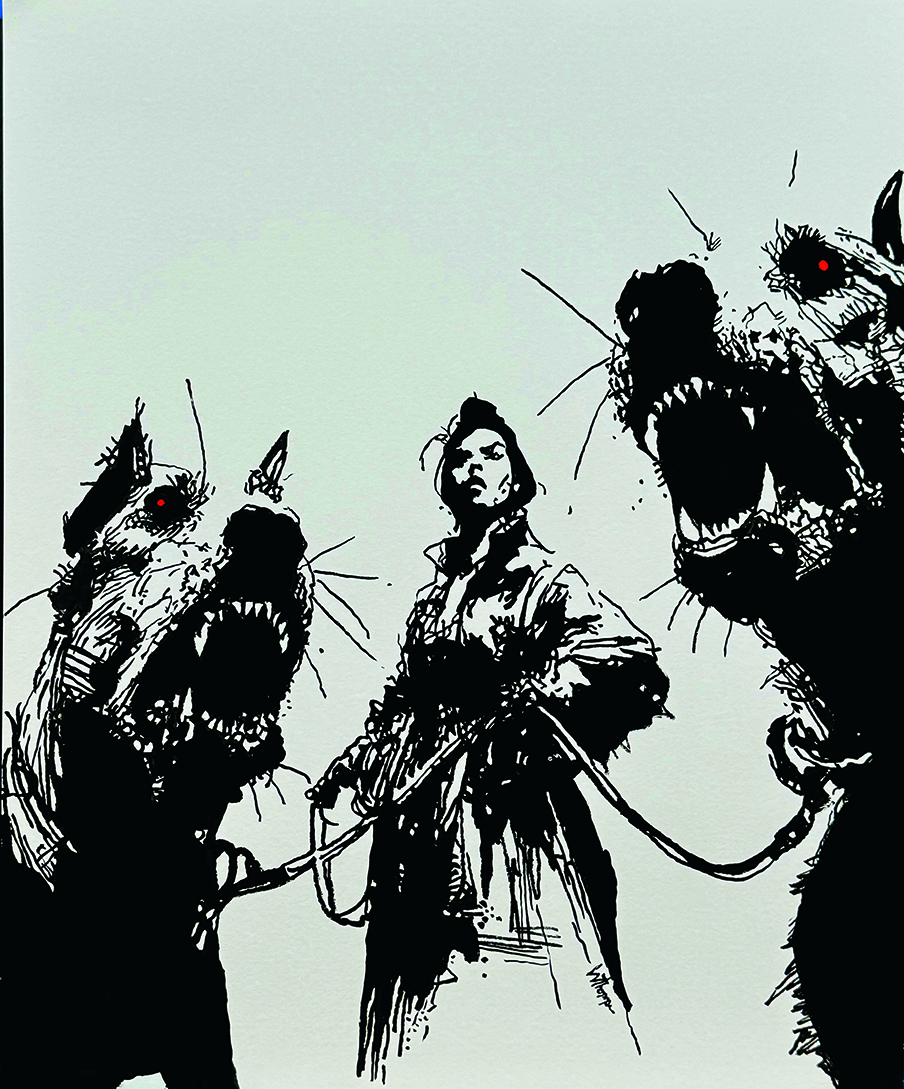
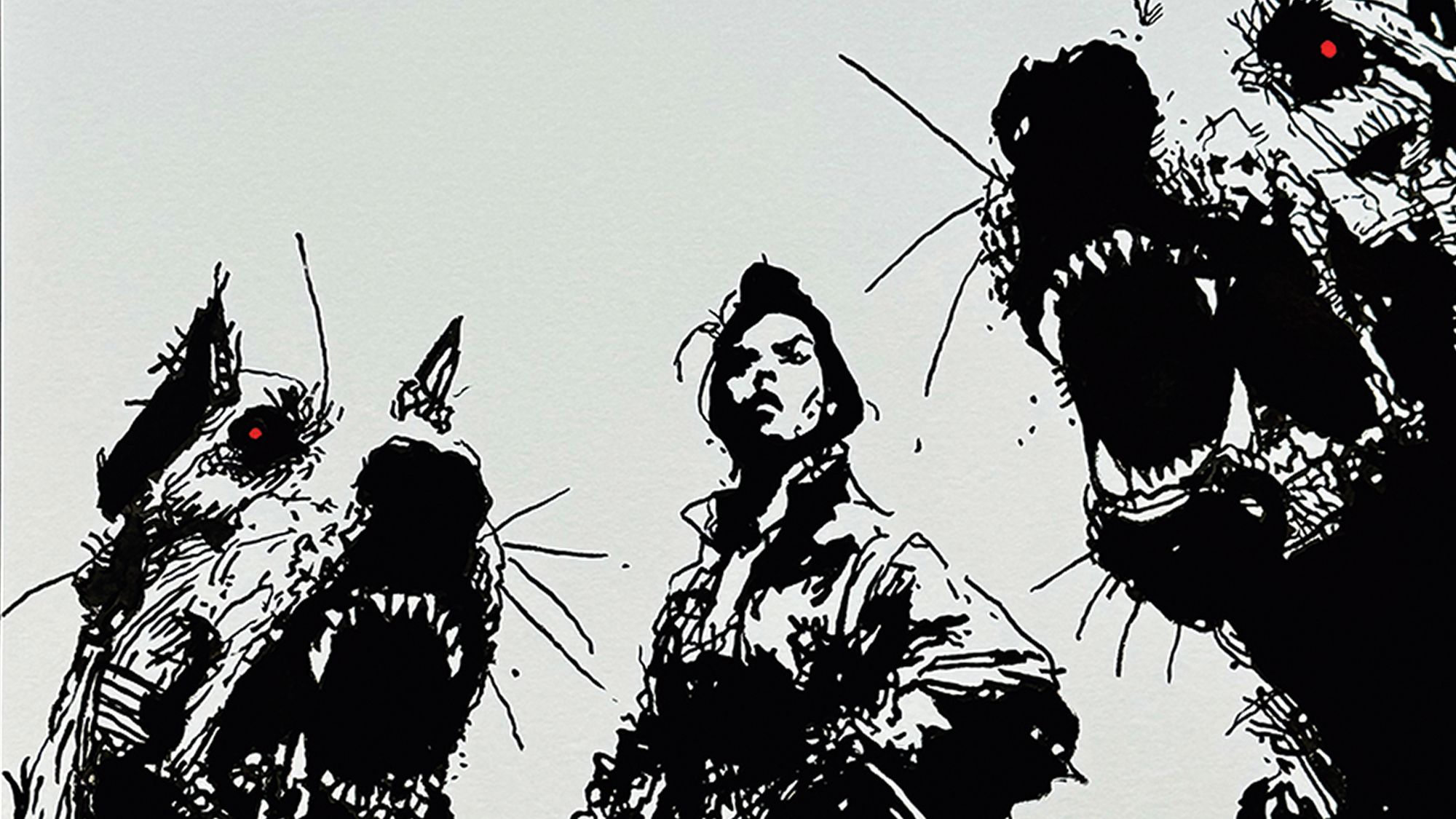
In "Prey," Thompson shifts focus to a more dynamic and visceral scene. The artwork features a formidable female figure, described as one who "doesn’t chase; she arrives." This assertion of power and inevitability is reinforced by the presence of "two beasts at her side, eyes burning red." The imagery suggests a moment of impending confrontation, where the prey has already been cornered. The burning red eyes of the beasts serve as a potent visual cue, signifying danger and predatory intent. Thompson’s linework here likely conveys a sense of coiled energy and controlled aggression, with the intricate details of the figures and their companions hinting at a rich backstory or a mythos yet to be fully revealed. The juxtaposition of the powerful huntress and her menacing companions against an implied, yet unseen, victim creates a palpable tension. The piece likely explores themes of power, dominance, and the primal instincts that drive both hunter and hunted. The "Southern American" aspect of his style might manifest in subtle cultural nods or an underlying ruggedness in the character design, a departure from more ethereal interpretations of such figures.

"Darkest Dungeon": Confronting Ruin and Resilience

"Darkest Dungeon" plunges the viewer into a scene of grim determination and overwhelming odds. The artwork portrays "a lone warrior" who is "consumed by shadow" and confronts "a ruined fortress looming overhead." This setting is rich with symbolism, evoking a sense of desolation, decay, and the immense challenges faced by those who dare to venture into such places. The "crumbling stone" of the fortress serves as a "warning," while each "step forward" by the warrior is an "act of defiance." Thompson’s skill in rendering textures, particularly the rough, weathered surfaces of the fortress, would be paramount in this piece. The interplay of light and shadow, achieved through careful application of sumi and Diamine inks, would likely emphasize the warrior’s isolation and the oppressive atmosphere of the scene. The description suggests a narrative of perseverance against seemingly insurmountable obstacles, a common theme in both folklore and modern storytelling. The "Southern American" influence could perhaps be interpreted through the stoicism and grit of the warrior, embodying a resilience often associated with certain Southern cultural archetypes.

"Malfeasance": The Embodiment of Destruction

The final featured piece, "Malfeasance," presents a terrifying embodiment of pure, unadulterated destructive force. Thompson describes the entity as having "no mercy, no pause, no hesitation." This is not a creature that stalks or strategizes; it "erupts, horns forward, eyes burning with the singular purpose of absolute destruction." The visual representation would undoubtedly be a powerful display of menacing form and aggressive intent. The "horns forward" suggest a direct, frontal assault, while the "burning eyes" communicate an intense, singular focus on annihilation. Thompson’s use of dark inks and sharp, dynamic lines would be essential in conveying this raw power and ferocity. The piece likely taps into archetypal fears of primal destruction and the forces that seek to obliterate. The "Southern American" element in this context might manifest in a certain raw, untamed energy or a connection to darker, more visceral folklore that is sometimes present in the region’s storytelling traditions.

This artist created a ‘Southern American sumi-e’ art style using sumi and Diamine ink on Bristol vellum

The Genesis and Evolution of Southern American Sumi-e

Will Thompson’s artistic journey, from law student to acclaimed ink artist, highlights a growing trend of individuals forging unique paths in the art world by blending diverse influences. The term "Southern American Sumi-e" itself is a significant marker of this innovation. Sumi-e, with its roots in Tang Dynasty China and its development in Japan, has traditionally been associated with themes of nature, Zen Buddhism, and a pursuit of spiritual enlightenment through art. Thompson’s recontextualization of this ancient practice within a Southern American framework is a bold and compelling statement.

The specific materials Thompson employs – sumi ink and Diamine ink on Bristol vellum – are critical to his distinctive aesthetic. Sumi ink, traditionally made from soot and animal glue, offers a depth of black that is unparalleled, allowing for subtle gradations and rich tonal variations. Diamine inks, known for their vibrant colors and diverse formulations, when used in conjunction with sumi, can introduce unexpected accents and enhance the overall mood of a piece. Bristol vellum, a heavy, smooth paper, provides an ideal surface for the fine, detailed linework that defines Thompson’s style. Its ability to withstand multiple layers of ink without buckling or feathering is essential for his meticulous process.

Thompson’s philosophy of a "Self-Creating Prophecy" and his embrace of "spontaneous, ADHD-fueled creativity" offer insight into his artistic process. In an era where many artists meticulously plan and execute their work with digital tools, Thompson’s reliance on traditional methods, combined with a mindset that embraces both control and a degree of controlled chaos, is particularly noteworthy. This approach allows for an organic development of his compositions, where the artwork seems to guide the artist as much as the artist guides the artwork. This can be seen as a modern interpretation of the spontaneous brushwork often celebrated in traditional Sumi-e, but infused with a contemporary understanding of neurodiversity and creative expression.

Influences and Inspirations: Sci-Fi and the Natural World

The dual influences of science fiction and the natural world are clearly articulated in Thompson’s body of work. Science fiction, with its capacity to explore speculative futures, alien landscapes, and complex ethical dilemmas, provides a rich source of thematic material. It allows Thompson to create fantastical creatures, otherworldly environments, and narratives that push the boundaries of imagination. This aligns with the often surreal and symbolic nature of traditional ink wash painting, which can be used to represent abstract concepts and emotional states.

This artist created a ‘Southern American sumi-e’ art style using sumi and Diamine ink on Bristol vellum

Simultaneously, his engagement with the natural world grounds his fantastical creations. The intricate patterns of leaves, the textures of bark, the forms of animals – these elements, observed closely, can inform the detailed linework and the organic flow of his compositions. It’s possible that his "Southern American" influence brings a specific regional flora and fauna into play, or perhaps a more rugged, less idealized depiction of nature, reflecting the unique ecosystems and landscapes of the American South. This grounding in the tangible world prevents his fantastical elements from becoming entirely abstract, making his creations more relatable and impactful.

Broader Implications and Artistic Context

Will Thompson’s emergence as a prominent ink artist with a distinctive style has broader implications for the contemporary art scene. He represents a new generation of artists who are not afraid to blend disparate traditions, experiment with materials, and draw from a wide range of influences. His "Southern American Sumi-e" challenges traditional classifications and opens up new avenues for artistic interpretation.

The fact that his work is gaining recognition suggests a growing appreciation for traditional media, particularly ink drawing, which can be seen as a counterpoint to the digital art that dominates much of the contemporary landscape. The tactile nature of ink on paper, the skill required for fine linework, and the inherent depth and permanence of the medium offer a unique artistic experience. Furthermore, Thompson’s success, amplified by his online presence, demonstrates the power of social media and digital platforms in connecting artists with global audiences and fostering appreciation for niche artistic styles.

The potential for "Southern American Sumi-e" to evolve into a recognized movement is significant. As more artists explore this fusion of cultural and stylistic elements, a distinct vocabulary of imagery, themes, and techniques could emerge. This could lead to exhibitions, critical discourse, and a deeper understanding of how art can reflect and reinterpret regional identities within a global context.

This artist created a ‘Southern American sumi-e’ art style using sumi and Diamine ink on Bristol vellum

For aspiring artists inspired by Thompson’s work, resources like Creative Bloq’s ink drawing tips and guides to the best pens for artists offer a starting point. These resources underscore the practical aspects of engaging with ink art, providing a bridge between admiration and active creation. The continued exploration of such traditional mediums, infused with contemporary perspectives and personal narratives, promises to enrich the art world for years to come. Will Thompson’s "Southern American Sumi-e" is not just a personal artistic style; it is a potential harbinger of new directions in ink art, demonstrating that tradition and innovation can coalesce to create something profoundly original and captivating. His work serves as a testament to the enduring power of meticulous craftsmanship, imaginative storytelling, and the unique voice that emerges when artistic boundaries are intentionally blurred.

July 19, 2026 0 comment
0 FacebookTwitterPinterestEmail
NFTs & Digital Collectibles

Galactic Geckos: An OG Solana NFT Project’s Enduring Legacy and Evolution

by Nila Kartika Wati July 19, 2026
written by Nila Kartika Wati

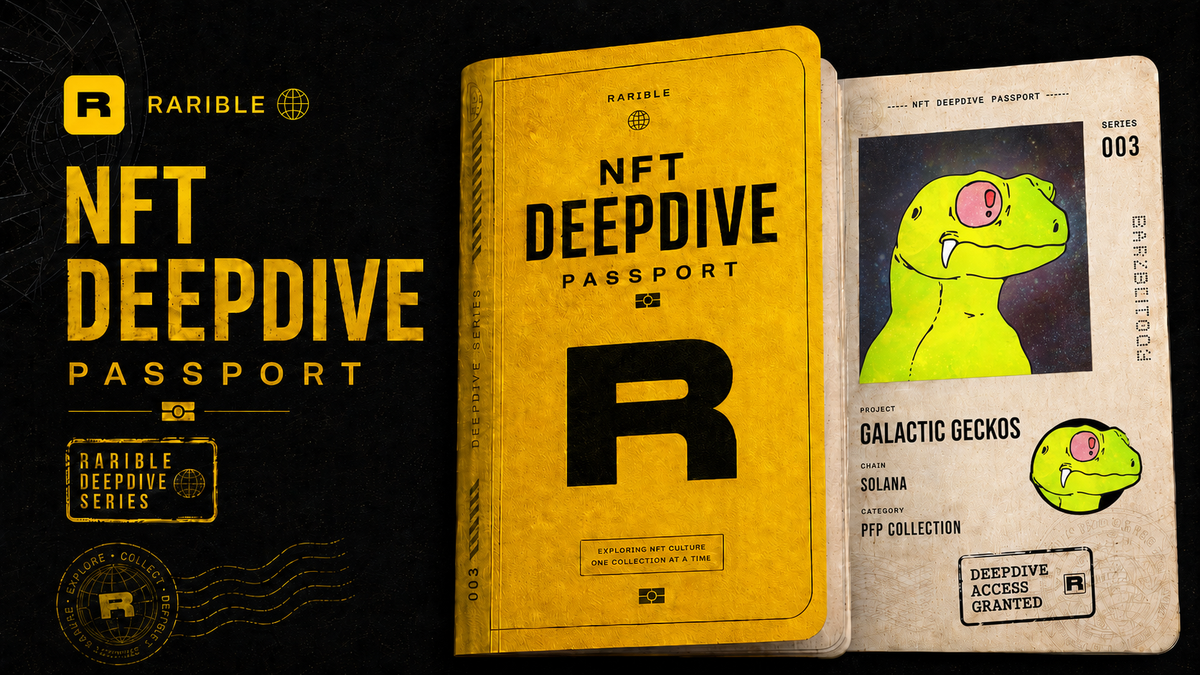
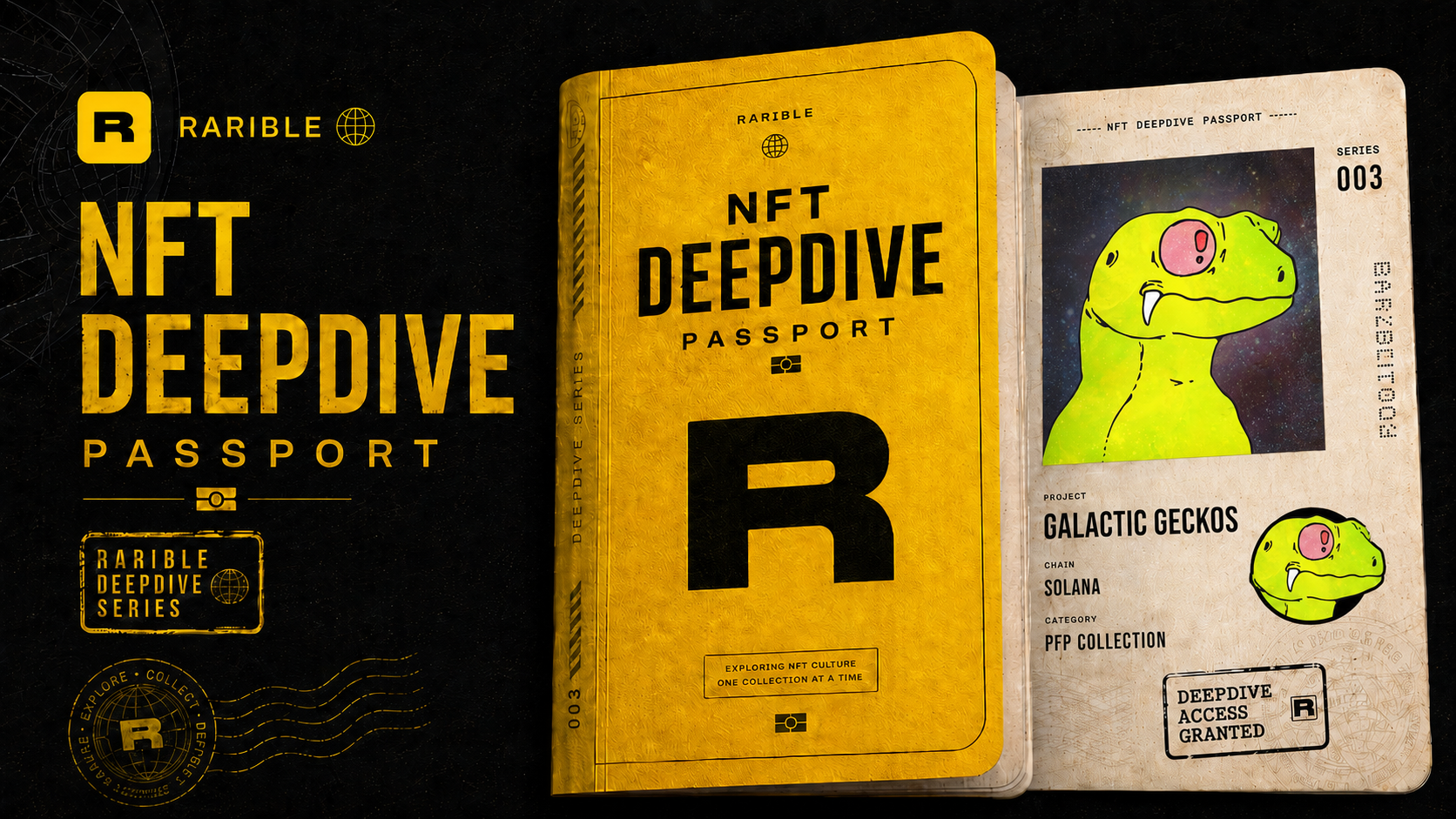
Galactic Geckos, a foundational collection on the Solana blockchain, represents far more than just an early profile picture (PFP) project. It has evolved into a robust social adventure club and a lore-driven intellectual property (IP) brand, instrumental in shaping the nascent Solana NFT ecosystem. Its unique blend of hand-drawn artistry, intricate faction-based storytelling, and an exceptionally loyal community has cemented its status as a defining force in the space. This comprehensive analysis, presented in collaboration with Rarible Passport and the Galactic Geckos / Galactic Gecko Space Garage (GGSG) team, delves into the project’s origins, its pivotal 2021 launch, the rise of "The Garage" as a formidable holder community, and the enduring factors that maintain GGSG’s relevance today. This is not merely a profile of a collection, but a shared narrative of a project that has consistently adapted and thrived through multiple Solana NFT market cycles. From its initial concept of space-racing geckos to its complex lore, including the Enigma Crystals, Concordians, immortalized Geckos, and the broader GeckoDAO ecosystem, GGSG exemplifies a project that transcends mere floor price speculation. Its core tenets revolve around identity, narrative depth, community ownership, and the long-term alignment between the project’s vision and its dedicated holders. Even when public attention shifts towards newer Solana NFT endeavors, Galactic Geckos continues its persistent development beneath the surface. Through initiatives such as the GGSG app, Collector Profiles, GreenListed, exclusive community alpha groups, innovative staking mechanics, and the development of Galactic Overdrive, the project continually expands its universe while ensuring that value remains intrinsically linked to the original collection. To commemorate this Rarible Passport, a special Rarible Gacha Station giveaway is being hosted, offering participants a chance to win one of five $25 Rarible Gacha Station packs. Details on how to enter can be found in the official Galactic Geckos Discord announcement.

Project Snapshot: The Pillars of Galactic Geckos

Galactic Geckos, often abbreviated as GGSG, has established itself as a cornerstone of the Solana NFT landscape. Launched on September 22, 2021, with a mint price of 2 SOL, the collection comprises 10,000 unique Galactic Geckos. This PFP project doubles as a social adventure club and a lore-rich IP brand, built on the Solana blockchain. The genesis of GGSG was spearheaded by the founding GGSG team, with the distinctive hand-drawn art meticulously crafted by Gossip Goblin. Following an initial phase, the founding team was acquired by Genuine Articles / GA and a community-led group in February 2022, a transition that significantly recalibrated the project’s focus towards holder value. Today, GGSG NFTs are available on prominent marketplaces including Magic Eden, Tensor, Artifacte, and Orbis, with official project information accessible via the Galactic Geckos website and the dedicated GGSG app. As of June 22, 2026, the current floor price hovers around 6.26 SOL, approximately $455. The collection has witnessed significant market activity, with an all-time high floor price recorded by CoinGecko at approximately $4,400 on December 21, 2023, and a peak of 65 SOL on April 9, 2023. Notably, 902 Geckos have been designated as "immortalized" or soulbound, meaning they are permanently removed from the circulating supply, while an additional 7,111 are currently staked, with the majority committed for 12 months or longer. This strategic approach to supply management significantly impacts the liquidity of the collection.

Executive Summary: A Deep Dive into GGSG’s Enduring Value

In essence, Galactic Geckos stands as an original Solana PFP and social adventure club, distinguished by its compelling lore, instantly recognizable hand-drawn art, and a deeply ingrained community culture. Its primary challenge lies in the perception that its public-facing momentum may not match that of newer, more aggressively marketed Solana NFT projects, leaving its robust value proposition as a well-guarded secret within its active community.

The significance of Galactic Geckos cannot be overstated. As one of the pioneering Solana NFT collections, it emerged during the initial surge of Solana NFTs in September 2021. It quickly garnered attention for its unique space-racing gecko characters, its narrative framework built around distinct factions, and its strong sense of community identity. GGSG played a crucial role in demonstrating that the Solana NFT culture could flourish beyond imitations of established trends like monkeys and apes. The project meticulously constructed a universe populated by four distinct factions, enriched with detailed trait lore, Enigma Crystals, and the concept of "The Garage" as a cohesive holder community.

In contrast to many contemporary projects that rely on ephemeral hype cycles, Galactic Geckos has demonstrated remarkable resilience, navigating multiple market phases. Its most potent asset is not solely its artistic merit but the community’s sustained ability to keep the brand vibrant through active DAO participation, a strong holder culture, experimental IP development, deflationary staking mechanisms often referred to as "immortality," community-centric tools, and an unwavering commitment to market relevance.

Origins and History: Forging a Universe on Solana

The genesis of Galactic Geckos can be traced back to September 22, 2021, when it launched on the Solana blockchain. With an initial mint price of 2 SOL and a total supply capped at 10,000 NFTs, the collection was envisioned as an NFT Social Adventure Club centered around "warrior turned space racing geckos."

The conceptual underpinnings of GGSG extended far beyond a simple PFP set. The project introduced a science-fiction universe where intergalactic conflict had transitioned from warfare to high-stakes spaceship racing. Each Gecko was assigned to one of four distinct factions: Alura, Targari, Martu, and Barada. This faction system provided holders with a more defined identity within the community and contributed to a more immersive and engaging world than typically offered by early generative NFT collections.

The artistic direction was helmed by the acclaimed artist Gossip Goblin, whose impressive portfolio includes contributions to prominent Magic: The Gathering cards and AI-generated films lauded by influential figures such as Joe Rogan. Gossip Goblin’s meticulous, hand-drawn approach to every Gecko trait imbued the collection with a highly recognizable aesthetic. Furthermore, the project elevated individual traits by embedding them within a rich narrative tapestry, a groundbreaking approach at the time. Each of the 162 original, unique traits was accompanied by detailed lore, setting a new standard for depth in generative art projects.

NFT Project Passport: Galactic Geckos

The timing of the launch proved strategically advantageous. Galactic Geckos debuted during a period of significant growth for Solana NFTs, following the successful market entries of projects like Degenerate Ape Academy and Solana Monkey Business, which had already established a robust market for Solana collectibles. GGSG differentiated itself by offering a compelling alternative to the prevailing ape and monkey themes, presenting a reptile-centric, space-themed collection with a strong emphasis on community-driven storytelling.

Post-launch, the project encountered challenges. Misalignments in the incentives between the original founding team and the NFT holders led to considerable friction. These negotiations culminated in a pivotal buyout of all founders by GenuineArticles and a consortium of community members in February 2022. This pivotal event marked a significant shift in the project’s trajectory, with all subsequent initiatives meticulously designed to enhance the value of Gecko NFTs. This included the implementation of a "hybrid DAO" executive model. This innovative structure combines the agility of a lean executive team with a flat organizational hierarchy, facilitating deep integration and consistent input from the broader community. The evolution into GeckoDAO became a defining element of the project’s identity, with GreenListed emerging as a dedicated investment affiliate focused on nurturing Web3 and Solana ecosystem builders.

Recent Developments: Sustained Innovation and Community Engagement

The Galactic Geckos project has remained remarkably active, consistently delivering value and expanding its ecosystem. Recent developments underscore a commitment to innovation and community enrichment.

In January 2026, Galactic Geckos participated in a significant GG x Lucid activation, intricately linked to Yuga Labs’ Otherside metaverse. This collaboration underscored GGSG’s capacity to engage in cross-community Web3 cultural moments beyond the Solana ecosystem alone. Furthermore, holders were granted an allocation for LucidAI, scheduled for an airdrop later in the year.

Simultaneously, Galactic Overdrive, an affiliated trading-card game developed by Space Squid Studios in conjunction with GGSG, entered its alpha phase across iOS, Android, and web platforms. This game, conceptualized over four years with a primary focus on player enjoyment preceding any financial layers, has shown exceptional promise. During its alpha, over 90% of players returned for multiple sessions, with more than 20% engaging daily without any form of compensation. A broader beta release is anticipated in the third quarter of 2026.

The introduction of Collector Profiles in 2026 marked another milestone, featuring holder badges and tools designed to recognize and showcase collecting achievements. This initiative reinforces the project’s core ethos: value accrues to the holders of the original Geckos, rooted in the project’s lore and foundational assets, rather than through speculative side tokens.

As of June 22, 2026, GGSG maintained a floor price of approximately 6.26 SOL, with a total of 10,000 assets and around 2,983 unique holders, according to data from HowRare. The scarcity is amplified by the fact that 902 Geckos are permanently soulbound ("immortalized") and 7,111 are staked, leaving a realistically liquid float of only about 2,000 NFTs – a notably thin supply relative to the community’s size and engagement.

The GeckoDAO and its investment arm, GreenListed, continue to be integral to the project’s positioning as a nexus for community and investment. While recent public updates regarding GreenListed have been less frequent, its historical impact is undeniable. Notably, GreenListed led the seed round for Matrica, a leading cross-chain token-gating protocol, with a seven-figure investment and secured a board seat.

In 2026, GGSG established an internal AI expertise group, building upon its five-year history of facilitating member "alpha" groups. These groups have covered diverse areas including crypto and stock trading, DeFi/DLMM optimization, wellness, and the Gecko Growth Group. These initiatives provide substantial community value, offering insights and opportunities that often come with significant fees in paid groups, and have assisted members in advancing their careers and generating additional income. The Growth Group alone has empowered over 80 members to effectively monetize their social media presence on X.

NFT Project Passport: Galactic Geckos

Ongoing staking rewards and opportunities continue to be a significant component of the GGSG ecosystem, with several Token Generation Events (TGEs) anticipated in the third and fourth quarters of 2026. At their peak values, rewards for staked Geckos have surpassed $23,000, based on CoinGecko data. Future notable airdrops may include CUBE ($ISO) and LucidAI.

Actively Building: A Lean, Value-Accretive Model

The question of whether the project remains actively engaged in building is answered with a resounding yes, particularly when considering its lean, no-dilution model. Galactic Geckos consistently operates on multiple fronts simultaneously. These include the development of the Galactic Overdrive game, the ongoing enhancement of the live app and its suite of tools (My Garage, rarity trackers, rewards dashboards), the implementation of Collector Profiles, the expansion of AI and Growth groups, and GreenListed’s strategic investments. Crucially, these efforts are synergistic rather than competitive, all converging towards the singular objective of driving value back to the original Gecko NFTs.

New Products and Partnerships: Expanding Horizons

The most visible recent development is the Galactic Geckos x Lucid activation, integrated with the Otherside metaverse. Furthermore, Galactic Overdrive, a new trading-card game that has been in development for four years, has now reached its alpha stage and is slated for a broad beta release this summer, generating significant anticipation within the community.

Communication Strategy: Deliberate Understatement

Compared to the more vocal Solana NFT projects, GGSG’s communication strategy is notably more subdued and less focused on rigid roadmaps. The project intentionally under-markets its developments, favoring a "surprise and delight" approach over constant hype. Progress is often disseminated as subtle hints to holders before any public announcements. Even Galactic Overdrive, a potentially significant catalyst for the project, has yet to be opened to the wider public. This deliberate approach ensures that the project’s value proposition remains, by design, a closely guarded secret.

Growth Beyond the NFT Community: Building Bridges

Galactic Geckos is indeed expanding its reach beyond its existing NFT community. The Otherside / Lucid activation serves as a prime example of GGSG’s ability to connect with broader Web3 communities outside of Solana. The Geckos community embraces the principle that value stems not solely from art and provenance, but from the caliber of the surrounding community. The Gecko network now extends beyond Solana’s borders. Gecko avatars have been featured within Yuga’s Otherside metaverse, and GreenListed stands as one of the most substantial NFT-affiliated venture groups in Web3. Its seed investment in Matrica was instrumental in creating infrastructure now utilized across Ethereum and Bitcoin. Discussions are also underway for a significant real-world asset partnership, with GGSG positioned as the exclusive NFT partner.

Hype vs. Substance: The Quiet Builder

While the project may appear quiet on the surface, it is exceptionally busy underneath. GGSG focuses on compounding capabilities rather than engaging in hype cycles. Over 4.5 years post-buyout, the project, according to its internal tracking, has generated more value for its holders than any comparable NFT collection, demonstrating category-leading floor appreciation and realized rewards. It pioneered novel concepts such as the "Hero’s Journey" (a one-year lockup) and "immortal" (soulbound) staking, established early NFT growth groups, and made pioneering moves into DLMM and AI tooling. Many of these "meta" strategies are first originated by Geckos before being popularized by better-funded projects. Furthermore, GGSG has achieved top-tier outcomes without ever engaging in external fundraising, a testament to the sustainability of NFTs independent of recurring capital extraction.

Roadmap and Future Plans: A Principled Approach to Evolution

Galactic Geckos deliberately eschews a formal, rigid roadmap. This strategic choice preserves the project’s flexibility to adapt to evolving market conditions and to consistently surprise and delight its holders, rather than being constrained by predetermined paths that might become obsolete. The following outlines current directions and planned initiatives, ranging from confirmed developments to ongoing discussions.

Planned Initiatives: Charting the Course Forward

Plan Status Expected Impact
Galactic Overdrive TCG Beta Expected Summer 2026 Highly positive. The alpha version proved engaging, and opening it to a wider player base could significantly boost awareness for both the TCG and GGSG.
Maintain and Expand GGSG App/Tools Live / Ongoing Supports onboarding, holder discovery, rarity research, airdrop tracking, and community participation, enhancing the overall holder experience.
Continue IP and Lore Development Ongoing / Partially Community-Driven The Geckoverse, factions, trait lore, Crystals, Concordians, and the Fifth Faction narrative provide ample scope for future storytelling and media extensions, fostering long-term engagement.
GreenListed / Ecosystem Investing Ongoing (less public) Maintains GGSG’s connection with Solana builders and early-stage opportunities. GreenListed’s past investments, like leading Matrica’s seed round, demonstrate its strategic value to holders.
Community Activations and Partner Events Ongoing Activations such as GG x Lucid keep the brand culturally relevant and connected to broader Web3 communities. Upcoming TGEs in 2026 for partners like LucidAI and CUBE / $ISO promise additional rewards.
Physical Expansion (Merchandise, RWA) Confirmed Q3/Q4 2026 Extends brand reach and collectability into physical goods and tokenized physical assets, broadening the appeal and utility of the GGSG ecosystem.
Deflationary Tokenomics via Immortals Ongoing Each immortalized Gecko permanently reduces the circulating supply, further tightening an already limited float and compounding value for remaining NFTs as the collection’s overall value grows.

In essence, the project’s plan is guided by a core principle: to align every initiative behind the original Galactic Geckos, prioritize holder rewards, and allow for compounding surprises and innovations.

Strengths: The Enduring Pillars of GGSG’s Success

Galactic Geckos possesses a formidable set of strengths that have propelled its longevity and influence within the Solana NFT space.

NFT Project Passport: Galactic Geckos

OG Solana Status and Cultural Weight

As one of the earliest collections to emerge during the initial Solana NFT boom, Galactic Geckos holds significant historical and cultural weight. This legacy status grants it a level of recognition and respect that newer projects often struggle to attain.

Distinctive Art and Compelling Lore

The unique hand-drawn art by Gossip Goblin, coupled with the intricate faction system, detailed trait backstories, and the immersive space-racing universe, makes GGSG far more memorable and engaging than many generic PFP projects. This rich narrative provides a deep well for ongoing community engagement and IP expansion.

Strong Community Identity: "The Garage"

Holders are not merely acquiring an image; they are becoming part of "The Garage," a vibrant and cohesive community. The faction system, the shared lore, the established DAO culture, and the long-term commitment of its holder base foster a profound sense of belonging and collective purpose.

Aligned Incentives and Value Accrual

GGSG operates under a hybrid-DAO model with a lean executive team that values broad community input. Critically, the project eschews dilution and external fundraising. Every initiative is meticulously designed to funnel value back to the original Gecko NFTs. The deflationary "immortalization" mechanic permanently removes Geckos from the 10,000 supply, progressively tightening an already scarce float and enhancing the value proposition for existing holders.

A Track Record of Innovation, Backed by an Investment Arm

Galactic Geckos has a proven history of originating innovative meta-strategies before they become widely adopted by better-funded projects. This includes pioneering the "Hero’s Journey" (one-year lockup) and "immortal" (soulbound) staking, establishing the first NFT growth group, and making early forays into DLMM and AI tooling. Its investment arm, GreenListed, has demonstrated significant strategic acumen, notably leading Matrica’s seed round and securing a board seat in what is now a leading cross-chain token-gating protocol.

Resilience Across Multiple Market Cycles

Galactic Geckos has successfully navigated the early Solana NFT boom, subsequent bear market downturns, the significant leadership buyout in 2022, and evolving market narratives. By the project’s own metrics, it has consistently delivered category-leading floor appreciation and rewards per Gecko, all without resorting to external funding. This enduring resilience is a critical indicator of stability and long-term viability in the often-volatile NFT sector, where many projects fade into obscurity.

July 19, 2026 0 comment
0 FacebookTwitterPinterestEmail
Crypto Trading & Analysis

U.S. Treasury Designates Four New Cryptocurrency Addresses Linked to Iran’s Central Bank, Freezing Over $131 Million in Stablecoins

by Reynand Wu July 19, 2026
written by Reynand Wu

The U.S. Department of the Treasury’s Office of Foreign Assets Control (OFAC) has significantly escalated its efforts to counter illicit financial activities by Iran, announcing on Tuesday the designation of four additional cryptocurrency addresses linked to the Central Bank of Iran. This move, detailed in an update to OFAC’s existing sanctions against the Iranian financial institution, aims to choke off channels through which the regime allegedly circumvents international sanctions, finances its operations, and supports regional proxies, including the U.S.-designated terror group Hezbollah. On-chain data analysis immediately following the announcement revealed that these newly identified wallets had collectively received approximately $165 million in stablecoins. Crucially, their issuer, Tether, acting on the designation, promptly froze balances totaling $131 million, effectively rendering a substantial portion of these funds inaccessible to the Iranian regime.

This latest action by OFAC represents a strategic expansion of the financial blockade targeting the Central Bank of Iran. The U.S. Treasury has long contended that Iran has increasingly leveraged cryptocurrency to circumvent the debilitating effects of international sanctions, a practice that enables the regime to fund its domestic and international activities. The funds are allegedly channeled to support a range of operations, including the financing of its own military and security apparatus, as well as providing financial lifelines to affiliated groups in the region. The designation of these specific cryptocurrency addresses underscores OFAC’s commitment to tracing and disrupting these illicit financial flows within the digital asset ecosystem.

The scrutiny of the Central Bank of Iran’s cryptocurrency operations has intensified considerably in recent months, particularly in the wake of escalating regional conflicts. This heightened attention has prompted more aggressive enforcement actions. Just last month, OFAC took the significant step of sanctioning major Iranian cryptocurrency exchanges. These platforms were identified as key conduits through which the Central Bank facilitated the movement of funds into and out of stablecoins, highlighting a sophisticated, albeit illicit, financial network. The consecutive actions demonstrate a multi-pronged strategy by the U.S. government to dismantle Iran’s ability to utilize digital assets for sanctioned purposes.

Further compounding the challenges for Iran’s financial maneuvering, reports emerged during the height of regional tensions of proposals by Iranian actors to implement a cryptocurrency-based toll system for vessels transiting the Strait of Hormuz. Chainalysis, a blockchain analysis firm that has been instrumental in identifying these illicit flows, assessed that shipping companies complying with such a toll would face severe sanctions exposure from the United States and its allies. This proposal, if implemented, would have represented another attempt by Iran to leverage digital currencies for economic gain and exert influence over critical global trade routes.

Iran’s Strategic Reliance on Stablecoins

Chainalysis’s extensive research into the cryptocurrency habits of the Iranian regime reveals a pronounced preference for stablecoins. This strategic choice is understandable from the perspective of illicit actors seeking to operate within the digital asset space. Stablecoins are designed to maintain a stable value, typically pegged to a fiat currency like the U.S. dollar, making them highly liquid and widely accepted globally. These characteristics are invaluable for any financial actor, legitimate or illicit, as they facilitate seamless transactions and reduce the volatility risks inherent in other cryptocurrencies.

However, this very stability and the centralized nature of stablecoin issuance also present a significant vulnerability for illicit actors. Unlike decentralized cryptocurrencies, stablecoin issuers, such as Tether, have the technical capability and often the legal obligation to freeze assets held in specific wallet addresses at the direction of law enforcement and regulatory agencies. This feature has become a powerful tool for OFAC in its pursuit of sanctioned entities.

Since OFAC’s initial designations and subsequent actions, Tether has demonstrated its willingness to cooperate with U.S. authorities. The company has now frozen nearly $475 million from wallet addresses previously identified by OFAC as being controlled by the Central Bank of Iran. This cumulative freezing of funds represents a substantial financial impediment to the Iranian regime, effectively rendering a significant portion of its digital asset holdings inaccessible. The mechanism of freezing a stablecoin balance on a specific address prevents the holder from initiating any outgoing transactions or spending those funds, effectively immobilizing them.

On-chain analysis, conducted using advanced tools like Chainalysis Reactor, has provided granular insights into the flow of funds into these newly designated wallets. The data indicates that the addresses added to OFAC’s sanctions list received their funds originating upstream from an institutional liquidity provider and an Asia-based payment processor. This tracing of the funds’ origin is crucial for OFAC as it allows for the identification of potential intermediaries and further avenues for sanctions enforcement. Understanding these upstream flows is critical to dismantling the entire network of financial support that the Central Bank of Iran attempts to build through digital assets.

Chronology of OFAC Actions Against Iran’s Crypto Holdings

The recent designation of four new cryptocurrency addresses by OFAC is not an isolated event but rather a continuation of a sustained campaign to curb Iran’s use of digital assets for illicit purposes. Tracing the timeline of these actions provides a clearer picture of the escalating U.S. government response:

OFAC Sanctions Iran Central Bank Crypto Wallets, Freezing $131M in Stablecoins
  • September 2025: OFAC first signaled its intent to target Iran’s "shadow crypto banking network" by sanctioning entities and individuals involved in facilitating illicit digital asset transactions for Iran. This marked an early recognition of the growing trend and a commitment to address it.
  • June 2026: In a significant escalation, OFAC sanctioned major Iranian cryptocurrency exchanges. This action directly targeted the infrastructure that the Central Bank of Iran and other sanctioned entities were reportedly using to convert fiat currency into stablecoins and vice versa, aiming to disrupt the on-ramps and off-ramps of this illicit financial system.
  • April 2026: Further refining its strategy, OFAC updated its designation of the Central Bank of Iran to specifically include cryptocurrency addresses. This indicated a move towards directly targeting the digital wallets themselves, rather than solely focusing on the exchanges facilitating the transactions.
  • July 2026 (Present Action): The most recent action, announced on Tuesday, significantly broadens the scope of the Central Bank of Iran’s designation by adding four new cryptocurrency addresses. This latest move, coupled with Tether’s immediate freezing of over $131 million, underscores the ongoing and intensifying nature of OFAC’s efforts to seize and block illicitly obtained digital assets.

This chronological progression demonstrates a strategic evolution in OFAC’s approach, moving from broader sanctions against facilitators to more direct and targeted actions against the financial instruments and infrastructure themselves.

Supporting Data and Analysis

The figures released by OFAC and corroborated by on-chain analysis paint a stark picture of the scale of Iran’s alleged cryptocurrency operations. The $165 million in stablecoins received by the four newly designated wallets represent a substantial sum, indicative of the volume of transactions being processed. The immediate freezing of $131 million by Tether is a testament to the effectiveness of regulatory pressure on stablecoin issuers and the inherent traceability of blockchain transactions.

Chainalysis’s own research has provided crucial insights into the types of stablecoins used and their velocity. While the specific stablecoins involved in this latest designation have not been explicitly detailed, OFAC’s previous actions and broader investigations have often highlighted the use of USDT (Tether) and other USD-pegged stablecoins due to their liquidity and widespread acceptance.

The tracing of funds originating from an institutional liquidity provider and an Asia-based payment processor is particularly noteworthy. This suggests a degree of sophistication in Iran’s efforts to obscure the ultimate beneficial ownership of these funds. Institutional liquidity providers are often sophisticated financial entities that may facilitate large-volume trades, while payment processors can act as intermediaries in various cross-border transactions. Identifying these entities, even if they are not directly complicit, is a crucial step in understanding the broader network of financial actors involved in illicit transactions.

The implications of these actions extend beyond the immediate financial impact on Iran. For the cryptocurrency industry, it reinforces the ongoing tension between decentralization and regulatory oversight. While blockchain technology offers transparency, the ability of issuers like Tether to freeze assets highlights the centralized points of control that regulators can leverage. This also puts pressure on exchanges and other service providers to enhance their know-your-customer (KYC) and anti-money laundering (AML) procedures to avoid inadvertently facilitating sanctioned activities.

Official Responses and Broader Impact

OFAC’s actions are driven by a clear mandate to protect U.S. national security and foreign policy interests by disrupting illicit financial flows. The Treasury Department has consistently stated its commitment to preventing state and non-state actors from using the global financial system, including emerging digital asset markets, to fund terrorism, proliferation, or other destabilizing activities.

While specific statements from the Central Bank of Iran or other Iranian government entities regarding these latest designations are not immediately available in the provided text, historically, Iran has often denied allegations of using cryptocurrency to circumvent sanctions, framing such accusations as politically motivated.

The broader impact of these designations is multi-faceted. For the Iranian regime, it represents a continued tightening of the financial noose, making it more difficult and expensive to access funds necessary for its operations and support networks. This can lead to increased pressure on the regime’s domestic economy and its ability to project influence abroad.

For the international community, these actions underscore the growing importance of robust regulatory frameworks for digital assets. The ability of OFAC to effectively track and freeze these funds demonstrates the power of combining blockchain analytics with traditional financial enforcement tools. It also highlights the ongoing challenge of combating illicit finance in an increasingly interconnected and technologically advanced world. The successful freezing of these funds by Tether serves as a strong deterrent to other illicit actors and a clear signal to the broader cryptocurrency ecosystem about the consequences of facilitating sanctioned activities. The U.S. Treasury’s persistent efforts suggest that this will remain a key area of focus in its foreign policy and national security strategy.

July 19, 2026 0 comment
0 FacebookTwitterPinterestEmail
Crypto Trading & Analysis

Investor Borrowing in the U.S. Stock Market Reaches Historic Levels, Signaling Potential Systemic Risk

by Raul Delapena Setiawan July 19, 2026
written by Raul Delapena Setiawan

Investor borrowing in the U.S. stock market has surged to a staggering record of $1.5 trillion in June, a level that historically precedes elevated risk across the financial system. This unprecedented accumulation of margin debt, which allows investors to borrow money from their brokers to purchase securities, has intensified as market participants seek to amplify their returns, raising concerns among financial analysts and regulators about potential systemic vulnerabilities.

The Alarming Surge in Margin Debt

The latest figures, compiled by Adam Kobeissi and citing data from the Financial Industry Regulatory Authority (FINRA), the New York Stock Exchange (NYSE), and JPMorgan, reveal a relentless upward trajectory in margin debt. In June alone, margin debt saw its third consecutive monthly increase, adding an impressive $281.2 billion, representing a substantial 23% leap. Over the past twelve months, the increase has been even more dramatic, with margin debt climbing by a remarkable $494.1 billion, or a staggering 49%. This rapid ascent underscores a widespread eagerness among investors to leverage borrowed funds at historic rates, effectively magnifying their exposure to the equity markets.

This aggressive use of leverage is a double-edged sword. While it can significantly boost profits when markets move favorably, it can also lead to catastrophic losses when asset prices decline sharply. The sheer volume of borrowed money now circulating in the market suggests that a significant downturn could trigger cascading sell-offs as leveraged positions are liquidated to meet margin calls, potentially creating a domino effect throughout the financial ecosystem.

Historical Parallels and Emerging Indicators

The current situation is drawing comparisons to previous periods of market exuberance and subsequent correction. Kobeissi highlights that multiple indicators of investor leverage are now flashing red. A broader measure of investor leverage, which accounts for cash held in brokerage accounts and subtracts it from total margin borrowing, has risen to approximately 1.4% of the S&P 500 market capitalization. This figure is nearing its highest point on record and notably exceeds the peak levels observed in 2018, as well as surpassing the approximately 1.1% reached during the dot-com bubble of 2000.

"US investors have never been more leveraged," Kobeissi stated, emphasizing the unprecedented nature of the current borrowing environment. This historical context is crucial for understanding the potential implications of such high leverage. During the dot-com bubble, excessive speculation fueled by easy credit led to a dramatic market crash, wiping out trillions in market value and causing significant economic disruption. The 2008 financial crisis also saw a buildup of leverage in various financial instruments, contributing to the severity of the global economic downturn.

Understanding Margin Debt and Its Risks

Margin debt represents the total amount of money investors have borrowed from their brokers to trade securities. When an investor buys securities on margin, they deposit a portion of the purchase price (the initial margin) and borrow the rest from the brokerage firm. The securities purchased are typically held as collateral for the loan.

The allure of margin trading lies in its potential to magnify returns. For example, if an investor has $10,000 and borrows another $10,000 on margin to buy $20,000 worth of stock, a 10% increase in the stock’s value would result in a 20% profit on their initial investment ($2,000 profit on $10,000 capital). However, a 10% decrease in value would lead to a 20% loss, potentially wiping out their initial capital and even leading to further debt if the margin call is not met.

Key Risks Associated with Margin Debt:

  • Magnified Losses: As illustrated, leverage amplifies both gains and losses. A small price movement against a leveraged position can lead to substantial financial damage.
  • Margin Calls: Brokers maintain a "maintenance margin" requirement. If the value of the securities in a margin account falls below this level, the broker will issue a "margin call," demanding that the investor deposit additional funds or sell securities to bring the account back into compliance. Failure to meet a margin call can result in the broker forcibly liquidating the investor’s holdings, often at unfavorable prices.
  • Forced Liquidation: In rapidly declining markets, margin calls can trigger a wave of forced selling by brokers. This can exacerbate price declines, creating a feedback loop where falling prices trigger more margin calls, leading to further selling pressure. This "cascade effect" can destabilize markets.
  • Systemic Risk: When a large number of investors are highly leveraged, a significant market downturn can trigger widespread margin calls and forced liquidations. This can lead to liquidity crunches, stress on brokerage firms, and potentially broader financial instability, impacting the entire financial system.

Historical Context: A Timeline of Leverage

The history of U.S. stock market leverage provides valuable context for the current surge in margin debt.

  • Pre-2000s: Margin debt was a significant factor in market cycles, but its overall size relative to the market capitalization was generally lower than what is being observed today.
  • Dot-Com Bubble (Late 1990s – Early 2000s): This era witnessed a substantial increase in margin debt, fueled by speculative investment in technology stocks. As the bubble burst, margin calls led to significant selling pressure, contributing to a sharp market correction. The broader measure of leverage relative to S&P 500 market cap peaked around 1.1% during this period.
  • Financial Crisis (2007-2008): While margin debt was a factor, the crisis was more broadly characterized by leverage in complex financial instruments like mortgage-backed securities and credit default swaps. However, leveraged investors in equities also faced significant challenges.
  • Post-2008 Recovery and Expansion: Following the financial crisis, a prolonged period of low interest rates and quantitative easing by central banks encouraged risk-taking. This environment saw a steady climb in margin debt as investors sought higher returns.
  • 2018 Peak: Margin debt reached new highs in 2018, prompting concerns about market stability, though the subsequent market performance did not immediately result in a major crisis.
  • COVID-19 Pandemic (2020 onwards): The market’s rapid recovery from the pandemic-induced lows in early 2020, coupled with unprecedented fiscal and monetary stimulus, further fueled investor appetite for risk. This period has seen margin debt reach successive record highs.
  • June 2024 Record: The latest figures of $1.5 trillion in margin debt and the broader leverage measure nearing historical highs underscore the current elevated risk environment.

Broader Economic and Market Implications

The implications of such a high level of investor leverage extend beyond individual portfolios and can impact the broader economy.

  • Increased Market Volatility: Highly leveraged markets are inherently more volatile. Sharp price swings become more likely, as forced selling can amplify downward movements. This increased volatility can deter institutional investors and create uncertainty, potentially slowing economic growth.
  • Risk of Contagion: If a significant number of leveraged investors face margin calls simultaneously, it could lead to a liquidity crisis. This could strain brokerage firms, potentially impacting their ability to lend and operate, and could even spill over into other financial markets.
  • Impact on Consumer and Business Confidence: A severe market downturn triggered by excessive leverage could erode consumer and business confidence, leading to reduced spending and investment, and potentially impacting employment.
  • Regulatory Scrutiny: Historically, periods of high leverage have attracted increased attention from financial regulators. It is plausible that FINRA and other regulatory bodies will continue to monitor these trends closely and may consider adjustments to margin requirements or other oversight measures to mitigate systemic risk.

Official Responses and Analyst Perspectives

While specific official responses from regulatory bodies like the Securities and Exchange Commission (SEC) or FINRA directly addressing the $1.5 trillion figure are not immediately available in the provided context, such data typically informs their ongoing risk assessments. These institutions are tasked with maintaining fair and orderly markets, and they monitor leverage levels as a key indicator of potential instability.

Financial analysts and market strategists have voiced concerns about the sustainability of the current market trajectory given the record leverage. Many view this as a sign of investor complacency or excessive optimism, which can precede significant market corrections.

"The sheer volume of margin debt is a flashing red signal for the market," commented a senior market analyst who requested anonymity due to company policy. "While there’s no immediate trigger for a crash, this level of borrowing makes the market significantly more vulnerable to any negative shocks. We are essentially building a house of cards on borrowed money."

Another perspective suggests that while the absolute level of margin debt is high, its relation to the overall market capitalization of equities might offer some nuance. However, the fact that the broader leverage measure, which accounts for available cash, is nearing historical highs regardless of absolute market size, still points to a significant increase in risk appetite.

Looking Ahead: Navigating Uncharted Territory

The current record levels of investor borrowing present a complex challenge for market participants and regulators alike. The unprecedented scale of leverage suggests that the U.S. stock market is operating in a high-risk environment. Investors who are employing margin should exercise extreme caution, fully understanding the amplified risks involved.

The historical data indicates that periods of such high leverage have often preceded significant market dislocations. Whether this time will be different remains to be seen, but the underlying mechanics of amplified gains and magnified losses, coupled with the potential for cascading liquidations, suggest that prudence and risk management should be paramount for all investors. The coming months will likely be closely watched to see if this trend of record borrowing continues and how the market responds to these elevated leverage levels.


Disclaimer: Opinions expressed at The Daily Hodl are not investment advice. Investors should do their due diligence before making any high-risk investments in Bitcoin, cryptocurrency or digital assets. Please be advised that your transfers and trades are at your own risk, and any losses you may incur are your responsibility. The Daily Hodl does not recommend the buying or selling of any assets including cryptocurrencies, nor is The Daily Hodl an investment advisor. Please note that The Daily Hodl participates in affiliate marketing.

Generated Image: Midjourney

July 19, 2026 0 comment
0 FacebookTwitterPinterestEmail
Blockchain Technology & Development

IOTA Foundation Delivers Key Milestones in Q2 2026, Accelerating Global Trade Infrastructure and Protocol Enhancements

by Reynand Wu July 19, 2026
written by Reynand Wu

The second quarter of 2026 has been a period of significant advancement for the IOTA Foundation, marked by crucial developments in its core protocol, substantial progress in the real-world deployment of its digital trade infrastructure, and robust ecosystem growth. This progress update, covering the period from April to June 2026, details the organization’s strategic focus on scaling TWIN, the open digital trade infrastructure, and its successful implementation of key technological upgrades.

Strategic Realignment and Focus on TWIN

In line with the foundational principles outlined in the IOTA Manifesto, the IOTA Foundation has intensified its commitment to supporting and scaling TWIN. This strategic imperative has led to a significant organizational restructuring. Engineering, research, design, and product teams have been vertically integrated into a unified pipeline. This move signifies a departure from isolated, general-purpose blockchain development, concentrating the Foundation’s talent and resources on building a resilient, compliant, and production-grade network specifically tailored for the demands of the global economy and international trade. This focused approach aims to accelerate the adoption of digital trade solutions on a global scale.

Core Protocol and Data Infrastructure Advancements

This quarter witnessed a historic achievement in the development of IOTA’s core network infrastructure. The engineering team successfully deployed a highly resilient consensus model, a critical step towards ensuring the stability and reliability of the network. Simultaneously, the node codebase has undergone significant streamlining, a move designed to meet the stringent requirements of institutional adoption.

Starfish Consensus and Network Hardening

A landmark event of Q2 2026 was the successful launch of the Starfish consensus mechanism on the IOTA Mainnet. This upgrade represents a major enhancement to the network’s security and efficiency. The Starfish consensus model is designed to bolster the network’s resilience against attacks and improve its overall performance. The deployment was announced via social media on April 28, 2026, with the IOTA Foundation sharing a visual representation of the upgrade, underscoring the significance of this technical milestone. This development is crucial for building trust among enterprise users who require robust and secure distributed ledger technology. The hardening of the network through Starfish is a direct response to the growing demand for enterprise-grade DLT solutions capable of handling high transaction volumes and complex data flows inherent in global trade.

Data Layer and Operational Efficiency Improvements

Beyond core consensus, Q2 saw substantial improvements in the IOTA data layer, focusing on enhancing usability for developers and reducing operational costs for network participants. These enhancements are vital for making the IOTA network more accessible and economically viable for a wider range of applications, particularly those within the trade sector that rely on efficient data exchange. The efforts to make the network "cheaper for the people running it" are directly aimed at fostering broader adoption by reducing the barrier to entry for node operators and decentralized application developers. This includes optimizations in data storage, retrieval, and transaction processing, which are critical for the real-time demands of international trade logistics.

TWIN Ecosystem and Global Deployments Gain Momentum

The development and expansion of TWIN have been a central theme in Q2 2026. The initiative is actively cultivating commercial relationships, broadening its ecosystem footprint, and strengthening its pipeline of prospective deployments across key global trade corridors.

Strategic Collaborations and Partnerships

The IOTA Foundation has been actively forging strategic collaborations to accelerate TWIN’s integration into existing trade ecosystems. These partnerships are crucial for bridging the gap between nascent digital trade infrastructure and established global supply chains. While specific details of all collaborations are not fully disclosed, the emphasis on strategic alliances indicates a concerted effort to build a comprehensive network effect for TWIN. These partnerships likely involve technology providers, logistics companies, financial institutions, and governmental bodies, all working towards a shared vision of digitized and streamlined trade.

Global Corridors and Emerging Markets

TWIN’s expansion into new geographical regions is a testament to its growing global relevance. A significant development in this area was the selection of Kenya, Nigeria, and Morocco as the inaugural countries to implement ADAPT – the Africa Digital Access and Public Infrastructure for Trade initiative. This announcement, made on May 19, 2026, highlights a strategic focus on unlocking trade potential in emerging markets through digital transformation. ADAPT aims to leverage IOTA’s technology to build essential digital infrastructure, facilitating greater access to trade opportunities for businesses within these nations. The selection of these African nations signifies a commitment to fostering inclusive economic growth and modernizing trade practices in regions that stand to benefit most from digital innovation. This initiative is expected to serve as a blueprint for similar deployments in other emerging economies, demonstrating the adaptability and scalability of the TWIN framework. The successful implementation in these pilot countries could pave the way for significant increases in intra-African trade and strengthen their integration into global supply chains.

Legal and Governance Frameworks Mature

Significant progress has been made across multiple legal and governance workstreams during the second quarter, crucial for ensuring the compliant and sustainable deployment of IOTA-based solutions, particularly for TWIN.

Data Protection and Regulatory Compliance

Work has continued to ensure that the Trade Logistics Information Pipeline (TLIP) is fully prepared for its public release, adhering strictly to applicable data protection obligations in Kenya. This meticulous approach to compliance is paramount for building trust with regulatory bodies and corporate entities. The legal groundwork being laid for TLIP’s launch demonstrates a commitment to responsible innovation, recognizing the sensitive nature of trade data.

UK Pilot Preparations and Industry Support

Legal preparations are underway for the TWIN pilots in the United Kingdom. These pilots are designed to support the integration of TWIN solutions across the logistics and transportation industry. This strategic focus on a major economic hub like the UK underscores the ambition to establish TWIN as a leading digital trade infrastructure in developed markets as well. The collaboration with UK-based entities is expected to provide valuable insights into the practical application of digital trade solutions within established regulatory frameworks.

Governance Strategy and Sustainable Funding

Collaboration with TWIN’s strategic partners has focused on defining a robust governance strategy and operating model to drive widespread adoption. This includes developing frameworks for intellectual property (IP) ownership and licensing, as well as establishing sustainable funding models. These efforts are critical for ensuring the long-term viability and scalability of the TWIN ecosystem, fostering an environment where all stakeholders can contribute and benefit. The focus on sustainable funding models suggests a move towards a decentralized and self-sustaining ecosystem, reducing reliance on perpetual external funding and promoting a more robust economic structure for the network.

Ecosystem Communications and Brand Strategy Reinforcement

The Communications team has effectively shifted its focus from protocol-centric awareness to building institutional trust. The emphasis is now on highlighting compliance, interoperability, and tangible real-world outcomes.

"Trusted Trade" Campaign and Web Optimizations

The official launch of the "Trusted Trade" brand awareness campaign in Q2 2026 has been a significant success. This campaign visually communicates how digital trust is intrinsically embedded within global logistics processes. The campaign has demonstrably boosted TWIN’s visibility threefold, and user engagement on TWIN-related platforms has quadrupled. This surge in interest is further supported by a healthy follower growth of 9% across corporate channels, indicating strong resonance with the target audience. The IOTA Foundation plans to leverage these corporate channels to sustain and amplify this momentum.

In parallel, key functional IOTA interfaces have undergone comprehensive redesign and optimization. This includes the IOTA Foundation portal and specialized digital notarization features, a new digital notarization center on the Explorer, and the integration of the Rabby wallet with the EVM Bridge. These web surface optimizations are designed to cater to a growing and diverse global stakeholder base, making the platform more accessible and user-friendly. The redesign reflects a commitment to providing a seamless user experience for both technical and non-technical users engaging with the IOTA ecosystem.

High-Impact Content Releases

The second quarter saw the publication of several high-signal content pieces that effectively documented the Foundation’s technological shifts and the successes within the TWIN ecosystem. These releases aim to educate and inform a broad audience about the practical applications and benefits of IOTA’s technology in the realm of global commerce. The Foundation continues to refine its visual identity, employing clean, abstract animations and technical illustrations to represent the evolution of its invisible digital infrastructure into the new fabric of global commerce. This consistent branding effort reinforces the message of a sophisticated yet accessible technological foundation.

Academic Publications and Research Validation

The IOTA Research team has continued its commitment to validating the underlying architecture through peer-reviewed academic channels. During Q2 2026, three major research papers were submitted, further contributing to the body of knowledge and scientific understanding of IOTA’s technological innovations. These submissions underscore the Foundation’s dedication to rigorous scientific validation and its contribution to the broader academic discourse on distributed ledger technology and its applications. The publication of these papers is expected to attract further academic interest and collaboration, reinforcing the credibility and robustness of the IOTA protocol.

Outlook for Q3 2026

With significant announcements anticipated for the upcoming quarter, the IOTA Foundation is poised to share further insights into the behind-the-scenes work of its various teams. The momentum built in Q2 2026, particularly in the development of TWIN and the hardening of the core protocol, suggests a strong trajectory for continued progress and innovation in the latter half of the year. The focus on real-world application, institutional trust, and scalable infrastructure positions IOTA as a key player in the future of global trade and digital economies. The upcoming period is expected to bring more tangible evidence of the impact of these developments on international commerce.

July 19, 2026 0 comment
0 FacebookTwitterPinterestEmail
Altcoins & Token Projects

Stablecoins Enter the Octagon as World Liberty Financial and UFC Pioneer On-Chain Performance Bonuses

by Nana Wu July 19, 2026
written by Nana Wu

The intersection of professional sports and decentralized finance reached a new milestone this week as World Liberty Financial’s USD1 stablecoin was utilized to facilitate performance bonuses for the Ultimate Fighting Championship (UFC). This development represents a significant shift in the utility of digital assets, moving them from the periphery of speculative trading into the highly visible arena of mainstream sports entertainment. While the crypto industry has long sought "real-world" use cases, the integration of a dollar-pegged stablecoin into the payout structure of a global sports organization like the UFC serves as a high-profile proof of concept for the efficiency and speed of blockchain-based settlements.

The use of USD1 in this context is not merely a promotional maneuver; it is an experiment in the modernization of payroll and incentive structures. Traditionally, performance bonuses in professional sports involve complex legacy banking systems, international wire transfers, and varying settlement times, particularly for international athletes. By utilizing a stablecoin, the UFC and World Liberty Financial are demonstrating a streamlined alternative that offers near-instantaneous liquidity and a transparent ledger of transaction. This event marks a pivotal moment for World Liberty Financial, a project that has garnered significant headlines due to its high-profile political associations and its stated mission to maintain the dominance of the U.S. dollar in the digital age.

The Emergence of World Liberty Financial and the USD1 Stablecoin

World Liberty Financial (WLF) entered the market with a mandate to bridge the gap between traditional finance and decentralized protocols. Central to this ecosystem is USD1, a stablecoin designed to maintain a 1:1 peg with the United States dollar. Unlike volatile cryptocurrencies such as Bitcoin or Ethereum, USD1 is intended to function as a reliable medium of exchange and a stable store of value within the digital economy. The project has positioned itself as a defender of American financial leadership, arguing that the proliferation of dollar-backed stablecoins is essential to ensuring the greenback remains the world’s reserve currency in a digitized global market.

The launch of USD1 comes at a time when the stablecoin sector is experiencing unprecedented growth. As of early 2025, the total market capitalization of stablecoins has surpassed $190 billion, with daily transaction volumes often rivaling or exceeding those of major credit card networks. However, the market remains dominated by established players like Tether (USDT) and Circle (USDC). For a newcomer like USD1, securing a partnership with a premier global brand like the UFC provides the necessary visibility to compete for market share and user trust.

A Chronology of Crypto Integration in Professional Sports

The decision to pay UFC bonuses in USD1 is the latest chapter in a multi-year trend of cryptocurrency integration within the sports world. To understand the significance of this event, one must look at the timeline of how digital assets have permeated the industry:

  1. 2020–2021: The Sponsorship Era. Major exchanges like Crypto.com and FTX signed multi-hundred-million-dollar deals for stadium naming rights and jersey patches. During this phase, crypto was largely seen as a marketing engine.
  2. 2022: The NFT and Fan Token Wave. Leagues like the NBA and organizations like Socios introduced digital collectibles and fan tokens, attempting to gamify fan engagement through blockchain technology.
  3. 2023: Regulatory Consolidation. Following the collapse of several high-profile crypto firms, the sports industry pivoted toward "flight to quality," focusing on regulated entities and stable, dollar-linked assets.
  4. 2024–2025: Functional Integration. The focus shifted from "crypto as a logo" to "crypto as a tool." This led to the current phase, where stablecoins are being used for actual financial operations, such as the UFC’s performance bonus payouts.

The UFC has been at the forefront of this evolution. In 2021, the organization announced a historic $175 million partnership with Crypto.com, which included the introduction of "Fan Bonus of the Night" paid in Bitcoin. The transition to using USD1 for performance bonuses suggests a move toward assets with lower volatility, which are more practical for athletes’ immediate financial needs.

Supporting Data: The Economics of Stablecoin Adoption

The shift toward stablecoin-based payments is supported by compelling economic data. According to industry reports, the cost of an international wire transfer can range from $25 to $50 per transaction, excluding currency conversion fees which can take an additional 1% to 3% of the total value. In contrast, a stablecoin transaction on a high-throughput blockchain typically costs less than $0.01 and settles in seconds.

For an organization like the UFC, which manages a roster of over 600 athletes from more than 70 different countries, the logistical hurdles of traditional banking are non-trivial. Stablecoins eliminate the "weekend lag" of banking hours and bypass the intermediary correspondent banks that often delay international payments. Furthermore, the transparency of the blockchain allows for automated auditing, ensuring that bonuses are paid out exactly as contracted, with a public (or semi-public) record of the transaction.

Market data also indicates a growing preference among "gig economy" workers and high-net-worth individuals for stablecoin payments. A 2024 survey of professional athletes across various disciplines found that nearly 20% had expressed interest in receiving a portion of their salary or endorsements in digital assets, citing ease of transfer and the ability to immediately enter decentralized yield-bearing accounts as primary motivators.

World Liberty’s USD1 Stablecoin Enters UFC Bonus Spotlight

Operational Mechanics: How the Bonus Payout Functions

While the public-facing aspect of the UFC bonus is the headline, the underlying operational process is where the real innovation lies. For a stablecoin payout to be successful, several layers of infrastructure must work in tandem:

  • Compliance and KYC: Before any payout occurs, recipients must undergo "Know Your Customer" (KYC) and Anti-Money Laundering (AML) checks. This ensures that the use of USD1 complies with federal and international financial regulations.
  • Wallet Infrastructure: Athletes are typically provided with or required to maintain a digital wallet capable of supporting the USD1 token. This involves the secure management of private keys and a basic understanding of on-chain custody.
  • Liquidity Off-Ramps: A critical component of the USD1 ecosystem is the ability for the athlete to convert the stablecoin back into physical cash if they choose. World Liberty Financial has focused on ensuring that USD1 is supported by major exchanges and liquidity providers to facilitate these "off-ramps."

By using USD1 for "Performance of the Night" or "Fight of the Night" bonuses—which are typically $50,000 increments—the UFC is testing the system with significant but controlled amounts of capital. This allows the organization to refine its internal accounting processes before potentially expanding the program to base salaries or larger pay-per-view points.

Official Responses and Strategic Perspectives

While the UFC has historically been aggressive in its pursuit of technological partnerships, the integration of USD1 is viewed as a strategic alignment with the "pro-crypto" movement currently gaining momentum in the United States. Analysts suggest that the partnership between the UFC—led by CEO Dana White—and World Liberty Financial is a natural extension of their shared demographic. The UFC’s audience is predominantly young, tech-savvy, and increasingly skeptical of traditional financial institutions, making them the ideal demographic for stablecoin adoption.

Representatives from World Liberty Financial have emphasized that the UFC bonus program is a cornerstone of their broader distribution strategy. "The goal of USD1 is to be the most accessible and utilized stablecoin in the world," a project spokesperson noted in a recent briefing. "By putting this technology in the hands of elite athletes who have a global platform, we are demonstrating that DeFi is not just for developers—it’s for everyone who wants a faster, fairer financial system."

Broader Impact and Implications for the Financial Sector

The implications of this move extend far beyond the octagon. If a major sports league can successfully and legally migrate its incentive structure to the blockchain, it sets a precedent for other industries. We may soon see similar models adopted in the film industry for residual payments, in corporate sales for commission bonuses, or in global logistics for vendor settlements.

However, the path to mass adoption is not without challenges. Regulatory scrutiny remains a primary concern. The SEC and other global regulators are closely watching how stablecoin issuers manage their reserves and whether these assets are being used to circumvent traditional financial oversight. World Liberty Financial’s success with USD1 will depend heavily on its ability to maintain a transparent 1:1 reserve of U.S. dollars and high-quality liquid assets, such as Treasury bills.

Furthermore, there is the "political" dimension. Given World Liberty Financial’s high-profile associations, the project is often viewed through a partisan lens. While this provides immense visibility, it also invites a level of scrutiny that more "neutral" stablecoins might avoid. The UFC’s participation provides a layer of commercial legitimacy that helps decouple the technology from the political narrative, focusing instead on the utility of the product.

Conclusion: From Promotional Experiment to Routine Infrastructure

The payment of UFC performance bonuses in USD1 is a landmark event that signals the maturation of the stablecoin market. It marks the transition of digital assets from a speculative investment class to a functional tool for global commerce. By choosing a highly visible, high-stakes environment like the UFC, World Liberty Financial is betting that the speed and transparency of USD1 will speak for itself.

As the experiment continues, the industry will be watching closely to see if other sports organizations follow suit. If the feedback from athletes remains positive and the regulatory hurdles are successfully navigated, the "on-chain bonus" may soon become the standard rather than the exception. For now, the story of USD1 and the UFC serves as a compelling reminder that the future of finance is being written one block at a time, often in the most unexpected of places. The real test for USD1 will not be the first bonus paid, but the thousandth—proving that stablecoins can provide the reliable, invisible infrastructure that a modern, global economy demands.

July 19, 2026 0 comment
0 FacebookTwitterPinterestEmail
Altcoins & Token Projects

Circle Secures Final OCC Approval to Establish National Trust Bank as Federal Oversight Reshapes the Digital Asset Landscape

by Asro July 19, 2026
written by Asro

Circle Internet Group, the global financial technology firm and primary issuer of the USDC stablecoin, has achieved a historic milestone in the integration of decentralized finance and traditional banking by securing final approval from the U.S. Office of the Comptroller of the Currency (OCC) to establish a national trust bank. Operating as Circle National Trust, the newly chartered institution—formally known as First National Digital Currency Bank, N.A.—represents a paradigm shift in how digital assets are governed, custodied, and integrated into the core of the United States financial system. This federal authorization marks the culmination of a multi-year effort by Circle to transition from a state-regulated money transmitter to a federally chartered financial institution, placing its operations under the direct supervision of the nation’s primary regulator for national banks.

The establishment of Circle National Trust provides the company with a robust framework to offer institutional-grade custody services for USDC and other digital assets. Unlike traditional commercial banks that engage in fractional reserve lending, this national trust bank is designed to focus on the safekeeping of assets, providing a "full-reserve" model that ensures every digital dollar issued is backed by highly liquid, transparently managed reserves. By operating under the oversight of the OCC, Circle effectively bridges the gap between the nascent world of public blockchains and the rigorous standards of the federal banking system, offering a level of regulatory certainty that has long been sought by institutional investors, corporate treasuries, and global financial intermediaries.

The Road to Federal Approval: A Chronological Overview

The path to securing a national bank charter is notoriously rigorous, requiring an exhaustive review of a firm’s capital adequacy, risk management protocols, cybersecurity infrastructure, and compliance with Anti-Money Laundering (AML) and Know Your Customer (KYC) regulations. Circle’s journey toward this federal milestone began in earnest during the summer of 2025, a period characterized by heightened regulatory scrutiny following several years of volatility in the broader cryptocurrency markets.

In June 2025, Circle formally submitted its application to the OCC to establish a limited-purpose national bank. The application detailed a vision for a "digital-first" bank that would not engage in traditional lending but would instead serve as a neutral, regulated infrastructure provider for the digital economy. Following months of intensive review and dialogue with federal regulators, the OCC granted Circle a "conditional" approval in December 2025. This preliminary nod was contingent upon Circle meeting specific operational milestones, including the hardening of its internal controls and the demonstration of its ability to maintain seamless interoperability with the existing Federal Reserve payment systems.

The final approval, announced recently, confirms that Circle has met all the stringent requirements set forth by the Comptroller. As a National Association (N.A.), Circle National Trust now joins the ranks of the country’s most established financial institutions, gaining the ability to operate across state lines without the need for individual state-by-state licensing, a significant operational advantage that streamlines its ability to scale both domestically and internationally.

Strengthening the Infrastructure of the Digital Dollar

The primary function of Circle National Trust will be to provide institutional custody for USDC, the world’s second-largest stablecoin by market capitalization and a critical piece of infrastructure for the decentralized finance (DeFi) ecosystem. By bringing USDC under the umbrella of a federally chartered trust bank, Circle is addressing one of the primary concerns of institutional participants: the "counterparty risk" associated with unregulated or offshore stablecoin issuers.

USDC has long positioned itself as the "compliance-first" stablecoin, maintaining its peg to the U.S. dollar through a reserve of cash and short-term U.S. Treasuries held in the custody of leading financial institutions like BNY Mellon. The launch of Circle National Trust internalizes much of this process, allowing Circle to manage its reserves with a direct line of sight to federal regulators. This structure is intended to provide a "gold standard" for transparency, with the bank subject to regular examinations by the OCC, ensuring that its governance and risk management practices meet the same standards as the largest banks in the country.

Jeremy Allaire, Chairman and CEO of Circle, emphasized that this milestone is about more than just a single company’s growth; it is about the evolution of the financial system itself. Allaire noted that the approval marks a "defining step" in bringing blockchain technology into the heart of U.S. finance. He further stated that federal oversight sets a new standard for transparency and scale, ultimately unlocking a new phase of adoption where leading financial institutions can build on public blockchains with clarity and confidence.

Institutional Implications and Market Reaction

The move toward federal chartering is expected to trigger a significant wave of institutional adoption. For years, many large-scale financial players—including pension funds, insurance companies, and sovereign wealth funds—have remained on the sidelines of the digital asset space due to the lack of a "qualified custodian" that meets federal banking standards. With the establishment of Circle National Trust, these entities now have a federally regulated partner capable of holding digital assets in a secure, audited environment.

Market analysts suggest that this development could lead to a "flight to quality" within the stablecoin market. Currently, the stablecoin landscape is dominated by Tether (USDT), which, while highly liquid, has frequently faced questions regarding its reserve transparency and regulatory status. Circle’s successful pursuit of an OCC charter provides a stark contrast, offering a regulated alternative that appeals specifically to the risk-averse requirements of the traditional corporate and banking sectors.

Furthermore, the bank’s ability to interface directly with the Federal Reserve’s payment systems could significantly reduce settlement times and costs for cross-border transactions. By utilizing USDC as a settlement layer within a regulated bank framework, Circle can offer near-instantaneous global payments that bypass the complexities of the legacy correspondent banking system. This "internet-native" approach to banking is designed to make the movement of value as efficient as the movement of information.

Regulatory Context and the Role of the OCC

The OCC’s decision to grant this charter reflects a broader, albeit cautious, shift in how U.S. regulators view the digital asset industry. Under various administrations, the OCC has navigated the fine line between fostering innovation and ensuring the safety and soundness of the banking system. The granting of a national trust charter to a digital asset firm signals that the regulator sees a path forward for blockchain-based finance within the existing legal framework, provided those firms adhere to the highest standards of banking conduct.

Historically, the OCC has used its "Interpretive Letters" to clarify that national banks can provide custody for digital assets and use stablecoins for payment activities. However, granting a full charter to a dedicated digital asset entity like Circle is a more permanent and significant endorsement. It suggests that the "unbundling" of banking services—where specialized firms handle specific functions like custody or payments rather than all-encompassing commercial banking—is a trend that federal regulators are now prepared to support.

Impact on the Global Stablecoin Landscape

The establishment of Circle National Trust comes at a time of intense global competition for the future of digital money. Central banks around the world are exploring Central Bank Digital Currencies (CBDCs), while private issuers are launching stablecoins pegged to various fiat currencies. By securing a U.S. federal charter, Circle reinforces the role of the "private-sector digital dollar" as a viable alternative to state-run digital currencies.

This move is also likely to influence regulatory developments in other jurisdictions. As the U.S. provides a clear pathway for stablecoin issuers to become regulated banks, other financial hubs in Europe, Asia, and the Middle East may feel pressured to accelerate their own legislative frameworks to remain competitive. The "Circle model"—combining the speed of blockchain with the oversight of a premier national regulator—could become the blueprint for how digital asset firms operate globally.

Looking Ahead: The Future of Circle National Trust

As Circle National Trust begins its operations, the focus will shift to its ability to attract and retain large-scale institutional clients. The bank’s success will be measured by its ability to maintain the stability of the USDC peg, the transparency of its audits, and the seamlessness of its integration with traditional financial markets.

Industry observers will also be watching to see if other digital asset firms follow in Circle’s footsteps. While the barrier to entry for an OCC charter remains exceptionally high, the precedent set by Circle demonstrates that the path to federal legitimacy is open for firms willing to invest the necessary resources into compliance and governance.

The establishment of First National Digital Currency Bank, N.A. is a clear indicator that the "wild west" era of cryptocurrency is giving way to a more mature, regulated, and institutionalized phase. By bringing digital assets into the core of the U.S. financial system, Circle is not only securing its own future but is also laying the groundwork for a more efficient, transparent, and inclusive global economy. The era of the federally regulated digital dollar has officially arrived, promising to redefine the relationship between technology and money for decades to come.

July 19, 2026 0 comment
0 FacebookTwitterPinterestEmail
Altcoins & Token Projects

Altcoin Market Struggles Amidst Bearish Sentiment as Major Tokens Fall Below Key Moving Averages

by Lina Irawan July 19, 2026
written by Lina Irawan

The global cryptocurrency market is currently grappling with a period of intense volatility and sustained bearish pressure, as altcoins face significant headwinds that have intensified over the past 30 days. While Bitcoin (BTC) has historically served as a bellwether for the broader digital asset ecosystem, its recent performance has failed to provide the necessary momentum to lift the altcoin sector out of its current slump. With Bitcoin trading consistently below the psychological $60,000 threshold, the secondary market—comprising major assets such as Ethereum (ETH), Solana (SOL), and XRP—remains firmly entrenched in a "red zone," characterized by declining valuations and a lack of investor confidence.

The current market environment is defined by a notable divergence between Bitcoin and the rest of the market. While Bitcoin has seen its own share of corrections, the altcoin sector has borne the brunt of the recent downturn. This trend is underscored by significant on-chain movements and technical indicators that suggest a deepening bear cycle for non-Bitcoin assets. Market participants are increasingly concerned as key support levels are breached, leading to a broader reassessment of the near-term outlook for the decentralized finance (DeFi) and smart contract platform sectors.

Technical Indicators Signal Structural Weakness

Recent data provided by CryptoQuant analysts highlights the severity of the current altcoin correction. According to their latest findings, a staggering 84% of altcoins are currently trading below their 200-day Moving Average (DMA). The 200-day DMA is widely regarded by institutional and retail traders alike as a critical barometer for long-term market trends. When an asset trades below this line, it is generally considered to be in a structural bear market. The fact that the vast majority of the altcoin market has failed to maintain this level indicates a lack of underlying support and a shift in investor sentiment toward capital preservation.

The magnitude of this decline becomes even more apparent when comparing the current cycle to previous market peaks. Analysts have noted that some altcoins have posted losses approaching 65% since the fourth quarter of 2023 and the early months of 2024. In contrast, Bitcoin’s decline from its recent highs has fluctuated around the 50% mark, demonstrating its relative resilience as a "digital gold" hedge compared to more speculative assets. The "Total 3" index, a metric that tracks the total market capitalization of all cryptocurrencies excluding Bitcoin and Ethereum, has plunged further below its 200-day DMA, signaling that the "long tail" of the crypto market is suffering from a severe liquidity vacuum.

Exchange Dynamics and the Role of Binance

Trading activity on centralized exchanges (CEXs) provides further insight into the bearish sentiment prevailing in the market. Binance, the world’s largest cryptocurrency exchange by trading volume, has become a focal point for analysts monitoring retail and whale behavior. Recent data shows a steady stream of inflows to the exchange, which typically serves as a precursor to selling pressure. When investors move their assets from private wallets to exchanges, it often indicates an intent to liquidate positions or hedge against further downside.

84% of Binance Altcoins Remain Below Key Technical Level: CryptoQuant

The selling pressure appears to be coming from two distinct groups. On one hand, retail traders are reportedly dumping their holdings in a state of "panic," attempting to prevent mounting losses as prices continue to slide. On the other hand, a cross-section of "whales"—large-scale holders who accumulated assets during the market upswing in the first quarter of the year—are also gradually exiting their positions. This synchronized exit by both small-scale and large-scale investors has created a surplus of supply that the current market demand is unable to absorb.

Macroeconomic Pressures and the Global Financial Landscape

The struggles of the altcoin market cannot be viewed in isolation from the broader macroeconomic environment. Financial markets globally are currently facing significant pressures, including fluctuating interest rates, inflationary concerns, and shifting central bank policies. One of the most critical indicators currently flashing a "risk-off" signal is the United States Reserve Ratio. As the supply of available capital shrinks due to tightening monetary policies, crypto traders are finding it increasingly difficult to maintain leveraged positions or justify entries into high-risk altcoins.

Capital flows have notably shifted toward Bitcoin and other traditional "safe-haven" assets as investors seek to insulate themselves from macroeconomic volatility. This flight to quality has left altcoins starved of the liquidity needed to sustain a recovery. Analysts point out that this is not a short-term anomaly but rather part of a "prolonged period of stagnation" that is testing the limits of even the most seasoned investors. Historical data suggests that this is the second-longest underperformance streak for altcoins since 2020. The only comparable period occurred during the previous bear market, where a similar dynamic of underperformance lasted for approximately ten months before a meaningful trend reversal took place.

The Impact on Institutional Investment and Spot ETFs

The bearish sentiment has also permeated the institutional sector, which many had hoped would provide a floor for prices following the approval of spot exchange-traded funds (ETFs). Despite the initial excitement surrounding the launch of spot Ethereum ETFs, the reality has been underwhelming for many bulls. In the last 30 days, spot ETF volumes have seen a marked decline, and institutional funds have posted significant outflows.

Ethereum, the leading altcoin, has experienced a particularly difficult stretch. Over the past week, ETH has stretched its sideways trading into a downward slide of 5.2%, bringing its monthly slump to over 22%. At the time of reporting, Ethereum is trading at approximately $2,566, a figure that sits well below the optimistic projections issued by analysts at the start of the year. While some bulls are still pricing in a recovery after the market reaches what they hope is a "cycle bottom," the lack of institutional follow-through has made a quick rebound increasingly unlikely.

Performance Snapshot: SOL, XRP, and the Wider Market

Other major altcoins are also feeling the heat. Solana (SOL), which had shown relative strength earlier in the year, plummeted 1.5% in a single day, though it has managed to maintain a slightly positive weekly inflow with gains of roughly 4% over a seven-day window. This minor resilience in Solana is often attributed to its robust developer ecosystem and continued interest in its high-speed blockchain, but it remains susceptible to the broader market’s gravitational pull.

84% of Binance Altcoins Remain Below Key Technical Level: CryptoQuant

XRP has faced even steeper challenges, recording a 6% decline as it continues to navigate a complex regulatory and market landscape. The wider cryptocurrency market capitalization has dipped by 2.07%, falling to a total of $2.04 trillion. This contraction in market value is a clear signal of the low sentiment and high levels of uncertainty that currently define the digital asset space.

Analysis of Implications and the Path Forward

The current state of the altcoin market suggests a "purge" of speculative excess. The high percentage of tokens trading below their 200-day DMA indicates that the market is in a phase of consolidation and re-evaluation. For a sustainable recovery to occur, several factors must align. First, Bitcoin must establish a firm support level and begin a convincing trend upward to restore general market confidence. Second, the macroeconomic environment, particularly in the United States, must show signs of stabilization or a shift toward more accommodative monetary policies.

Until these conditions are met, altcoins are likely to remain in a period of stagnation. This "waiting game" is a characteristic feature of crypto market cycles, where periods of explosive growth are followed by long intervals of price discovery and capital rotation. For investors, the current environment serves as a reminder of the inherent risks of the altcoin market and the importance of monitoring technical indicators and macroeconomic trends.

The next few months will be critical in determining whether the current slump is a precursor to a deeper bear market or merely a mid-cycle correction before a year-end rally. With institutional interest cooling and retail traders remaining cautious, the burden of proof lies with the bulls to demonstrate that the value proposition of these altcoins remains intact despite the prevailing price action. For now, the "altcoin season" that many anticipated remains a distant prospect as the market navigates one of its most challenging phases in recent years.

July 19, 2026 0 comment
0 FacebookTwitterPinterestEmail
Altcoins & Token Projects

Robinhood Chain Memecoin Market Reels as Leading Launchpad Noxa Shuts Down After Twelve Million Dollar Fee Haul

by Dwi Wanna July 19, 2026
written by Dwi Wanna

The burgeoning decentralized finance ecosystem on the Robinhood Chain faced its most significant architectural crisis this week following the abrupt dissolution of Noxa, the dominant launchpad responsible for the vast majority of the network’s recent memecoin activity. On July 11, 2026, Noxa management announced a cessation of operations, a move that sent shockwaves through a market that had, until days prior, been hailed as the newest frontier for retail-driven crypto speculation. The shutdown occurred after Noxa successfully extracted an estimated $12 million to $14.5 million in protocol fees within a narrow two-week window, leaving investors and developers questioning the long-term viability of the nascent blockchain.

Noxa was far more than a mere peripheral service; it functioned as the primary liquidity engine for the Robinhood Chain. Since the chain’s official launch on July 1, 2026, Noxa had facilitated the deployment of over 60,000 unique tokens, accounting for approximately 75% of all smart contract deployments on the network. This unprecedented level of dominance allowed the platform to briefly eclipse industry giants like Solana’s Pump.fun in daily fee generation—a feat maintained for five consecutive days during the height of the "Robinhood Summer" frenzy. However, the sudden disappearance of this infrastructure has precipitated a liquidity vacuum, leading to a sharp correction in the valuation of top-tier ecosystem assets.

The Rise and Sudden Fall of Noxa: A Chronological Breakdown

To understand the magnitude of Noxa’s exit, one must examine the rapid timeline of the Robinhood Chain’s ascent. The network was positioned by Robinhood leadership, including CEO Vlad Tenev, as a high-performance environment designed to bridge traditional finance with decentralized applications. While the stated goal was the proliferation of tokenized real-world assets (RWAs), the reality of the first two weeks of July was a localized "memecoin season" that rivaled the early days of Base and Solana.

The chronology of the collapse began on July 8, 2026, when Tenev declared on social media that "Robinhood Summer is here," signaling institutional confidence in the network’s growth. By July 10, the Robinhood Chain had flipped Base to become the second-most active network for Uniswap deployments by volume, trailing only Ethereum Mainnet. At this peak, cumulative decentralized exchange (DEX) volume surpassed $4 billion.

The turning point arrived on July 11. Noxa leadership issued a statement citing an overwhelming influx of "bot spam" and "low-quality token floods" as the primary reasons for halting new token launches. While presented as a measure to protect the integrity of the ecosystem, the market reacted with immediate skepticism. Two days later, on July 13, the Noxa website went dark entirely. The team initially attributed the outage to technical difficulties with Cloudflare, but the platform did not return to full functionality.

In a final, highly scrutinized move, Noxa announced it would redirect 100% of its ongoing trading fees to token creators. While framed as a benevolent gesture toward the community, critics argued it was a calculated exit strategy, allowing the developers to step away from operational responsibilities while the infrastructure they built began to crumble.

Market Impact: The Devaluation of Flagship Assets

The immediate fallout of the Noxa shutdown was felt most acutely by CASHCAT, the flagship memecoin of the Robinhood Chain. At its zenith, CASHCAT boasted a market capitalization of $226 million and had attracted 267,642 unique wallet holders—a staggering level of adoption for a token less than ten days old. Following the news of Noxa’s departure, CASHCAT’s valuation plummeted by more than 33% in a 24-hour period.

Other ecosystem tokens that had previously posted triple-digit gains, including FOX and HOODIE, followed a similar downward trajectory. These assets were deeply integrated into Noxa’s bonding curve mechanics and liquidity pools. Without the launchpad’s continuous flow of new users and the "front-page" visibility it provided, these tokens lost the momentum required to sustain their speculative premiums.

The impact was not limited to individual tokens. The total DEX volume on the Robinhood Chain, which had peaked at $878 million on July 12, began a steady decline as traders migrated their capital back to more established networks like Solana or Base. Although the chain’s Total Value Locked (TVL) has remained relatively resilient near the $200 million mark, the velocity of capital has slowed significantly, suggesting a shift from active speculation to passive holding or staged exits.

The "Soft Rug" Controversy and Community Reaction

The crypto community remains deeply divided over the nature of Noxa’s exit. On social media platforms, the discourse has split into two distinct camps. One segment of the market views Noxa’s decision to halt operations as a principled stand against the "extractive" nature of bot-driven memecoin launches. Supporters of this view argue that the platform’s decision to return fees to creators is evidence of a "clean exit" rather than a malicious act.

Robinhood Chain’s Noxa Crashes After Receiving $12M In Fees, Top Memecoins Plunge By Over 30%

Conversely, a large contingent of investors and analysts have labeled the event a "soft rug." This term describes a scenario where a project team does not explicitly steal funds (a "hard rug") but instead abandons the project after extracting maximum value through fees or token sales, effectively leaving the community with a dying ecosystem. Prominent traders have pointed to the $12 million in fees as a motive for a "hit-and-run" operational model.

"Noxa the scam and other similar platforms slowly killed the momentum," noted a popular analyst under the pseudonym Shuarix. "The volume is already rotating to other chains. People got caught in the hype of a new chain without realizing the infrastructure was built on sand."

However, not all high-stakes players share this pessimism. The trader known as 0xAvast, who reportedly turned a modest investment into a multi-million dollar position during the CASHCAT rally, dismissed the current downturn as "irrelevant FUD" (Fear, Uncertainty, and Doubt). These conflicting perspectives highlight the high-risk, high-reward nature of early-stage blockchain ecosystems where sentiment can shift as rapidly as the underlying code.

Institutional Divergence: Memecoins vs. Real-World Assets

A critical aspect of the Noxa crisis is the stark disparity between the Robinhood Chain’s intended purpose and its actual usage. When Robinhood launched the chain, the primary marketing focus was on the tokenization of Real-World Assets (RWAs). However, as of mid-July 2026, the total market cap of RWA projects on the network stands at a mere $12.66 million.

To put this in perspective, at its peak, the CASHCAT memecoin alone was worth more than twelve times the entire RWA sector on the chain. This imbalance suggests that while Robinhood provided the "rails" for institutional-grade finance, the initial "passengers" were almost exclusively retail speculators. The collapse of Noxa exposes the fragility of a network whose growth is top-heavy with speculative assets. If the Robinhood Chain is to survive this volatility, it must find a way to pivot back to its original value proposition or foster a new generation of launchpads that prioritize long-term stability over short-term fee extraction.

The Search for a New Engine: Rival Platforms Step In

The void left by Noxa has created a competitive scramble among secondary launchpads. Platforms such as flap.sh, trensh.today, and bankr have all seen a marginal uptick in activity as they attempt to capture the displaced volume. A new entrant, Pons, has also positioned itself as a direct successor to Noxa, offering similar bonding curve mechanics but promising enhanced bot protection and more transparent governance.

Despite these efforts, none of the existing rivals have yet demonstrated the "brand pull" or the sheer scale that Noxa commanded. The technical barrier to entry for a launchpad is relatively low, but the social capital required to drive hundreds of millions of dollars in volume is difficult to replicate. Furthermore, the exit of Vlad.fun, another rival platform that went dark citing "internal integrity issues" just days after Noxa, has created a broader crisis of confidence in Robinhood Chain-native tooling.

Analytical Implications and Future Outlook

The Noxa episode serves as a cautionary tale for the broader cryptocurrency industry regarding "platform-dependent" ecosystems. In many modern Layer 2 and specialized Layer 1 networks, the health of the chain is inextricably linked to the health of its dominant dApps. When a single entity controls 75% of a chain’s deployments and then abruptly exits, the resulting damage to the network’s reputation can be permanent.

For Robinhood, the challenge now lies in damage control. The company’s foray into a proprietary blockchain was intended to showcase its technological prowess and its ability to capture the DeFi market. However, the association with "soft rugs" and volatile memecoin crashes may deter the very institutional partners needed for the RWA sector to flourish.

Investors moving forward must weigh the potential for "next-CASHCAT" style returns against the systemic risk of infrastructure failure. As the Robinhood Chain enters a period of consolidation, the focus will likely shift from how many tokens are being launched to how many of them possess actual utility beyond the bonding curve. The Noxa collapse has proven that in the world of decentralized finance, the platform is often more powerful than the asset—and when the platform disappears, it takes the market’s momentum with it.

July 19, 2026 0 comment
0 FacebookTwitterPinterestEmail
Newer Posts
Older Posts

Recent Posts

  • TRON DAO Expands MetaMask Integration Across Major Ecosystem dApps to Streamline Onchain Finance Access
  • Navigating the Bear Market: Why Analyst Alex Mason Views Bitcoin’s Drop to $59,000 as Part of a Predictable Cycle
  • Deconstructing the $10 Trillion XRP Valuation Scenario and the Realities of Institutional Blockchain Adoption
  • Announcing a Trillion Dollar Security grant for WEBCAT
  • Behind the Scales: How Artist Wojtek Fus and the Team Brought a Petrified Serpent to Life for Paul Coulthard’s God of Bones

Recent Comments

No comments to show.
  • Facebook
  • Twitter

@2021 - All Right Reserved. Designed and Developed by PenciDesign


Back To Top
Crypto Gohan
  • Home

We are using cookies to give you the best experience on our website.

You can find out more about which cookies we are using or switch them off in .

Crypto Gohan
Powered by  GDPR Cookie Compliance
Privacy Overview

This website uses cookies so that we can provide you with the best user experience possible. Cookie information is stored in your browser and performs functions such as recognising you when you return to our website and helping our team to understand which sections of the website you find most interesting and useful.

Strictly Necessary Cookies

Strictly Necessary Cookie should be enabled at all times so that we can save your preferences for cookie settings.