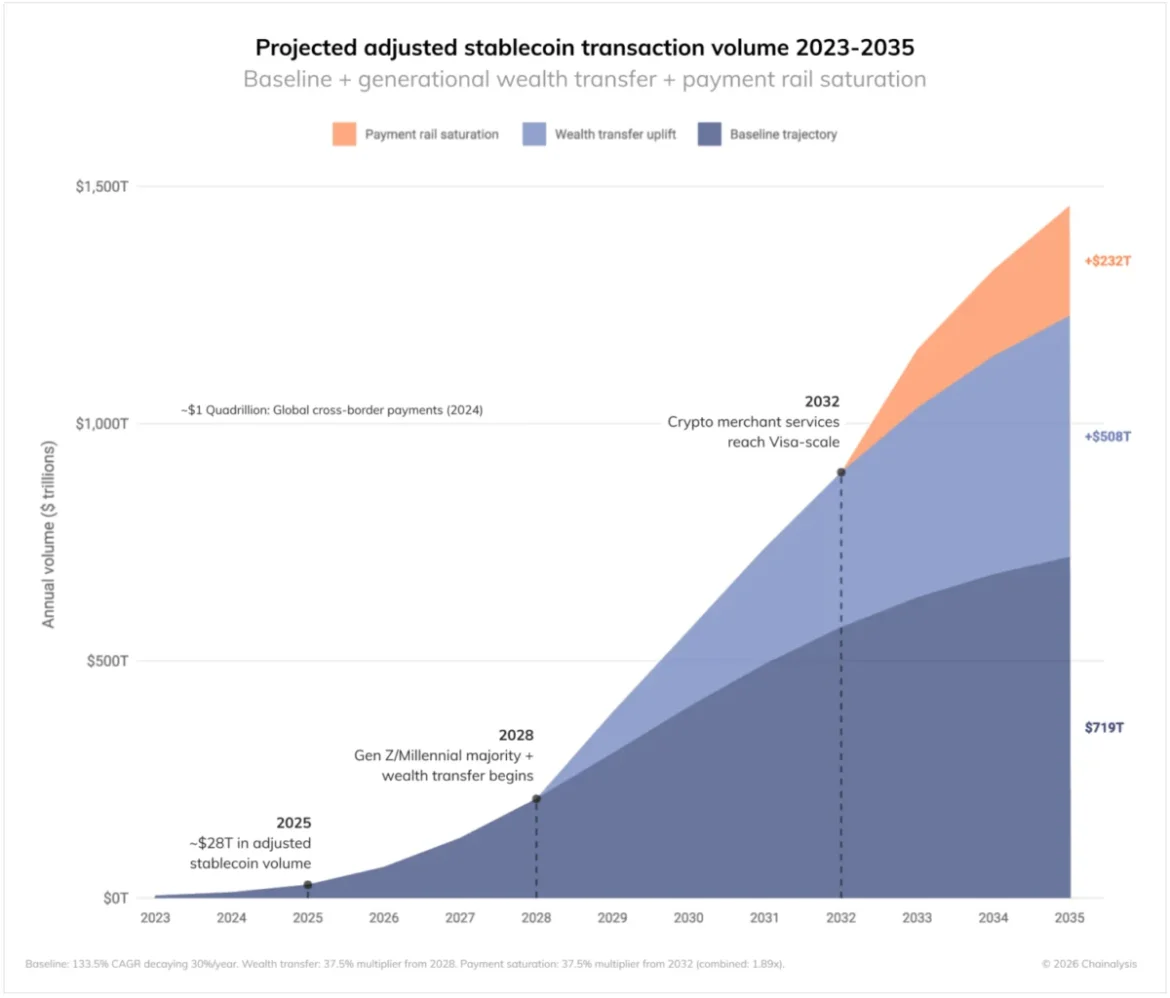
In 2025, stablecoins processed $28 trillion in real economic volume. By 2035, that figure could reach $1.5 quadrillion, surpassing today’s entire cross-border payments market. This projection, derived from Chainalysis’ forthcoming report, "The New Rails: How Digital Assets Are Reshaping the Foundations of Finance," signals a seismic shift in global financial infrastructure, driven by the increasing utility and adoption of stablecoins.
The rapid ascent of stablecoins, digital assets pegged to stable underlying assets like fiat currencies, has captured the attention of financial institutions worldwide. This surge in interest is further underscored by recent legislative momentum, such as the GENIUS Act in the United States, which has signaled a more defined regulatory framework for digital assets. Beneath the policy discussions and market speculation, however, lies a critical question for traditional finance: what does the economic data reveal about the inherent risks and burgeoning opportunities presented by stablecoins?
For established financial players, the advent of stablecoin technology presents a compelling case for innovation. It offers the potential to unlock significantly faster, more cost-effective, and programmable payment systems. Conversely, institutions that hesitate to embrace these on-chain rails risk obsolescence and disintermediation in an evolving financial landscape.
The Inherent Advantages of On-Chain Payments
Unlike the established payment systems, which are often characterized by layers of intermediaries, batch processing, and multi-day settlement windows, stablecoins operate with remarkable efficiency. They facilitate near-instantaneous settlement, function 24/7, and bypass the traditional friction of correspondent banking for cross-border transactions. This translates into tangible benefits for both financial institutions and their clientele: reduced transaction costs, enhanced payment finality, and the enablement of programmable money that can be seamlessly integrated into software and existing business workflows.
The operational advantages of stablecoin-powered payments are profound. They can significantly reduce reconciliation overhead, eliminate the need for multiple intermediaries, and enable continuous, round-the-clock transactions across global markets. These benefits are already driving widespread adoption in critical sectors such as remittances, business-to-business (B2B) payments, and treasury operations, as evidenced by increasing transaction volumes and user engagement.
This report, the first in a series exploring the multifaceted use cases of stablecoins across various financial products, places a primary focus on the payments sector, where stablecoins currently exhibit the most significant traction. However, the transformative potential of stablecoins extends far beyond payments, poised to reshape lending, capital markets, and treasury and liquidity management. Two powerful forces are converging to accelerate this evolution: the largest generational wealth transfer in history, projected to move up to $100 trillion to crypto-native Millennials and Gen Z, and the steady, quiet march toward stablecoin acceptance at the point of sale. These catalysts, acting in concert, have the potential to fundamentally alter the competitive dynamics of the payments landscape, a shift that traditional financial institutions can no longer afford to ignore.

Measuring True Utility: Adjusted Stablecoin Volume Projections
The raw transaction data associated with stablecoins can often be misleading, inflated by activities such as liquidity provisioning, bot trading, and Maximum Extractable Value (MEV) transfers. These activities, while contributing to on-chain activity, do not reflect genuine economic utility. To provide a more accurate picture of real-world impact, Chainalysis employs the metric of "adjusted stablecoin volume." This metric meticulously filters for organic economic activity, focusing on transactions that represent actual payments, remittances, and settlements.
Since 2023, adjusted stablecoin volume has demonstrated a remarkable compound annual growth rate (CAGR) of 133%, reaching an estimated $28 trillion in real economic activity in 2025. Projecting this baseline growth forward, assuming no significant additional catalysts, the volume could potentially reach $719 trillion by 2035.
However, this baseline projection likely understates the true potential acceleration of stablecoin adoption. Two significant macro inflection points are anticipated to drive this growth substantially:
- The Generational Wealth Transfer: A demographic shift of unprecedented scale is set to occur as wealth transitions from older generations to younger, more digitally adept demographics.
- Point-of-Sale (POS) Saturation: The increasing integration of stablecoins into everyday commerce at retail points of sale will normalize their use and broaden their accessibility.
Factoring in these powerful catalysts, Chainalysis’ projections are revised upwards. By 2035, stablecoin volumes could approach $1.5 quadrillion, a figure that would eclipse the estimated $1 quadrillion in global cross-border payments today. This suggests a fundamental reordering of global payment flows and infrastructure.
The Imminent $100 Trillion Transition: A Generational Shift in Wealth and Digital Asset Adoption
Beginning around 2028, traditional financial institutions in North America and Europe are poised to confront a profound demographic transformation. Millennials and Gen Z, demographics where nearly half have historically held or currently hold cryptocurrency, will gradually constitute the majority of the adult population. This demographic shift will see them progressively supplanting Gen X and Baby Boomers as the primary drivers of financial activity and consumer behavior.
Accompanying this demographic evolution is an enormous movement of capital. Merrill Lynch estimates that by 2048, an astonishing $100 trillion in wealth could be transferred from the Baby Boomer generation to their children and grandchildren. This "Great Wealth Transfer" represents a critical juncture for the financial services industry.

The impact of this wealth transfer on cryptocurrency adoption is projected to be substantial. Chainalysis estimates that this transition alone could add an estimated $508 trillion to annual stablecoin transaction volumes by 2035. Beyond direct stablecoin usage, this shift is also expected to catalyze broader adoption of crypto assets, fostering ancillary growth in on-chain prediction markets, the tokenization of real-world assets, and other hybrid financial products that bridge traditional finance (TradFi) and decentralized finance (DeFi). For incumbent financial institutions, this presents a dual imperative: either actively capture the financial flows from an increasingly crypto-native client base or risk seeing significant capital migrate to on-chain ecosystems. This necessitates a proactive strategy to integrate digital asset capabilities into their service offerings.
Crypto at Every Point of Sale: The Normalization of On-Chain Commerce
The integration of stablecoins into merchant services marks a pivotal stage in the evolution of on-chain payment utility: a transition from specialized transfers to mainstream, everyday commerce.
Currently, the act of paying with cryptocurrency often represents a deliberate choice, a conscious decision by the user. However, as stablecoin acceptance becomes a standard feature of retail infrastructure, this distinction will blur. The experience of using stablecoins for transactions will become indistinguishable from traditional methods like swiping a credit or debit card. This shift is already underway, with stablecoin payments gradually moving from a conscious consumer decision to a seamless background settlement process.
In stark contrast to legacy card networks, stablecoin rails offer the potential for near-instantaneous merchant settlement and a significant reduction in interchange-related costs. These fees, a significant operational expense for merchants, can be substantially mitigated or eliminated through on-chain payment solutions.
If current trends in transaction count growth persist, on-chain stablecoin transactions could potentially match the transaction volumes of major off-chain networks like Visa and Mastercard sometime between 2031 and 2039. Given that adoption curves for payment networks are rarely linear, it is plausible that on-chain transaction counts could intersect or even surpass legacy rails before the end of the current decade.
The implications for the payments industry are profound. As stablecoins become ubiquitous at the point of sale, consumers will begin to evaluate payment options based on similar criteria as they do with credit cards: transaction costs, settlement speed, and potential incentives like cashback rewards. Stablecoin-linked payment cards will emerge as direct competitors to existing payment infrastructure. For established players like Visa and Mastercard, this is not a distant threat but an accelerating countdown to a fundamentally altered competitive landscape. Chainalysis estimates that POS saturation alone could contribute an additional $232 trillion in annual stablecoin volumes by 2035, further solidifying the economic significance of these digital rails.
The Institutionalization of On-Chain Finance: A Strategic Imperative

The confluence of the generational wealth transfer and the impending point-of-sale saturation signals a new financial baseline, one where stablecoin rails are an integral component of global payment infrastructure. The strategic approach of traditional financial institutions is evolving from mere regulatory positioning to active execution. This involves a concerted effort to acquire relevant platforms, forge strategic partnerships, and build the necessary infrastructure to operate seamlessly across both legacy and on-chain payment rails.
Notable examples of this strategic shift are already emerging. Stripe’s acquisition of Bridge and Mastercard’s partnership with BVNK represent significant strategic investments in the future of payments. These moves underscore a growing recognition within the financial industry that the blockchain is rapidly becoming the essential plumbing for the next era of global commerce and financial transactions.
For incumbent financial institutions, the calculus is becoming increasingly straightforward. The institutions that proactively build for this emerging reality will be strategically positioned to define its trajectory and capture significant market share. Conversely, those that adopt a wait-and-see approach risk finding themselves relegated to settling transactions on payment rails built and controlled by others, potentially diminishing their relevance and competitive edge in the years to come.
FAQs
What is the difference between raw and adjusted stablecoin volume?
Raw stablecoin volume encompasses all on-chain activity, including speculative trading and internal transfers. Adjusted stablecoin volume, however, filters out this "noise" to isolate genuine economic utility, focusing on transactions related to payments for goods and services, remittances, and legitimate settlements.
How will the “Great Wealth Transfer” affect crypto adoption?
The impending transfer of an estimated $100 trillion to Millennials and Gen Z—demographics demonstrably more comfortable with digital assets—is anticipated to significantly boost cryptocurrency adoption. Chainalysis projects this shift could add over $500 trillion to annual on-chain transaction volumes by 2035, fundamentally reshaping investment and spending patterns.
When will crypto payments reach the same scale as Visa and Mastercard?
Based on current growth trends, stablecoin transaction volumes are projected to intersect with the transaction volumes of major card networks like Visa and Mastercard between 2031 and 2039. This projection is driven by the increasing normalization of on-chain payments at the point of sale, positioning them as a standard for global commerce.
This article is based on a preview of Chainalysis’ forthcoming report, "The New Rails: How Digital Assets Are Reshaping the Foundations of Finance." Readers are encouraged to reserve their copy of the full report for more in-depth analysis and data. The information presented here is for informational purposes only and does not constitute financial, investment, or legal advice. Recipients should consult with their own qualified advisors before making any decisions.