
The United Kingdom is strategically positioning itself at the forefront of a significant transformation in financial markets: the practical integration of tokenized financial assets. Leveraging its robust capital markets, influential asset management sector, and established role as a hub for financial market infrastructure, the UK is embracing tokenization not as a fringe experiment, but as a fundamental evolution of its existing financial ecosystem. This proactive approach, underpinned by a deliberate and collaborative regulatory framework, is paving the way for widespread adoption and operational efficiency.
The journey towards this practical phase has been meticulously guided by key regulatory bodies. The Financial Conduct Authority (FCA), HM Treasury, and the Bank of England have collectively orchestrated a sequenced approach. This has involved providing clear guidance, conducting extensive consultations, and establishing regulatory sandboxes. These sandboxes have offered a controlled environment for innovation, allowing firms to test new technologies and business models while ensuring that high standards of market conduct and operational resilience are maintained. This measured strategy has cultivated an environment where tokenization is increasingly perceived as an enhancement to existing financial infrastructure, rather than a departure from established practices. Consequently, market participants, including index providers, asset managers, fintech innovators, and infrastructure developers, are transitioning from theoretical pilot programs to the development of production-grade implementations designed to address tangible operational challenges.
Tokenization as a Catalyst for Efficiency and Enhanced Connectivity
In the United Kingdom’s financial landscape, tokenization is primarily focused on re-engineering the operational mechanisms of existing financial instruments rather than introducing entirely novel asset classes. The digital representation of funds, securities, and reference data on blockchain networks unlocks significant opportunities for process automation. This is particularly relevant for post-trade operations, data dissemination, and cross-platform coordination, areas that currently grapple with fragmentation and high operational costs.
The potential benefits are amplified for a market like the UK, which plays a critical role in intermediating global capital flows. By enhancing the speed and consistency with which assets, data, and transactional instructions are exchanged between institutions, tokenization promises to reduce friction not only within the domestic market but also across international value chains connected to London’s financial ecosystem. Crucially, this integration does not necessitate the abandonment of existing infrastructure. Instead, tokenization is being layered onto current systems, requiring robust interoperability between blockchain networks, custodians, data providers, and compliance frameworks.
The foundational elements for successful tokenization are becoming increasingly clear, with a consistent theme emerging: the efficacy of tokenized assets hinges less on the token itself and more on the robustness of the supporting infrastructure.
The Primacy of Infrastructure: Data, Compliance, and Interoperability
As tokenization initiatives in the UK mature, a common thread has emerged: the success of these endeavors is intrinsically linked to the quality and sophistication of the underlying infrastructure. High-quality market data serves as a cornerstone for any institutional financial activity. Pricing, indices, and benchmark reference data are indispensable for portfolio construction, risk management, and a myriad of other critical functions.
A significant development in this area is the move by FTSE Russell, a division of the London Stock Exchange Group, to publish its global indices on-chain through Chainlink’s DataLink. This initiative is a testament to the growing recognition of the need for trusted data to be directly accessible on blockchain networks. By making benchmark data, which underpins the management of trillions of pounds in assets, available on-chain, this collaboration ensures that tokenized products can leverage the same reliable inputs that traditional funds and securities depend upon. This move, effective from late 2023, marks a crucial step in bridging the gap between traditional data provision and decentralized finance.
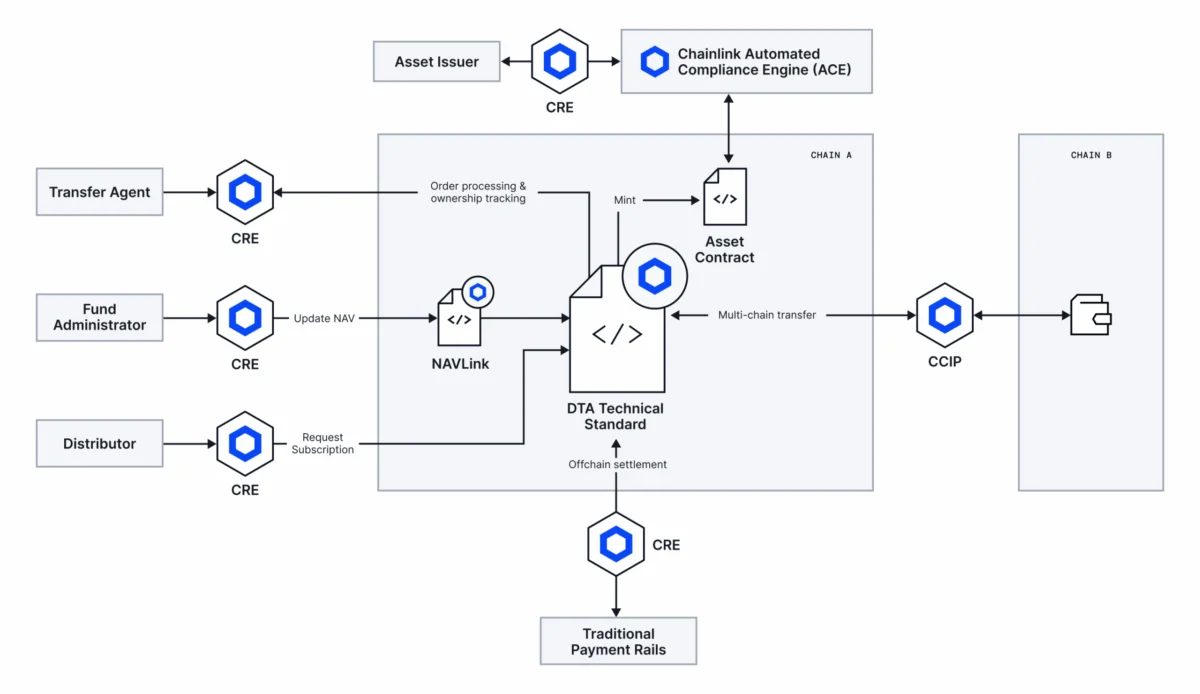
Compliance represents another critical structural priority. UK financial institutions operate under stringent governance and supervisory frameworks, and tokenized assets must adhere to these same exacting standards. This has spurred significant interest in programmable compliance and policy enforcement mechanisms that can operate seamlessly across diverse blockchain environments while remaining aligned with regulatory mandates. Chainlink’s Automated Compliance Engine (ACE) is an example of infrastructure designed to address this need. ACE enables the direct embedding and consistent enforcement of compliance rules, eligibility checks, and policy controls within on-chain workflows, ensuring adherence across various networks.
This infrastructural development is further bolstered by market participants actively building case management and regulatory reporting workflows atop programmable compliance solutions. Collaborations are underway to align ACE with established regulatory frameworks for digital securities, illustrating how compliance, reporting, and governance can evolve in tandem with tokenization without compromising regulatory integrity.
Interoperability serves as the critical link that binds these infrastructural elements together. In practical terms, tokenized assets in the UK will need to interact with multiple blockchains, legacy systems, and international counterparties. Standardized interoperability frameworks, such as Chainlink’s Cross-Chain Interoperability Protocol (CCIP), and orchestration tools like the Chainlink Runtime Environment (CRE), are increasingly recognized as enabling technologies. These tools facilitate the secure movement of assets, data, and workflows across these disparate environments, ensuring seamless communication and transaction execution.
Institutional Momentum Across the UK Financial Ecosystem
The asset management and operations sectors are witnessing tangible progress. Schroders, a prominent global asset manager, participated in the Corporate Actions Lifecycle Management (CALM) project, a collaborative initiative led by Chainlink with the involvement of over twenty financial market participants. This project aims to modernize the processing of corporate actions, an area notoriously complex and costly due to fragmented data flows and manual reconciliation processes. By leveraging blockchain-based workflows and verifiable data infrastructure, the CALM project seeks to automate key lifecycle events, enhance data accuracy and timeliness, and mitigate operational risks. This aligns perfectly with the UK market’s emphasis on efficiency, transparency, and resilience in financial operations.
At the confluence of traditional finance (TradFi) and decentralized finance (DeFi), Chainlink’s engagements with Aave Labs and Euler Labs exemplify a burgeoning trend. These collaborations are exploring the integration of institutional-grade data, risk controls, and compliance considerations into on-chain lending and liquidity markets. For UK-based institutions with global operations, such integrations offer a strategic pathway to access the benefits of programmable financial primitives while maintaining essential safeguards and regulatory compliance.
These evolving use cases demonstrate a clear shift from broad, exploratory pilot programs towards production-oriented applications that target specific market inefficiencies and deliver tangible operational improvements.
A Regulatory Environment Architected for Gradual Scaling
The UK’s carefully calibrated regulatory approach has been instrumental in fostering this measured yet progressive development. Rather than mandating specific technologies, regulators have focused on defining desired outcomes—such as market integrity, consumer protection, and operational resilience. This allows firms the flexibility to determine the most effective methods for achieving these standards.
The FCA’s ongoing work on fund tokenization, coupled with proposals for a financial market infrastructure sandbox, signals a clear openness to innovation within defined parameters. This approach encourages institutions to invest in tokenization initiatives that are compatible with existing governance models, thereby avoiding the need for disruptive and potentially destabilizing changes. Within this supportive framework, emerging infrastructure like Chainlink’s Digital Transfer Agent (DTA) standard offers a glimpse into the future of fund administration. It demonstrates how core functions, such as ownership records, transfer restrictions, and lifecycle events, can be automated and synchronized across both on-chain and traditional systems, while remaining fully compliant with regulatory and operational requirements. The DTA standard, which has seen early input and refinement since its initial conceptualization in late 2023, aims to provide a technical blueprint for this seamless integration.
Crucially, this regulatory posture also facilitates interoperability with other international jurisdictions. By establishing clear standards and fostering an environment of innovation, the UK is enabling its firms to actively participate in global tokenized markets as these standards continue to converge worldwide.
Implications for UK Decision-Makers
For banks, asset managers, infrastructure providers, and policymakers in the UK, the current phase of tokenization is less about hypothetical experimentation and more about strategic execution. The focus is increasingly shifting towards selecting scalable infrastructure, seamlessly integrating digital assets into existing workflows, and ensuring that governance and risk management frameworks evolve in concert with technological advancements.
Successful tokenization initiatives are characterized by their emphasis on trusted data sources, standardized connectivity protocols, and the proactive integration of compliance considerations from the outset. Neutral infrastructure providers that facilitate these capabilities, without locking institutions into proprietary ecosystems, are playing an increasingly vital role in shaping the market’s trajectory. The development of open standards and interoperable solutions will be paramount in ensuring that the UK’s financial ecosystem can harness the full potential of tokenization. The implications are far-reaching, promising enhanced efficiency, reduced costs, and the creation of new avenues for capital formation and investment. As the UK continues to navigate this transformative period, its deliberate and infrastructure-focused approach positions it as a global leader in the practical application of tokenized finance.
