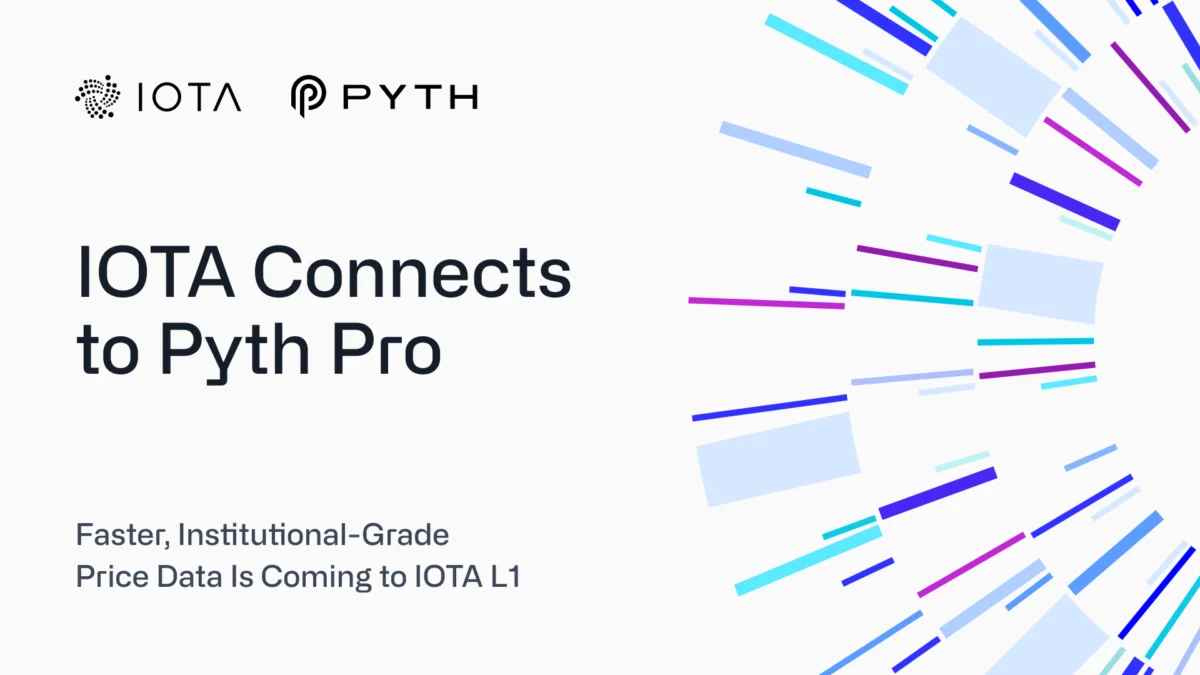
The IOTA ecosystem has reached a significant milestone in its decentralized finance evolution as Layer 1 officially integrates with Pyth Pro, the next-generation institutional-grade price feed infrastructure developed by the decentralized oracle network Pyth. This strategic integration marks a pivotal leap forward for developers building on IOTA, providing them with vastly improved data latency, enhanced system reliability, and an expansive catalogue of over 3,000 real-time price feeds spanning traditional and digital financial markets.
While the transition brings substantial performance upgrades to the IOTA network, it is part of a broader, sweeping architectural overhaul initiated by the Pyth Network. This network-wide migration shifts the ecosystem’s center of gravity away from legacy infrastructure toward a commercialized, high-performance tier designed to meet the rigorous demands of institutional finance. As the decentralized ledger technology (DLT) landscape matures, the convergence of traditional financial data standards with high-throughput blockchain networks like IOTA underscores an industry-wide push toward institutional adoption, tokenized real-world assets (RWAs), and high-frequency decentralized applications.
The Evolution of Decentralized Oracles and the Need for Speed
Decentralized oracles serve as the foundational bridges connecting blockchain smart contracts with real-world, off-chain data. In the early days of decentralized finance, simple price feeds updated at relatively slow intervals were sufficient to support basic lending and automated market-making protocols. However, as the ecosystem matured into complex derivatives trading, perpetual exchanges, and sophisticated cross-chain financial instruments, the limitations of early oracle designs became apparent. Latency issues, vulnerability to cross-chain bridge bottlenecks, and a lack of coverage for traditional asset classes hindered the growth of institutional-grade decentralized applications.
Pyth Network emerged to address these exact challenges by pioneering a first-party data model, sourcing price information directly from premier institutional market makers, traditional exchanges, and multi-national trading firms rather than third-party aggregators. This direct-sourcing methodology ensures high fidelity, cryptographic verification, and rapid update frequencies. For IOTA, which has increasingly focused on enterprise adoption, modular architecture, and scalable decentralized finance infrastructure, partnering with a leading oracle provider has been essential to unlocking advanced developer capabilities.
Understanding the Infrastructure Shift: From Pythnet to Pyth Pro
To fully grasp the magnitude of the recent integration, it is necessary to examine the underlying architectural transition occurring within the Pyth Network. Historically, real-time price feeds on IOTA and numerous other blockchain networks were powered by Pythnet—a specialized, decentralized app-chain built on Solana’s technology stack. Pythnet relied heavily on the Wormhole cross-chain interoperability bridge to relay authenticated price data packets across dozens of distinct layer-1 and layer-2 blockchain ecosystems.
While Pythnet successfully decentralized price delivery and provided sub-second updates to early adopters, the continuous growth of the multichain universe necessitated a more robust, scalable, and commercially sustainable foundation. Consequently, the Pyth Network core contributors announced the formal retirement of Pythnet, pivoting the network’s primary infrastructure toward Pyth Pro.
Pyth Pro is engineered specifically to function as an institutional-tier product. It consolidates a massive array of over 3,000 price feeds spanning equities, foreign exchange (FX) markets, commodities, exchange-traded funds (ETFs), fixed income securities, and digital assets into a unified, high-performance distribution network. By leveraging standardized application programming interfaces (APIs) and transparent tiered subscription models, Pyth Pro bridges the operational gap between traditional financial institutions and decentralized protocols.
Technical Implications for IOTA Developers
For developers building smart contracts and decentralized applications (dApps) on IOTA Layer 1, the migration to Pyth Pro delivers immediate, tangible technical advantages. Previously, IOTA smart contracts could query cryptographically verified prices refreshed approximately every second. While efficient for basic use cases, the new Pyth Pro infrastructure dramatically reduces latency while scaling the sheer volume and diversity of accessible data points.
Applications requiring constant, high-frequency price updates—such as decentralized perpetual exchanges, algorithmic margin trading platforms, synthetic asset protocols, and automated risk management systems—stand to benefit the most from this upgrade. By gaining access to TradFi-grade data quality directly on-chain, IOTA developers can construct sophisticated financial products that rival the execution speeds and asset depth of traditional centralized brokerages.
However, this transition also introduces critical operational requirements for the developer community. Because Pyth is deprecating its legacy architecture, existing implementations relying on Pyth Core must undergo manual migration. Developers have been given a strict deadline of August 18 to update their smart contracts and integrate the new Pyth Pro endpoints. Failure to complete this migration before the deadline will result in legacy price feeds freezing, potentially disrupting dependent decentralized applications. This urgent timeline highlights the active maintenance required when building on composable, modular blockchain infrastructure.
A Commercial Transition and New Economic Models
Beyond the technical enhancements, the migration to Pyth Pro signifies a fundamental shift in the economic models governing decentralized oracle networks. The previous iteration of Pyth offered largely free, decentralized price feed services supported by network grants and early-stage ecosystem incentives. While effective for bootstrapping network growth, this model presented long-term sustainability challenges regarding node operator compensation, data provider incentives, and continuous infrastructure maintenance.
Pyth Pro introduces a revenue-based economic model characterized by structured, tiered subscription pricing for institutional consumers and high-demand enterprise users. This commercial evolution ensures that first-party data publishers—such as global trading desks and market-making heavyweights—receive fair economic compensation for contributing high-fidelity financial data to the decentralized ecosystem.
For the IOTA Foundation and the broader IOTA community, aligning with this commercialized oracle infrastructure positions the network securely within the modern digital economy. As financial institutions increasingly demand predictable service-level agreements (SLAs), guaranteed uptime, and rigorous compliance standards, subsidized or community-funded oracle models often fall short. By adopting Pyth Pro, IOTA developers gain access to enterprise-grade data guarantees that satisfy the compliance and operational prerequisites of institutional capital.
Broader Industry Impact: Bridging DeFi and TradFi
The integration of Pyth Pro into IOTA Layer 1 is part of a synchronized, network-wide migration occurring across the entire blockchain landscape. As Pyth transitions its entire ecosystem from legacy systems to institutional-grade rails, networks that fail to keep pace risk technological stagnation. IOTA’s proactive adoption ensures its developer ecosystem remains competitive in a multi-chain environment where speed, security, and data diversity dictate platform success.
This infrastructural upgrade arrives at a time when the convergence of decentralized finance (DeFi) and traditional finance (TradFi) is accelerating rapidly. Tokenization of real-world assets—ranging from United States Treasury bills and corporate bonds to physical real estate and commodities—requires ultra-reliable, tamper-proof pricing data to maintain accurate net asset values (NAV) and execute automated liquidations. Without institutional-grade oracles, the tokenization of RWAs remains vulnerable to price manipulation, stale data feeds, and oracle front-running.
By embedding Pyth Pro into its foundational layer, IOTA provides the necessary infrastructure for institutional participants to securely deploy capital on-chain. Financial institutions exploring private permissioned ledgers or public DLT environments require the same data integrity they experience in legacy financial markets. Pyth Pro’s ability to deliver traditional asset classes alongside digital assets through standardized APIs acts as a critical catalyst for this institutional influx.
Chronology and Timeline of the Transition
The path toward the current IOTA-Pyth Pro integration reflects a carefully coordinated multi-phase timeline executed by the Pyth Network core contributors and supported by regional ecosystem foundations:
- Early Development Phase: Pyth Network establishes its decentralized footprint via Pythnet, relying on the Wormhole bridge to connect high-frequency price feeds to non-native chains, including IOTA.
- Strategic Roadmap Announcement: Pyth Network leadership publishes comprehensive proposals outlining the "next chapter" of oracle infrastructure, detailing the eventual retirement of Pythnet and the introduction of Pyth Pro alongside a revenue-based economic model.
- Infrastructure Rollout: Pyth Pro is deployed as the centralized tier for institutional data distribution, consolidating over 3,000 price feeds across multi-asset classes.
- IOTA Layer 1 Integration: The IOTA Foundation announces the official connection of IOTA L1 to Pyth Pro, granting local developers immediate access to low-latency, institutional-grade price feeds.
- Developer Migration Window: An industry-wide migration period is enforced, culminating in a strict deadline of August 18 for developers utilizing Pyth Core to update their codebase or face service discontinuation.
Implications for the Future of IOTA Ecosystem Growth
The successful integration of Pyth Pro opens a new chapter for IOTA’s burgeoning DeFi ecosystem. Historically, IOTA faced criticism during earlier market cycles for prioritizing pure Internet of Things (IoT) machine-to-machine data streaming over traditional financial smart contract applications. However, with the successful rollout of IOTA’s EVM-compatible layers, modular frameworks, and institutional partnerships, the protocol has established itself as a versatile, high-utility distributed ledger.
With reliable, sub-second institutional price data now natively accessible on IOTA Layer 1, project founders and enterprise builders can conceptualize and deploy advanced financial primitives with confidence. Whether powering automated insurance payout contracts triggered by real-time weather or commodity indices, or supporting high-leverage decentralized exchanges, the availability of Pyth Pro removes a historically significant technical barrier.
Nevertheless, developers and stakeholders must remain vigilant regarding the impending August 18 migration deadline. Ecosystem health during infrastructure upgrades relies heavily on clear communication, community coordination, and technical preparedness. The IOTA Foundation’s proactive dissemination of migration guidelines aims to mitigate any potential disruption, ensuring a seamless transition for active decentralized applications.
As the decentralized oracle landscape continues to consolidate around high-performance, commercially sustainable models, the partnership between IOTA and Pyth Network exemplifies the maturation of Web3 infrastructure. By aligning with institutional standards, IOTA reinforces its commitment to supporting secure, scalable, and enterprise-ready decentralized applications capable of bridging the gap between traditional global markets and the decentralized future.