
The global silver market finds itself at a precarious technical juncture, testing the resilience of long-term investors as prices hover dangerously close to the psychological $40 threshold. Following a dramatic retreat from summer highs near $70, silver has experienced a sharp acceleration in downward momentum. This aggressive sell-off has exposed deep structural fragilities across the precious metals complex, leaving market participants scrambling to assess whether crucial support levels will hold or if a deeper correction is underway.
As macroeconomic headwinds mount, characterized by shifting central bank policies, a robust U.S. dollar, and fluctuating industrial demand, the immediate future of silver hinges on its ability to stave off persistent bearish pressure. Market analysts and floor traders alike are closely monitoring daily closes, recognizing that a breach of current support could trigger a cascading wave of automated liquidations.
Chronology and Recent Price Action
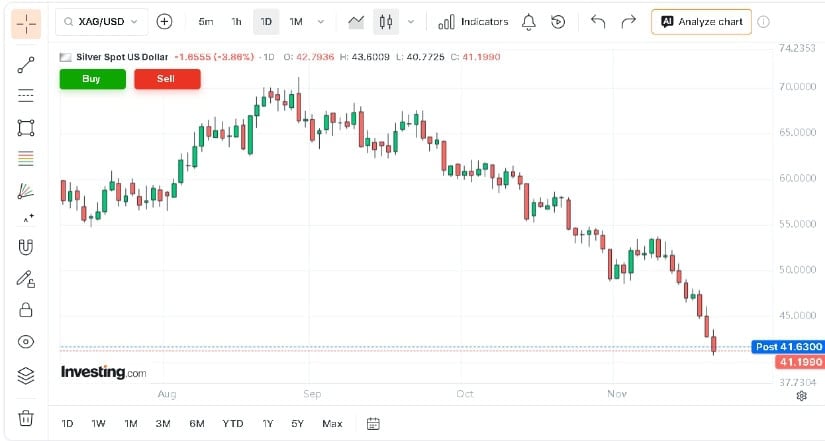
The current downward trajectory represents a dramatic reversal from the bullish conditions that characterized much of the earlier part of the year. In August, silver reached impressive cyclical highs, touching approximately $70 per ounce amid robust investor enthusiasm and safe-haven demand. However, this peak marked the exhaustion of the bullish run, initiating a sustained period of distribution characterized by a distinct pattern of successive lower highs and lower lows.
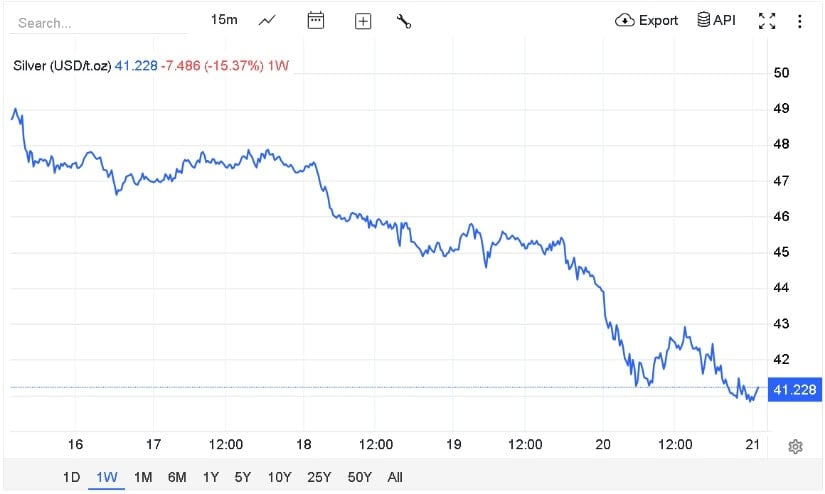
A brief glimmer of hope emerged in November, when the precious metal attempted a technical recovery. This relief rally briefly pushed prices back toward the $53 region, enticing optimistic buyers back into the market. The optimism proved short-lived, however. The recovery collapsed swiftly under renewed selling pressure, dragging prices down by 15.37% over a single week to hover around $41.23 per ounce, according to Trading Economics data.

The intraday data further illustrates the intensification of the sell-off. Daily charts from Investing.com indicate a single-session loss of 3.86%, which brought prices down to an intraday low of $40.77 before a modest stabilization near $41.20. This rapid descent has pushed the asset to the lower boundary of its broader daily consolidation range, placing immense strain on market participants who entered long positions during the earlier phases of the year.
Macroeconomic Catalysts and Market Pressures
The collapse in silver prices is not occurring in a vacuum; rather, it reflects a broader macro-driven rout across the entire precious metals sector. According to a prominent market report published by the Wall Street Journal, the synchronized decline in both gold and silver has been heavily catalyzed by rising yields on U.S. government bonds and a persistently strong U.S. dollar.
As Treasury yields climb, the opportunity cost of holding non-yielding assets like precious metals increases significantly, diverting institutional capital toward fixed-income instruments. Concurrently, a strengthening greenback makes dollar-denominated commodities more expensive for international buyers, dampening global demand. Adding to these monetary headwinds are expectations of continued, cautious policy tightening by the Federal Reserve, keeping market participants on edge regarding December rate decisions.
Crucially, silver occupies a unique dual role in the global economy, functioning both as a monetary hedge and an essential industrial input. This dual identity often exacerbates its price volatility. Unlike gold, which is driven primarily by investment and central bank reserves, silver is deeply integrated into manufacturing supply chains, including electronics, solar energy technology, and automotive production. When macroeconomic indicators flash warning signs regarding global economic growth and manufacturing activity, industrial demand expectations contract rapidly. This industrial vulnerability often causes silver to underperform relative to gold during periods of macroeconomic anxiety, amplifying downside price swings.
Technical Outlook: The Battle for the $40 Floor
From a technical analysis perspective, the short-term outlook for silver remains decidedly bearish. Technical summaries from platforms such as Investing.com categorize silver as a "strong sell," citing Relative Strength Index (RSI) readings entrenched well below the neutral 50 threshold. Furthermore, the majority of short- and medium-term moving averages continue to project downward momentum, signaling that sellers remain firmly in control of the market dynamics.
The immediate focal point for the trading community is the $40 price level. The recent session low of $40.77 serves as the first line of defense, but the psychological and technical significance of the round $40 mark cannot be overstated.
Market technicians outline two primary scenarios for the immediate future:
- Bearish Continuation: Should silver experience consecutive daily closes below the $40 threshold, it would invalidate remaining bullish structures, reinforce the prevailing series of lower lows, and likely invite a new wave of algorithmic selling pressure toward deeper historical support zones.
- Bearish Exhaustion and Rebound: Conversely, if prices dip temporarily below $40 only to experience a rapid, volume-backed recovery, it would indicate that dip-buyers and short-sellers are stepping in to cover positions. Such a price action would suggest that the current selling pressure is becoming exhausted.
Should a meaningful recovery materialize from these lower levels, analysts point to an initial resistance band between $42.80 and $43.60, representing the opening and higher levels of recent daily trading sessions. Overcoming this hurdle would be necessary for silver to challenge stronger resistance barriers around the $45 mark, where prior selling pressure was heavily concentrated. A broader, more formidable resistance zone sits between $47 and $48, representing a major historical consolidation area that preceded the initial breakdown.
Broader Implications for Investors and Industry
The ongoing correction in the silver market carries profound implications for various market participants, ranging from speculative day traders to long-term industrial consumers. For active traders, risk management has become the paramount concern. Maintaining strict stop-loss protocols around the $40 level is widely considered essential to protect capital against a potential accelerated downturn.
For long-term investors and physical bullion holders, the current volatility underscores the importance of a diversified portfolio and a high tolerance for cyclical drawdowns. While structural long-term drivers—such as the global green energy transition and persistent photovoltaic manufacturing demand—remain supportive of silver’s utility, short-term price discovery is currently dictated almost entirely by macroeconomic liquidity and interest rate trajectories.
Industrial manufacturers, who rely heavily on predictable input costs, are navigating a complex environment. While lower silver prices temporarily reduce raw material acquisition costs, extreme price volatility complicates hedging strategies and supply chain budgeting.
What Market Participants Are Watching Next
As trading resumes, market participants are keeping a watchful eye on several key indicators to gauge the next definitive move:
- U.S. Dollar and Treasury Yield Fluctuations: Any cooling of bond yields or a softening of the U.S. dollar could provide immediate relief to precious metals, whereas continued strength in these metrics will sustain downward pressure.
- Federal Reserve Communications: Signals regarding monetary policy trajectories, particularly concerning December rate decisions, will heavily dictate risk sentiment across global financial markets.
- Industrial Data Releases: Manufacturing purchasing managers’ indexes (PMIs) and industrial output reports from major global economies will be scrutinized for clues regarding actual physical demand for silver.
- Daily Closes Relative to $40: Ultimately, price action around the $40 level will dictate market psychology in the immediate term, serving as the definitive battleground between entrenched bears and opportunistic buyers.
Until decisive technical resistance is cleared or a solid foundation of support is definitively established, the silver market remains vulnerable to further downside consolidation. Traders and investors are advised to exercise caution, closely monitor macroeconomic data releases, and maintain disciplined risk management strategies as the market navigates this critical phase.