The digital asset landscape across Central and Southeast Asia and Oceania (CSAO) is undergoing a structural transformation, characterized by shifting adoption patterns, regulatory maturation, and an increasing reliance on stablecoins for cross-border utility. According to recent data tracking digital asset activity between July 1, 2025, and June 30, 2026, the region’s overall crypto economy contracted by 6.8%. Despite this regional contraction, specific markets registered notable growth across various use cases, ranging from tokenization initiatives and corporate treasury management to peer-to-peer (P2P) transfers.

The CSAO region ranks as the sixth-largest cryptocurrency economy globally. However, the aggregate regional figure masks a high degree of internal diversity. While institutional participation gained substantial momentum in advanced financial centers like Singapore and Australia, emerging markets such as the Philippines, Thailand, and Vietnam experienced P2P activity that significantly outperformed global trends. Meanwhile, India maintained its position as a major hub for speculative asset trading and centralized exchange inflows, and nations like Pakistan began re-evaluating their regulatory stances following years of strict prohibitions.
Regional Dynamics and Market Diversification

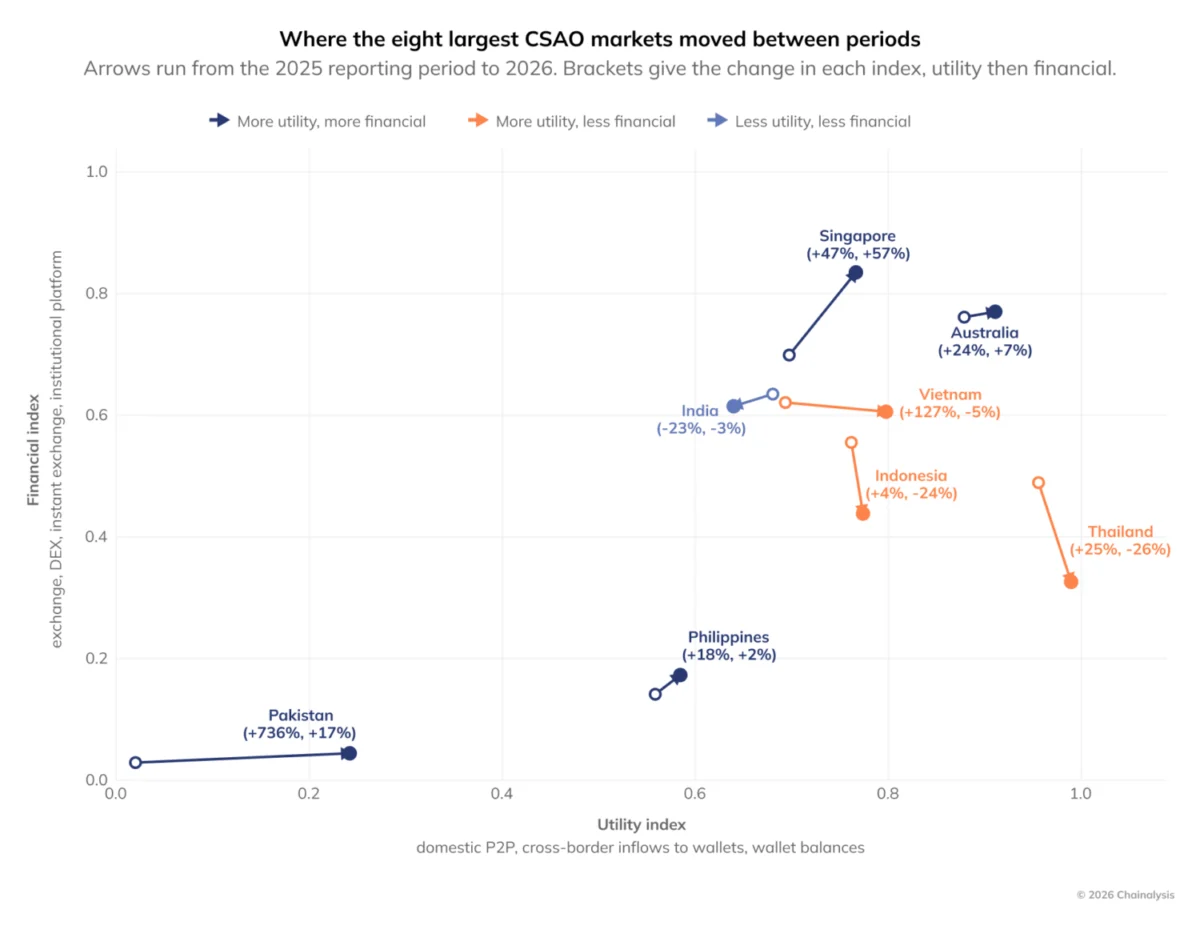
To understand the trajectory of digital asset adoption in CSAO, analysts evaluate activity across two distinct frameworks: a financial index and a utility index. The financial index tracks capital moving into exchanges, reflecting speculative trading, staking, lending, and investment-driven behavior. Conversely, the utility index measures the frequency and manner in which digital assets support day-to-day economic functions, such as domestic P2P payments and cross-border remittances.
During the 2026 period, Singapore emerged as the region’s largest measured crypto economy, recording $284 billion in total activity, which represents a 55.4% year-over-year increase. Australia followed as the second-largest digital assets market at $173.1 billion, despite experiencing a minor 5.6% contraction in overall activity driven by a decline in decentralized exchange (DEX) volume. India secured the third position with $135 billion in economic activity, despite a 14.7% contraction during the global bear market.

The growth observed in markets like Singapore and Australia was largely underpinned by institutional-platform activity. Institutional platforms—defined as market makers, prime brokers, over-the-counter (OTC) trading desks, custodians, and institutional-only exchanges—processed $152.3 billion across the region, marking a 40% year-over-year increase. By the end of the second quarter of 2026, institutional activity accounted for 18.9% of all regional crypto service inflows.
Regulatory Evolution and Institutional Integration

The acceleration of institutional participation across CSAO has been closely tied to regulatory developments. Governments and financial authorities throughout the region have actively worked to establish clearer legal frameworks, shifting traditional financial institutions from a posture of cautious observation to active integration.
In Singapore, the Monetary Authority of Singapore (MAS) has implemented targeted measures, including the Digital Payment Token (DPT) licensing regime and a comprehensive stablecoin regulatory framework. These policies have provided regulated entities with the legal clarity necessary to develop institutional-grade use cases. Consequently, Singapore’s institutional platform activity rose 94% year-over-year to $60 billion. This institutionalization is further evidenced by a shift in custody preferences: while 90% of Singapore-held crypto sat in self-custody wallets in 2020, that figure fell to 48% by mid-2026, dropping further below global benchmarks as capital moved into professionally managed custodial services.

In Australia, institutional inflows reached $40 billion, representing nearly a quarter of all service inflows in the country. Market participants attribute this growth to the rise of regulated financial wrappers, such as exchange-traded funds (ETFs) and retirement account integrations, alongside progressive regulatory measures. Australia’s legislative roadmap includes an expanded Anti-Money Laundering and Counter-Terrorism Financing (AML/CFT) regime implemented in 2026, as well as the Australian Securities and Investments Commission’s (ASIC) upcoming licensing framework for digital asset and tokenized custody platforms scheduled for 2027. Furthermore, initiatives like Project Acacia—a joint research project by the Reserve Bank of Australia and the Digital Finance Cooperative Research Centre—have explored the wholesale applications of tokenized assets and digital money.
Cross-Border Utility and the Rise of Stablecoins

While institutional finance anchors advanced markets, the utility index highlights a different trend across the wider region: the dominance of stablecoins in cross-border settlements. Across all analyzed CSAO markets, cross-border stablecoin activity consistently exceeded domestic stablecoin usage, with a regional ratio of 3.2 to 1. In Malaysia, this disparity was even more pronounced, with cross-border activity measuring 29.5 times larger than domestic transactions.
Industry experts explain that many countries in the region already possess highly efficient domestic digital payment rails, minimizing the utility of stablecoins for everyday local retail purchases. However, traditional banking systems often introduce significant friction, delays, and high fees for international transfers. Regulated stablecoins have thus become a practical tool for corporate treasuries, regional merchants, and remittance senders.

In the Philippines, which hosts one of the world’s largest remittance markets, stablecoins are increasingly utilized to streamline inbound funds from a vast diaspora. Executives at regional digital asset exchanges estimate that between 5% and 10% of total inbound remittances to the Philippines are now settled using stablecoins, with major remittance providers actively deploying stablecoin settlement infrastructure. Similarly, business-to-business (B2B) cross-border payments have become a deployed reality for corporate treasuries seeking to bypass traditional banking inefficiencies.
P2P Resilience in Southeast Asia

Beyond institutional finance and corporate settlements, smaller-value peer-to-peer (P2P) transfers continue to thrive in specific Southeast Asian economies. The Philippines, Thailand, and Vietnam recorded a combined 5.4 million small-value P2P transfers (defined as transactions under $10,000) during the 2026 period. This accounted for 14.4% of the global P2P total, despite the three nations representing just 2.5% of the worldwide crypto economy.
Data indicates that over 80% of domestic transfers within these three countries were under $1,000, with an average transfer size of $618, well below the global average of $1,210. Analysts attribute this high volume of retail-level activity to unique economic conditions. In Vietnam, for instance, stablecoins have increasingly functioned as an informal dollar savings vehicle for retail users seeking a hedge against the depreciation of the local currency, the dong. Additionally, burgeoning freelance and digital nomad populations in these countries rely heavily on P2P networks for international compensation.

Market Shifts in South Asia
South Asia presented a contrasting narrative during the reporting period. Pakistan experienced a notable 736% increase in its utility index score, though analysts emphasize this growth occurred off a very shallow base, rising from $69 million in 2025 to $351 million in 2026. This expansion followed a significant regulatory pivot in April 2026, when Pakistan officially dropped a seven-year ban prohibiting commercial banks from servicing cryptocurrency companies.

Meanwhile, India solidified its standing as the region’s largest market for centralized exchange (CEX) inflows, recording $88.4 billion during the 2026 period. Despite a 14.7% contraction in its broader crypto economy amid global market corrections, India’s investor base has shown signs of maturation. Industry leaders note a demographic broadening, with an influx of older investors (aged 35 and above) and higher-net-worth individuals entering the market. Rather than engaging in short-term speculative flipping, a growing segment of Indian users is accumulating digital assets as a diversification tool alongside traditional asset classes like equities, gold, and mutual funds.
However, India’s domestic exchange ecosystem has faced headwinds. The volume of crypto received by domestic Indian platforms dropped sharply following the introduction of a 1% tax deducted at source (TDS) on virtual digital asset transactions in 2022. While compliant domestic exchanges enforce this tax, offshore platforms frequently do not, driving a significant portion of trading volume away from local operators.

Implications and Future Outlook
The trajectory of the Central & Southeast Asia and Oceania crypto economy points toward a permanent integration of blockchain infrastructure into traditional financial systems. Market participants suggest that the industry has crossed a threshold, transitioning from a speculative retail asset class toward foundational utility.

Nevertheless, experts caution that increased institutional participation elevates the stakes for the sector. Sustained growth will depend heavily on the continued establishment of robust regulatory frameworks, enhanced investor protection, and secure market infrastructure. Any major institutional failure or regulatory misstep could threaten the fragile trust being built between traditional financial institutions and digital asset innovators.
As the region moves forward, the primary focus for policymakers and market leaders alike will be ensuring that regulatory clarity fosters innovation while safeguarding financial stability, positioning blockchain technology to reshape how capital, trade, and commerce are conducted across the Asia-Pacific region.