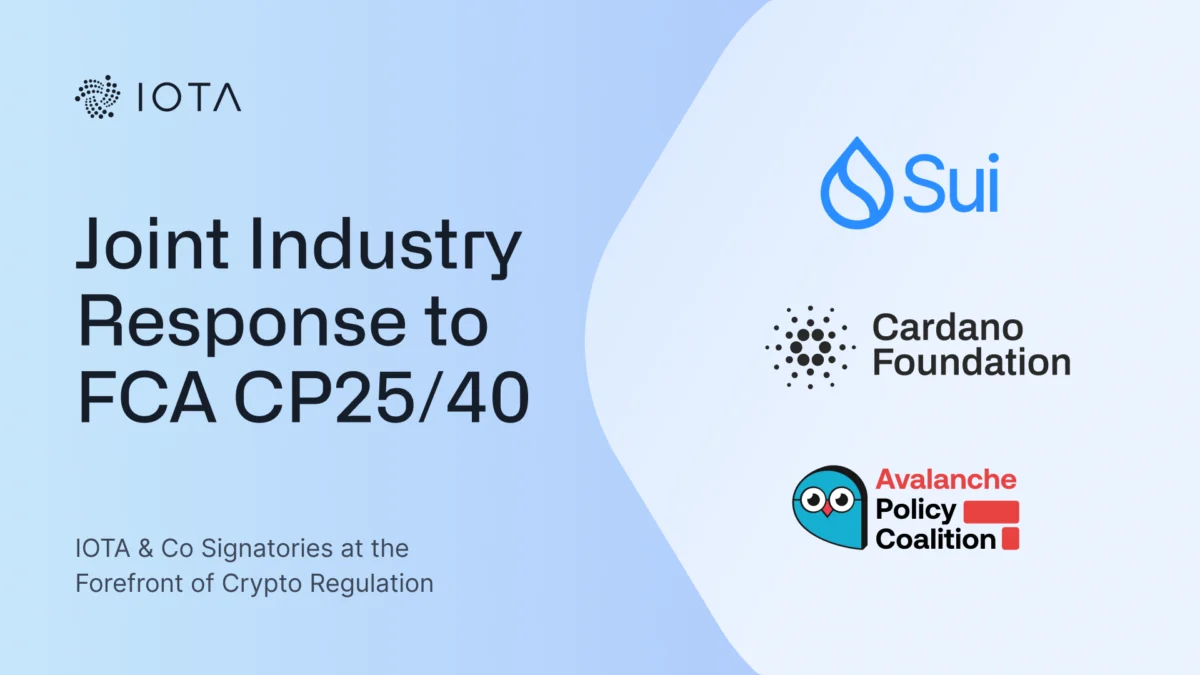
The landscape of global cryptocurrency regulation is experiencing a transformative shift as institutional stakeholders and foundational blockchain entities actively engage with financial watchdogs to shape the future of digital asset compliance. In a landmark collaborative effort, the IOTA Foundation has spearheaded a joint regulatory response to the United Kingdom Financial Conduct Authority’s (FCA) Consultation Paper CP25/40, addressing the intricate framework required for governing cryptoasset activities. Joined by prominent industry heavyweights including the Sui Foundation, the Cardano Foundation, and the Avalanche Policy Coalition, the coalition has delivered a unified message to British regulators: future oversight must rigorously target custody and control while remaining strictly proportionate to ensure that non-custodial and decentralized innovation is not stifled.
This coordinated submission represents a critical milestone in industry-regulator relations, underscoring the determination of foundational blockchain organizations to contribute technical expertise to public policy formulation. As the UK government seeks to solidify its reputation as a globally competitive hub for financial technology and digital assets, market participants emphasize the delicate balance required between robust consumer protection and the preservation of technological neutrality. The collaborative response focuses heavily on two of the most complex segments of the modern digital economy: staking mechanisms and decentralized finance (DeFi). By examining the operational realities of these sectors, the co-signatories aim to guide the FCA away from overreaching regulatory mandates and toward a framework grounded in technical accuracy and risk-weighted proportionality.
Background and Context of FCA Consultation Paper CP25/40
The publication of Consultation Paper CP25/40 marks a significant progression in the UK’s legislative roadmap for bringing cryptoassets within the perimeter of traditional financial regulation. Following years of preliminary scoping, governmental declarations, and phased legislative enactments, the FCA has been tasked with drafting comprehensive rules that align digital asset activities with established financial services standards. The overarching objective of the UK regulatory agenda is twofold: to protect retail participants from excessive financial harm and market abuse, and to foster a hospitable economic climate that attracts fintech investment, promotes job creation, and encourages technological experimentation.
However, crafting rules for an asset class as technologically diverse as blockchain presents formidable challenges. Traditional financial regulation relies fundamentally on the presence of central intermediaries—such as banks, clearinghouses, and brokers—that exercise custody over client funds and act as single points of control. In stark contrast, public blockchain networks operate on distributed ledgers, utilizing cryptography, consensus algorithms, and autonomous smart contracts to facilitate peer-to-peer transactions. Applying legacy regulatory concepts directly to decentralized architectures risks creating severe legal ambiguity, threatening the viability of foundational technologies such as staking and DeFi. Recognizing this friction, the IOTA Foundation and its coalition partners mobilized to provide policymakers with a comprehensive analysis of how these technologies actually function beneath the surface.
The Mechanics of Staking: Custodial Versus Non-Custodial Models
At the core of the coalition’s submission to the FCA is a meticulous examination of staking, a fundamental process through which proof-of-stake blockchain networks secure their ledgers and achieve consensus. Staking involves locking up native digital tokens to validate transactions and earn network rewards. While the economic outcome appears uniform to the end-user, the underlying operational and legal architectures vary dramatically. The joint response urges the FCA to draw a sharp, unambiguous legal line between custodial staking and non-custodial or delegated staking models.
In a custodial staking arrangement, a centralized firm—such as a regulated exchange or a specialized institutional custodian—retains direct control over the user’s private keys and digital assets. The custodian intermediates the entire process, deciding how tokens are deployed, managing validator nodes on behalf of clients, and handling reward distributions. The coalition acknowledges that these custodial models introduce traditional counterparty risks, operational vulnerabilities, and information asymmetries. Consequently, the co-signatories fully support applying stringent regulatory safeguards to custodial staking services. These measures include mandatory disclosure of key terms, robust information provision, explicit prior consent protocols for retail clients, and rigorous record-keeping standards designed to protect less-sophisticated market participants.
Conversely, the coalition argues passionately that non-custodial and delegated staking must be categorically excluded from these specific regulatory requirements. In a non-custodial framework, users retain absolute ownership and control of their private keys at all times. They delegate their voting or validation power to network nodes directly through on-chain smart contracts without ever surrendering asset custody to a third-party intermediary. Because the software provider or node operator cannot access, freeze, or misappropriate the user’s underlying capital, the fundamental sources of risk associated with custodial intermediaries are entirely absent. Subjecting non-custodial staking to traditional custodial regulations would not only misidentify the source of risk but would also penalize decentralized participation, effectively driving legitimate technological activity out of the UK jurisdiction.
Navigating the Complexities of Decentralized Finance (DeFi)
Beyond staking, the coalition’s submission addresses the regulatory minefield surrounding Decentralized Finance, commonly known as DeFi. Decentralized finance encompasses a broad ecosystem of financial applications—including automated market makers, lending protocols, and liquidity pools—operating entirely through smart contracts deployed on public blockchains. DeFi eliminates traditional middlemen, replacing human financial intermediaries with deterministic code that executes automatically when predetermined conditions are met.
In Consultation Paper CP25/40, the FCA expressed a clear intention to capture decentralized activities where a clearly identifiable controlling person or entity effectively carries out regulated financial services. While the IOTA Foundation, Sui Foundation, Cardano Foundation, and Avalanche Policy Coalition recognize the regulatory imperative to prevent bad actors from using the decentralized label as a shield for illicit operations, they caution against overly broad definitions of control. The submission stresses that the concept of a "clear controlling person" must be defined with absolute technical precision and objective criteria.
DeFi protocols are structurally designed around self-custody, global and open participation, and decentralized governance models, such as Decentralized Autonomous Organizations (DAOs). These architectural traits fundamentally alter how risks materialize and how they can be mitigated. The coalition recommends that regulatory expectations must scale strictly in proportion to demonstrable, unilateral control over protocol operations, ongoing governance decisions, or direct economic outcomes. Crucially, regulatory obligations should never be triggered merely by software development activity, code contribution, community governance participation, or the provision of underlying blockchain infrastructure. By safeguarding these foundational activities, the UK can ensure that open-source developers and validators are not criminalized or overburdened for maintaining public digital infrastructure.
Distinguishing Infrastructure Functions from Financial Intermediation
A unifying thread throughout the collaborative response is the imperative distinction between infrastructure functions and financial intermediation. In traditional finance, market infrastructure and intermediary services are frequently intertwined within regulated corporate entities. In the blockchain ecosystem, however, these layers are strictly separated. Public networks function much like foundational communication protocols—such as the internet’s TCP/IP—serving as neutral, public utilities upon which anyone can build applications.
The co-signatories advise the FCA to anchor all regulatory obligations firmly to the presence of three specific legal and operational criteria: custody, direct discretion, and unilateral control. Entities that provide software development tools, network validation, peer-to-peer communications, or other protocol-level services without exercising custody over client assets or holding unilateral decision-making power over user funds are performing infrastructure roles. Treating these technical contributors as financial intermediaries would fundamentally misunderstand the architecture of distributed ledgers. The coalition asserts that maintaining the neutrality of public blockchain infrastructure is paramount to preserving systemic stability, fostering technological competition, and encouraging homegrown innovation within the United Kingdom.
Broader Impact, Economic Implications, and Future Engagement
The joint submission by the IOTA Foundation, Sui Foundation, Cardano Foundation, and Avalanche Policy Coalition carries profound implications for the trajectory of the UK’s digital asset market. As regulatory bodies across G20 nations race to establish comprehensive rulebooks following international standards set by organizations like the Financial Stability Board (FSB) and the International Organization of Securities Commissions (IOSCO), the UK has a unique opportunity to position itself as a forward-thinking, technically literate jurisdiction.
If the FCA incorporates the coalition’s recommendations into its final policy statement resulting from CP25/40, it will establish a vital legal precedent. Such an outcome would provide much-needed legal certainty for institutional investors and Web3 startups alike, assuring them that the UK market understands the technical realities of distributed ledger technology. Furthermore, proportionate regulation targeting actual points of custodial risk will protect everyday consumers without imposing prohibitive compliance costs on non-custodial innovators.
The participating foundations have expressed their collective desire to continue an open, constructive dialogue with the FCA. By offering ongoing technical briefings, empirical market data, and architectural insights, the industry hopes to assist regulators in drafting guidance that successfully bridges the gap between traditional financial oversight and decentralized technological innovation. As the consultation period concludes and policymakers review the influx of industry feedback, the stance adopted by the UK regulator will be closely monitored by global digital asset markets as a bellwether for future regulatory harmonization worldwide.