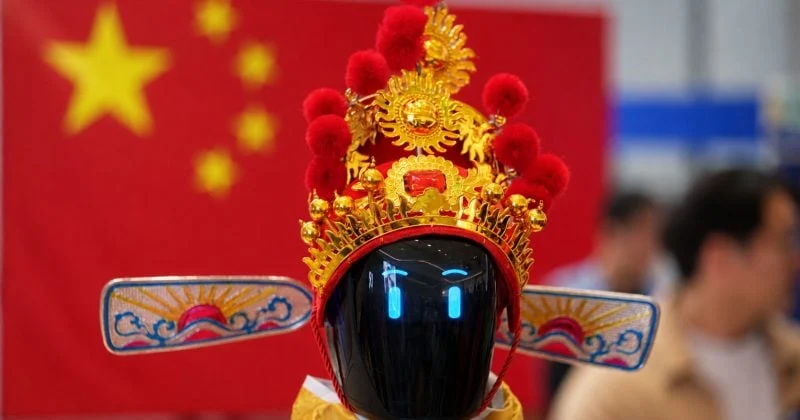
In a significant escalation of the ongoing technological rivalry between Washington and Beijing, United States Treasury Secretary Scott Bessent has signaled that the federal government is prepared to impose targeted sanctions on Chinese artificial intelligence (AI) firms. The warning, issued during a televised interview on FOX Business’ "Mornings with Maria," underscores a hardening stance within the Trump administration regarding the protection of American intellectual property in the rapidly evolving field of generative AI. Secretary Bessent’s comments suggest that the U.S. is moving beyond hardware-centric restrictions, such as chip export bans, to directly target the software and foundational models developed by foreign entities.
Secretary Bessent articulated a clear policy boundary: while the current administration remains supportive of open-source AI development as a driver of innovation, it will not tolerate what it perceives as the systematic appropriation of American technological breakthroughs by overseas competitors. "If we see, especially, that overseas models are stealing from our great companies, we have the ability to sanction them because of this theft," Bessent stated. This position marks a pivotal moment in U.S. trade and technology policy, framing the competitive landscape of AI not just as a race for capability, but as a legal and ethical battleground over the ownership of digital intelligence.
The Shift from Hardware to Software Protection
For the past several years, the primary mechanism of U.S. policy aimed at curbing China’s AI progress has been the restriction of physical infrastructure. This included tightening export controls on high-end semiconductors, specifically those produced by NVIDIA and AMD, which are essential for training large language models (LLMs). However, the latest rhetoric from the Treasury Department indicates a shift toward "model-level" intervention.
By threatening sanctions against specific companies rather than broad categories of hardware, the U.S. government is seeking to address the perceived "software gap." This gap refers to the ability of Chinese developers to achieve high levels of performance in AI tasks despite having limited access to the latest generation of H100 or Blackwell GPUs. The Treasury’s concern centers on the possibility that Chinese firms are "shortcuting" the expensive and time-consuming process of R&D by utilizing the outputs of American models to train their own systems—a process known in the industry as model distillation.
Understanding the Controversy: Model Distillation and IP
At the heart of the Treasury’s warning is the technical and legal ambiguity surrounding "model distillation." This technique involves using a highly advanced, "teacher" model (such as OpenAI’s GPT-4o or Anthropic’s Claude 3.5 Sonnet) to generate vast amounts of synthetic data. This data is then used to train a smaller, "student" model. The resulting student model often inherits much of the reasoning and coding capability of the larger model while being significantly cheaper and faster to run.
U.S. AI developers have increasingly argued that this practice constitutes a form of intellectual property theft. They contend that the "weights" and "biases" of their models—the mathematical values that represent the model’s knowledge—are proprietary. When a competitor uses a model’s output to replicate its internal logic, they are essentially "reverse-engineering" the product without the multi-billion dollar investment required for the initial training.
However, this view is not universally shared within the tech industry. Critics and some academic researchers argue that distillation is a standard method of knowledge transfer that has been used in machine learning for decades. They point out that the data generated by an AI model, once released to the public or provided via an API, is essentially information that can be learned from, much like a human student learns from a textbook written by an expert.
A Chronology of Escalating Tech Tensions
The current friction is the result of a multi-year timeline of escalating measures and counter-measures between the world’s two largest economies:
- October 2022: The U.S. Department of Commerce implements sweeping export controls on advanced computing chips and semiconductor manufacturing equipment to China.
- August 2023: President Biden signs an executive order restricting U.S. venture capital and private equity investments into Chinese tech sectors, including AI and quantum computing.
- Early 2024: Chinese AI models, most notably Moonshot AI’s Kimi series and Alibaba’s Qwen models, begin to top global leaderboards in specific categories like long-context window processing and Python coding.
- Mid-2024: Reports surface that the Trump administration is considering "Section 301" investigations into Chinese AI practices, a move that could lead to heavy tariffs or total bans on certain software services.
- July 2024: Axios reports that internal White House discussions have pivoted toward restricting the export of "weights" for open-source models to prevent foreign adversaries from fine-tuning American technology for military use.
- The Present: Secretary Bessent’s warning on FOX Business confirms that the Treasury Department is now viewing model development through the lens of national security and intellectual property enforcement.
The Rise of Chinese AI Competitors
The urgency in Washington is driven by the rapid progress of the Chinese AI ecosystem. While American firms like OpenAI and Anthropic held a definitive lead throughout 2023, the gap is narrowing. Moonshot AI’s Kimi K3, for instance, has demonstrated "agentic" capabilities—the ability to perform multi-step tasks and interact with external software—that rival Western counterparts.
Data from recent benchmarks suggests that Chinese models are increasingly efficient. In the "HumanEval" coding benchmark, several Chinese-developed models now score within the top 10% of all global systems. Furthermore, Chinese firms have pivoted toward "MoE" (Mixture of Experts) architectures, which allow for high performance with lower compute requirements, effectively mitigating some of the impact of U.S. chip sanctions.
Industry Dissent and the Fair Use Paradox
The prospect of sanctions has sparked a complex debate within the American tech sector itself. Microsoft CEO Satya Nadella has emerged as a nuanced voice in this discussion, raising questions about the consistency of the industry’s stance on intellectual property.
Nadella recently pointed out a potential hypocrisy: major AI companies rely heavily on the "Fair Use" doctrine to justify training their models on trillions of words of copyrighted text and code from the public internet. However, those same companies often impose highly restrictive terms of service that forbid others from using their model’s outputs for training purposes. This "Fair Use for me, but not for thee" dynamic has led to internal friction within the U.S. tech coalition.
Furthermore, Clem Delangue, the CEO of Hugging Face—the world’s largest repository for open-source AI—has cautioned against over-attributing China’s success to "theft" or distillation. Delangue argues that China’s advances are the result of a massive influx of domestic talent, state-backed research initiatives, and a cultural emphasis on rapid iteration. He suggests that sanctions based on distillation claims might be difficult to enforce because it is technically challenging to prove that a model was trained on a specific dataset once the training process is complete.
Domestic Legal Complications for U.S. Firms
The Treasury’s focus on international IP theft comes at a time when U.S. AI companies are facing their own significant legal challenges at home. Anthropic, one of the leading "safety-focused" AI labs in the U.S., recently received court approval to begin payments under a massive $1.5 billion settlement. The settlement followed a lawsuit by a group of authors who alleged that Anthropic had illegally "scraped" and stored thousands of copyrighted books to train its Claude model.
This domestic litigation creates a diplomatic hurdle for the U.S. government. If American companies are found by their own courts to have "stolen" data from American citizens to build their models, it becomes more difficult to justify international sanctions against foreign companies for using similar methods of data acquisition.
Broader Implications and Global Impact
The imposition of sanctions on Chinese AI developers would have far-reaching consequences for the global digital economy:
- Bifurcation of the AI Ecosystem: The world could see a "Splinternet" for AI, where Western countries use models governed by U.S. IP standards, while the Global South and China utilize a separate stack of technology.
- Supply Chain Disruptions: Many global software products currently integrate APIs from both U.S. and Chinese providers. Sanctions would force a costly and complex decoupling for multinational corporations.
- Stifled Innovation: Critics of the Treasury’s plan argue that by restricting the flow of model data and distillation techniques, the U.S. might inadvertently slow down the global pace of AI safety research, which requires transparent access to various model architectures.
- Retaliation: Beijing has previously responded to U.S. tech sanctions by restricting exports of critical minerals like gallium and germanium, which are vital for semiconductor manufacturing. A move against Chinese software firms could trigger a new round of trade barriers.
Analysis of Future Policy Directions
Secretary Bessent’s remarks indicate that the Treasury is currently in a "fact-finding" phase. The administration is likely looking for "smoking gun" evidence—such as internal documents or leaked training logs—that proves Chinese firms are systematically bypassing U.S. terms of service.
The effectiveness of such sanctions remains to be seen. Unlike physical goods, software and model weights are highly portable and can be transferred via encrypted channels, making enforcement a logistical nightmare. However, by targeting the financial "on-ramps" and "off-ramps" of these companies, the U.S. Treasury can effectively cut them off from global capital markets and prevent them from doing business with any firm that uses the U.S. dollar.
As the 2026 fiscal year approaches, the intersection of national security, economic protectionism, and artificial intelligence is set to remain the most volatile front in U.S.-China relations. The warning from Secretary Bessent serves as a clear signal to the global tech community: the "wild west" era of AI development, characterized by the free-flowing exchange of data and techniques, is rapidly coming to an end, replaced by a new era of digital borders and state-enforced intellectual property.