
Foundry, the digital asset infrastructure giant and operator of the world’s most prolific Bitcoin mining pool, has officially signaled its intent to expand its ecosystem by launching a dedicated Zcash (ZEC) mining pool tailored for institutional participants. Scheduled for a targeted debut in April 2026, the initiative represents a significant bridge between the privacy-preserving features of the Zcash protocol and the rigorous compliance requirements of public companies and large-scale financial institutions. The move comes at a pivotal moment for Zcash, which has recently experienced a dramatic surge in its network computing power, signaling renewed interest from the global mining community despite a complex regulatory environment for privacy-centric digital assets.
The Strategic Expansion of a Mining Powerhouse
Foundry, a subsidiary of Digital Currency Group (DCG), has long maintained a dominant position in the cryptocurrency mining sector. Its flagship operation, Foundry USA, consistently ranks as the top Bitcoin mining pool globally by total hashrate, often accounting for nearly 30% of the Bitcoin network’s total computational power. By leveraging its existing infrastructure and reputation for reliability, Foundry aims to address what it perceives as a critical deficit in the Zcash ecosystem: the lack of enterprise-grade mining facilities.
A mining pool functions as a collective where individual miners pool their computational resources to increase the probability of successfully mining a block and earning rewards. While Zcash has existed since 2016, much of its mining infrastructure has historically been fragmented or managed by entities that do not meet the stringent auditing and transparency standards required by North American public companies. Foundry’s entry into this space is intended to provide a "safe harbor" for institutional capital looking to secure the Zcash network while adhering to Western regulatory frameworks.
Mike Coyler, CEO of Foundry, emphasized that the decision was driven by the maturation of Zcash as an asset class. "Zcash has matured into an institutional-grade asset, but the mining infrastructure supporting it hasn’t kept pace," Coyler stated. By launching this pool, Foundry is essentially betting that institutional interest in privacy-preserving technology will continue to grow, provided the underlying infrastructure is robust and compliant.

Understanding Zcash: Privacy, Compliance, and Tokenomics
To understand the significance of Foundry’s move, one must examine the unique value proposition of Zcash. Launched in late 2016 by the Electric Coin Company, Zcash was built on the foundation of Bitcoin’s codebase but introduced a revolutionary cryptographic tool known as zk-SNARKs (Zero-Knowledge Succinct Non-Interactive Arguments of Knowledge). This technology allows users to prove they possess certain information—such as the right to spend funds—without revealing the details of the transaction itself, such as the sender, receiver, or amount.
While mainstream cryptocurrencies like Bitcoin and Ethereum are "pseudonymous"—meaning every transaction is recorded on a public ledger for anyone to see—Zcash offers "shielded" transactions. This distinction is vital for institutional use cases where financial privacy is not just a preference but a legal or competitive necessity. The Foundry press release noted that Zcash demonstrates how "financial privacy and compliant digital infrastructure can coexist," suggesting that the protocol’s ability to provide selective disclosure for audits makes it more palatable to regulators than "dark" coins that offer no such transparency options.
Zcash’s economic model mirrors that of Bitcoin. It features a hard supply cap of 21 million tokens and utilizes a Proof-of-Work (PoW) consensus mechanism. New ZEC tokens are minted through mining, and the rewards are periodically reduced through "halving" events. This scarcity-driven model is a primary draw for investors who view ZEC as a privacy-focused alternative to "digital gold."
Analyzing the Zcash Hashrate Boom
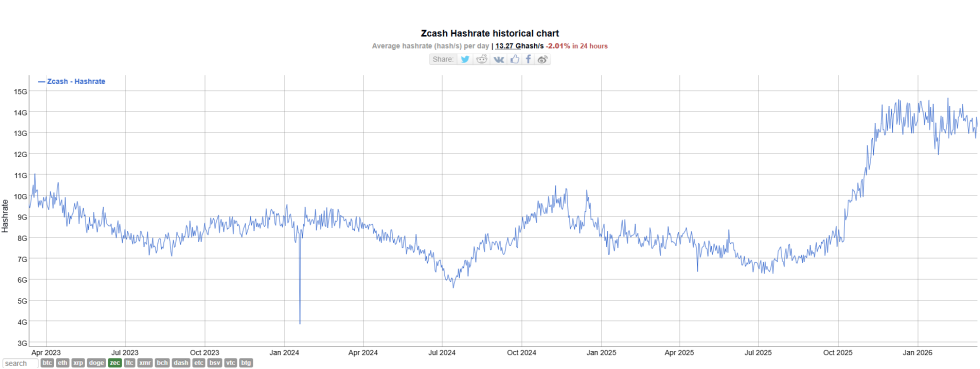
Foundry’s announcement coincides with a period of unprecedented growth in the Zcash network’s security. Data from blockchain analytics provider BitInfoCharts reveals that the ZEC hashrate has undergone a massive expansion over the last six months. In October, the network’s computing power was measured at approximately 8 Gigahashes per second (Ghash/s). As of early 2026, that figure has climbed to over 13 Ghash/s, representing an increase of more than 60%.
Several factors contribute to this hashrate surge:

- Hardware Efficiency: The deployment of new generations of ASIC (Application-Specific Integrated Circuit) miners designed specifically for the Equihash algorithm has made mining more profitable and efficient.
- Network Reliability: Recent upgrades to the Zcash protocol have improved network stability, encouraging long-term miners to commit more resources.
- Institutional Anticipation: The "Foundry effect" often leads to a pre-emptive increase in hashrate as smaller miners and early-stage institutional players position themselves ahead of a major pool launch.
A rising hashrate is generally viewed as a bullish indicator for a Proof-of-Work blockchain, as it makes the network more resistant to 51% attacks and demonstrates that miners—the network’s primary stakeholders—are willing to invest significant capital into its future.
Reactions from the Zcash Community and Shielded Labs
The response from the core Zcash development and support community has been overwhelmingly positive. Zooko Wilcox, the founder of Zcash and currently the Chief Product Officer at Shielded Labs, hailed the partnership as a milestone for the protocol. Shielded Labs, an independent organization based in Switzerland, plays a crucial role in the ongoing development and promotion of Zcash.
"We at Shielded Labs are delighted that Foundry—the largest Bitcoin mining pool, and one based in North America—is launching an enterprise-grade Zcash mining pool," Wilcox said. He highlighted the importance of North American-based operations, which offer a level of jurisdictional clarity and operational transparency that is often missing in the global mining landscape.
The involvement of a US-based entity like Foundry also mitigates concerns regarding the geographic centralization of mining power. For years, a significant portion of crypto mining was concentrated in regions with low regulatory oversight. Foundry’s commitment to Zcash signals a shift toward a more geographically diverse and professionally managed network.
The Regulatory Landscape and Future Implications
Despite the technological and infrastructural advancements, Zcash continues to navigate a complex regulatory environment. Privacy coins have frequently been targeted by regulators concerned about money laundering and illicit finance. In some jurisdictions, exchanges have been pressured to delist ZEC or restrict its shielded features.
However, Foundry’s entry suggests a different narrative: that privacy is a feature, not a bug, of the future financial system. By providing an "institutional-grade" pool, Foundry is signaling to the market that it believes Zcash can operate within the bounds of existing financial regulations. This move may encourage other large-scale infrastructure providers to reconsider their stance on privacy-preserving assets.
Furthermore, the timing of the launch in April 2026 allows for a significant lead time during which the regulatory landscape in the United States and Europe (particularly under the MiCA framework) may become clearer. If Foundry can successfully onboard public companies into its Zcash pool, it would serve as a powerful case study for the legitimacy of privacy coins in a regulated economy.
Market Performance and Economic Outlook
At the time of the announcement, Zcash was trading at approximately $209. While the asset has seen an 11% retracement over the past week—following a broader market correction—the long-term price action reflects a recovery from previous lows. The integration of enterprise-level mining could serve as a catalyst for price stability, as institutional miners typically have longer time horizons and different liquidity needs compared to retail participants.
As the industry moves toward 2026, the focus will likely remain on the "institutionalization" of the crypto space. Foundry’s expansion into Zcash is more than just the addition of a new coin to its roster; it is a strategic endorsement of the Equihash mining sector and a bet on the enduring value of digital privacy. For miners, the new pool offers a reliable, US-based platform to earn ZEC. For the Zcash network, it offers the promise of increased security and a seat at the table of mainstream finance.
The upcoming launch will undoubtedly be monitored closely by competitors and regulators alike. Should Foundry replicate the success it found with its Bitcoin pool, the Zcash network could see a new era of growth, defined by professional management, high-performance hardware, and a renewed focus on the fundamental right to financial privacy in the digital age.