
Foundry, the Digital Currency Group (DCG) subsidiary that operates the world’s largest Bitcoin mining pool, has officially announced its strategic expansion into the privacy-preserving cryptocurrency sector with the planned launch of an institutional-grade Zcash (ZEC) mining pool in April 2026. This move represents a significant milestone for the Zcash ecosystem, which has long sought to attract large-scale capital and enterprise-level participants to its decentralized network. By leveraging its dominant position in the Bitcoin mining industry, Foundry aims to bridge the gap between sophisticated financial institutions and the specialized requirements of privacy-centric blockchain protocols.
The announcement comes at a pivotal moment for Zcash, a digital asset that combines the scarcity and supply mechanics of Bitcoin with advanced zero-knowledge cryptography to provide enhanced transactional privacy. While Zcash has established itself as a technological pioneer in the "privacy coin" category, its mining infrastructure has historically been dominated by smaller, decentralized pools or retail-focused operations. Foundry’s entry into this space is intended to provide a regulated, transparent, and high-performance alternative for public companies and institutional investors who are required to adhere to strict compliance and operational standards.
The Strategic Evolution of Foundry and the Mining Landscape
Foundry has built a formidable reputation as the operator of Foundry USA, which consistently ranks as the top Bitcoin mining pool globally by total computing power, or hashrate. As of early 2024, Foundry USA often commands between 25% and 30% of the total Bitcoin network hashrate, providing a stable and reliable platform for North American miners. The decision to diversify into Zcash suggests a broader corporate strategy to become a multi-asset infrastructure provider.
Mike Coyler, CEO of Foundry, emphasized that the decision was driven by the perceived maturity of the Zcash asset class. According to Coyler, while Zcash has evolved into a sophisticated financial instrument suitable for institutional portfolios, the underlying mining infrastructure has failed to evolve at the same pace. The upcoming Zcash pool will be modeled after Foundry’s successful Bitcoin operations, focusing on geographic concentration in North America, regulatory alignment, and "institutional-grade" service levels that include audited payout structures and robust security protocols.
A mining pool acts as a hub where individual miners combine their computational resources to increase the statistical probability of solving a block and earning rewards. In the competitive world of Proof-of-Work (PoW) mining, solo mining is increasingly unfeasible for all but the largest operations. By joining a pool like the one Foundry is building, institutional miners can ensure a steady stream of revenue proportional to their contributed hashrate, mitigating the volatility associated with block discovery.

Technical Foundation: Why Zcash Matters to Institutions
Zcash was launched in 2016 by a team of world-renowned cryptographers, including Zooko Wilcox. It was the first widespread application of zk-SNARKs (Zero-Knowledge Succinct Non-Interactive Arguments of Knowledge), a form of zero-knowledge proof that allows one party to prove to another that a statement is true without revealing any information beyond the validity of the statement itself.
While Bitcoin and Ethereum utilize a transparent ledger where every transaction, sender, and receiver is visible to the public, Zcash offers "shielded" transactions. These transactions hide the sender, recipient, and amount on the public blockchain, though they remain verifiable by the network’s consensus rules. This feature is particularly attractive to institutions that require financial privacy for competitive reasons or to protect sensitive client data, yet need to remain compliant with anti-money laundering (AML) and know-your-customer (KYC) regulations.
The Zcash protocol allows for selective disclosure through "viewing keys," which enable a user to share transaction details with auditors or regulators without making the data public. This "compliant privacy" model is a cornerstone of Foundry’s pitch to institutional clients. The press release noted that Zcash demonstrates how financial privacy and compliant digital infrastructure can coexist, a sentiment that aligns with the growing demand for "Privacy-Enhancing Technologies" (PETs) in global finance.
Analyzing the Recent Surge in Zcash Network Hashrate
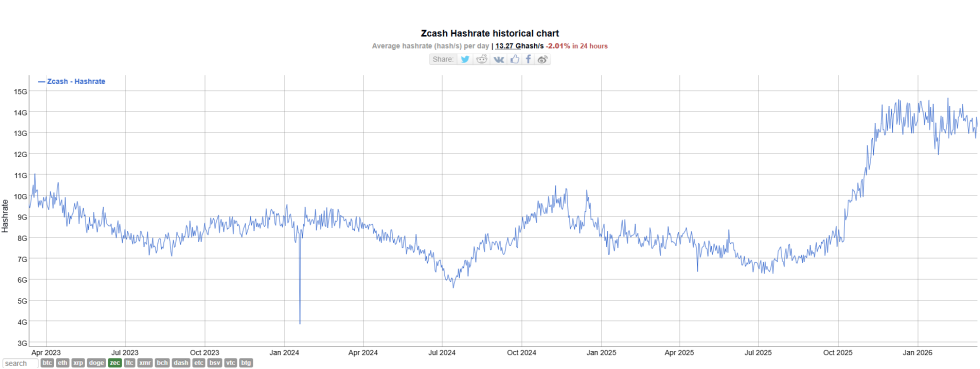
The timing of Foundry’s announcement coincides with a remarkable surge in the Zcash network’s total hashrate. Data from blockchain analytics provider BitInfoCharts reveals that the computing power securing the Zcash network has experienced a dramatic upward trajectory over the last several months. In October, the ZEC hashrate was measured at approximately 8 Gigahashes per second (Ghash/s). By early 2024, that figure had climbed to over 13 Ghash/s, representing a nearly 63% increase in network security and miner participation in a relatively short window.
This growth in hashrate is often a leading indicator of miner confidence. Several factors could be contributing to this trend:
- Hardware Efficiency: The release of new, more efficient Application-Specific Integrated Circuit (ASIC) miners designed specifically for the Equihash algorithm (which Zcash uses) has likely boosted the total network power.
- Speculative Positioning: Miners may be positioning themselves ahead of future network upgrades or halving events, anticipating a long-term appreciation in the value of ZEC.
- Institutional Interest: The anticipation of Foundry’s entry may already be prompting professional mining firms to allocate resources toward Zcash in preparation for the April 2026 launch.
The hashrate is a critical metric for any Proof-of-Work blockchain, as it determines the cost of a 51% attack. A higher hashrate makes the network more resilient against malicious actors, further cementing its status as an "institutional-grade" asset.

Economic Parallels with Bitcoin: Scarcity and Halvings
Zcash was built using a modified version of the Bitcoin codebase, meaning it shares many of the same "hard money" characteristics that have made Bitcoin a popular store of value. Like Bitcoin, Zcash has a hard supply cap of 21 million tokens. New ZEC tokens are entered into circulation through the mining process, where miners are rewarded for securing the network and processing transactions.
Furthermore, Zcash follows a four-year "halving" schedule. Approximately every four years, the block reward issued to miners is cut in half, reducing the rate of new supply inflation. This deflationary pressure is a key component of the ZEC investment thesis. Foundry’s involvement ensures that institutional miners can participate in this ecosystem using a platform that understands the nuances of these cycles, providing the same level of sophisticated reporting and tax-compliant documentation that they receive for their Bitcoin operations.
Official Responses and Ecosystem Support
The reaction from the Zcash community and its leadership has been overwhelmingly positive. Zooko Wilcox, the founder of Zcash and current Chief Product Officer at Shielded Labs, expressed his enthusiasm for the partnership. Shielded Labs, an independent organization based in Switzerland dedicated to supporting the Zcash ecosystem, views Foundry’s entry as a validation of the protocol’s long-term viability.
"We at Shielded Labs are delighted that Foundry—the largest Bitcoin mining pool, and one based in North America—is launching an enterprise-grade Zcash mining pool," Wilcox stated. He noted that having a major North American player involved in the mining process enhances the geographic decentralization of the network and provides a bridge for Western capital to enter the privacy-tech space.
The involvement of a US-based entity like Foundry also provides a layer of comfort for domestic miners who are wary of joining pools located in jurisdictions with opaque regulatory environments. Foundry’s commitment to transparency and compliance is expected to lower the barrier to entry for publicly traded mining firms that are currently focused exclusively on Bitcoin.
Market Context: ZEC Price Volatility and Regulatory Headwinds
Despite the positive infrastructure news, Zcash faces a complex market environment. At the time of the announcement, ZEC was trading at approximately $209, reflecting an 11% decline over a seven-day period. This volatility highlights the broader challenges facing the privacy coin sector.
Regulatory bodies in various jurisdictions, including the European Union and parts of Asia, have recently intensified their scrutiny of privacy-centric assets. Some exchanges have delisted privacy coins to simplify their compliance burdens, leading to liquidity concerns. However, proponents of Zcash argue that its "shielded" technology is fundamentally different from "obfuscation-based" coins, as it offers the aforementioned viewing keys for regulatory transparency.
Foundry’s decision to launch a pool in 2026 suggests a long-term bullish outlook that looks past current price fluctuations. It signals a belief that by the time the pool is fully operational, the regulatory framework for privacy coins will have matured, and the demand for institutional-grade privacy solutions will have intensified.
Broader Implications for the Proof-of-Work Ecosystem
Foundry’s expansion into Zcash is more than just a single-company initiative; it is a bellwether for the evolution of the Proof-of-Work (PoW) landscape. As Bitcoin mining becomes increasingly competitive and capital-intensive, large-scale operators are looking for ways to leverage their existing expertise and infrastructure across other PoW assets.
The launch of an institutional Zcash pool could lead to several industry-wide shifts:
- Infrastructure Standardization: Other mining pool operators may be forced to upgrade their reporting and compliance tools to compete with Foundry’s "institutional-grade" standard.
- Hashrate Redistribution: A professionalized Zcash pool may attract hashrate away from other Equihash-based coins, consolidating security around Zcash.
- Validation of Privacy Tech: Having a DCG-backed company provide infrastructure for a privacy coin serves as a powerful counter-narrative to the idea that privacy technology is inherently "illicit."
As the April 2026 launch date approaches, the industry will be watching closely to see how many institutional miners migrate to the Foundry platform. If successful, this venture could provide a blueprint for how other specialized digital assets can attract the enterprise-level support necessary to achieve global scale and long-term sustainability. For now, Foundry’s move stands as a significant vote of confidence in the future of financial privacy and the enduring relevance of Proof-of-Work mining.