
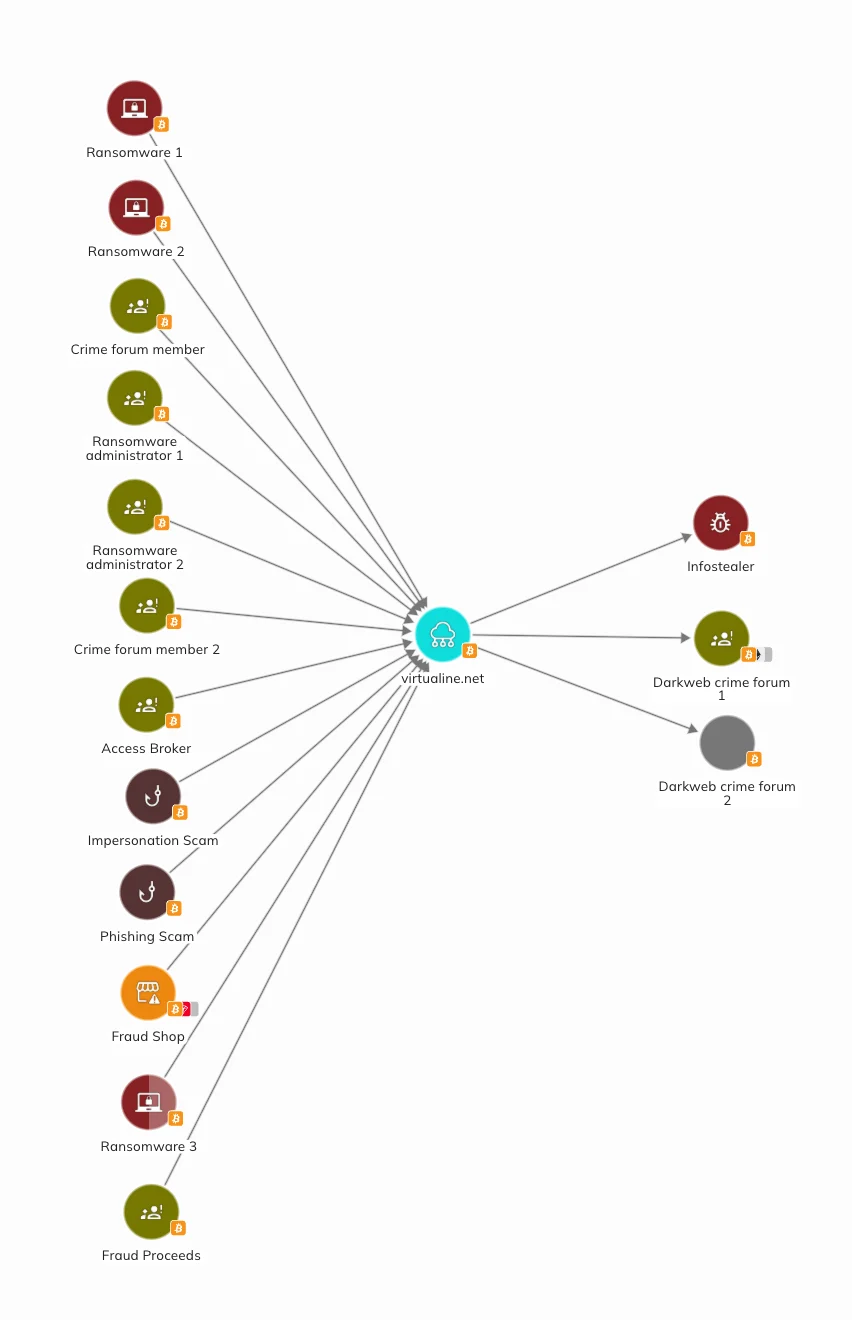
Global law enforcement agencies, led by the United States and supported by international police forces and private-sector blockchain analytics firms, have executed a coordinated, court-authorized seizure of virtualine.net, the primary web domain belonging to Virtualine. Announced on October 27, 2026, by the U.S. Attorney’s Office for the Eastern District of Virginia and the FBI Washington Field Office, the operation marks a major blow against the backbone of the international cybercrime economy. Virtualine, which operated under a staggering array of operational aliases including Secury, Massgod, Spamhouse, Lanedo, and Omegatech, functioned as a premier bulletproof hosting (BPH) provider. For years, the network deliberately ignored legal requests, abuse reports, and Digital Millennium Copyright Act (DMCA) takedown notices, effectively providing a digital safe haven for threat actors orchestrating global ransomware extortion schemes, phishing campaigns, malware distribution networks, carding operations, and illicit marketplaces.
The successful dismantling of Virtualine’s core web asset was not accomplished in isolation. It required an intricate cross-border collaboration spanning multiple continents. Investigators from Germany’s Polizei Hessen, the Netherlands’ Politie Midden-Nederland, and the United Kingdom’s National Crime Agency (NCA) worked in close tandem with American federal authorities. Furthermore, the public sector was heavily aided by critical intelligence provided by the private sector. OverRIPE, a coalition of independent security researchers and threat intelligence professionals specializing in malicious hosting infrastructure, joined forces with blockchain analytics leader Chainalysis to trace the illicit monetary flows sustaining Virtualine’s operations and map its expansive footprint across the criminal underworld.
Understanding the Mechanics and Threat Profile of Bulletproof Hosting
To comprehend the significance of the Virtualine seizure, one must understand the structural role that bulletproof hosting providers play in the modern cyber threat landscape. Traditional web hosting services maintain strict terms of service and cooperate swiftly with law enforcement agencies and intellectual property holders when notified of malicious activities hosted on their servers. If a phishing kit or a command-and-control (C2) server is detected, legitimate hosts will typically suspend the account and preserve logs for investigators.
Bulletproof hosting providers deliberately invert this standard operational model. BPH providers explicitly market their services to individuals and syndicates operating outside the bounds of the law. They intentionally bypass, ignore, or reject abuse complaints, court orders, and law enforcement inquiries. By leasing offshore infrastructure—often situated in jurisdictions with lax cybercrime legislation or limited mutual legal assistance treaties—these providers guarantee that criminal operations can maintain persistent access to the internet.
The versatility of BPH infrastructure makes it an indispensable component of the cybercrime-as-a-service (CaaS) ecosystem. A single bulletproof server can simultaneously host ransomware command-and-control infrastructure, distribute infostealer logs capable of harvesting corporate credentials, store malicious mobile applications, and power illicit marketplaces trading in stolen financial data. Without bulletproof hosting, many sophisticated multi-stage cyberattacks would struggle to maintain the operational uptime required to execute large-scale extortion or fraud.
The Audacious Marketing and Evasion Tactics of Virtualine
Virtualine operated with a degree of brazen impunity that distinguished it even among other malicious hosting providers. Rather than hiding in the deepest recesses of encrypted messaging applications, Virtualine openly advertised its illicit capabilities on prominent Russian-language and English-language cybercrime forums, including Exploit.in and HackForums.
The provider’s public communications served as a marketing campaign for lawlessness. In a September 2024 post on the cybercrime forum Exploit.in, a representative of Virtualine directly addressed prospective criminal clients with an explicit policy statement: “You can use Virtualine for all illegal/black hat activities (including phishing, carding, email spam, port scanning and all others) except for child contents and terrorism activities.” The provider doubled down on its anti-compliance ethos in June 2025 on HackForums, boasting in a promotional thread that “Virtualine ignored more abuse than your last three therapists.”
As international pressure mounted and law enforcement agencies increasingly targeted malicious infrastructure, Virtualine sought to adapt its business model to retain its criminal clientele. In March 2026, the provider introduced what it marketed as an “additional protection plan.” For an upgraded fee, Virtualine promised that upon receiving an official law enforcement request or subpoena regarding a customer’s hosted infrastructure, the provider would automatically migrate the targeted criminal infrastructure to an entirely separate shell company completely unaffiliated with Virtualine. Once safely relocated behind a new corporate facade, the server would be reactivated, effectively creating a perpetual game of digital whack-a-mole for global investigators.
Despite Virtualine’s public-facing claims that it prohibited child exploitation and terrorism, federal prosecutors and digital investigators uncovered a darker reality. According to court filings and investigative disclosures, Virtualine knowingly hosted a criminal online forum that not only facilitated the commercial sale of sexually explicit and suggestive images and videos of minors and adults, but also actively promoted a "hack-for-hire" service designed to illicitly infiltrate victims’ personal accounts and steal intimate media.

Chronology of the Investigation and Enforcement Action
The culmination of the Virtualine operation on October 27, 2026, was the result of a protracted, multi-agency investigation that tracked the provider’s technical evolution and financial trails over several years.
- September 2024: Virtualine actively solicits business on the Exploit.in forum, explicitly listing permitted illicit activities such as phishing, carding, and spam while carving out nominal exemptions for terrorism and child exploitation.
- June 2025: The hosting provider publishes promotional material on HackForums, marketing its aggressive defiance of law enforcement and abuse complaints with slogans highlighting its refusal to cooperate with authorities.
- March 2026: Recognizing increased international scrutiny, Virtualine rolls out its specialized “additional protection plan,” designed to migrate criminal infrastructure to unassociated shell companies upon receipt of law enforcement subpoenas.
- October 27, 2026: The U.S. Attorney’s Office for the Eastern District of Virginia and the FBI Washington Field Office officially announce the court-authorized seizure of
virtualine.net, supported by law enforcement partners in Germany, the Netherlands, and the United Kingdom, alongside intelligence contributions from Chainalysis and OverRIPE.
Cryptocurrency as the Financial Lifeline and On-Chain Exposure
A critical dimension of Virtualine’s business model was its financial architecture. The hosting provider accepted direct Bitcoin payments through unhosted, self-custodied wallet addresses. By bypassing traditional financial institutions and hosted cryptocurrency exchanges, Virtualine allowed its criminal customers to purchase server space without triggering standard Know Your Customer (KYC) compliance checks or Anti-Money Laundering (AML) monitoring systems. Once the illicit payments were collected, Virtualine engaged in multi-step laundering processes to obscure the origin of the funds and integrate them back into the traditional economy.
However, the immutable nature of blockchain ledgers proved to be Virtualine’s undoing from a financial tracing perspective. Advanced on-chain analysis conducted by Chainalysis utilizing tools like Chainalysis Reactor revealed that Virtualine’s cryptocurrency addresses were not isolated silos; rather, they maintained deep, direct exposure to the broader global cybercrime ecosystem.
The blockchain intelligence maps demonstrated that Virtualine wallets routinely interacted with wallets tied to prominent ransomware strains, infostealer distribution networks, Russian-language cybercrime forums, illicit carding shops, and widespread scam and phishing operations. This interconnected financial footprint provided undeniable proof that Virtualine was not a neutral communications intermediary, but rather an active, financial beneficiary of the global cybercrime economy. The cryptocurrency payments flowing into Virtualine served as the universal settlement layer for a vast array of interconnected criminal enterprises.
Implications and Strategic Guidance for Corporate Compliance Teams
The successful disruption of virtualine.net carries profound implications for financial institutions, cryptocurrency businesses, and corporate compliance teams around the globe. The operation underscores the reality that bulletproof hosting providers are not merely fringe technical annoyances, but foundational economic infrastructure that enables sophisticated cyber threats—such as ransomware and large-scale fraud—to scale globally.
For cryptocurrency exchanges, OTC desks, and financial intelligence units (FIUs), exposure to cryptocurrency addresses associated with known bulletproof hosting providers must be treated as a critical early warning sign of downstream financial crime risk. Wallets that transact with BPH providers frequently exhibit direct ties to ransomware extortion payouts, stolen credential markets, and high-risk fraudulent infrastructure.
In response to the takedown, compliance platforms have updated their intelligence suites. Chainalysis has officially labeled and categorized the cryptocurrency wallet addresses linked to Virtualine within its compliance product suite, enabling automated screening tools to flag historical and prospective transactions touching the defunct hosting provider’s financial network.
As international law enforcement increasingly targets the underlying infrastructure and financial pipelines of cybercrime-as-a-service, operators of malicious hosting platforms face a shrinking margin for error. The seizure of Virtualine demonstrates that cross-border cooperation between public law enforcement agencies, security coalitions, and private-sector blockchain analytics firms can successfully dismantle even the most resilient and defiant criminal enterprises, sending an unmistakable message to the digital underground that safe havens for cybercrime are increasingly temporary.
