
The United States Department of the Treasury’s Office of Foreign Assets Control (OFAC) enacted a sweeping package of financial sanctions targeting a sophisticated international network of operatives, front companies, and financial facilitators. On October 28, 2026, OFAC officially designated 10 individuals and one primary entity for their critical roles in orchestrating North Korean government-run IT worker schemes. These illicit operations generate hundreds of millions of dollars annually, providing the primary financial lifeblood for the Democratic People’s Republic of Korea’s (DPRK) unlawful ballistic missile and nuclear weapons development programs.
The targeted network relies on a complex web of deception, wherein highly trained state-sponsored North Korean computer programmers secure remote employment at legitimate Western corporations. Posing as non-North Korean freelancers or independent applicants by utilizing stolen identities, virtual private networks (VPNs), and proxy infrastructure, these operatives earn substantial salaries in cryptocurrency. The newly announced sanctions strike directly at the financial pipeline responsible for laundering these digital assets, converting them into fiat currency, and funneling the proceeds back to Pyongyang.
An Evolving Threat Landscape: Scale and Economic Impact
The North Korean IT worker phenomenon has grown exponentially over the past several years, evolving from an isolated security concern into a multi-jurisdictional financial threat. According to comprehensive reports by the United Nations Panel of Experts, these overseas IT worker operations now span dozens of countries across Asia, Africa, Europe, and the Americas, generating an estimated $250 million to $600 million in annual revenue for the regime.
For the Kim Jong Un regime, these funds are indispensable. Facing stringent international sanctions that have historically crippled traditional avenues of state finance, Pyongyang has pivoted toward cyber-enabled financial crime, state-sponsored heists, ransomware deployments, and IT worker fraud. The human resources deployed in these schemes are not ordinary job seekers; they are specialized operatives trained in state-run academies who are frequently quartered in countries with lax regulatory oversight, such as Russia and China. Beyond merely earning salaries to fund weapons programs, these workers occasionally exploit their privileged access to corporate networks to deploy malware, expropriate proprietary data, and conduct corporate espionage.
Chronology of Government Crackdowns and Regulatory Action

The United States government and its international allies have steadily escalated their response to the DPRK IT worker threat over the past half-decade, transitioning from broad public advisories to targeted criminal indictments and financial blockades.
In May 2022, the Federal Bureau of Investigation (FBI), the Department of State, and the Department of the Treasury issued a joint advisory warning global employers about the tactics employed by North Korean IT workers. The advisory detailed how these agents manipulate freelance platforms, falsify resumes, and deploy proxy computers—often referred to as "laptop farms"—operated by willing or unwitting accomplices based in the United States and other Western nations.
Following this foundational warning, federal prosecutors within the U.S. Department of Justice ramped up enforcement actions. Over the next two years, the DOJ brought multiple indictments and secured convictions against U.S.-based facilitators who managed domestic laptop farms. These domestic operatives forwarded hardware and maintained local internet connections to deceive employers into believing that North Korean workers were physically located within Western jurisdictions.
By 2023, OFAC began designating primary front companies that managed these networks abroad, notably targeting the Chinyong Information Technology Cooperation Company. Subsequent actions in March 2026 targeted other administrative entities, such as the Amnokgang Technology Development Company, which managed overseas delegations. The October 2026 sanctions represent the logical next phase in this enforcement arc, focusing squarely on the financial intermediaries and Russian-based fixers who handle the delicate conversion of crypto earnings into usable cash.
Inside the Financial Pipeline: Russian Facilitators and Front Companies
The latest Treasury action sheds light on the mechanical process by which digital assets generated through corporate employment are laundered into sovereign fiat currency. Central to this pipeline are Russian nationals and specialized front organizations operating on Moscow’s soil.
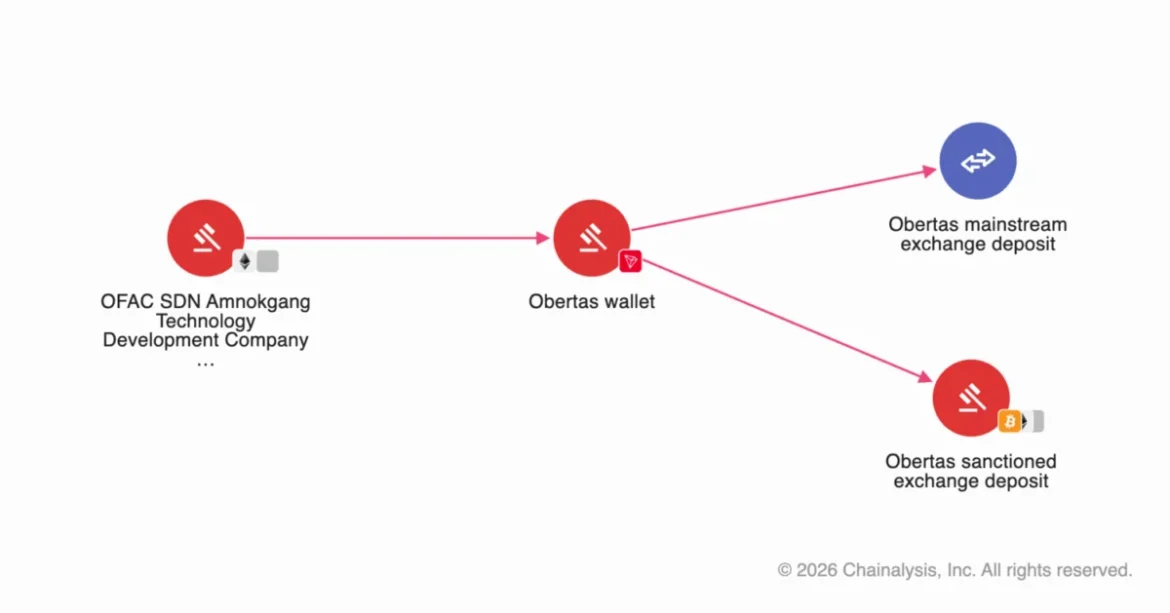
Among those sanctioned are Russian nationals Vitold Viktorovich Obertas and Ilya Aleksandrovich Boykov. According to OFAC and advanced blockchain analysis conducted by digital forensics firms, Obertas has actively served as a financial intermediary for illicit DPRK transactions since at least early 2023, though his activity intensified notably into 2025 and 2026. Obertas allegedly converted nearly $2 million in cryptocurrency into fiat currency for North Korean officials, utilizing accounts across both mainstream and high-risk, sanctioned exchanges. On-chain intelligence reveals that Obertas received funds directly from front organizations like Amnokgang Technology Development Company before moving the assets through consolidation addresses and liquidating them via platforms such as the now-sanctioned Russian exchange Garantex.

Similarly, Ilya Aleksandrovich Boykov provided crucial logistical and cryptocurrency monitoring support to North Korean front networks, moving digital assets through sophisticated multi-hop transactions to obscure their ultimate origin.
The sanctions also target key DPRK managers operating within Russia. Individuals such as Kim Ki Hyok and Kim Hyo Dong were explicitly designated for their roles in supervising IT worker delegations. Kim Ki Hyok led an administrative delegation linked to front structures and transferred nearly $500,000 in cryptocurrency, while Kim Hyo Dong managed a separate sub-delegation under the Chinyong umbrella, facilitating over $100,000 in financial assets while actively engaging in sanctions evasion protocols.
FFTDC and the Integration of Generative AI in Corporate Fraud
A significant addition to OFAC’s targeted entity list is the First Financial and Technical Development Center (FFTDC), a North Korean-controlled entity operating directly out of Russia. FFTDC functions as a centralized deployment hub for overseas IT workers tasked with generating hard currency for Pyongyang.
Since 2025, FFTDC has overseen at least six Russia-based DPRK operatives—identified as Kim Kyong Ju, Ri Thae Chol, So Hyon Jin, Han Yu Song, Kim Sung Gwan, and Hyon Se Il—who collectively generated upwards of $750,000 for the center. All six individuals have been added to the sanctions registry.
Of particular concern to cybersecurity researchers and intelligence analysts is FFTDC’s utilization of advanced artificial intelligence tools. North Korean operatives have increasingly integrated generative AI into every phase of the employment lifecycle. By leveraging large language models, these workers rapidly fabricate highly polished resumes tailored to specific corporate job postings, draft persuasive cover letters, and generate articulate responses for written technical assessments.
Furthermore, during the interview phase, operatives have been observed utilizing AI-generated profile photos and real-time deepfake video technology to mask their true identities during remote hiring calls. These technological enhancements significantly lower the barrier to entry for less-skilled regime operatives, enabling them to bypass traditional corporate human resources screening processes and penetrate sensitive engineering teams within multinational organizations.

Broader Economic Implications and Compliance Imperatives
The October 2026 sanctions underscore a broader, systemic challenge for global corporations and financial institutions: the increasing convergence of traditional human resources recruitment with advanced cryptocurrency compliance risks.
For corporate human resources departments, the threat requires a fundamental overhaul of vetting procedures. Companies that rely exclusively on remote video interviews, digital identity checks, and self-certified references remain acutely vulnerable to infiltration. Security experts strongly advise organizations to implement rigorous endpoint device monitoring, mandate hardware-based multi-factor authentication, verify physical tax and banking documentation, and cross-reference applicant data against emerging government threat intelligence reports.
For the digital asset ecosystem, the actions highlight the persistent vulnerability of decentralized finance (DeFi) protocols and alternative liquidity providers to state-sponsored laundering operations. Blockchain analytics companies have moved swiftly in response to OFAC’s latest decree, updating their proprietary screening suites and Know-Your-Transaction (KYT) software. Designated cryptocurrency wallet addresses have been labeled across major monitoring networks, ensuring that any inbound or outbound exposure to these nodes will automatically trigger high-priority sanctions alerts for regulated financial institutions and virtual asset service providers.
As Washington and its international partners continue to tighten the noose around North Korea’s revenue-generation apparatus, the intersection of remote workforce management, artificial intelligence, and digital asset compliance will remain a primary battleground in the ongoing effort to disrupt the proliferation of weapons of mass destruction.
