
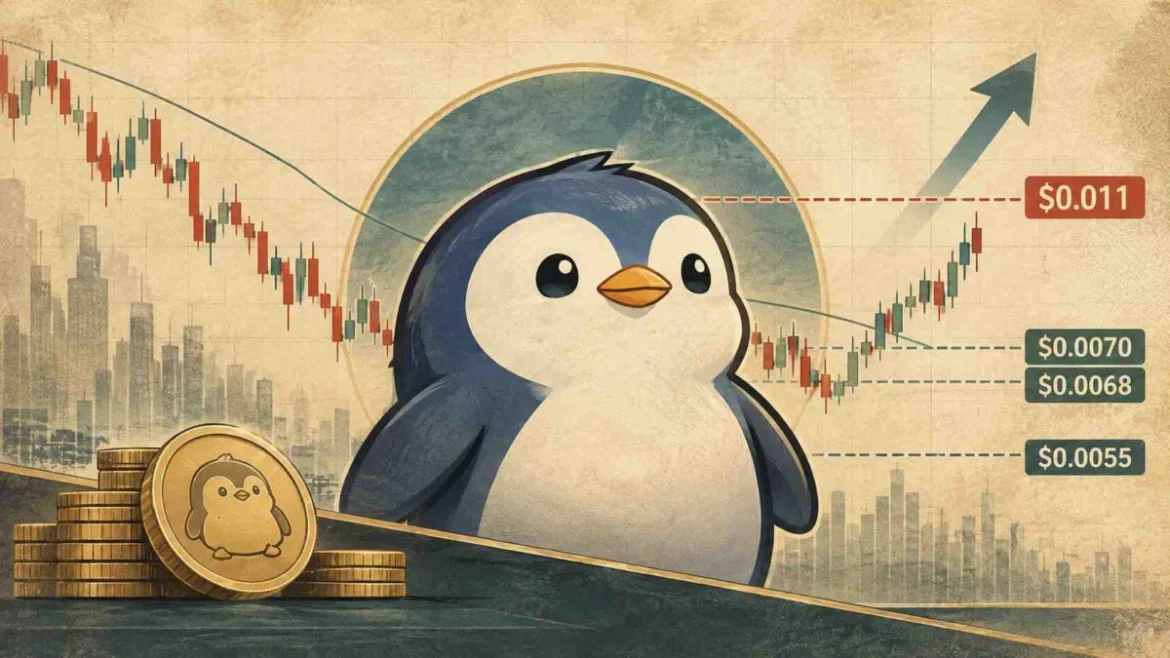
Pudgy Penguins (PENGU) is currently navigating a precarious phase in its market lifecycle, as digital asset traders closely monitor whether bullish participants can reclaim market control following an extended period of downward price action. Trading near the $0.0073 threshold, the token faces a complex array of technical hurdles, most notably a stubborn resistance ceiling at $0.011 that has systematically thwarted previous recovery rallies over the past several months. While the broader Pudgy Penguins ecosystem continues to make headlines through successful mainstream retail expansion and brand licensing initiatives, the performance of its native cryptocurrency underscores a widening disconnect between commercial brand visibility and token valuation. Market participants across various timeframes are now evaluating whether current support levels can hold or if deeper historical corrections lie ahead.
Chronology and Market Evolution of the PENGU Token
The trajectory of Pudgy Penguins as a digital asset phenomenon began in July 2021 with the launch of an Ethereum-based non-fungible token (NFT) collection comprising 8,888 unique, procedurally generated penguin avatars. Spearheaded initially by a community-driven turnaround after early leadership challenges, the project quickly established itself as a cornerstone of the Web3 collectibles sector. Under subsequent leadership, the brand aggressively transcended native crypto boundaries, pivoting into a consumer goods powerhouse. The introduction of physical plush toys into major international retail chains—such as Walmart, Target, and Walgreens—exposed millions of traditional consumers to the intellectual property.

Capitalizing on this expanding retail footprint, the ecosystem later introduced the PENGU token to deepen community engagement, facilitate decentralized governance, and fuel ecosystem utility. With a maximum circulating supply capped at approximately 88.89 billion tokens, PENGU initially captured immense speculative and community-driven interest. However, following its meteoric rise to an all-time high of approximately $0.068 in 2024, the token has suffered a severe correction, mirroring broader macroeconomic tightening and shifting liquidity trends within the digital asset market. Today, with a market capitalization hovering near $464 million, PENGU trades at a steep discount from its historical peak, forcing long-term holders and short-term speculators alike to reassess the asset’s structural health.
Technical Analysis: Resistance Barriers and Support Confluences
Detailed chart evaluations shared by prominent cryptocurrency analysts highlight the strict boundaries defining PENGU’s current trading range. Technical assessments of the daily chart, notably highlighted by analyst @MstrTranquility, emphasize that the $0.011 level has functioned as an impenetrable ceiling over multiple quarters. Repeated upward pushes have consistently met with aggressive profit-taking and selling pressure at this threshold, establishing it as the primary barrier that bulls must decisively conquer to alter the macro trend. Conversely, historical charts point to a robust demand zone near $0.0055, where buyers previously stepped in to arrest steep sell-offs.
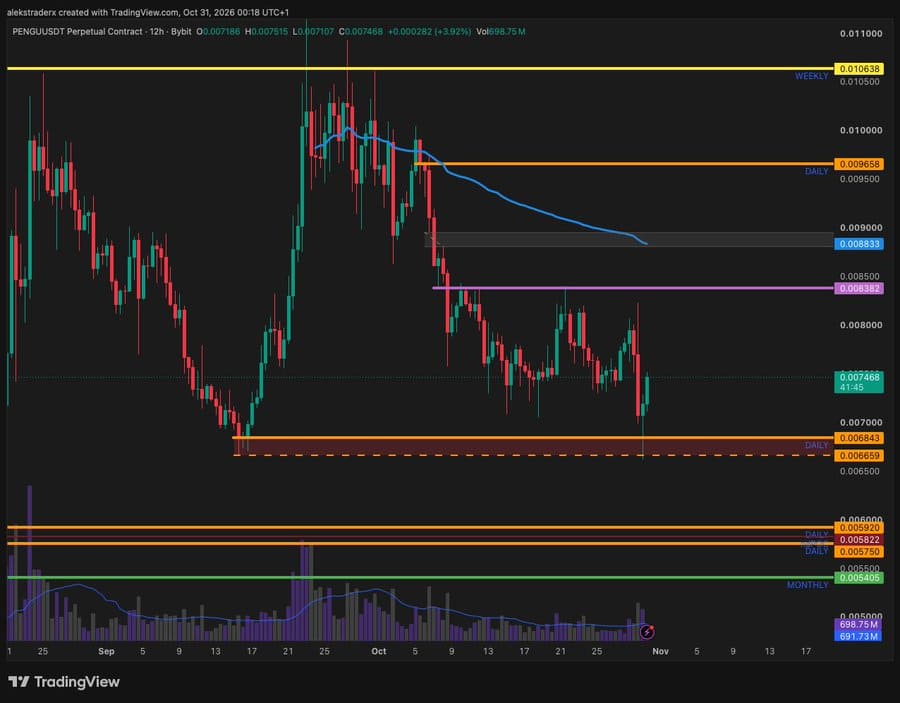
Short-term data extracted from 12-hour perpetual swap markets on exchanges like Bybit, as analyzed by market commentator @alekstraderx, provide a more granular view of immediate price action. PENGU currently navigates a tighter band defined by an overhead resistance zone stretching toward $0.0106 and immediate support nested around the psychological $0.0070 and $0.0068 thresholds. Technical summaries sourced from TradingView further compound this cautious outlook. The spot price, hovering near $0.00735, has registered nominal intraday gains of approximately 0.88% over a 24-hour window; however, this minor relief fails to mask larger losses, including a 4.82% contraction over seven days and a 22.95% depreciation over the preceding month.
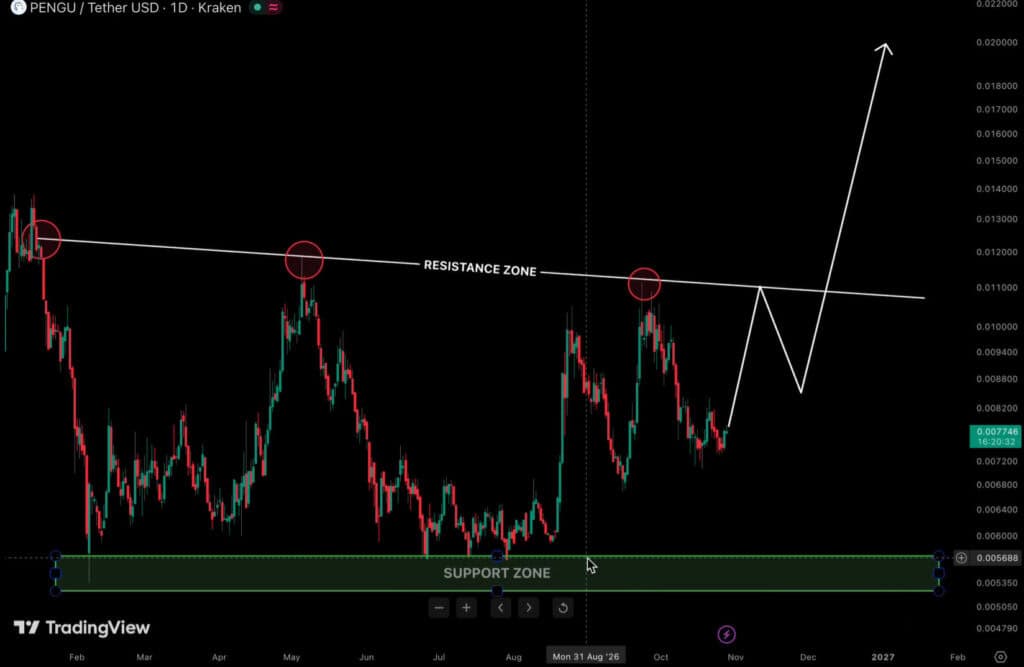
Furthermore, traditional momentum indicators and moving average configurations continue to favor a bearish bias. Both short-term and long-term simple moving averages (SMAs) and exponential moving averages (EMAs) remain positioned comfortably above the current spot price, signaling that former support foundations have successfully morphed into formidable resistance barriers. Meanwhile, the Relative Strength Index (RSI) lingers in a neutral-to-weak momentum territory rather than plunging into deeply oversold extremes, suggesting that an immediate, exhaustion-driven trend reversal is not guaranteed. Shorter-term traders are keeping a close eye on an intermediate resistance target at $0.0083; breaching this level would offer the first tangible proof of shifting buyer sentiment, though a full-scale trend reversal remains contingent on clearing the $0.0106 to $0.011 band.
Industry Implications and the Brand-Token Disconnect
The current predicament faced by Pudgy Penguins highlights a recurring phenomenon within the modern cryptocurrency landscape: the divergence between real-world brand success and token market performance. While Pudgy Penguins is widely lauded as one of the few Web3 native intellectual properties to successfully bridge the gap into mainstream retail commerce, its native asset remains strictly tethered to the capricious nature of cryptocurrency liquidity, market sentiment, and speculative capital flows.
Market analysts emphasize that consumer-facing adoption—such as plush toy sales, digital games, and licensing deals—does not automatically translate into sustained buying pressure for an associated utility or governance token. Unlike equity shares that derive value from corporate earnings, crypto tokens often rely heavily on network utility, tokenomics, and prevailing sector-wide liquidity cycles. Consequently, even as the Pudgy Penguins enterprise expands its corporate footprint, PENGU token holders remain vulnerable to broader crypto market corrections, regulatory headwinds, and shifting risk appetites among institutional and retail speculators.
Forward Outlook: Scenarios for Bulls and Bears
As PENGU sits at this critical market juncture, market participants are weighing two distinct operational scenarios. In the bullish outlook, buyers must defend the immediate support floor at $0.0070 and $0.0068 to prevent a cascading sell-off. Successfully holding these levels could pave the way for a relief rally toward the $0.0083 intermediate resistance. To genuinely spark a major structural reversal, however, bulls must muster the trading volume required to decisively break and sustain a position above the $0.011 resistance zone. Such a breakout, if accompanied by expanding volume and improving momentum indicators, could invalidate the prevailing downtrend and open the door for a retest of higher historical price targets.
Conversely, the bearish scenario remains active if macro conditions deteriorate or if selling pressure intensifies. A sustained breakdown beneath the $0.0068 threshold would likely trigger stop-loss orders and invite accelerated liquidations, exposing the token to a deeper descent toward the $0.0055 historical support zone, or in a worst-case structural failure, towards the distant $0.0037 level. Until technical indicators confirm a definitive shift in market structure—moving beyond isolated daily recoveries into a sustained sequence of higher highs and higher lows—the overall outlook for Pudgy Penguins (PENGU) remains one of cautious observation. Traders and investors will continue to monitor volume metrics, order book depth, and broader crypto market trends to determine whether the token can finally overcome its stubborn overhead barriers.
