

The global cryptocurrency market is currently navigating a wave of intense defensive positioning, characterized by a sharp deterioration in retail sentiment and sustained capital outflows from institutional-grade investment vehicles. According to recent blockchain and social intelligence analytics, market participants across multiple major digital assets are exhibiting extreme caution. This defensive posture coincides with a testing period for Bitcoin, which has slipped below the $74,000 threshold to test critical support near the $73,000 region.
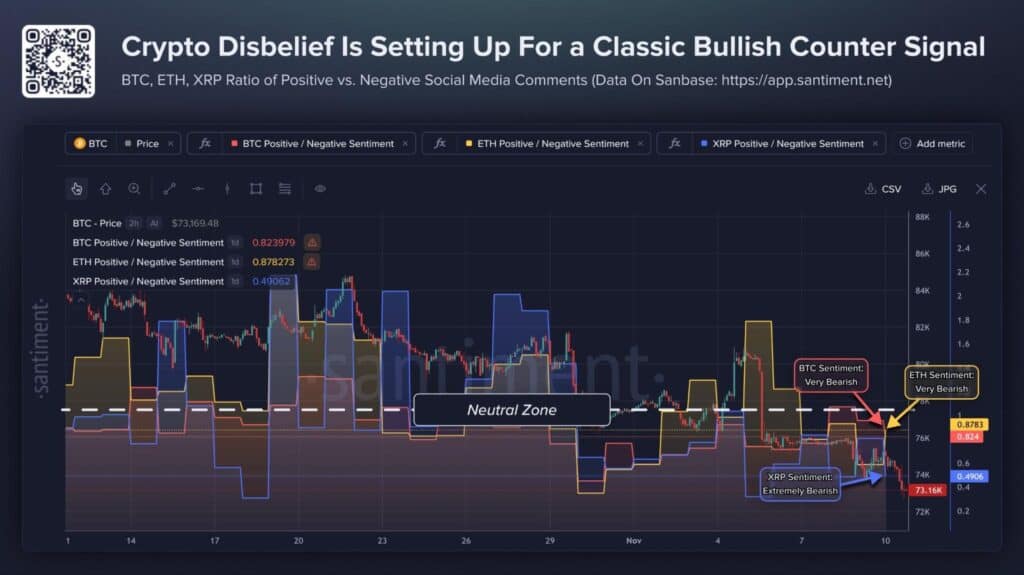
Market intelligence platform Santiment has reported that social commentary surrounding leading cryptocurrencies—specifically Bitcoin (BTC), Ethereum (ETH), and XRP—has tilted heavily into bearish territory. This wave of pessimism is running parallel to significant liquidations and withdrawals from United States-based spot Bitcoin exchange-traded funds (ETFs). While these indicators reflect widespread apprehension among retail traders and institutional allocators alike, historical market precedents suggest that such extreme consensus fear often serves as a potential contrarian indicator for future price stabilization
or recovery.
An Analysis of Social Sentiment Across Leading Digital Assets
The psychology of the retail cryptocurrency investor has shifted markedly over recent sessions, moving from cautious optimism to widespread anxiety. Santiment’s cross-platform data extraction—which monitors engagement and sentiment trends across major social channels including X (formerly Twitter), Reddit, Telegram, and specialized forums—indicates that negative commentary is substantially outpacing bullish perspectives.
To quantify this phenomenon, analysts utilize a positive-to-negative comment ratio, where any reading falling below the neutral threshold of 1.0 signifies that bearish commentary outnumbers bullish discussions. The latest metrics reveal a pervasive sense of gloom across the digital asset ecosystem. Bitcoin recorded a positive-to-negative ratio of 0.82, reflecting persistent headwinds as prices test crucial psychological and technical supports. Ethereum closely mirrored this trend with a slightly higher, yet still decidedly bearish, ratio of 0.88.
However, the most pronounced negative sentiment was observed in the market surrounding XRP, which registered a weak reading of 0.49. This metric implies that for every positive comment regarding XRP across monitored social channels, there are more than two negative counterparts. Santiment formally characterized this environment in a social media release, noting that retail fear is reaching a boiling point as traders confront prolonged consolidation and downward price pressure near multi-week lows.

Despite the clarity of these social metrics, financial analysts frequently issue caveats regarding how sentiment data should be interpreted. Social media sentiment indicators measure the psychological tone of public discussions rather than direct, on-chain investor positioning or realized capital flows. Consequently, high levels of negative chatter reflect heightened emotional stress and defensive dialogue, but they do not automatically quantify the exact volume of capital being transacted or liquidated by market participants.
Chronology of U.S. Spot Bitcoin ETF Outflows
While retail traders express mounting frustration across social platforms, institutional and traditional finance channels are simultaneously revealing substantial capital retrenchment. U.S. spot Bitcoin exchange-traded funds, which serve as a primary barometer for institutional engagement in the digital asset space, have experienced consistent, heavy withdrawals over a multi-week period.
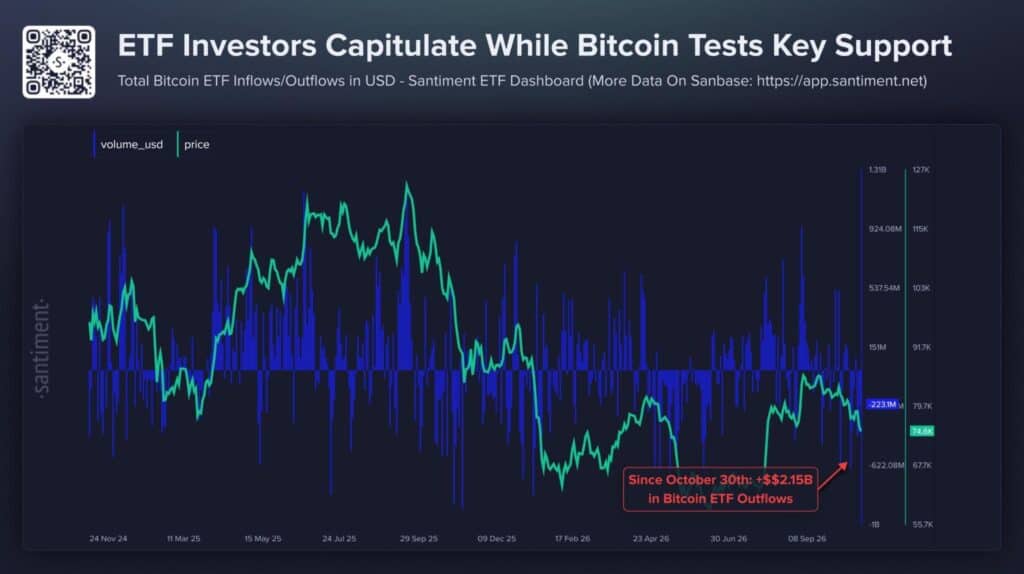
The recent wave of capital flight began accelerating in late October. On October 30, the collective suite of U.S. spot Bitcoin ETFs registered approximately $643.2 million in single-day net outflows, marking one of the heaviest withdrawal periods since the products were introduced to the market. This massive divestment set a cautious tone for the remainder of the trading period as Bitcoin’s price momentum stalled.
As the calendar turned to November, the outflows failed to abate, establishing a clear pattern of institutional risk aversion. The chronological breakdown of net outflows underscores the steady pressure exerted on these regulated financial products:
- October 30: Approximately $643.2 million in net outflows.
- November 2: An additional $398.6 million withdrawn from the funds.
- November 5: Capital withdrawals continued with $430.2 million leaving the ecosystem.
- November 6: Funds recorded a further $411.9 million in net outflows.
- November 9: Market participants pulled roughly $201 million from the products.
- November 10: An additional $95 million in net withdrawals was finalized.
When aggregated from the initial onset of this trend on October 30 through the finalized trading sessions ending November 10, cumulative net outflows from U.S. spot Bitcoin ETFs reached approximately $2.22 billion. This sustained reduction in assets under management highlights a coordinated effort by institutional participants to reduce risk exposure in response to broader macroeconomic uncertainties and declining technical structures in the underlying spot markets.
Market Mechanics and the Anatomy of Institutional Retrenchment
The structural design of spot Bitcoin ETFs provides unique visibility into traditional financial market behavior regarding digital assets. However, market experts point out inherent limitations in these data sets. Daily net flow figures illustrate the net aggregate movement of capital into and out of the funds, but they do not distinguish between retail-driven brokerage accounts and institutional-grade wealth management portfolios. Furthermore, these ETFs represent only a fraction of the global liquidity pool for Bitcoin, which also trades heavily on centralized exchanges, decentralized protocols, and over-the-counter (OTC) desks.
The correlation between mounting ETF outflows and Bitcoin’s descent toward the $73,000 region demonstrates the sensitivity of spot prices to institutional demand shocks. When capital exits these regulated vehicles, the underlying custodians must typically liquidate corresponding amounts of physical Bitcoin to satisfy redemptions, thereby exerting direct downward pressure on spot market prices. This feedback loop between institutional redemptions and spot price depreciation often accelerates bearish sentiment across retail communities, creating a cyclical reinforcement of fear.
Evaluating the Contrarian Perspective: Is a Market Bottom Forming?
Paradoxically, seasoned market analysts and quantitative strategists often monitor periods of extreme retail pessimism and heavy institutional liquidations for signs of an impending market pivot. This approach is rooted in contrarian investing theory, which posits that major market bottoms rarely form when investors are optimistic and exuberant. Instead, historical price cycles frequently indicate that sustainable recoveries materialize only after weak hands have been shaken out, selling pressure has exhausted itself, and prevailing sentiment has turned overwhelmingly negative.
When negative commentary dominates social discourse and capital outflows peak, market expectations have often fully priced in the existing downside risks. Under such conditions, the pool of potential sellers shrinks significantly, leaving the market less vulnerable to further aggressive dumping. If macroeconomic catalysts or structural demand factors stabilize, even a modest return of buying interest can trigger a sharp upward correction against a backdrop of low liquidity and high skepticism.
Nevertheless, financial professionals caution against relying on sentiment extremes in isolation. While sentiment readings of 0.82 for Bitcoin, 0.88 for Ethereum, and 0.49 for XRP indicate severe bearish bias, extreme fear can persist for extended periods during prolonged structural corrections. The presence of ongoing ETF withdrawals further underscores that institutional confidence has not yet fully recovered, suggesting that confirmation of a definitive market bottom requires more than just elevated social pessimism.
Key Technical and Fundamental Indicators to Watch
As the digital asset market moves through the current consolidation phase, investors, analysts, and institutional allocators are closely monitoring several critical indicators to determine the next directional move:
-
Bitcoin Price Stability at Support: The primary focus remains on Bitcoin’s ability to hold and defend the $73,000 price region. A failure to maintain this technical floor could expose the asset to deeper retracements, whereas a sustained defense and subsequent bounce would validate the resilience of current buyers.
-
Reversal of ETF Flow Trends: A critical milestone for institutional market recovery will be a demonstrable halt in ETF outflows followed by consistent net inflows. A return of positive daily flows would signal that traditional allocators are regaining their appetite for regulated digital asset exposure.
-
Sentiment Threshold Recovery: Observers will track social metrics for Ethereum and XRP, alongside Bitcoin, to see if sentiment ratios can climb back toward or above the neutral 1.0 threshold. Such a shift would indicate a reduction in panic and a more balanced dialogue among retail participants.
-
Broader Macroeconomic Influences: The interplay between crypto market dynamics and macroeconomic data—including inflation prints, central bank monetary policy shifts, and traditional equity market performance—will continue to dictate overarching risk sentiment.
Broad Implications for the Digital Asset Ecosystem
The convergence of steep ETF outflows and extreme social pessimism highlights the complex and volatile nature of modern cryptocurrency markets. As institutional integration deepens via regulated financial products, the sensitivity of digital assets to macroeconomic shifts and institutional liquidity cycles has grown correspondingly.
While the current environment is undeniably challenging for short-term holders and speculators, it also serves as a stress test for the market’s underlying maturity. Whether the ongoing sell-off represents the final capitulation phase of a local correction or the prelude to extended consolidation will depend on the evolution of capital flows and macroeconomic conditions in the weeks ahead. For now, market participants remain on high alert, balancing the risks of prolonged downward momentum against the historical opportunities presented by extreme market fear.
