

The intersection of wearable technology and outdoor advertising is poised to redefine how consumers interact with urban environments, shifting static billboards into interactive portals. For decades, the Out-of-Home (OOH) advertising industry has relied on traditional static formats and, more recently, digital screens to capture the attention of hurried pedestrians. However, as major technology firms and innovative startups accelerate the development of augmented reality (AR) and smart glasses, the future of urban marketing is moving away from purely physical displays and toward integrated, immersive digital experiences.
This technological convergence arrives at a time when consumer habits are heavily skewed toward digital devices. Urban planners, media buyers, and creative agencies are closely monitoring how wearable computing will alter visual consumption in public spaces, challenging assumptions about the future decline of physical advertising.
The Evolution of Out-of-Home Advertising: From Paper to Pixels
To understand the trajectory of modern advertising, it is necessary to examine the historical evolution of OOH media. For over a century, billboards functioned primarily as one-way communication channels. Advertisers printed static messages on vinyl or paper, relying on high-traffic locations to secure impressions from commuters and pedestrians.

The introduction of digital out-of-home (DOOH) screens in the early 21st century marked a significant shift, allowing campaigns to incorporate motion graphics, real-time data updates, and dynamic scheduling. Despite these advancements, the fundamental limitation remained: the medium relied entirely on visual capture from a distance, requiring passive observation rather than active participation.
Attempts to bridge the gap between physical advertising and digital engagement—such as the widespread deployment of Quick Response (QR) codes—met with limited long-term success. While QR codes experienced a resurgence during the COVID-19 pandemic for contactless menus and verification, their integration into outdoor advertising has largely failed to establish a permanent, habitual behavior among consumers. Pedestrians rarely pause in crowded thoroughfares to extract their smartphones, open a camera application, and scan a pixelated matrix. Consequently, engagement rates for OOH QR campaigns have historically remained low, leaving advertisers searching for a more seamless method of interactivity.
The Rise of Smart Glasses and Spatial Computing
The next frontier in consumer technology centers on wearable spatial computing devices, commonly referred to as smart glasses. Unlike bulky virtual reality headsets designed for isolated indoor use, modern smart glasses are increasingly indistinguishable from traditional eyewear. Key players in the technology sector, alongside specialized hardware startups, have invested billions of dollars in developing lightweight frames capable of projecting high-resolution digital data, images, and video feeds directly into the user’s field of vision.
Market analysts project that the adoption of wearable augmented reality will accelerate significantly over the coming decade as hardware miniaturization improves battery life, field of view, and aesthetic appeal. These devices are engineered not to isolate the wearer from the physical world—as smartphones often do by forcing users to look downward—but to enhance real-world perception through contextual data overlays.

If smart glasses achieve mainstream saturation, the implications for physical public spaces will be profound. Rather than diminishing the value of physical infrastructure, augmented reality relies on the physical world as a canvas. Billboards, storefronts, and architectural landmarks serve as physical anchors for digital content, making urban environments infinitely more malleable and informative.
Immersive OOH Experiments: The Electric Garden Model
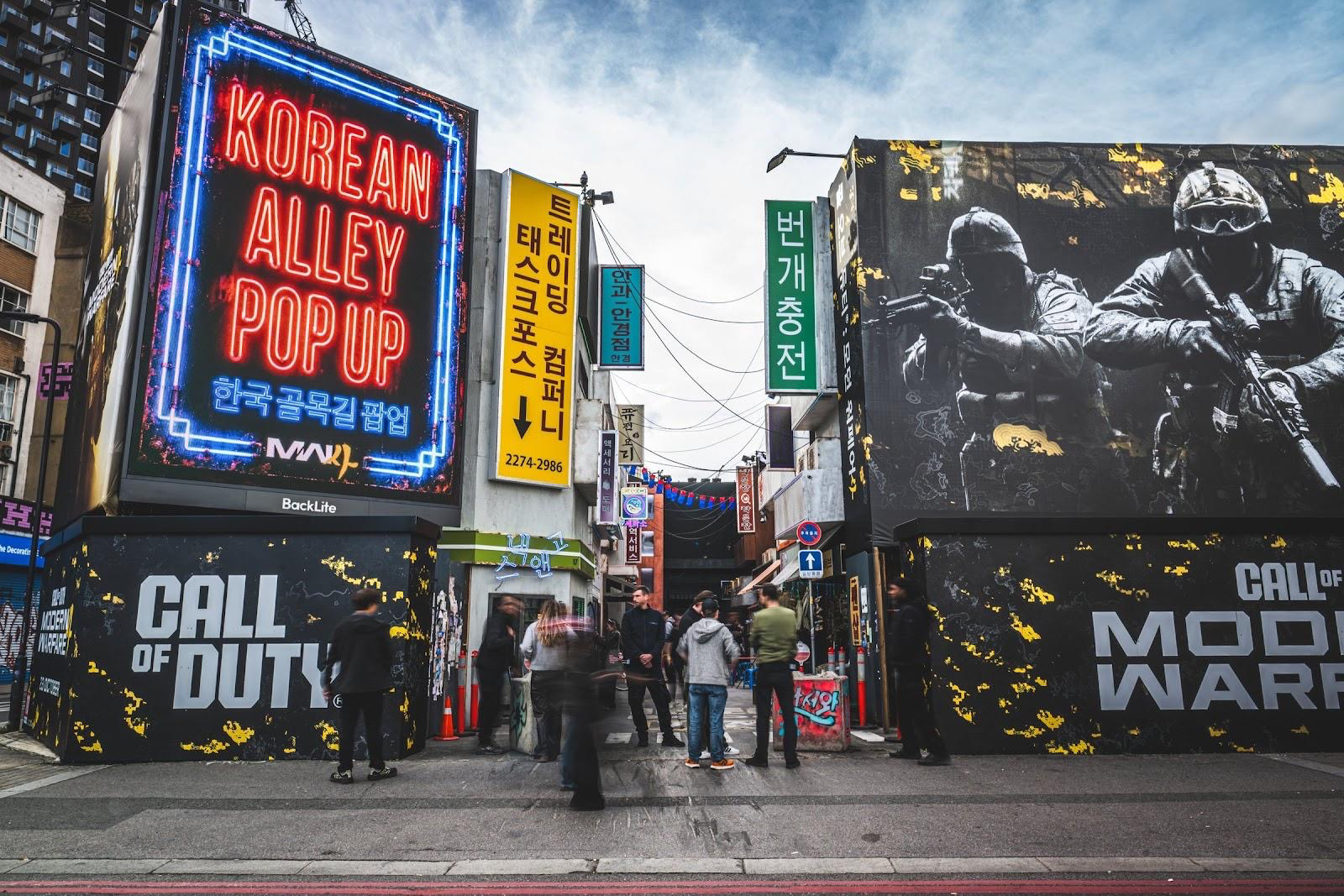
Early iterations of this experiential shift can already be observed in major metropolitan areas like London. A notable example is Electric Garden, an open-air experiential marketing site located on Shoreditch High Street. Spanning approximately 21,000 square feet, the venue positions itself as a physical environment that consumers can walk directly into, bridging the gap between traditional digital screens and immersive brand worlds.
The site utilizes a combination of giant digital street-facing screens that transition into physical, world-building environments behind the scenes. For instance, launch activations—such as campaigns for major entertainment franchises like Activision’s Call of Duty—have transformed the physical footprint into meticulously detailed, neon-lit alleyways complete with atmospheric lighting, interactive props, and gamified narrative missions.
Industry stakeholders note that such campaigns highlight a growing demand for experiential marketing. While traditional digital displays capture initial attention, physical and spatial environments provide consumers with a tangible reason to pause, participate, and share their experiences across social networks.

Implications of AR Integration for Urban Design and Creative Strategy
The integration of augmented reality with physical billboards introduces complex new parameters for creative agencies and urban designers. If smart glasses become ubiquitous, the functionality of outdoor advertisements will no longer be constrained by physical materials or static dimensions.
When a wearer directs their smart glasses toward a movie billboard, the underlying software—potentially powered by localized AI assistants embedded within the eyewear—could instantly execute a range of interactive functions. Without requiring physical interaction with a handheld smartphone, the user could stream a high-definition trailer, check real-time local cinema showtimes, or project turn-by-turn navigation directly onto the pavement to guide them to the nearest participating theater.
This capability shifts the core objective of billboard design. Creators will need to conceptualize advertisements not merely as striking visual compositions, but as spatial anchors loaded with hidden metadata, interactive triggers, and dynamic utility.
Economic and Regulatory Considerations

As the boundary between physical and digital advertising blurs, industry analysts anticipate significant economic and regulatory discussions. The monetization of augmented reality space in public domains raises questions regarding digital pollution, user privacy, and spatial zoning rights.
Currently, municipal authorities regulate physical billboards based on dimensions, illumination levels, and structural safety. However, the introduction of AR overlays means that a single physical billboard could host an infinite number of targeted digital layers, visible only to users wearing specific brands of smart glasses or subscribing to particular content networks. This presents complex regulatory challenges regarding who holds the rights to project digital content over public or private architectural spaces.
Furthermore, privacy advocates have raised concerns regarding gaze tracking and targeted advertising in public environments. If smart glasses are capable of monitoring where a user’s attention is directed within a cityscape, advertisers could theoretically gather unprecedented metrics on OOH engagement, tracking not just foot traffic, but exact dwell times, eye movements, and conversion pathways from street-level impressions to digital transactions.
Future Outlook for the Advertising Sector
The convergence of augmented reality and out-of-home advertising suggests that the future of urban media will not be purely digital, nor exclusively physical. Instead, the physical world will serve as the foundational infrastructure upon which rich, interactive digital layers are constructed.
While technical hurdles remain—including battery efficiency, device weight, privacy frameworks, and consumer adoption rates—the strategic alignment between tech hardware manufacturers and global media agencies indicates a clear directional trend. Billboards are unlikely to become obsolete in a digital future; rather, they are set to become more dynamic, functional, and deeply integrated into the daily lives of urban inhabitants.
