• Home
Crypto Gohan
keep your memories alive
Blockchain Technology & Development

Verify your Workflows with IOTA Audit Trails

by Laily UPN July 20, 2026
written by Laily UPN

The IOTA Foundation has announced the alpha release of IOTA Audit Trails, an open-source solution designed to bring verifiable, ordered histories to business processes. This new offering, part of the IOTA Notarization toolkit, aims to address the inherent trust issues arising from fragmented data across disparate databases and spreadsheets. By anchoring governed histories on a shared, tamper-resistant ledger layer, IOTA Audit Trails enables independent verification of every record and the authority behind it. The solution is accessible now through a Move package, a Rust SDK, and WebAssembly bindings.

Every operational process within an organization, from manufacturing and supply chain logistics to clinical trials and regulatory compliance, generates a digital footprint. These trails, however, are often scattered across a complex web of databases, spreadsheets, internal logs, and manual reports. This fragmentation poses a significant challenge to establishing trust, as records can be susceptible to alteration, deletion, or backfilling. Furthermore, access controls are typically confined to individual applications, leaving external parties reliant on potentially unreliable exported reports rather than direct, verifiable evidence.

IOTA Audit Trails seeks to resolve this by providing a structured mechanism to anchor critical events, cryptographic hashes, metadata, and operational proofs onto the IOTA public ledger. This approach ensures that these elements can be independently verified across organizational boundaries without necessitating the migration of entire private business systems or the exposure of sensitive raw documents on-chain. The core proposition is to offer a transparent and immutable record of who performed what action, when, and under what permissions. Developers can integrate this functionality via Move smart contracts, a robust Rust SDK for backend integrations, or WebAssembly bindings for seamless incorporation into JavaScript and TypeScript applications.

The Imperative of Verifiable Histories in a Distributed World

Traditional audit systems are often designed with an inward-looking perspective, primarily serving internal incident investigation and reporting obligations. These systems typically rely on a central administrator or a singular database, with trust placed in a single point of control. This model falters significantly when workflows extend beyond the confines of a single organization. The critical question then becomes: how can a regulator, a business partner, an insurer, a customer, or a downstream system confidently verify that a record was created at the correct time, by the appropriate entity, and with the requisite authority?

IOTA Audit Trails provides an explicit answer to this challenge. It establishes a system where roles define permissible actions, capabilities delegate these roles to specific wallets or services, and records are immutably written into an ordered on-chain history. This architecture empowers verifiers to directly inspect the state of the trail and the sequence of records through read-only clients, eliminating the need for write permissions or reliance on intermediaries. This democratizes verification, fostering greater trust and transparency in inter-organizational processes.

Navigating Data Visibility and Privacy on the Ledger

A fundamental consideration for any solution operating on a public ledger, such as the IOTA network, is data visibility and privacy. IOTA Audit Trails operates on the IOTA public ledger, meaning that any data anchored on-chain should be treated as publicly readable. Consequently, organizations handling sensitive information – be it proprietary documents, personal data, confidential reports, or medical records – must adopt a strategic approach. The recommended practice is to store the original, sensitive content off-chain and to anchor only hashes, cryptographic references, or non-sensitive metadata to the audit trail.

This strategy allows organizations to establish a verifiable record of existence, order, and integrity for their data without compromising confidentiality. The public ledger ensures the integrity and availability of the anchored information, while application-level design remains responsible for implementing robust privacy measures, encryption, and access controls for the underlying off-chain data. This separation of concerns is crucial for building trust and compliance into data-intensive workflows.

Evolving from Individual Notarizations to Governed Histories

The introduction of IOTA Audit Trails builds upon the foundation laid by the earlier IOTA Notarization service. While IOTA Notarization enabled developers to anchor individual records onto the IOTA ledger, Audit Trails extends this capability by transforming it into a structured, ordered history with integrated governance mechanisms.

An audit trail, in this context, is a shared on-chain object that meticulously stores records in chronological sequence. Each record can encapsulate text or binary data, along with optional metadata and tags. Crucially, the trail itself retains immutable creation metadata, modifiable operational metadata, configuration for locking mechanisms, defined roles, assigned capabilities, and rules for tag management. This comprehensive approach moves beyond simply answering "has this data changed?" to addressing more nuanced questions: "who added this record, under which defined role, in what specific order, and according to which lifecycle rules?" This granular level of detail is invaluable for complex regulatory and operational environments.

Defining Roles, Capabilities, and Permissions: The "Who, What, and When"

IOTA Audit Trails is specifically engineered for environments characterized by diverse actors with distinct responsibilities. Consider a scenario involving a product manufacturer responsible for logging lifecycle events, an auditor tasked with inspecting records, a compliance officer managing retention policies, and a system operator overseeing tag management or metadata updates. The solution elegantly accommodates this separation of duties through a sophisticated role-based access control (RBAC) framework.

This framework typically encompasses:

Business Records That Cross Every Boundary
  • Roles: Predefined sets of permissions assigned to specific functions or entities.
  • Capabilities: Specific actions that a role is authorized to perform, such as creating records, updating metadata, or locking the trail.
  • Permissions: The explicit granting of capabilities to roles, defining what actions can be taken on a given audit trail.
  • Actors: The entities (e.g., wallets, services) that are assigned specific roles, thereby enabling them to perform authorized actions.

By combining these controls, development teams can effectively model practical governance structures without the prohibitive overhead of developing custom smart contracts for every unique audit workflow. This significantly accelerates development and ensures consistency across different applications.

The Lifecycle of an Audit Trail: From Inception to Finality

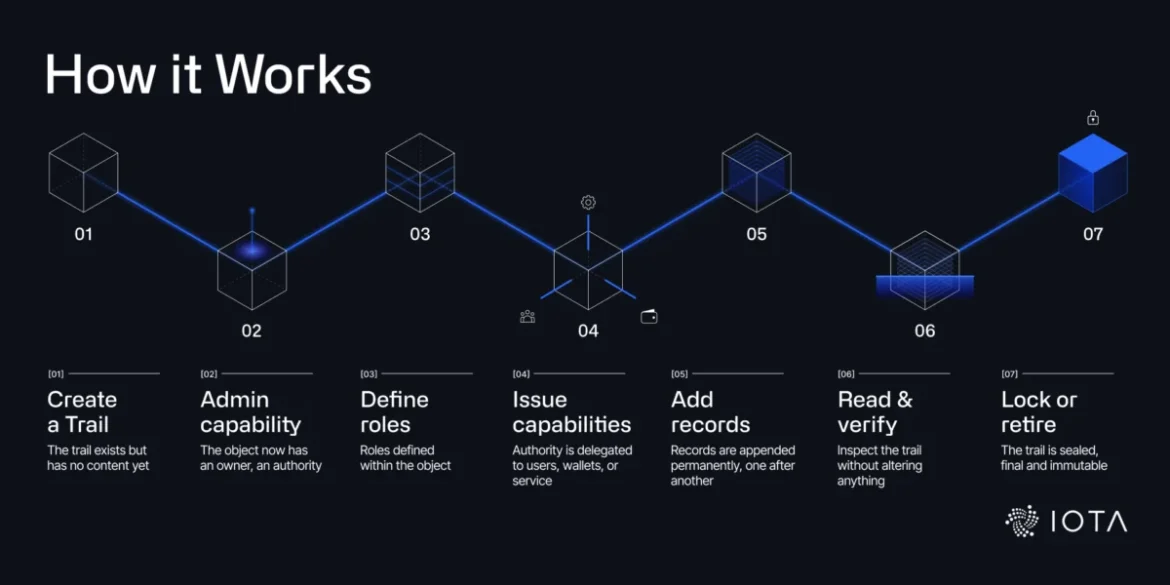
The operational flow of an IOTA Audit Trail is designed to be intuitive for developers. The creation and management of these trails can be executed directly through the Rust SDK, WebAssembly bindings, or the Move package.

A typical lifecycle of an audit trail might involve the following steps:

  1. Trail Creation: An authorized entity initiates the creation of a new audit trail, defining initial roles, capabilities, and any relevant metadata. This establishes the foundational governance structure.
  2. Record Appending: Designated actors, assigned specific roles with appending capabilities, can add new records to the trail. Each record is time-stamped and anchored immutably to the IOTA ledger, along with associated metadata.
  3. Metadata Updates: Certain roles may be granted permissions to update specific operational metadata associated with the trail or individual records, providing flexibility for evolving operational needs.
  4. Trail Locking: At a defined point in its lifecycle, an audit trail can be locked by an authorized entity. This action typically renders the trail immutable, preventing further record additions or modifications, thus signifying a state of finality or completion for a specific phase of the process.
  5. Verification: Any authorized party, or even the public if the trail is designed for broad transparency, can query the IOTA ledger to verify the integrity, order, and authenticity of the records within the audit trail.

This iterative process provides developers with a reusable and robust pattern for constructing append-oriented histories that incorporate explicit authority and lifecycle controls, fostering accountability and trust.

Comprehensive Developer Tooling for Seamless Integration

IOTA Audit Trails is provisioned as a core component of the IOTA Notarization toolkit, offering developers multiple pathways for integration:

  • Move Package: This package is designed for on-chain smart contract logic, enabling the direct implementation of audit trail governance within the Move programming language.
  • Typed Rust SDK: For backend integrations and enterprise-level applications, the typed Rust SDK provides a performant and reliable interface for interacting with audit trails.
  • WebAssembly Bindings: These bindings offer a convenient way to integrate audit trail functionality into JavaScript and TypeScript applications, facilitating frontend and full-stack development.

The repository also features ready-to-run examples that demonstrate practical applications, including customs clearance, clinical trial data management, and digital product passports. A key design principle is the separation of transaction construction from submission. This allows developers the flexibility to integrate IOTA Audit Trails with their existing wallet solutions, custom signing processes, or established "gas station" flows for transaction fee management.

Transformative Impact Across Industries Through Shared Verification

The general-purpose nature of IOTA Audit Trails makes it applicable to any workflow demanding a verifiable and ordered history. Its impact is particularly profound in sectors where records frequently cross organizational boundaries, carry significant regulatory weight, or require validation by parties external to the originating system.

  • Supply Chains and Digital Product Passports: Manufacturers can meticulously record lifecycle events, maintenance logs, inspection reports, and certifications. This creates an unbroken chain of custody for components, tracing their journey from production to end-use and providing irrefutable proof of provenance.
  • Legal and Compliance: Teams can establish verifiable histories for critical processes such as approvals, regulatory filings, contract execution, and operational records subject to strict compliance mandates. This streamlines audits and reduces the risk of disputes.
  • Customs and Trade: The solution can facilitate coordinated clearance steps, inspections, and declarations across multiple participating entities. Role-scoped updates ensure that each party contributes to the verifiable record in a controlled and authorized manner.
  • IoT and Automation Systems: Machine events, sensor attestations, automated maintenance actions, and system state changes can be logged with clear provenance, enhancing the reliability and trustworthiness of automated processes.

In all these applications, the transformative value of IOTA Audit Trails lies in the principle of shared verification. Instead of disparate parties needing to reconcile their own internal logs after the fact, all participants can rely on a single, immutable, and ordered history, significantly reducing friction and fostering collaboration.

Embarking on the Journey with IOTA Audit Trails

Teams eager to explore the capabilities of IOTA Audit Trails are encouraged to engage with the provided resources:

  • Documentation: Comprehensive guides and API references detailing the functionality and integration points.
  • Code Repository: Access to the open-source code, enabling detailed inspection and contribution.
  • Examples: Practical, ready-to-deploy examples showcasing diverse use cases.
  • Community Channels: Forums and discussion platforms for seeking support and sharing insights with the IOTA developer ecosystem.

IOTA Audit Trails is currently available for teams looking to experiment, validate architectural designs, and provide valuable feedback to the IOTA builder community. Initial deployments can be hosted on the IOTA Testnet, offering a risk-free environment for development and testing. As confidence grows and validation is achieved, organizations can seamlessly transition to the IOTA Mainnet for production-ready deployments.

The inherent trustworthiness of audit logs is fundamentally tied to the integrity of the underlying system. When that system is a centralized database or managed by a single administrator, trust often fails to propagate effectively across organizational divides. IOTA Audit Trails fundamentally alters this paradigm by transforming fragmented record histories into shared, verifiable objects. This empowers any authorized party, irrespective of their position within a workflow, to independently inspect and validate these histories, fostering unprecedented levels of transparency and accountability. The IOTA Foundation invites developers to explore the examples, model their initial audit trails, and rigorously verify their records, roles, and governance rules, anticipating the innovative solutions that will emerge from this new capability.


July 20, 2026 0 comment
0 FacebookTwitterPinterestEmail
Altcoins & Token Projects

XRP Price Targets $1.20 Resistance as Upbit Wallet Flow Dominance Signals Rising South Korean Momentum

by Reynand Wu July 20, 2026
written by Reynand Wu

The digital asset market is currently focusing its attention on XRP as the token approaches a critical technical juncture at the $1.20 price level, bolstered by a significant shift in regional exchange activity. On-chain data indicates that momentum is increasingly concentrating within the South Korean market, specifically through Upbit, the nation’s largest cryptocurrency exchange. This geographical shift in liquidity and trading volume has historically served as a precursor to heightened volatility for XRP, a token that maintains a deeply rooted following among South Korean retail investors. As the asset tests multi-month resistance, the convergence of exchange flow data and technical price structures suggests a pivotal week ahead for one of the industry’s highest-cap altcoins.

The Shift in Exchange Flow Dominance

According to recent data provided by CryptoQuant, a leading provider of on-chain analytics, the distribution of XRP wallet flows has undergone a rapid transformation. On June 7, Upbit’s XRP Net Wallet Flow Dominance—a metric that measures the concentration of deposit and withdrawal activity across major global exchanges—stood at approximately 13%. By June 14, this figure surged to 31%, marking the highest level of dominance recorded for the exchange since May 2024.

This 18-percentage-point increase in just one week signifies a sharp rotation of capital toward South Korean infrastructure. In the context of the global cryptocurrency market, "dominance" in wallet flows suggests that a plurality of the network’s transactional activity is being routed through a single entity. For XRP, which is traded globally on platforms such as Binance, Coinbase, and OKX, the fact that nearly one-third of all exchange-related wallet activity is centralized on Upbit highlights a significant regional imbalance that often precedes major price movements.

Market analysts observe that such spikes in exchange-specific flow often reflect a buildup of local demand or a coordinated movement by large-scale holders, often referred to as "whales," positioning themselves within a specific regulatory or liquidity environment. South Korea’s crypto market is unique due to its high retail participation and the occasional presence of the "Kimchi Premium," where digital assets trade at higher prices on local exchanges compared to the global average.

Technical Analysis: The $1.20 Resistance Zone

While the on-chain data points toward South Korea, the price chart remains the primary arbiter of market sentiment. XRP has established the $1.20 level as a formidable psychological and technical barrier. This zone is not merely a round number; it represents a historical area of supply where previous rallies have stalled and selling pressure has intensified.

A clean break above $1.20 is viewed by technical analysts as a "line in the sand" for the current bullish cycle. For a breakout to be considered valid, market participants are looking for a daily close above this level accompanied by an expansion in trading volume. A sustained hold above $1.20 would likely flip the level from resistance to support, potentially opening a path toward the $1.50 and $2.00 targets.

However, the risk of a "liquidity sweep" remains high. In such a scenario, the price might briefly pierce the $1.20 level to trigger "buy-stop" orders and attract breakout traders, only to reverse sharply as large sellers use the influx of buy orders to exit their positions. Traders are currently monitoring the "depth" of the order books on Upbit and other major exchanges to determine if there is sufficient "follow-through" buying power to sustain a move above this threshold.

Chronology of Recent Market Developments

The current push toward $1.20 is the culmination of several weeks of building momentum and external fundamental shifts.

  1. Early June Consolidation: XRP spent the first week of June trading in a tight range, hovering between $0.95 and $1.05. During this period, wallet flow dominance was relatively evenly distributed across global exchanges.
  2. June 7 – The Pivot: On-chain data began to show the first signs of divergence. While the price remained stable, Upbit’s share of wallet flows began to climb from its baseline, suggesting that South Korean investors were beginning to accumulate or transfer XRP in anticipation of a move.
  3. June 10–13 – Momentum Building: As Bitcoin and Ethereum showed signs of stability, XRP began to outperform the broader market on a relative basis. During this window, the wallet flow dominance on Upbit crossed the 25% threshold.
  4. June 14 – Peak Dominance: Upbit reached 31% dominance in XRP wallet flows. Simultaneously, the price of XRP began its ascent toward the $1.20 resistance level, creating a "perfect storm" of high-volume regional activity and technical pressure.
  5. Present State: The market is currently observing how the asset reacts to the $1.20 level. The elevated flow on Upbit remains consistent, indicating that the regional interest has not yet dissipated despite the proximity to resistance.

The Role of the South Korean Market

South Korea has long been a powerhouse for XRP trading. Unlike many other digital assets that find their primary liquidity in the United States or Europe, XRP has a "cult-like" status among Korean retail traders. The regulatory environment in South Korea, while strict, provides a framework that has allowed exchanges like Upbit, Bithumb, and Korbit to thrive.

XRP Eyes $1.20 Breakout As Upbit Flows Hit Highest Share Since May 2024

The concentration of activity on Upbit is particularly telling because the exchange is often the epicenter of retail "fomo" (fear of missing out) in the region. When XRP begins to trend on South Korean social media and trading platforms, it can lead to a self-reinforcing cycle of buying. This regional enthusiasm often provides the necessary "delta" to push XRP through resistance levels that might otherwise hold firm in a more fragmented market.

However, observers also note that South Korean volume can be "mercenary" in nature. The capital that flows into XRP during a momentum spike can just as quickly exit or rotate into other high-beta altcoins once the trend shows signs of exhaustion. Therefore, while the 31% dominance is a bullish indicator for current momentum, it also introduces a degree of fragility if the $1.20 level is not breached successfully.

Fundamental Context and Institutional Sentiment

Beyond the technicals and exchange flows, the broader narrative surrounding Ripple Labs and the legal status of XRP continues to provide the fundamental backdrop for price action. While the primary legal battles with the U.S. Securities and Exchange Commission (SEC) have seen significant resolutions, the market remains sensitive to any updates regarding appeals or final judgments.

Furthermore, Ripple’s expansion into the stablecoin market with the announcement of RLUSD and its continued efforts to integrate XRP into cross-border payment corridors provide a "floor" of fundamental utility. Institutional sentiment toward XRP has gradually improved as the "regulatory clarity" narrative takes hold, distinguishing it from other altcoins that are still mired in legal uncertainty.

While the current move is largely driven by retail-led exchange flows on Upbit, the underlying institutional framework provides the confidence necessary for traders to hold through volatility. If the $1.20 level is broken, it may signal not just a retail rally, but a re-entry of institutional capital that has been waiting for a confirmed trend shift.

Analysis of Implications and Market Risks

The primary implication of the current data is that XRP is no longer moving in lockstep with the broader altcoin market, but is instead being driven by specific regional demand. This "decoupling" can be advantageous during periods of Bitcoin consolidation, as it allows XRP to capture idiosyncratic gains.

However, several risks remain:

  • The Bitcoin Factor: Historically, XRP struggles to maintain an independent rally if Bitcoin experiences a sharp correction. Even with 31% wallet flow dominance on Upbit, a broader market sell-off would likely see XRP rejected at $1.20.
  • The Difference Between "Flow" and "Buying": It is critical to distinguish between wallet flows and net buying. High wallet flow dominance can indicate that coins are moving onto an exchange to be sold just as easily as it can indicate they are being moved to facilitate trading. However, when paired with a rising price, the data usually leans toward an accumulation or high-turnover speculative environment.
  • Overextension: The rapid jump from 13% to 31% dominance suggests a "crowded trade." If the $1.20 level is not broken quickly, the "fast money" on Upbit may become impatient, leading to a sharp retracement as they liquidate positions.

Conclusion and Future Outlook

As XRP sits at the doorstep of $1.20, the data from Upbit serves as a vital barometer for market health. The concentration of activity in South Korea highlights a localized surge in demand that has the potential to catalyze a broader breakout. For bulls, the objective is clear: maintain the momentum on Upbit, secure a daily close above $1.20, and leverage the resulting media attention to attract global liquidity.

The coming days will determine whether the 31% dominance in wallet flows was a precursor to a new bullish era for XRP or a temporary spike in regional speculation. For now, the market remains in a "wait-and-see" posture, with all eyes on the order books of Seoul and the psychological barrier of $1.20. Success at this level would not only validate the current regional momentum but could also redefine XRP’s price trajectory for the remainder of the quarter.

July 20, 2026 0 comment
0 FacebookTwitterPinterestEmail
Altcoins & Token Projects

JPMorgan Chase CEO Jamie Dimon Vows to Oppose CLARITY Act Over Crypto Regulatory Concerns and Financial Stability Risks

by Nila Kartika Wati July 20, 2026
written by Nila Kartika Wati

Jamie Dimon, the Chairman and Chief Executive Officer of JPMorgan Chase, has issued a stark warning regarding the current trajectory of cryptocurrency legislation in the United States, specifically targeting the Clarity for Payment Stablecoins Act, commonly referred to as the CLARITY Act. Speaking in a recent high-profile interview, the leader of the nation’s largest bank by assets asserted that the financial sector is prepared to mount a significant defense against the bill in its current form. Dimon’s primary contentions center on what he perceives as a lack of fundamental investor protections and a failure to integrate stringent anti-money laundering (AML) and Know Your Customer (KYC) protocols that have long been the bedrock of the traditional banking system.

The CLARITY Act represents a landmark attempt by U.S. lawmakers to establish a comprehensive federal regulatory framework for stablecoins—digital assets pegged to the value of a sovereign currency, typically the U.S. dollar. While proponents of the bill argue it provides the legal certainty necessary for innovation and American leadership in the digital asset space, Dimon and a growing coalition of banking executives argue that the proposed rules create a "tilted playing field." According to Dimon, the legislation effectively allows non-bank crypto entities to perform functions traditionally reserved for regulated financial institutions—such as holding deposits and paying interest—without being subject to the same rigorous oversight, capital requirements, and consumer protection mandates.

The Core Arguments: AML, BSA, and Investor Protection

At the heart of Dimon’s opposition is the perceived erosion of the Bank Secrecy Act (BSA) and Anti-Money Laundering (AML) standards. For decades, the BSA has required financial institutions to assist U.S. government agencies in detecting and preventing money laundering. Dimon argues that the CLARITY Act, as currently drafted, does not do enough to ensure that stablecoin issuers are held to these same standards. In his view, the anonymity or pseudo-anonymity often associated with digital asset transactions poses a systemic risk to the integrity of the global financial system.

"It allows them to effectively pay interest on deposits—stablecoins or something like that—without the protection that they should have, and it doesn’t do anything for AML/BSA," Dimon stated during the interview. "It has almost no legal protection." This critique highlights a broader concern within the banking industry: regulatory arbitrage. If crypto firms can offer bank-like services without bank-like costs, they gain a competitive advantage that Dimon believes could destabilize the traditional banking sector.

Furthermore, Dimon highlighted the lack of a "safety net" for investors. Unlike traditional bank deposits, which are insured by the Federal Deposit Insurance Corporation (FDIC) up to $250,000, stablecoin holdings often lack such guarantees. While some stablecoin issuers claim to hold one-to-one reserves in liquid assets like U.S. Treasuries, the lack of a federal mandate for transparency and auditing remains a point of contention for skeptics like Dimon.

The Banking Coalition and the American Bankers Association

The opposition to the CLARITY Act is not limited to Wall Street giants like JPMorgan Chase. Dimon emphasized that the American Bankers Association (ABA), which represents banks of all sizes, including community banks and credit unions, is unified in its concern. This collective pushback suggests that the friction between traditional finance and the burgeoning crypto industry has reached a critical juncture.

Last month, ABA President Rob Nichols took an active stance by urging member bank CEOs to contact their respective senators. The ABA’s primary grievance involves provisions in the CLARITY Act that would permit crypto firms to offer "stablecoin rewards." The banking lobby argues that these rewards are functionally equivalent to interest payments on deposits. If non-bank entities can offer yield on digital dollars without the overhead of banking regulations, the ABA fears a massive "flight of deposits" from traditional banks into private stablecoins.

"The banks will not accept it that way," Dimon remarked, underscoring the breadth of the opposition. "The ABA, the small banks, the credit unions—it’s not just the big guys. We will fight it. If we lose, we lose and we’ll leave, but it will be fought."

Legislative Timeline and the Path Forward

The CLARITY Act has been a centerpiece of the House Financial Services Committee’s agenda, spearheaded by Chairman Patrick McHenry (R-NC). The bill has undergone several iterations and "markup" sessions, where lawmakers debate and amend the text. Despite some bipartisan support, the bill has faced hurdles in the Senate, where figures like Elizabeth Warren (D-MA) have echoed concerns similar to Dimon’s regarding AML and illicit finance.

The chronology of the bill’s development reflects the intense lobbying efforts from both the tech and finance sectors:

  • Early 2023: Initial drafts of stablecoin legislation emerge in the House, aiming to define who can issue stablecoins and what assets can back them.
  • Mid-2023: The House Financial Services Committee advances a version of the bill despite objections from some Democratic members and the White House regarding the role of the Federal Reserve.
  • May 2024: Reports surface of a potential breakthrough in negotiations between Chairman McHenry and Ranking Member Maxine Waters (D-CA), aiming for a bipartisan package.
  • June 2024: The ABA and JPMorgan Chase ramp up public opposition as the bill nears potential floor votes or inclusion in broader legislative packages.

The upcoming markup sessions are expected to be a primary battleground for these interests. Banks are expected to lobby for amendments that would either force stablecoin issuers to obtain banking charters or strictly limit their ability to offer yield-bearing products.

Supporting Data: The Rise of Stablecoins and Deposit Competition

The urgency felt by Jamie Dimon and the ABA is reflected in the rapid growth of the stablecoin market. As of mid-2024, the total market capitalization of stablecoins exceeds $160 billion, with Tether (USDT) and USD Coin (USDC) dominating the landscape. While this is a fraction of the trillions held in the U.S. banking system, the growth rate and the potential for stablecoins to facilitate "off-ramp" transactions from traditional finance are significant.

Data from the Federal Reserve and various financial analysts suggest that in a high-interest-rate environment, consumers are increasingly sensitive to yield. If stablecoin issuers can pass through the yield from their U.S. Treasury reserves to users—something traditional banks are often slow to do for checking and savings accounts—the incentive for consumers to shift funds becomes a tangible threat to bank liquidity.

Moreover, the "shadow banking" aspect of stablecoins is a point of empirical concern. A 2023 report by the Financial Stability Oversight Council (FSOC) noted that stablecoins could be subject to "runs" if the quality of their backing assets is questioned, potentially leading to contagion in the broader financial markets where those assets (like commercial paper or Treasuries) are sold off.

Implications for the Financial Ecosystem

The confrontation between Jamie Dimon and the proponents of the CLARITY Act signifies more than just a legislative dispute; it represents a fundamental debate over the future of money. If the CLARITY Act passes in its current form, it could signal a new era where digital asset firms compete directly with banks on a global scale, potentially leading to a more fragmented and decentralized financial system.

Conversely, if the banking lobby succeeds in stalling or significantly altering the bill, the U.S. crypto industry warns that innovation will move offshore. Countries in Europe (under the MiCA regulation) and jurisdictions like Singapore and the UAE have already established clearer rules for stablecoins, seeking to attract the very firms that the U.S. is currently debating how to regulate.

Dimon’s stance also reflects a complex internal duality at JPMorgan. While the CEO remains a vocal critic of the broader crypto market—once famously calling Bitcoin a "pet rock"—his firm has been a leader in blockchain adoption. JPMorgan’s "Onyx" platform and its proprietary "JPM Coin" facilitate hundreds of billions of dollars in wholesale payments and repo transactions for institutional clients. However, JPM Coin operates within a "closed-loop" system, fully compliant with existing banking regulations, which is the exact model Dimon believes the rest of the industry should follow.

Conclusion and Official Responses

As the CLARITY Act moves toward its next phase of legislative scrutiny, the tension between the "disruptors" of Silicon Valley and the "gatekeepers" of Wall Street is at an all-time high. Proponents of the bill, including various crypto advocacy groups like the Blockchain Association, have argued that the banking industry’s opposition is an attempt to protect a monopoly on the movement of money. They contend that the CLARITY Act actually introduces more oversight than currently exists in the unregulated corners of the crypto market.

However, for Jamie Dimon, the issue is one of systemic integrity. His commitment to "fight" the bill suggests that the banking industry will utilize its considerable political capital to ensure that any crypto framework mirrors the strictures of the traditional financial world. Whether the CLARITY Act can bridge this divide—satisfying the need for innovation while maintaining the rigorous standards of the Bank Secrecy Act—remains the most significant question for U.S. financial policy in 2024.

As the markup sessions approach, all eyes will be on Washington to see if a compromise can be reached or if the "war of words" between the titans of finance and the architects of digital policy will lead to a legislative stalemate. For now, Dimon’s message is clear: the banking sector will not yield its territory without a significant struggle.

July 20, 2026 0 comment
0 FacebookTwitterPinterestEmail
Altcoins & Token Projects

Altcoins Face Intensifying Headwinds as 84% Trade Below 200-Day Moving Average Amid Market Stagnation

by Reynand Wu July 19, 2026
written by Reynand Wu

The digital asset ecosystem is currently grappling with a significant period of volatility and downward pressure, as altcoins face intensifying headwinds characterized by bearish on-chain movements and a lack of momentum from market leaders. Over the last 30 days, the broader cryptocurrency market has struggled to find a solid floor, with Bitcoin (BTC) failing to provide the necessary sentiment boost to uplift smaller-cap assets. Bitcoin itself has faced challenges maintaining its position, frequently trading below the critical $60,000 threshold, which has historically served as a psychological and technical support zone. At the time of reporting, major altcoins including Ethereum (ETH), Solana (SOL), and XRP remain firmly entrenched in the "red zone," reflecting a broader trend of investor caution and capital preservation.

The Technical Breakdown: The 200-Day Moving Average Crisis

Recent data from CryptoQuant analysts highlights a sobering reality for altcoin investors: approximately 84% of all altcoins are currently trading below their 200-day Moving Average (DMA). In technical analysis, the 200-day DMA is widely regarded as a primary indicator of a long-term trend. When an asset trades below this line, it is generally considered to be in a macro bearish phase. The fact that the vast majority of the market is positioned beneath this level suggests that the current downturn is not merely a temporary correction but a sustained period of underperformance.

The depth of this decline is further evidenced by comparing current price levels to previous cycle peaks. While Bitcoin has seen fluctuations that keep its decline roughly 50% away from its highs, many altcoins have posted much steeper losses. Reports indicate that some assets have plummeted nearly 65% since their peaks in previous quarters. This disparity emphasizes the "flight to quality" phenomenon, where investors rotate capital out of high-beta altcoins and back into Bitcoin or stablecoins during times of economic uncertainty.

The "Total 3" index, which tracks the total market capitalization of all cryptocurrencies excluding Bitcoin and Ethereum, has become a focal point for analysts. This metric has plunged significantly below its own 200-day DMA, signaling a lack of liquidity and buying interest in the mid-to-small cap sectors. For many traders, the failure of the Total 3 index to reclaim this moving average is a sign that the "altcoin season" many had hoped for in late 2024 remains elusive.

Exchange Dynamics and Retail Sentiment on Binance

Trading activity on centralized exchanges, particularly Binance, offers a window into the current psychological state of the market. As the world’s largest cryptocurrency exchange by volume, Binance serves as a bellwether for retail and institutional sentiment. Recent data indicates a surge in inflows to the exchange, which typically suggests that investors are moving assets from private wallets to the exchange to prepare for selling.

Retail traders, often the most susceptible to market volatility, appear to be in a state of "panic selling." After months of sideways movement and gradual declines, many smaller investors are dumping their holdings to prevent further losses. This retail capitulation is being met with a lack of aggressive buying from the other side, leading to a "liquidation cascade" in some of the more illiquid altcoins.

84% of Binance Altcoins Remain Below Key Technical Level: CryptoQuant

Interestingly, it is not just retail investors who are exiting the market. Evidence suggests that a cross-section of "whales"—large-scale holders who accumulated assets during the first quarter of the year—are also gradually liquidating their positions. These whales, who entered the market during the initial excitement of the spot Bitcoin ETF approvals in the United States, are now facing a different macroeconomic reality. With interest rates remaining elevated and global liquidity tightening, the incentive to hold speculative digital assets has diminished.

Macroeconomic Pressures and the Liquidity Crunch

The broader financial landscape is playing a crucial role in the current crypto malaise. Analysts point to the United States Reserve Ratio and overall shrinking supply as significant risk factors. As the Federal Reserve manages its balance sheet and interest rate policy, the "cost of carry" for risky assets increases. When liquidity in the traditional financial system dries up, the cryptocurrency market—often viewed as the furthest end of the risk spectrum—is usually the first to feel the impact.

This liquidity crunch is also reflected in the performance of institutional investment vehicles. In the last 30 days, spot ETF volumes have seen a noticeable decline. While the launch of Bitcoin ETFs was initially a massive success, the subsequent "cool-off" period has seen lower daily inflows and, in some cases, sustained outflows. This institutional retreat suggests that the "smart money" is waiting for clearer signals regarding inflation and the Federal Reserve’s next moves before re-committing to the space.

Ethereum and the Spot ETF Paradox

Ethereum, the world’s second-largest cryptocurrency and the leading altcoin by market cap, has not been immune to the carnage. Despite the historic approval and launch of spot Ethereum ETFs in the United States, the asset’s price action has been underwhelming. Ethereum has stretched its sideways trading pattern for another week, sliding approximately 5.2% and bringing its monthly slump to over 22%.

Currently trading around the $2,500 to $2,600 range (with some local dips reaching lower), Ethereum is far below the bullish projections many analysts set for the second half of the year. The paradox of the "sell-the-news" event following the ETF launch has left many investors frustrated. While the ETFs were expected to bring in a wave of institutional capital, the initial weeks were marred by significant outflows from existing products, such as the Grayscale Ethereum Trust (ETHE), which put downward pressure on the price.

However, some market observers remain optimistic. They argue that the current price action represents a "cycle bottom" and that the long-term impact of the ETFs will be positive as they provide a regulated pathway for pension funds and insurance companies to gain exposure to the Ethereum ecosystem. For now, however, Ethereum remains a bellwether for the struggles of the broader altcoin market.

Solana and XRP: A Tale of Resilience and Decline

Within the top ten cryptocurrencies, Solana (SOL) and XRP provide contrasting narratives. Solana has shown a degree of relative resilience compared to its peers. While it plummeted 1.5% in recent daily trading, it has managed to maintain a positive weekly inflow, with gains up approximately 4% in that window. Solana’s ecosystem continues to benefit from high transaction volumes and a vibrant community of developers and meme-coin traders, which has provided a floor for its price action that other altcoins lack.

84% of Binance Altcoins Remain Below Key Technical Level: CryptoQuant

In contrast, XRP has struggled to maintain its momentum. The asset is down roughly 6% over the same period, as the market continues to digest the long-term implications of its ongoing legal battles and the general lack of a clear catalyst for a breakout. The wider cryptocurrency market cap has dipped by 2.07% to approximately $2.04 trillion, a figure that highlights the erosion of value across the board.

Historical Parallels: Comparing the Current Streak to 2020

The current period of stagnation is not unprecedented, but it is rare. Analysts note that this marks the second-longest underperformance streak for altcoins since 2020. The only comparable episode occurred during the depths of the last bear market, where the period of stagnation lasted approximately ten months.

In 2020, the market was eventually jolted out of its slumber by a combination of massive global stimulus and the "DeFi Summer" explosion. Today, the catalysts for a similar rebound are less clear. While technological advancements continue in the background—such as the growth of Layer 2 scaling solutions and the integration of Artificial Intelligence with blockchain—the market is currently lacking a "killer app" or a macroeconomic shift that would trigger a new wave of retail euphoria.

The Path Forward: What Needs to Change?

For the altcoin market to stage a meaningful recovery, several factors likely need to align. First, Bitcoin must establish a firm support level and begin a trend of "higher highs," which would restore confidence and encourage investors to move further down the risk curve. Second, the macroeconomic environment must become more favorable, perhaps through a pivot in Federal Reserve policy or a significant increase in global liquidity.

Furthermore, the "ETF effect" for Ethereum needs to transition from a period of outflows and volatility to one of steady, predictable inflows. If institutional investors begin to see Ethereum as a "yield-bearing" alternative to traditional assets (despite the current lack of staking in ETFs), it could provide the necessary spark for the rest of the altcoin market.

Until these conditions are met, the data suggests that altcoins will continue to face a challenging environment. With 84% of the market below the 200-day DMA, the burden of proof is on the bulls to demonstrate that the bottom is in. For now, the prevailing sentiment remains one of caution, as the market navigates one of its most prolonged periods of stagnation in recent history. The total crypto market cap of $2.04 trillion serves as a reminder of the scale of the industry, but also of the significant ground that has been lost during this latest bearish turn.

July 19, 2026 0 comment
0 FacebookTwitterPinterestEmail
Altcoins & Token Projects

Robinhood Chain Memecoin Market Reels as Dominant Launchpad Noxa Abruptly Shuts Down After 12 Million Dollar Fee Haul

by Azzam Bilal Chamdy July 19, 2026
written by Azzam Bilal Chamdy

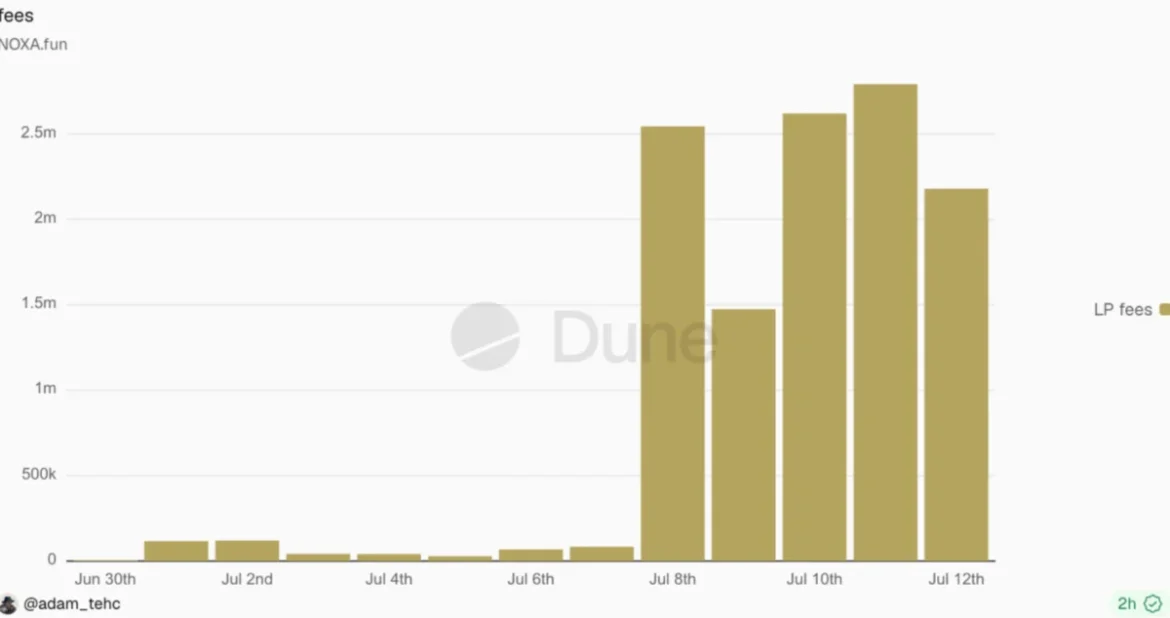
The nascent Robinhood Chain ecosystem, which recently emerged as a formidable contender in the decentralized finance (DeFi) landscape, is currently grappling with its first major systemic crisis. Noxa, the dominant launchpad responsible for the vast majority of the network’s speculative activity, abruptly ceased its operations on July 11, 2026. The platform’s departure comes after an unprecedented two-week period during which it generated more than $12 million in protocol fees, a figure that briefly positioned it as the most profitable launchpad in the entire cryptocurrency industry. This sudden exit has sent shockwaves through the market, resulting in a sharp contraction in trading volume and a significant devaluation of the chain’s flagship assets.

The Rise and Dominance of the Noxa Engine

When Robinhood Chain officially went live on July 1, 2026, it was positioned by its parent company as a high-performance, low-cost environment primarily intended for the tokenization of real-world assets (RWAs). However, as is common with high-throughput blockchains, the initial liquidity was driven almost exclusively by the memecoin sector. Noxa emerged as the central infrastructure for this boom.

Functioning as a fair-launch platform similar to Solana’s Pump.fun, Noxa allowed users to deploy tokens with minimal technical expertise and zero upfront liquidity. Its user-friendly interface resonated with the retail-heavy demographic of the Robinhood ecosystem. Within its short operational lifespan, Noxa facilitated the launch of over 60,000 unique tokens, accounting for approximately 75% of all token deployments on the Robinhood Chain.

The platform’s growth was so explosive that it achieved a cumulative decentralized exchange (DEX) volume of $4 billion in less than fourteen days. For five consecutive days leading up to its shutdown, Noxa’s daily protocol fees surpassed those of Pump.fun, a record-breaking feat that underscored the massive migration of speculative capital to the Robinhood-backed network. At its peak, Noxa was not merely a service provider; it was the primary economic engine of the chain.

Chronology of a Sudden Collapse

The timeline of Noxa’s ascent and subsequent disappearance highlights the volatility inherent in launchpad-driven ecosystems. The chain’s momentum was bolstered on July 8, when Robinhood CEO Vlad Tenev declared on social media that "Robinhood Summer is here," signaling official confidence in the network’s trajectory.

However, the euphoria was short-lived. On July 11, Noxa’s management team issued a statement halting all new token launches. The initial reason provided was the need to combat "bot spam" and an "overwhelming flood of low-quality tokens" that they claimed were degrading the user experience. While some viewed this as a responsible move to curate the ecosystem, others grew suspicious of the timing, given the platform’s massive fee accumulation.

By July 13, the situation escalated when the Noxa website went dark. The team initially blamed the outage on a technical issue with Cloudflare. Shortly thereafter, the platform made an unusual announcement: they would redirect 100% of ongoing trading fees from existing tokens to the original token creators. This move was interpreted by market analysts as a definitive exit strategy, with the platform effectively walking away from its primary revenue stream while leaving the infrastructure in a state of abandonment.

The contagion spread quickly. Rival platform Vlad.fun, which had attempted to capture the overflow of users from Noxa, also ceased operations just days later. The Vlad.fun team cited "internal integrity issues," a vague explanation that further eroded investor confidence and sparked fears of a coordinated "soft rug" across the chain’s primary gateways.

Market Impact: The Fall of CASHCAT and Ecosystem Tokens

The most immediate casualty of the Noxa shutdown was CASHCAT, the flagship memecoin of the Robinhood Chain. CASHCAT had served as a bellwether for the network’s health, reaching a peak market capitalization of $226 million. The token had attracted 267,642 unique wallets, representing the largest retail participation for a single asset on the chain.

Following the news of Noxa’s closure, CASHCAT’s value plummeted, shedding more than 33% within a 24-hour window. The selloff was not isolated to CASHCAT; other prominent ecosystem tokens such as FOX and HOODIE, which had posted triple-digit gains in the preceding week, saw their liquidity dry up as traders rushed to exit positions.

Robinhood Chain’s Noxa Crashes After Receiving $12M In Fees, Top Memecoins Plunge By Over 30%

Data indicates that DEX volume on the Robinhood Chain peaked at $878 million on July 12, just as the Noxa crisis began to unfold. Since then, volumes have steadily declined. While the network’s Total Value Locked (TVL) has remained relatively stable near the $200 million mark, the composition of that liquidity is now under scrutiny. The departure of the primary launchpad has left a vacuum that secondary platforms like flap.sh, trensh.today, and bankr are struggling to fill. While a new platform named Pons has attempted to step in, it currently lacks the brand recognition and historical track record required to restore the momentum seen during the "Noxa era."

Analyzing the "Soft Rug" Accusations and Platform Integrity

The crypto-community remains divided over the motivations behind Noxa’s exit. On social media platforms like X (formerly Twitter), a significant contingent of investors has labeled the move a "soft rug." This term refers to a situation where developers do not necessarily steal user funds directly but abandon a project after extracting maximum value—in this case, the $12 million in fees—thereby leaving the community with depreciating assets and no support infrastructure.

Conversely, some market participants, including prominent trader 0xAvast, have dismissed the panic as "irrelevant FUD" (Fear, Uncertainty, and Doubt). These proponents argue that the shutdown was a necessary step to prevent the chain from being completely overrun by automated bots and fraudulent "rug-pull" tokens that were being launched at a rate of thousands per hour.

The decision to redirect fees to creators is particularly polarizing. Proponents see it as a gesture of goodwill toward the builders who contributed to the chain’s early success. Skeptics, however, view it as a legal maneuver designed to distance the Noxa team from the ongoing trading of tokens that could potentially be classified as securities or fall under regulatory scrutiny.

The Divergence Between Speculation and Utility

The Noxa episode has brought a glaring disparity in the Robinhood Chain’s development to the forefront. When the chain was conceived, the primary value proposition was the integration of tokenized real-world assets. However, current data reveals that RWA market capitalization on the network stands at a mere $12.66 million.

At its height, the market cap of the CASHCAT memecoin alone was more than twelve times the size of the entire RWA sector on the chain. This imbalance highlights a recurring theme in the blockchain industry: while institutional-grade utility is the long-term goal, short-term network activity is often driven by high-risk speculation. The collapse of Noxa demonstrates the danger of an ecosystem becoming overly reliant on a single, speculative vertical.

Robinhood’s strategic position is now at a crossroads. The chain had successfully flipped Coinbase’s "Base" network to become the number two chain on Uniswap by deployment volume, a milestone achieved largely through Noxa’s integration. With that engine now gone, the network must prove it can attract sustainable liquidity that is not dependent on the "hyper-growth" tactics of a single launchpad.

Broader Implications for Exchange-Backed Blockchains

The events surrounding Noxa serve as a cautionary tale for the burgeoning sector of exchange-backed blockchains. As more traditional finance (TradFi) and fintech companies launch their own proprietary networks, they face the challenge of balancing decentralized permissionless innovation with the need for platform integrity.

For investors, the Noxa shutdown is a reminder of "infrastructure risk." In many modern DeFi ecosystems, the value of a token is inextricably linked to the platform that launched it. When a dominant launchpad ceases to function, it does not just stop new tokens from being created; it destroys the social and technical coordination that provides liquidity and visibility to existing assets.

As of mid-July 2026, the Robinhood Chain remains operational, and its underlying technology continues to process transactions. However, the "Robinhood Summer" has been cooled by a harsh reality check. The focus now shifts to whether the network can pivot toward its original goal of RWA tokenization or if it will remain a ghost town of abandoned memecoins.

The exit of Noxa, while financially lucrative for its founders, has left a stain on the early reputation of the Robinhood Chain. For the ecosystem to recover, it will likely require a move away from launchpad-dependent growth and toward a more diversified array of decentralized applications. Until then, the $12 million fee haul remains a stark symbol of the rewards—and the risks—of the modern memecoin gold rush. Investors are advised to exercise extreme caution and perform rigorous due diligence on the underlying infrastructure of any chain before committing significant capital to high-volatility assets.

July 19, 2026 0 comment
0 FacebookTwitterPinterestEmail
Crypto Regulations & Policy

Non-prosecution promises are not enough: Courts must rule on devs and money transmission

by Evan Lee Salim July 19, 2026
written by Evan Lee Salim

At the heart of the dispute is 18 U.S.C. § 1960, a federal statute that criminalizes the operation of an unlicensed money-transmitting business. While historically applied to entities that physically hold and move funds for customers—such as Western Union or traditional banks—recent prosecutions by the Southern District of New York (SDNY) have expanded this definition to include developers of non-custodial software. These are tools that allow users to maintain control of their own assets while utilizing decentralized protocols. Lewellen’s brief contends that by targeting the creators of the tools rather than the users of the tools, the government is effectively criminalizing the act of publishing mathematics and logic, a move that he argues is incompatible with the American legal tradition.

The Core Legal Conflict: Code as Protected Speech

The primary argument presented in Lewellen’s brief is that software code is a form of speech protected by the First Amendment. This is not a new concept in American law; the precedent was famously established in the 1990s through cases like Bernstein v. Department of State, which determined that cryptographic source code is a form of expression. Lewellen asserts that his work—specifically the development of non-custodial crowdfunding software—is an exercise of this right.

By threatening developers with prosecution for "unlicensed money transmission" simply because their code can be used to move value, the government is imposing a prior restraint on speech. The brief highlights that Lewellen has a "well-founded fear" of publishing, maintaining, or even marketing his software because the Department of Justice has refused to clarify that non-custodial development falls outside the scope of § 1960. As SEC Commissioner Hester Peirce has noted, and as cited in the brief, the act of publishing code is an intellectual endeavor that should not be conflated with the physical act of moving money.

Furthermore, the brief argues that the current application of the law violates the Due Process Clause of the Fifth Amendment. Under the "void for vagueness" doctrine, a law is unconstitutional if it does not provide a person of ordinary intelligence fair notice of what is prohibited. Lewellen argues that the shifting definitions used by the DOJ leave developers in a state of perpetual legal peril, unable to discern where "software development" ends and "money transmission" begins.

Chronology of Regulatory Escalation

The road to the Fifth Circuit began several years ago as federal agencies shifted their focus from centralized exchanges to decentralized protocols. The following timeline illustrates the escalation of tensions between the developer community and federal regulators:

  • August 2022: The U.S. Treasury’s Office of Foreign Assets Control (OFAC) sanctions Tornado Cash, a decentralized privacy protocol. This marked the first time the U.S. government sanctioned a piece of self-executing software rather than a person or entity.
  • August 2023: The DOJ indicts Tornado Cash founders Roman Storm and Roman Semenov, alleging they operated an unlicensed money-transmitting business. Crucially, the indictment focused on their roles as developers and maintainers of the code.
  • April 2024: Federal authorities arrest the founders of Samourai Wallet, Keonne Rodriguez and William Lonergan Hill, on similar charges. This prosecution sent shockwaves through the industry, as Samourai was a non-custodial service where users always retained their private keys.
  • Late 2025: Following a period of intense lobbying and public outcry, the administration released the "Blanche Memo." While intended to provide some clarity on prosecutorial priorities, the memo was criticized by legal experts for being non-binding and failing to offer a statutory safe harbor for developers.
  • July 2026: Michael Lewellen files his opening brief in the Fifth Circuit, seeking a pre-enforcement judgment to secure the right to publish his software without a money transmitter license.

The "Bet the Farm" Dilemma

A central theme of Lewellen’s filing is the concept of pre-enforcement review. In typical criminal cases, a defendant challenges the constitutionality of a law after they have been arrested. However, Lewellen argues that the stakes are too high for developers to "bet the farm" by breaking the law first and vindicating their rights second.

The threat of a felony conviction, which carries a potential five-year prison sentence per count under § 1960, is enough to force many developers to cease their work or move their operations outside of the United States. This "chilling effect" results in the loss of American innovation and the degradation of privacy tools available to the public. By seeking a declaratory judgment, Lewellen is asking the court to provide the "certainty of law" rather than requiring him to rely on the "noblesse oblige" or the shifting whims of prosecutorial discretion.

Supporting Data and Economic Impact

The uncertainty surrounding software development in the U.S. has led to a measurable shift in the global technology landscape. According to data from the 2025 Developer Report, the percentage of open-source blockchain developers based in the United States has dropped from 42% in 2018 to just 26% in early 2026. Many cited "regulatory hostility" and "legal risk" as the primary reasons for relocating to jurisdictions like Switzerland, Singapore, or the United Arab Emirates.

Furthermore, the economic implications of these prosecutions are significant. The decentralized finance (DeFi) sector, which relies heavily on non-custodial software, reached a Total Value Locked (TVL) of over $150 billion globally by mid-2026. U.S. developers who are sidelined by legal uncertainty are missing out on a market that is projected to grow at a compound annual growth rate (CAGR) of 25% over the next decade.

Coin Center, which has been instrumental in supporting Lewellen, argues that the current policy is counterproductive. By driving developers underground or overseas, the U.S. government loses the ability to engage with the creators of these technologies and forfeits its leadership position in the next generation of the internet.

Official Responses and Political Context

The Department of Justice has maintained that its prosecutions are necessary to combat money laundering and the financing of terrorism. In previous statements related to the Tornado Cash and Samourai Wallet cases, DOJ officials have argued that "functional control" of a system, even if non-custodial, can constitute money transmission if the developers profit from the transactions or provide a "service" that facilitates the movement of illicit funds.

However, the administration’s stance has been inconsistent. While the Blanche Memo suggested a more restrained approach, the DOJ has repeatedly refused to stipulate in court that the mere act of writing and publishing code is exempt from licensing requirements. This refusal is what prompted Lewellen’s lawsuit.

Legal scholars have noted that this case could be the most significant test of the First Amendment in the digital age. If the Fifth Circuit rules in favor of Lewellen, it would create a powerful precedent protecting developers across the country. Conversely, a ruling in favor of the government could embolden regulators to require licenses for a wide range of software activities, potentially extending to encrypted messaging apps or peer-to-peer networking tools.

Broader Implications for Privacy and Innovation

The outcome of Lewellen v. Department of Justice will resonate far beyond the cryptocurrency industry. At its core, the case is about the right to privacy and the right to build tools that enable that privacy. In an era of increasing digital surveillance, non-custodial software provides a vital check on both corporate and state power.

If developers are legally required to act as "gatekeepers" for the software they write, the very nature of open-source development will change. Open-source software relies on the ability of any individual to contribute to a codebase without assuming the liabilities of a financial institution. Forcing developers to obtain money transmitter licenses—which require expensive compliance programs, bonding, and state-by-state registration—would effectively end open-source contribution in the financial technology sector.

As John Adams famously declared, the United States is intended to be a "nation of laws, not of men." Lewellen’s brief is a plea for the court to return to this principle. By seeking a clear ruling on the limits of the government’s power, Lewellen is fighting for a future where innovation is governed by transparent rules rather than the unpredictable threats of federal prosecutors. The Fifth Circuit’s decision will determine whether the "speech" of the 21st century—software code—enjoys the same protections as the printed word did in the 18th century.

July 19, 2026 0 comment
0 FacebookTwitterPinterestEmail
Crypto Regulations & Policy

FTX sets July 31 date for $900 million creditor payout

by Layla Zulfa July 19, 2026
written by Layla Zulfa

The FTX bankruptcy estate has officially announced that it will commence its fifth major distribution of funds on July 31, allocating approximately $900 million to a broad spectrum of creditors. This move represents a significant milestone in the ongoing Chapter 11 reorganization process of the collapsed cryptocurrency exchange, which filed for protection in November 2022 following a massive liquidity crisis and allegations of systemic fraud. With this latest disbursement, the total amount of capital returned to creditors and claimants will approach the $10 billion mark, a figure that seemed improbable in the immediate aftermath of the exchange’s downfall.

This $900 million payout follows a substantial $2.2 billion distribution executed in March 2025. The bankruptcy estate, led by Chief Executive Officer and Chief Restructuring Officer John J. Ray III, has been working aggressively to liquidate assets, settle legal disputes, and recover diverted funds to maximize the recovery for those impacted by the exchange’s failure. The July 31 distribution is specifically targeted at holders of allowed claims within the "Convenience" and "Non-Convenience" classes who successfully met the administrative requirements by the June 16 record date.

Detailed Breakdown of the Fifth Distribution and Claim Classes

The distribution strategy employed by the FTX estate distinguishes between various classes of claims, each receiving a specific percentage of their "allowed" claim value based on the court-approved reorganization plan. This fifth round of payments significantly boosts the cumulative recovery percentages for several key groups.

For the "Allowed Class 5A Dotcom Customer Entitlement Claims," which primarily consists of international users of the FTX.com platform, the estate is distributing an additional 9%. This brings the total cumulative distribution for this class to 105% of their petition-date value. Similarly, "Allowed Class 5B US Customer Entitlement Claims"—representing users of the FTX US platform—will receive an additional 5%, also reaching a cumulative total of 105%.

General Unsecured Claims and Digital Asset Loan Claims are slated to receive a 3% increment in this round, raising their total recovery to 103%. Perhaps the most notable recovery is seen in the "Convenience Class," which generally encompasses retail customers and smaller creditors with claims below a certain dollar threshold. These creditors are set to reach a cumulative recovery of 120% of their allowed claim value. The estate’s decision to prioritize higher percentage recoveries for smaller claimants is seen as an effort to mitigate the social and economic impact on individual retail investors who were hit hardest by the collapse.

Beyond customer claims, the estate is also addressing preferred equity holders. On July 31, approximately $18 million will be distributed to eligible preferred equity holders through the Preferred Shareholder Remission Fund Trust. This brings the total payments to shareholders from this specific trust to $95 million, a rare occurrence in bankruptcy proceedings where equity holders are typically the last to receive any residual value.

The Chronology of the FTX Collapse and Recovery Efforts

The path to this multi-billion dollar distribution began with the dramatic collapse of FTX in November 2022. The crisis was triggered by a report highlighting the intertwined relationship between FTX and its sister trading firm, Alameda Research, which led to a "bank run" on the exchange. Within days, FTX, Alameda, and over 100 affiliated entities filed for Chapter 11 bankruptcy.

Following the filing, the new management team under John J. Ray III discovered a "complete failure of corporate controls." The subsequent years have been defined by a complex global effort to track down missing assets. Key milestones in the recovery timeline include:

  • November 2022: FTX files for Chapter 11 bankruptcy; Sam Bankman-Fried resigns as CEO.
  • December 2022: Federal prosecutors indict Sam Bankman-Fried on charges of wire fraud, securities fraud, and money laundering.
  • Early 2023: The estate begins identifying and securing billions of dollars in cash, liquid cryptocurrency, and investments.
  • Late 2023: The estate receives court approval to sell various assets, including stakes in high-profile startups like the AI firm Anthropic.
  • March 2024: Sam Bankman-Fried is sentenced to 25 years in prison for his role in the exchange’s collapse.
  • Early 2025: The first major wave of creditor distributions begins, marking a shift from asset recovery to capital return.
  • May 2025: The estate reaches a $54 million settlement with the law firm Fenwick & West, which was accused of enabling the misconduct at FTX.

The sale of the estate’s stake in Anthropic proved to be a turning point. In early 2024, the estate sold a significant portion of its shares in the AI company for nearly $900 million, followed by further divestments that capitalized on the artificial intelligence boom. These proceeds, along with the recovery of luxury real estate in the Bahamas and clawbacks from political donations and marketing deals, have been instrumental in funding the current distributions.

The Valuation Controversy: Dollar Value vs. Asset Recovery

Despite the announcement of recoveries exceeding 100%, the distribution process has not been without significant controversy. The primary point of contention among creditors involves the valuation of their claims. Under the reorganization plan, customer claims were "dollarized" based on the prices of cryptocurrencies at the time of the bankruptcy filing in November 2022.

During that period, the crypto market was at a cyclical low. Bitcoin (BTC) was trading at approximately $16,000 to $17,000, and Ethereum (ETH) was near $1,200. In the years since, the market has seen a massive resurgence, with Bitcoin reaching new all-time highs above $70,000. Creditors have argued that receiving "105% of the dollar value" of their assets from 2022 represents a massive loss in purchasing power compared to if they had been repaid in the original digital assets.

Legal experts note that while bankruptcy law typically mandates valuing claims at the time of the petition filing, the sheer scale of the market’s recovery has created a unique "opportunity cost" grievance. While the estate has touted the high percentage of dollar-based recovery as a success, many creditors view the outcome as a "forced sale" at the bottom of the market, which effectively transferred the upside of the subsequent bull market from the victims to the estate’s liquidators and other claimants.

Operational Logistics and Security Warnings

The distribution of $900 million involves complex logistics to ensure that funds reach the correct parties securely. FTX has partnered with established financial and digital asset service providers, including BitGo, Kraken, and Payoneer, to facilitate the payouts.

Eligible creditors who have selected a distribution provider and completed the necessary onboarding steps can expect to see funds in their accounts within one to three business days after the July 31 start date. The estate has emphasized that for future distributions, creditors must remain proactive. This includes completing rigorous identity verification (KYC) processes, submitting required tax documentation, and ensuring they are properly onboarded with one of the approved distribution partners.

Amid the distribution process, the FTX estate has issued a stern warning regarding cybersecurity. The high-profile nature of the repayments has made creditors a prime target for bad actors. Phishing emails, fraudulent websites, and social media scams impersonating the FTX claims portal have become increasingly sophisticated. The estate reiterated that it will never ask customers to connect a cryptocurrency wallet to a website to receive their distribution. All official communications are handled through verified channels, and creditors are urged to exercise extreme caution when clicking links or providing personal information.

Legal Settlements and Continued Litigation

The $900 million distribution is supported in part by the estate’s aggressive pursuit of third-party settlements. A notable recent success was the $54 million agreement with the law firm Fenwick & West. The firm, which provided legal services to FTX prior to its collapse, faced allegations that it helped facilitate or ignore the misconduct perpetrated by the exchange’s previous leadership. While Fenwick & West denied wrongdoing, the settlement provided an immediate cash infusion to the estate.

The estate continues to pursue various other "clawback" lawsuits. These include attempts to recover hundreds of millions of dollars from former FTX executives, as well as funds paid out to celebrities, sports teams, and venture capital firms in the months leading up to the bankruptcy. These legal battles are expected to continue for several years, potentially funding additional distribution rounds in the future.

Broader Implications for the Crypto Industry and Bankruptcy Law

The FTX bankruptcy is being closely watched as a landmark case for both the cryptocurrency industry and international bankruptcy law. The ability of the estate to return nearly $10 billion to creditors is being hailed by some as a testament to the effectiveness of the Chapter 11 process, even in cases involving complex digital assets and multi-jurisdictional fraud.

However, the case also highlights the limitations of current legal frameworks in dealing with the volatility of the crypto market. The "dollarization" of claims remains a precedent that may influence how future digital asset bankruptcies are handled, potentially leading to calls for legislative reform that would allow for "in-kind" distributions of digital assets in certain scenarios.

For the crypto industry, the ongoing distributions provide a sense of closure to one of its darkest chapters. As billions of dollars are returned to the market, analysts are monitoring whether this liquidity will be reinvested into digital assets or exited into traditional fiat currencies. Regardless of the market impact, the July 31 distribution serves as a critical step toward resolving the fallout of the FTX collapse and providing some measure of restitution to the thousands of individuals and entities affected by the exchange’s unprecedented failure.

July 19, 2026 0 comment
0 FacebookTwitterPinterestEmail
Japanese & Asian Crypto Markets

AI Era DeFi as Financial Infrastructure: Future of On-Chain Finance Envisioned by Japanese Founders at WebX 2026

by Nana Wu July 19, 2026
written by Nana Wu

The convergence of artificial intelligence and decentralized finance (DeFi) is no longer a speculative concept but a rapidly maturing reality that is poised to redefine the global financial architecture. At the WebX 2026 conference, one of Asia’s largest blockchain gatherings, a pivotal session titled "Will AI Kill DeFi? Japanese DeFi Founders Discuss In-depth" brought together a panel of industry leaders to dissect the evolving relationship between these two transformative technologies. The consensus among the experts was clear: far from being a threat to decentralized protocols, AI will act as a powerful catalyst, elevating DeFi from a niche experimental sector to the primary infrastructure of the modern financial world.

The panel featured a diverse range of perspectives from both the startup ecosystem and traditional financial institutions. The speakers included Sota Watanabe, Founder and CEO of DeltaForesight; Yuki Ozaki, Founder and CEO of Napier Labs; Keisuke Katsura, Head of the Open Innovation Lab and the DeFi Technology Department at SMBC Nikko Securities; and Masaaki Yoshitome, Founder and CEO of Secured Finance AG. The discussion was moderated by Daik1 End0, popularly known in the industry as DeFi Chef. Together, they explored how the rise of "AI agents"—autonomous programs capable of making financial decisions—will require a 24/7, programmable, and permissionless settlement layer, a role that only DeFi can fulfill.

The Division of Labor: AI for Decision-Making, DeFi for Execution

The core of the discussion centered on a fundamental paradigm shift in how financial transactions are processed. Yuki Ozaki of Napier Labs proposed a structural model that separates the cognitive and mechanical aspects of finance. In this framework, AI serves as the "decision-making" interface, while DeFi and smart contracts serve as the "execution layer."

As AI agents become more sophisticated, they will be capable of analyzing vast amounts of market data, predicting price movements, and identifying arbitrage opportunities at a speed and scale that far exceed human capabilities. However, for these decisions to result in actual financial movement, they require an underlying infrastructure that is equally fast and automated. Traditional banking systems, with their manual settlement processes and restricted operating hours, are incompatible with the instantaneous requirements of AI.

DeFi protocols, built on blockchain technology, provide the necessary environment for these agents to operate. Smart contracts act as immutable rulesets that execute transactions automatically once certain conditions are met. This synergy creates a closed-loop system where AI determines the "what" and "when" of a trade, and DeFi provides the "how," ensuring that assets are moved securely and transparently without the need for human intermediaries.

The Evolution of AI Agents and On-Chain Finance

The timeline of this convergence has been accelerating since the global explosion of Large Language Models (LLMs) in 2023. By 2026, the industry has moved beyond simple chatbots to "Agentic AI"—systems that do not just provide information but take autonomous action. Masaaki Yoshitome of Secured Finance AG emphasized that these agents are essentially becoming "new economic actors."

For an AI agent to participate in the economy, it needs a wallet and a currency. Because AI agents do not possess legal identities in the traditional sense, they cannot easily open accounts at legacy banks. This "identity gap" makes DeFi the natural home for AI-driven capital. On-chain finance allows any entity—human or machine—to interact with global liquidity pools as long as they hold the necessary cryptographic keys.

Supporting data from recent industry reports suggests that the volume of "bot-driven" transactions on decentralized exchanges (DEXs) has already surpassed 60% of total trading volume on major chains like Ethereum and Solana. As AI agents become more autonomous, this percentage is expected to climb, potentially leading to a future where the majority of financial activity is machine-to-machine.

The "Guardrail" Problem: Security and Liability in an Automated Era

While the integration of AI and DeFi offers unprecedented efficiency, it also introduces significant risks. The panel engaged in a rigorous debate regarding the "guardrails" necessary to prevent systemic failure or malicious exploitation. Sota Watanabe of DeltaForesight pointed out that the rise of AI significantly lowers the "cost of attack." Malicious actors can now use AI to scan smart contracts for vulnerabilities at a massive scale, leading to more frequent and sophisticated exploits.

Conversely, AI is also being deployed as a defensive tool. Yuki Ozaki noted that AI-driven auditing and real-time security monitoring are becoming standard in the DeFi space. The battle between AI attackers and AI defenders is defining the new frontier of cybersecurity. However, a major unresolved issue remains: liability.

AI時代、DeFiは金融インフラに──日本人創業者らが描くオンチェーン金融の未来【WebX 2026】 | NADA NEWS(ナダ・ニュース)

If an AI agent makes a catastrophic financial decision or exploits a protocol, who is held responsible? Is it the developer of the AI, the provider of the DeFi protocol, the front-end interface, or the user who deployed the agent? Sota Watanabe argued that current legal frameworks are woefully inadequate for addressing these questions. He stressed that for AI and DeFi to achieve mainstream adoption, there must be a clear institutional design that defines the "locus of responsibility."

Institutional Integration: From Legacy Systems to On-Chain Infrastructure

One of the most significant takeaways from the WebX 2026 session was the involvement of SMBC Nikko Securities, one of Japan’s premier financial institutions. Keisuke Katsura’s presence on the panel signaled that traditional finance (TradFi) is no longer viewing DeFi as a competitor, but as a technological upgrade to the aging plumbing of the global economy.

Katsura explained that his department was established not merely as an extension of existing business lines, but as a dedicated unit to reimagine financial infrastructure from the ground up. He highlighted that the efficiency gains from blockchain-based market structures are undeniable. By moving assets onto the chain (tokenization), institutions can reduce settlement times from days (T+2) to seconds (T+0), drastically reducing counterparty risk and freeing up capital.

Furthermore, Katsura emphasized that Japan has a unique opportunity to lead in this space. By leveraging its strong technological base and developing clear, innovation-friendly regulations, Japan can export its financial "value" to the global market. He argued that regulation should not be seen as a hindrance but as a "rule for promotion"—a way to provide users with the security and confidence needed to interact with new technologies.

Comparative Regulatory Landscape: Japan vs. The World

The discussion on regulation led to a comparative analysis of global standards. Masaaki Yoshitome, whose firm Secured Finance is based in Switzerland, noted that while Japan has made significant strides in defining crypto-assets under the Financial Instruments and Exchange Act, it still lags behind jurisdictions like Switzerland in terms of legal clarity for tokenized rights.

In Switzerland, the legal system explicitly recognizes the transfer of rights through the transfer of tokens on a blockchain. In Japan, while the path toward separate taxation for crypto-assets is becoming clearer, the fundamental legal effect of token possession and the transfer of underlying rights remains somewhat ambiguous. The panelists agreed that for Japan to become a global hub for the AI-DeFi era, it must modernize its civil and commercial codes to recognize the legal reality of on-chain transactions.

Chronology of DeFi’s Path to Infrastructure

To understand the current state of the market, it is helpful to look at the timeline of DeFi’s evolution:

  • 2020: The DeFi Summer. The birth of yield farming and liquidity mining, proving that decentralized protocols could attract billions in liquidity.
  • 2022: The Institutional Shakeout. The collapse of centralized entities like FTX and Celsius highlighted the importance of transparency and "code is law" principles found in DeFi.
  • 2024: The Tokenization Wave. Real-world assets (RWAs), such as US Treasuries and private credit, began moving on-chain in significant volumes.
  • 2025-2026: The Agentic Era. The shift toward AI agents as the primary users of DeFi protocols, leading to the current discussion at WebX 2026.

Implications and Future Outlook: The On-Chain Economy

The session concluded with a look toward the future. The consensus was that the phrase "DeFi is dying because of AI" is fundamentally incorrect. Instead, AI is the "killer app" that DeFi has been waiting for. For years, DeFi struggled with a user experience (UX) problem—interacting with wallets and gas fees was too complex for the average person. AI agents solve this by acting as a sophisticated buffer, handling the technical complexities on behalf of the user.

The broader implications for the global economy are profound. We are moving toward an "on-chain future" where:

  1. 24/7 Global Markets: Markets will never close, and liquidity will flow seamlessly across borders, managed by autonomous agents.
  2. Hyper-Efficiency: The removal of intermediaries will lower transaction costs to near-zero, enabling micro-transactions that were previously impossible.
  3. Programmable Wealth: Financial strategies will be encoded into AI agents, allowing for personalized, automated wealth management for everyone, not just the ultra-wealthy.

As the WebX 2026 panel demonstrated, the intersection of AI and DeFi is where the next generation of financial giants will be born. The "on-chain" future is no longer a distant vision; it is the infrastructure being built today by the founders and institutions who recognize that in the era of AI, the only logical financial system is one that is decentralized, transparent, and autonomous.

July 19, 2026 0 comment
0 FacebookTwitterPinterestEmail
Japanese & Asian Crypto Markets

Global Regulatory Shifts and Institutional Adoption Define the Evolving Crypto Landscape in July 2026

by Azzam Bilal Chamdy July 19, 2026
written by Azzam Bilal Chamdy

The third week of July 2026 has emerged as a landmark period for the global digital asset industry, characterized by sweeping legislative reforms in Japan, significant institutional expansion in the United States, and pioneering technological integrations in the retail and artificial intelligence sectors. As the maturation of the blockchain ecosystem continues, the period between July 12 and July 18, 2026, provided a clear indication that the divide between traditional finance and decentralized technology is narrowing. From the formalization of cryptocurrency as a regulated financial instrument in Japan to the introduction of spot trading for major assets on mainstream American brokerage platforms, the narrative of the week was one of stabilization, legitimacy, and practical utility.

Japan Formalizes Crypto Integration via FIEA Amendment

On July 15, 2026, the House of Councillors in Japan’s National Diet passed a significant amendment to the Financial Instruments and Exchange Act (FIEA), effectively transitioning the regulatory oversight of crypto-assets from the Payment Services Act to a more robust financial framework. This move, which passed with a substantial majority, represents a fundamental shift in how the Japanese government perceives digital assets. By reclassifying crypto-assets as a distinct category of financial instruments—separate from traditional securities but subject to similar rigors—the Japanese Financial Services Agency (FSA) aims to provide a higher level of investor protection and market integrity.

Under the new FIEA provisions, crypto-asset exchanges and service providers will be subject to stringent insider trading regulations and mandatory information disclosure requirements at the time of asset issuance. These measures are designed to mitigate the risks of market manipulation and provide retail investors with the same level of transparency they expect from the stock market. According to the FSA’s explanatory documents, the revised law is expected to be promulgated within the year, with a phased implementation schedule aiming for full operational status by the middle of fiscal year 2027.

The context for this legislative change is rooted in Japan’s long-standing effort to lead in crypto regulation while maintaining a secure environment. Historically, Japan was one of the first nations to implement a licensing system for crypto exchanges following the Mt. Gox collapse. However, as the market evolved to include complex derivatives and decentralized finance (DeFi) protocols, the Payment Services Act was deemed insufficient for the complexities of 2026. Analysts suggest that this shift will likely attract more institutional capital to the Japanese market, as the legal clarity provided by the FIEA reduces the perceived "regulatory risk" for pension funds and large-scale asset managers.

Morgan Stanley’s E*TRADE Launches Spot Crypto Trading

In a move that signals a deepening commitment to digital assets within the American banking sector, ETRADE, the retail brokerage subsidiary of Morgan Stanley, officially launched spot cryptocurrency trading on July 16, 2026. This development allows approximately 8.6 million households that utilize ETRADE’s self-directed investment channels to trade Bitcoin (BTC), Ethereum (ETH), and Solana (SOL) directly through their existing brokerage accounts.

The integration of these assets into a mainstream platform like E*TRADE is a significant milestone for retail adoption. By allowing investors to manage crypto-assets alongside traditional stocks, bonds, and ETFs, Morgan Stanley is effectively normalizing digital assets as a standard component of a diversified portfolio. The inclusion of Solana alongside the "Big Two" (Bitcoin and Ethereum) is particularly noteworthy, reflecting the market’s recognition of Solana’s growing ecosystem and its status as a high-performance blockchain.

This launch follows years of incremental steps by Morgan Stanley, which was among the first major U.S. banks to offer its wealthy clients access to Bitcoin funds in 2021. The expansion to the E*TRADE retail base suggests that the infrastructure for secure custody and clearing has reached a level of maturity that satisfies the bank’s internal risk compliance and the broader requirements of the Securities and Exchange Commission (SEC). Market observers expect this move to put pressure on other "Big Four" brokerage firms to accelerate their own crypto offerings to remain competitive in a landscape where digital asset exposure is increasingly demanded by millennial and Gen Z investors.

US and UK Treasury Departments Forge Common Crypto Standards

On July 14, 2026, the United States Department of the Treasury and His Majesty’s (HM) Treasury in the United Kingdom jointly published a white paper under the auspices of the Transatlantic Tomorrow Market Taskforce (TTMF). This collaborative effort aims to harmonize the regulatory frameworks for digital assets across the two most influential financial jurisdictions in the world. The document outlines a comprehensive 10-point plan, divided into five items concerning digital assets and five items concerning capital markets.

The primary objective of the TTMF initiative is to reduce the friction inherent in cross-border digital transactions and to prevent "regulatory arbitrage," where firms move to jurisdictions with more lenient rules. A key focus of the report is the support for asset tokenization and the utility of stablecoins in international trade. By aligning their definitions and oversight mechanisms, the US and UK hope to create a seamless corridor for Real World Asset (RWA) tokenization, allowing for the digital representation of everything from real estate to government bonds to be traded across borders with minimal legal hurdles.

This bilateral cooperation is seen as a response to the European Union’s Markets in Crypto-Assets (MiCA) regulation, which has already provided a unified framework for the EU. The US-UK alliance suggests a desire to maintain the dominance of the dollar and pound in the digital age. Financial analysts believe that if these two nations can successfully implement a common rulebook, it will likely serve as the "gold standard" for other G20 nations, further stabilizing the global crypto market.

Political Maneuvering Surrounds the CLARITY Act

In the United States, the legislative path for stablecoin regulation remains a central point of contention and political strategy. On July 17, 2026, Eleanor Terrett of Fox Business reported that despite high-level meetings between former President Donald Trump and Senate Republicans, the revised text of the CLARITY (Clarifying Lawful Overseas Use of Data Act) remains unreleased to the public. The CLARITY Act is widely considered the most critical piece of legislation for the legal operation of stablecoin issuers within the U.S.

Sources familiar with the discussions indicate that the recent meetings focused heavily on the ethical regulations and the balance of power between federal and state regulators regarding stablecoin oversight. While the industry has been eagerly awaiting the release of the updated text, the delay has led to speculation that the legislation is being fine-tuned to serve as a key policy platform in the upcoming election cycle. Industry stakeholders are now preparing for a potential release of the text in late July, with the hope that it will provide a clear pathway for companies like Circle and Paxos to operate with full federal backing.

The political significance of the CLARITY Act cannot be overstated. A clear regulatory framework for stablecoins would likely lead to an explosion in their use for payments and remittances, potentially integrating blockchain technology into the very plumbing of the American financial system.

Linux Foundation and Ripple Launch x402 for AI Payments

The intersection of Artificial Intelligence and blockchain technology saw a major advancement on July 14, 2026, with the Linux Foundation’s announcement of the "x402 Foundation." This new organization is tasked with managing and standardizing HTTP payment protocols specifically designed for AI agents. As autonomous AI agents become more prevalent in the economy—performing tasks such as data procurement, compute rental, and service automation—they require a standardized, machine-readable way to conduct financial transactions.

Ripple, the enterprise blockchain firm, has joined the x402 Foundation as a "Premier Member," signaling its intent to position the XRP Ledger and its payment technologies at the heart of the AI economy. The x402 standard is built upon the concept of the "402 Payment Required" HTTP status code, which has existed since the early days of the internet but remained largely unused. By revitalizing this protocol with blockchain-based settlement layers, the x402 Foundation aims to allow AI agents to make micro-payments instantly and globally without human intervention.

This initiative involves a consortium of over 40 companies and organizations from the finance, cloud computing, and payment sectors. The implications for the "Agentic Economy" are profound. If AI agents can autonomously pay for resources using a standardized protocol, the efficiency of digital services could increase exponentially, creating new business models that were previously impossible due to the high fees and slow speeds of traditional banking.

Retail Innovation: Lawson to Test JPYC Stablecoin Payments

In Japan, the practical utility of stablecoins is moving from theory to the storefront. On July 13, 2026, Lawson, one of the nation’s largest convenience store chains, announced it would begin testing payments using JPYC, a yen-denominated stablecoin. The pilot program is scheduled to begin in August 2026 at the "Lawson High-Five Gateway City Store" in Minato-ku, Tokyo, an experimental facility operated in collaboration with KDDI.

The demonstration experiment is being conducted in partnership with HashPort, a leading Japanese blockchain service provider specializing in digital wallets. The goal is to verify the feasibility of using stablecoins for everyday retail purchases, assessing transaction speeds, user experience, and back-end accounting integration. Lawson’s interest in JPYC follows the 2023 revision of Japan’s Payment Services Act, which legalized the issuance of stablecoins by non-bank entities under specific conditions.

If successful, the Lawson pilot could pave the way for a nationwide rollout of stablecoin payments across thousands of convenience stores. This would represent one of the most significant real-world applications of blockchain technology in a major global economy, proving that digital assets can function effectively as a medium of exchange for low-value, high-frequency transactions.

The Tokenization of Collectibles: Jupiter Gacha on Solana

Rounding out the week’s news, the decentralized exchange (DEX) Jupiter announced the beta launch of "Jupiter Gacha" on July 13, 2026. This service introduces a novel way to trade physical collectibles by tokenizing authenticated Pokemon and One Piece cards on the Solana blockchain. Through this platform, users can purchase digital "packs" that, when opened, grant the user a token representing a specific physical card that has been professionally graded and secured in a vault.

These tokens are pegged 1-to-1 with the physical assets, allowing them to be traded, sold, or transferred on the Solana network with the same ease as any other cryptocurrency. This "on-chaining" of physical assets addresses long-standing issues in the collectibles market, such as liquidity, provenance, and the risk of damage during shipping. By keeping the physical card in a temperature-controlled vault and trading the digital ownership right, collectors can speculate on the value of rare cards without the logistical burdens of physical ownership.

The choice of Solana for this project highlights the network’s suitability for high-volume, low-cost NFT and RWA transactions. As the market for tokenized real-world assets is projected to reach trillions of dollars by the end of the decade, the Jupiter Gacha project serves as a micro-cosm of a broader trend: the migration of all forms of value—from financial instruments to rare cardboard—onto the blockchain.

Summary of the Week’s Impact

The events of July 12–18, 2026, illustrate a global trend toward the institutionalization and practical application of blockchain technology. Japan’s legislative updates provide a blueprint for how developed economies can integrate crypto into existing financial law, while the US-UK cooperation highlights the necessity of international standards in a digital-first world. The entry of Morgan Stanley’s E*TRADE into the spot market and Lawson’s stablecoin trials suggest that both the "high finance" and "daily retail" sectors are reaching a point of convergence with digital assets.

Furthermore, the launch of the x402 Foundation and the tokenization of collectibles via Jupiter demonstrate that the technological frontier is moving beyond simple currency replacement. We are witnessing the birth of an infrastructure where AI agents can trade value and physical assets can be managed with digital precision. As the industry moves toward the final quarters of 2026, the focus has clearly shifted from speculative volatility to the construction of a durable, regulated, and highly functional global digital economy.

July 19, 2026 0 comment
0 FacebookTwitterPinterestEmail
Japanese & Asian Crypto Markets

Bokura no Saga The Comprehensive Guide to the Web3 Rebirth of a Classic Real Time Strategy Game on Oasys and ADIL Chain

by Raul Delapena Setiawan July 19, 2026
written by Raul Delapena Setiawan

Bokura no Saga, often referred to in English as Our Saga, represents a significant milestone in the evolution of mobile gaming by bridging the gap between traditional real-time strategy (RTS) mechanics and the burgeoning Web3 ecosystem. Originally a popular title within the Nico Nico app ecosystem, the game has been reimagined for a new era, integrating blockchain technology to provide players with true ownership of assets, a sustainable "Play to Earn" (P2E) model, and a decentralized economy. Developed for both iOS and Android platforms, the title is currently slated for a full-scale release in 2025, following a series of strategic demonstrations at major industry events such as the Tokyo Game Show.

As part of its pre-launch marketing and community-building strategy, the developers have introduced an incentive-based invitation system. Players utilizing the invitation code A1AAMY are eligible for specific in-game bonuses and rewards, a move designed to accelerate user acquisition and foster a robust social layer within the game’s infrastructure. This strategy underscores the project’s commitment to a community-centric growth model, which is essential for the longevity of decentralized gaming environments.

僕らのサーガの遊び方|Web3リメイク版バトルロワイヤルRTSの概要

The Architectural Foundation: Oasys and ADIL Chain

The technical backbone of Bokura no Saga is built upon a dual-chain architecture, leveraging the Oasys blockchain—specifically the MCHverse—and the ADIL Chain. Oasys has gained prominence in the blockchain industry for its "Zero Gas Fee" architecture for users and its high-speed transaction processing, making it an ideal choice for a high-frequency interaction genre like RTS. By utilizing the MCHverse, Bokura no Saga taps into a pre-existing community of blockchain gamers and a proven infrastructure for Non-Fungible Token (NFT) interoperability.

The integration of the ADIL Chain further enhances the game’s scalability and security. This multi-chain approach ensures that the game’s primary utility token, the Saga Token, and its various NFT assets can be managed with minimal friction. The use of these specific blockchains indicates a strategic preference for ecosystems that prioritize the gaming experience over speculative trading, a shift that is increasingly defining the second generation of Web3 gaming.

僕らのサーガの遊び方|Web3リメイク版バトルロワイヤルRTSの概要

Core Gameplay Mechanics: A Three-Pillar System

Bokura no Saga maintains the core appeal of its predecessor while introducing layers of strategic depth facilitated by blockchain technology. The gameplay loop is centered around three primary pillars: City Development, Quests and Exploration, and Inter-Player Warfare.

1. Species Selection and Early Strategy

Upon entering the world of Bokura no Saga, players must select from three distinct species. This choice is not merely aesthetic; it dictates the initial trajectory of a player’s strategy. Each species possesses unique characteristics that influence resource gathering efficiency, unit strengths, and defensive capabilities. By diversifying the species, the developers ensure a rock-paper-scissors dynamic in large-scale combat, preventing a single dominant strategy from monopolizing the competitive landscape.

僕らのサーガの遊び方|Web3リメイク版バトルロワイヤルRTSの概要

2. City Development and Land NFTs

The "Land" system serves as the foundational element of the game’s economy. Players are tasked with building facilities, managing resources, and upgrading their headquarters to unlock more advanced units and technologies.

  • C-Rank Land: These are accessible to free-to-play players. While they allow for basic gameplay and development, they are subject to seasonal resets.
  • High-Rank Land NFTs: These are permanent assets owned by the player. High-rank land provides significant advantages, such as the ability to establish guilds and maintain progress across multiple seasons. The scarcity of these NFT plots creates a secondary market where players can trade or lease their digital real estate.

3. Quests and Treasure Hunts

To gather the resources necessary for city expansion, players must dispatch their "Heroes" and troops on quests. The "Treasure Hunt" mechanic is particularly noteworthy in the Web3 context. During exploration, players can discover rare items and equipment. While these items start as standard in-game assets, players have the option to consume "Orbs" to transform them into NFTs. This "NFT-ization" process allows players to move items to external marketplaces, effectively turning their in-game achievements into real-world value.

僕らのサーガの遊び方|Web3リメイク版バトルロワイヤルRTSの概要

Seasonal Structure and the Tokenomic Model

Bokura no Saga operates on a seasonal span of approximately three months (one "quarter"). This structure is designed to keep the competitive environment fresh and provide recurring opportunities for new players to enter the rankings. At the end of each season, top-performing players and guilds are rewarded with Saga Tokens and rare NFTs based on their contributions and standing.

One of the most ambitious aspects of the project is its revenue-sharing model. The developers have stated an intention to distribute up to 50% of the game’s revenue back into the ecosystem in the form of cryptocurrency rewards. This approach aims to solve the sustainability issues that plagued early "Play to Earn" titles, which often relied on a constant influx of new capital to remain viable. By tying rewards to actual game revenue—generated through item sales, land transactions, and other services—Bokura no Saga seeks to create a more balanced and durable economic cycle.

僕らのサーガの遊び方|Web3リメイク版バトルロワイヤルRTSの概要

Chronology of Development and Future Roadmap

The journey of Bokura no Saga from a legacy mobile app to a Web3 powerhouse follows a clear timeline of technological adaptation:

  • Pre-2023: The original version of the game enjoyed a successful run on the Nico Nico app platform.
  • September 2023: The original service was terminated following the closure of the Nico Nico app infrastructure, prompting the transition to a standalone Web3 model.
  • Late 2023: The project was officially announced as a Web3 remake. It gained significant attention at the Tokyo Game Show, where the developers showcased the new graphics and blockchain integration.
  • 2024: This year focuses on alpha and beta testing. The developers are refining the balance between the "Demon King Army" and the "Hero Army" mechanics.
  • 2025: The scheduled window for the global release on iOS and Android. Post-launch plans include the expansion of the "Metaverse" elements, where players can open digital shops within their city fields to engage in peer-to-peer commerce.

The Endgame: Demon King Army vs. Hero Army

The seasonal climax of Bokura no Saga features a unique asymmetrical warfare event known as the "Demon King Army vs. Hero Army" battle. In this scenario, the game world is typically divided into eight "Hero Nations" standing against one "Demon King Nation."

僕らのサーガの遊び方|Web3リメイク版バトルロワイヤルRTSの概要
  • The Hero Nations: Players in these nations must coordinate across borders to mount a collective defense and eventually an offensive against the Demon King.
  • The Demon King Nation: While outnumbered, this side possesses overwhelming individual power and defensive fortifications.

Winning this final conflict yields the season’s largest reward pool. If the Demon King side wins, the rewards are concentrated among a smaller group of players, leading to massive individual payouts. If the Hero side wins, the rewards are distributed more broadly across the allied nations. This mechanic encourages high-level diplomacy and social engineering, as players must decide whether to remain loyal to their allies or seek personal gain through subversion.

Broader Impact and Industry Implications

The revival of Bokura no Saga as a blockchain title is indicative of a broader trend within the Japanese gaming industry: the "Web3 Remake." Established intellectual properties (IPs) are increasingly being viewed as the perfect candidates for blockchain integration because they come with a pre-existing fan base and proven gameplay loops.

僕らのサーガの遊び方|Web3リメイク版バトルロワイヤルRTSの概要

By removing the "gas fee" barrier through the Oasys network and focusing on a genre (RTS) that naturally encourages long-term engagement and asset accumulation, Bokura no Saga is positioned to be a case study in how to successfully transition a traditional gaming audience to Web3. The emphasis on "living within the game," as suggested by the developers’ vision for a metaverse-style economy, moves the needle away from the "extractive" nature of early blockchain games toward a more "contributive" model.

Conclusion and Outlook

Bokura no Saga stands at the intersection of nostalgia and innovation. For returning players, it offers a modernized version of a beloved strategy game with enhanced visuals and new social features. For the Web3 community, it provides a sophisticated RTS experience with a deep, revenue-backed economy and genuine asset ownership.

僕らのサーガの遊び方|Web3リメイク版バトルロワイヤルRTSの概要

As the project moves toward its 2025 release, the focus will remain on balancing the competitive needs of "whales" (large-scale NFT owners) with the accessibility required for "minnows" (free-to-play or low-spend players). If the 50% revenue distribution model proves successful, it could set a new standard for the industry, proving that blockchain games can be both fun to play and economically viable in the long term. With its robust seasonal structure, intricate guild diplomacy, and the high-stakes drama of the Demon King battles, Bokura no Saga is a title that demands the attention of both hardcore strategists and blockchain enthusiasts alike.

July 19, 2026 0 comment
0 FacebookTwitterPinterestEmail
Newer Posts
Older Posts

Recent Posts

  • TRON DAO Expands MetaMask Integration Across Major Ecosystem dApps to Streamline Onchain Finance Access
  • Navigating the Bear Market: Why Analyst Alex Mason Views Bitcoin’s Drop to $59,000 as Part of a Predictable Cycle
  • Deconstructing the $10 Trillion XRP Valuation Scenario and the Realities of Institutional Blockchain Adoption
  • Announcing a Trillion Dollar Security grant for WEBCAT
  • Behind the Scales: How Artist Wojtek Fus and the Team Brought a Petrified Serpent to Life for Paul Coulthard’s God of Bones

Recent Comments

No comments to show.
  • Facebook
  • Twitter

@2021 - All Right Reserved. Designed and Developed by PenciDesign


Back To Top
Crypto Gohan
  • Home

We are using cookies to give you the best experience on our website.

You can find out more about which cookies we are using or switch them off in .

Crypto Gohan
Powered by  GDPR Cookie Compliance
Privacy Overview

This website uses cookies so that we can provide you with the best user experience possible. Cookie information is stored in your browser and performs functions such as recognising you when you return to our website and helping our team to understand which sections of the website you find most interesting and useful.

Strictly Necessary Cookies

Strictly Necessary Cookie should be enabled at all times so that we can save your preferences for cookie settings.