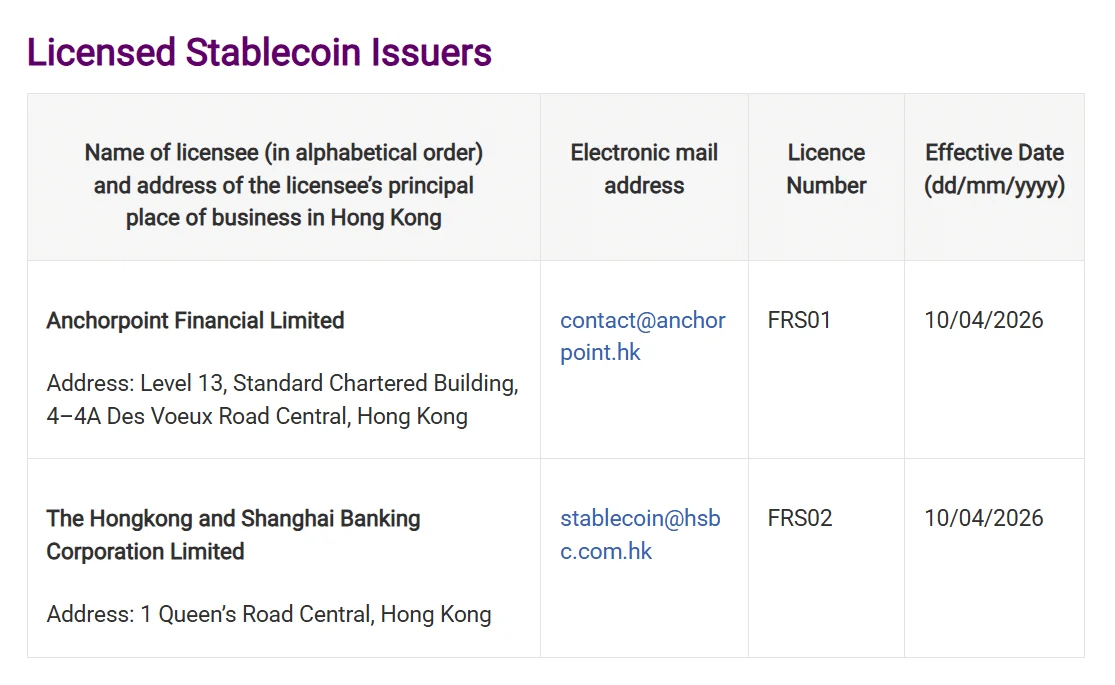
The Hong Kong Monetary Authority (HKMA) has officially granted the first batch of stablecoin issuer licenses under its newly established regulatory framework, marking a transformative milestone in the city’s ambition to become a premier global hub for digital assets. Anchorpoint—a strategic fintech venture formed through a collaboration between Standard Chartered Hong Kong, Animoca Brands, and SCBHK HKT—alongside banking giant HSBC Hong Kong, have emerged as the inaugural entities to receive these landmark authorizations. This development signals a significant shift in the institutional adoption of blockchain technology within one of the world’s most influential financial corridors.
According to official statements released on April 10, 2026, Anchorpoint is moving swiftly to capitalize on its new regulatory standing. The firm has announced plans to launch HKDAP, a regulated stablecoin fully backed by the Hong Kong dollar. The rollout of HKDAP is scheduled to occur in phases, with the initial launch expected to commence in the second quarter of the year. The licensing of these two entities follows years of rigorous consultation and legislative drafting aimed at integrating digital currency into the traditional financial system while maintaining stringent oversight.
The Strategic Formation of Anchorpoint and the Role of HSBC
The licensing of Anchorpoint is particularly noteworthy due to the high-profile nature of its backers. The venture represents a convergence of traditional banking expertise, Web3 innovation, and telecommunications infrastructure. Standard Chartered, a global banking powerhouse, provides the financial credibility and regulatory compliance framework. Animoca Brands, a leader in the digital property rights and metaverse space, brings technological agility and a deep understanding of the decentralized ecosystem. SCBHK HKT, the joint venture between Standard Chartered and the telecommunications giant HKT, provides the retail and payment infrastructure necessary for mass-market adoption.
Bill Winters, Group Chief Executive of Standard Chartered, emphasized that the bank’s involvement in Anchorpoint is part of a broader strategy to lead in financial innovation. Winters characterized the bank as a critical bridge between legacy clients and the evolving digital markets. He noted that the issuance of HKDAP provides a powerful, regulated medium of exchange that will facilitate the "rewiring" of financial markets and support the next generation of international trade.
Simultaneously, HSBC Hong Kong’s entry into the licensed stablecoin space reinforces the institutional consensus regarding the utility of tokenized fiat. As the largest bank in Hong Kong, HSBC’s participation provides the scale and liquidity essential for a stablecoin to function effectively within a high-volume financial environment. The dual licensing of a specialized fintech venture and a traditional systemic bank suggests that the HKMA is pursuing a diversified ecosystem where various business models can coexist under the same regulatory umbrella.
Understanding the HKDAP Model and Phased Rollout
Anchorpoint’s flagship product, HKDAP, is designed to address the volatility and transparency concerns that have historically plagued the stablecoin market. By being pegged 1:1 to the Hong Kong dollar and operating under the HKMA’s supervision, HKDAP aims to offer the stability of sovereign currency with the efficiency of blockchain technology.
Dominic Maffei, CEO of Anchorpoint, stated that the firm’s primary focus is empowering the financial ecosystem with a secure and accessible form of tokenized money. The operational strategy for HKDAP centers on a B2B2C (Business-to-Business-to-Consumer) model. Rather than attempting to reach every individual user directly, Anchorpoint will utilize a network of selected distributors, including banks, payment processors, and ecosystem partners. This approach is intended to ensure that the stablecoin is integrated into existing financial workflows, such as tokenized asset settlement and cross-border capital flows.
The phased rollout beginning in Q2 2026 will likely focus on institutional use cases first, such as interbank settlements and trade finance, before expanding into retail applications. By targeting the "rewiring" of cross-border payments, Anchorpoint hopes to reduce the costs and delays associated with traditional correspondent banking networks.
A Chronology of Hong Kong’s Regulatory Journey
The issuance of these licenses is the culmination of a multi-year effort by the Hong Kong government to reclaim its status as a crypto-friendly jurisdiction after a period of relative uncertainty.
- October 2022: The Financial Services and the Treasury Bureau (FSTB) issued a policy statement on the development of virtual assets, signaling a pro-innovation stance.
- June 2023: Hong Kong launched its Virtual Asset Service Provider (VASP) licensing regime, allowing retail investors to trade major cryptocurrencies like Bitcoin and Ethereum on licensed exchanges.
- March 2024: The HKMA introduced a "sandbox" for stablecoin issuers, allowing potential applicants to test their operational models in a controlled environment.
- August 2025: The Stablecoins Ordinance officially came into force. This legislative framework established the legal basis for licensing and provided the HKMA with the power to supervise issuers.
- April 2026: Anchorpoint and HSBC become the first entities to transition from the sandbox or application phase to full licensure.
This timeline demonstrates a methodical and cautious approach. Unlike other jurisdictions that have seen rapid, unregulated growth followed by systemic failures, Hong Kong has prioritized the creation of a "guardrail" system designed to prevent the type of de-pegging events seen with algorithmic stablecoins in previous years.
The Stablecoins Ordinance: Strict Requirements and Penalties
The Stablecoins Ordinance of 2025 is among the most comprehensive sets of digital asset regulations globally. It mandates that all issuers of fiat-linked stablecoins in Hong Kong obtain a license from the HKMA. The requirements are designed to ensure that issuers have the financial "staying power" to survive market turbulence.
Key provisions of the ordinance include:
- Capital Requirements: Issuers must maintain a minimum paid-up capital of HK$25 million (approximately US$3.2 million).
- Liquidity Standards: Issuers are required to hold at least HK$3 million in liquid assets at all times to meet potential redemption demands.
- Reserve Management: The ordinance requires that reserves be held in high-quality, liquid assets (such as government bonds or cash deposits) and be segregated from the issuer’s operating funds.
- Enforcement: To deter unauthorized activity, the framework imposes severe penalties. Unlicensed issuance of stablecoins can result in fines of up to HK$5 million and prison sentences of up to seven years.
In addition to the Ordinance, the HKMA has released detailed guidelines on anti-money laundering (AML) and counter-financing of terrorism (CFT). These guidelines require stablecoin issuers to perform rigorous "Know Your Customer" (KYC) checks, bringing the digital asset space in line with global banking standards.
Market Data and the Global Competitive Landscape
The global stablecoin market has grown into a cornerstone of the digital economy. As of early 2026, the total market capitalization of stablecoins has surpassed $311 billion, according to data from CoinGecko. However, the market remains heavily skewed toward US dollar-denominated tokens. Tether (USDT) and USD Coin (USDC) account for the vast majority of transaction volume and liquidity.
Hong Kong’s move to license HKD-backed stablecoins is an attempt to provide a viable alternative for regional trade and local financial products. By offering a regulated HKD option, the HKMA is positioning the city to capture a portion of the settlement volume that currently relies on offshore USD tokens. This is particularly relevant for the Greater Bay Area, where integrated financial services require seamless currency movement between Hong Kong and mainland China.
Furthermore, the introduction of regulated stablecoins serves as a bridge to other emerging technologies, such as Central Bank Digital Currencies (CBDCs). While the HKMA continues to explore the "e-HKD," the licensing of private issuers like Anchorpoint and HSBC allows for market-led innovation to proceed in parallel with public-sector initiatives.
Implications for the Future of Trade and Tokenization
The entry of HSBC and the Anchorpoint consortium into the stablecoin market is expected to accelerate the trend of asset tokenization. Tokenization involves representing real-world assets—such as real estate, bonds, or commodities—as digital tokens on a blockchain. For tokenization to scale, a reliable "on-chain" currency is required to facilitate the purchase and settlement of these assets. Regulated stablecoins provide this missing link.
Industry analysts suggest that the use of HKDAP and similar tokens could drastically improve the efficiency of international trade. Currently, cross-border payments involve multiple intermediary banks, high fees, and settlement times that can span several days. A regulated stablecoin allows for "atomic settlement," where the transfer of the asset and the payment happen simultaneously and nearly instantaneously.
Moreover, the B2B2C model proposed by Anchorpoint could lead to the integration of stablecoins into everyday consumer apps. Imagine a scenario where a user can pay for services through the HKT telecommunications network using HKDAP, or where rewards points are issued as programmable, stable digital tokens.
Navigating the China Factor
A critical aspect of Hong Kong’s stablecoin strategy is its relationship with mainland China. While Beijing remains steadfast in its ban on private cryptocurrency trading and mining, it has allowed Hong Kong to serve as a "regulatory laboratory." The HKMA’s focus on fiat-backed, highly regulated stablecoins aligns with China’s broader goals of financial stability and the internationalization of the Renminbi (RMB).
By maintaining a strict licensing regime, Hong Kong addresses China’s concerns regarding capital flight and monetary sovereignty. The Stablecoins Ordinance ensures that every digital token in circulation is accounted for and backed by physical reserves within the banking system. This "cautious innovation" allows Hong Kong to remain a global financial leader while respecting the macro-prudential boundaries set by the mainland.
As the second quarter of 2026 approaches, the global financial community will be watching the performance of HKDAP and HSBC’s digital offerings closely. The success of these licensed issuers could provide a blueprint for other jurisdictions—such as the United States and the United Kingdom—that are still grappling with how to integrate stablecoins into their legal frameworks. For now, Hong Kong has taken a decisive lead, proving that with the right balance of oversight and institutional support, the future of money is digital, regulated, and stable.