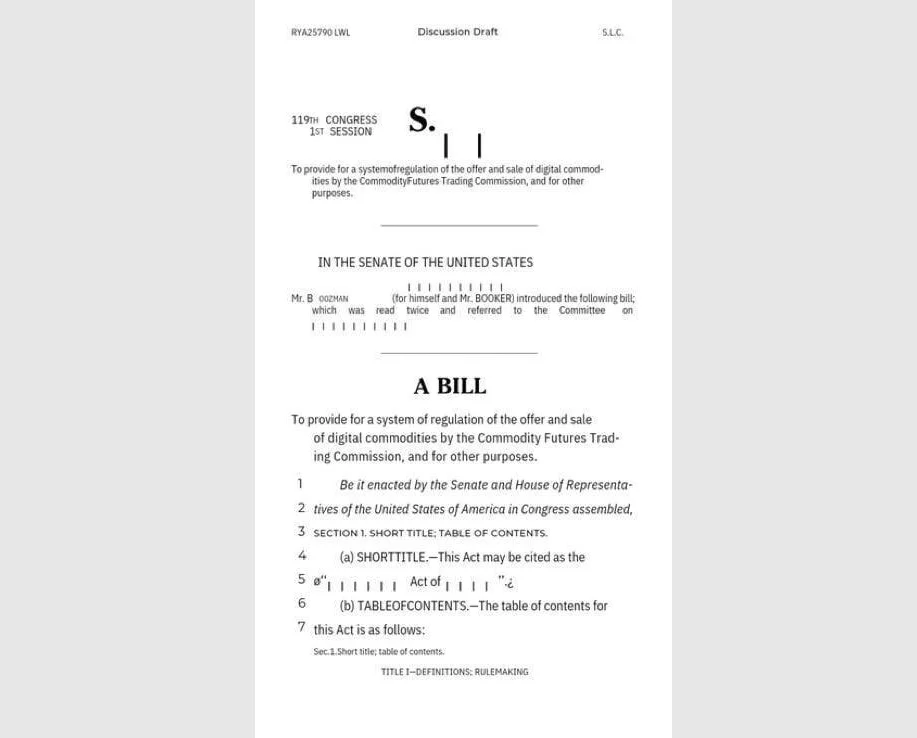
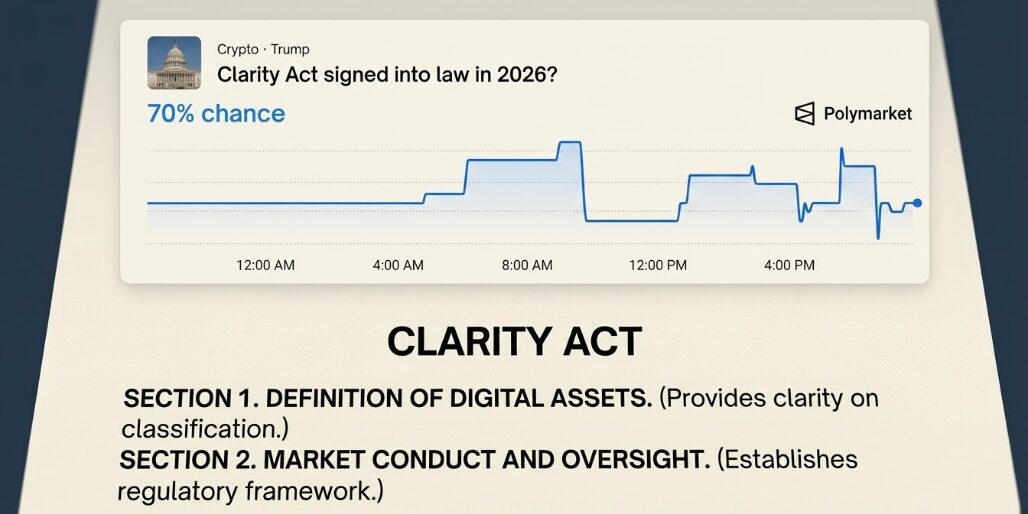
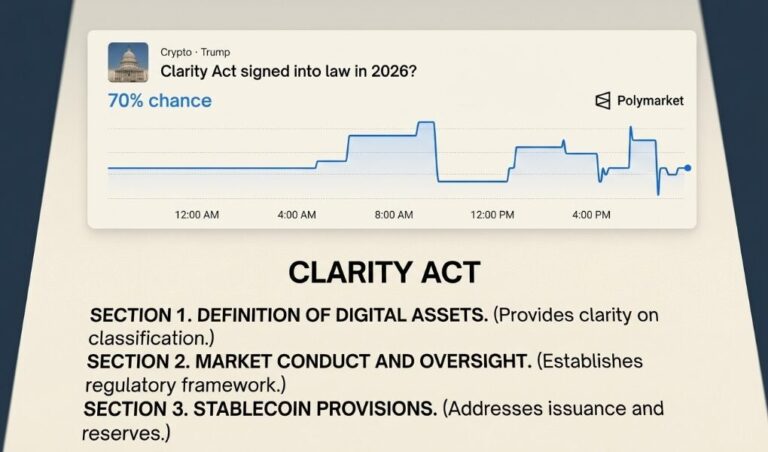
The probability of the Digital Asset Market Clarity Act, commonly known as the CLARITY Act, being signed into law within the 2026 calendar year has seen a notable decline according to the latest data from decentralized prediction markets. As of March 10, 2026, the "Yes" contract on Polymarket—a leading indicator of real-world event outcomes—dropped to 73%, a five-percentage-point decrease from the 78% high recorded just one week prior on March 3. This shift reflects a growing sentiment among market participants and political analysts that the path to comprehensive federal crypto regulation in the United States has encountered significant, multifaceted roadblocks involving banking lobbyists, executive ultimatums, and partisan legislative maneuvering.
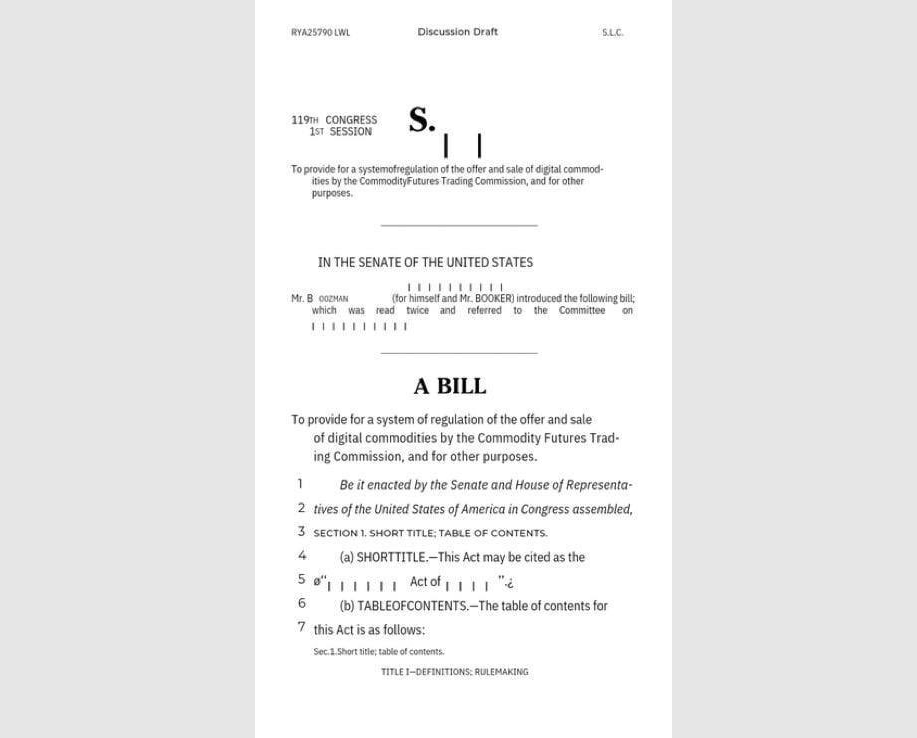
The CLARITY Act represents the most ambitious attempt to date by the United States Congress to provide a definitive legal framework for the digital asset industry. Its primary objective is to resolve the long-standing jurisdictional dispute between the Securities and Exchange Commission (SEC) and the Commodity Futures Trading Commission (CFTC). By establishing clear criteria for which digital assets constitute securities and which are commodities, the bill aims to eliminate the "regulation by enforcement" approach that has characterized the U.S. regulatory environment for much of the 2020s. However, despite passing the House of Representatives with bipartisan support in July 2025, the bill’s momentum in the Senate has stalled under the weight of competing interests and broader political conflicts.
A Chronology of Obstruction: The March 2026 Setbacks
The recent downturn in market confidence can be traced to a series of events in early March 2026 that highlighted the fragility of the current legislative compromise. In late February, Scott Bessent, a key figure in the financial policy discourse, noted that several major cryptocurrency firms had expressed reservations about the current draft of the bill. Mirroring the sentiment of Coinbase CEO Brian Armstrong, who famously stated that the industry would "rather have no bill than a bad bill," Bessent indicated that internal industry divisions were beginning to weaken the unified front necessary to push the legislation through a divided Senate.
On March 6, 2026, a report from Reuters sent shockwaves through the sector, revealing that the American Bankers Association (ABA) had officially rejected a compromise deal brokered by the White House. The proposed deal sought to find a middle ground between traditional financial institutions and stablecoin issuers. The central point of contention involved "stablecoin rewards"—the ability for digital asset providers to offer interest or yield-like incentives to users. The banking sector, fearing a massive migration of deposits from traditional savings accounts to yield-bearing stablecoins, viewed these provisions as an existential threat to their liquidity models. The ABA’s refusal to accept the White House’s terms effectively halted the progress of the CLARITY Act’s stablecoin provisions, which are considered the backbone of the entire legislative package.
The situation grew even more complex on March 8, 2026, when President Donald Trump issued a high-stakes ultimatum via his Truth Social platform. The President declared that he would not sign any significant legislation, explicitly mentioning the CLARITY Act, until Congress passes the "Safeguard American Voter Eligibility" (SAVE) Act. The SAVE Act, which focuses on tightening voter ID requirements and citizenship verification for federal elections, has become a cornerstone of the administration’s domestic agenda. By tying the fate of crypto regulation to a highly contentious election integrity bill, the administration has introduced a level of partisan volatility that many analysts believe could push the CLARITY Act’s approval beyond the 2026 midterms.
The Tillis Factor and the Moderator’s Challenge
Adding to the legislative friction, Senator Tom Tillis was appointed as a new moderator for the CLARITY Act discussions on March 9, 2026. While Tillis has historically shown an interest in financial innovation, his recent rhetoric has leaned toward the concerns of the traditional banking industry. Tillis has expressed sympathy for the argument that excessive concessions to the crypto industry regarding stablecoin rewards could trigger a destabilizing "deposit flight" from regional and national banks.
As a moderator, Tillis is tasked with balancing the demands of the "Crypto Caucus" in the Senate with the cautious stance of the Senate Banking Committee. His focus on direct dialogue between bank representatives and crypto executives suggests a desire for a comprehensive consensus, but such a consensus remains elusive. Critics argue that his appointment may further slow the bill’s progress as new rounds of testimony and revisions are expected to accommodate the banking lobby’s concerns.
Supporting Data and Prediction Market Trends
The 5% drop on Polymarket is more than a mere statistical fluctuation; it represents a recalibration of risk by investors who use these platforms to hedge against regulatory outcomes. In January and February 2026, the CLARITY Act was viewed as a "near-certainty" due to the perceived urgency of establishing a U.S. digital asset framework to compete with the European Union’s MiCA (Markets in Crypto-Assets) regulations.
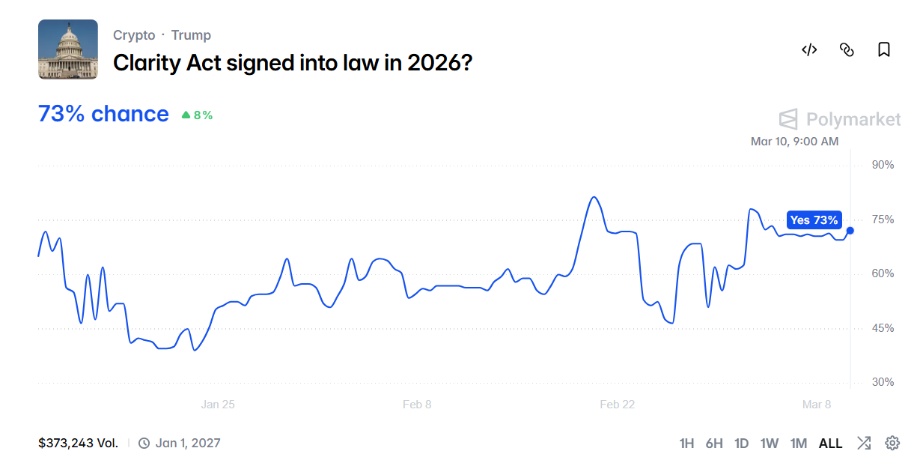
However, the current 73% probability suggests that while the market still believes the bill is likely to pass eventually, the "short-term optimism" that it would happen by the end of 2026 is evaporating. Analysts point to several key data points that support this cooling trend:
- The Legislative Calendar: With the 2026 midterms approaching, the window for passing non-essential, complex financial legislation is closing.
- The SAVE Act Odds: Polymarket currently gives the SAVE Act only an 18% chance of passing in its current form, suggesting that the President’s veto threat on the CLARITY Act is a formidable hurdle.
- DeFi Market Volatility: Tokens associated with Decentralized Finance (DeFi) protocols have seen a localized price correction of 8-12% following the Reuters report, indicating that the market is pricing in a longer wait for institutional-grade regulatory clarity.
Broader Impact and Industry Implications
The delay of the CLARITY Act has profound implications for the U.S. economy and the global digital asset landscape. For institutional investors, the lack of federal clarity remains the single largest barrier to entry. Large-scale pension funds and insurance companies, which have been eyeing the crypto sector since the approval of Bitcoin and Ethereum ETFs in previous years, require the "legal safe harbor" that the CLARITY Act promises.
Furthermore, the "Stablecoin War" between banks and fintech firms is now at a fever pitch. If the CLARITY Act fails to pass in 2026, the U.S. risks a fragmented regulatory environment where individual states, such as New York and Wyoming, continue to set their own divergent standards. This fragmentation increases compliance costs for startups and encourages American firms to relocate their headquarters to jurisdictions like Singapore, the UAE, or the EU, where regulatory frameworks are already operational.
The DeFi sector is particularly vulnerable to this legislative stalemate. The current version of the CLARITY Act includes provisions that would exempt certain decentralized protocols from the strict reporting requirements intended for centralized exchanges. Without these protections, the SEC may continue its aggressive enforcement actions against DeFi developers, potentially stifling innovation in the burgeoning "on-chain" economy.
Outlook for the Remainder of 2026
Despite the recent setbacks, the CLARITY Act is far from dead. The 73% probability remains significantly higher than most pending legislation, reflecting a fundamental consensus that the status quo is unsustainable. To regain its upward momentum, several key "checkpoints" must be met in the coming months:
- Resumption of Bipartisan Negotiations: If Senator Tillis can broker a compromise on stablecoin rewards that satisfies the ABA without alienating crypto firms, the odds of passage will likely surge.
- The "SAVE Act" Resolution: A legislative compromise on the SAVE Act or a decoupling of the two bills by the White House would remove a major political roadblock.
- Economic Pressure: If the U.S. continues to see a capital flight of crypto-related businesses to Europe, political pressure from the pro-innovation wing of both parties may force a floor vote in the Senate.
In conclusion, the CLARITY Act’s journey through the 2026 Senate has entered a "sobering phase." The initial excitement of the House’s success has been replaced by the gritty reality of Washington power politics. While the fundamental need for regulatory clarity remains unchanged, the timeline has become a casualty of the broader struggle between traditional finance and the digital future, as well as the inevitable friction of a high-stakes election year. Investors and industry stakeholders should prepare for a period of "cautious waiting," as the next few months of Senate negotiations will determine whether 2026 is the year of American crypto clarity or another year of missed opportunities.