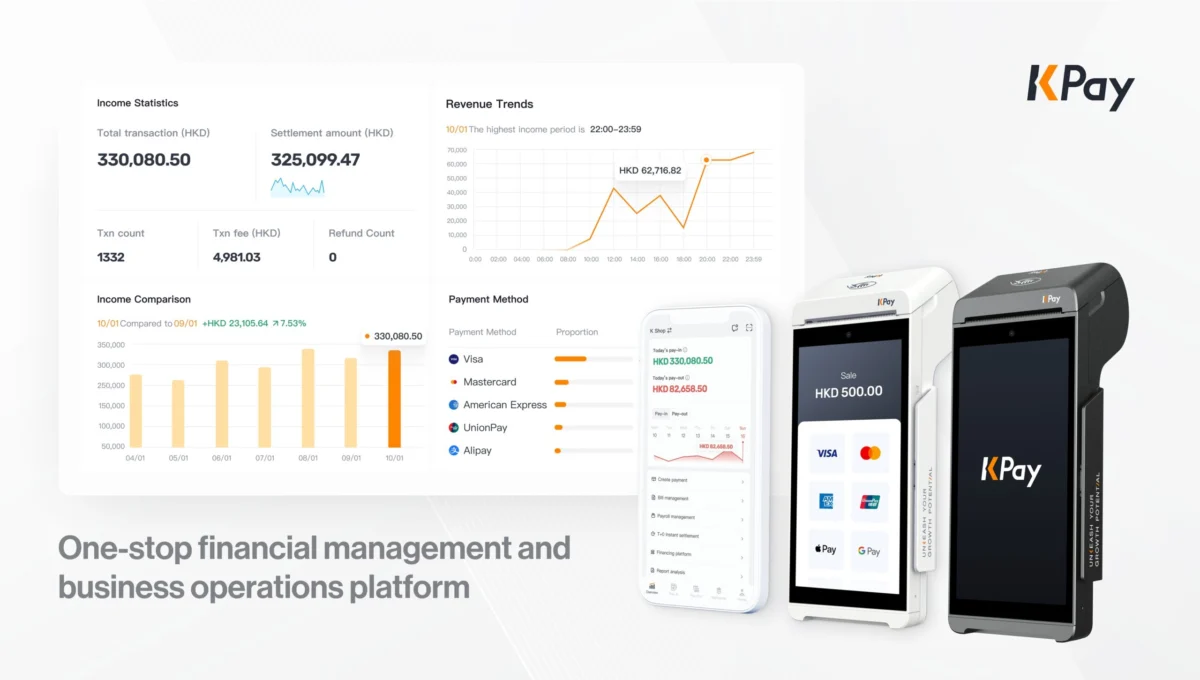
The Asian financial technology landscape has reached a significant milestone with KPay, a leading one-stop financial management platform, announcing the successful closure of a $55 million Series A funding round. This investment, led by the London-based private equity firm Apis Partners through its Apis Growth Markets Fund III, marks a pivotal moment for the Hong Kong-headquartered startup as it seeks to address the chronic inefficiencies plaguing small and medium-sized businesses (SMBs) across the Asia-Pacific region. The infusion of capital is earmarked for aggressive product innovation, regional expansion, and the integration of advanced technologies such as artificial intelligence to streamline merchant operations.
The Evolution of KPay: From Revenue Optimization to Financial Integration
The genesis of KPay was not a sudden epiphany but rather a calculated pivot born out of direct observation of market friction. Before founding KPay, Davis Chan and his co-founding team operated in the digital marketing and merchant services space, focusing primarily on helping small businesses optimize their customer traffic and revenue streams. However, as they embedded themselves deeper into the daily operations of their clients, a recurring theme emerged: while merchants were becoming adept at attracting customers, they were struggling under the weight of archaic, fragmented financial systems.
Traditional financial institutions have historically underserved the SMB sector, offering rigid products designed for large corporations or basic consumer accounts that lack the necessary business integration. Chan observed that merchants were often forced to juggle multiple disconnected platforms for payment processing, payroll, bill settlement, and accounting. This fragmentation created a "data silo" effect, where business owners had no real-time visibility into their overall financial health.
“Traditional financial solutions for merchants and SMBs do not effectively cater to the modern needs for business agility, integration, and data-informed decision-making,” Chan noted during the funding announcement. He emphasized that the current fragmented approach results in higher operational costs and a significant lack of actionable business insights, which are crucial for survival in a post-pandemic economy. Consequently, KPay was launched three years ago with a mission to unify these disparate threads into a single, cohesive ecosystem.
Rapid Market Penetration and Operational Milestones
Since its inception, KPay has demonstrated remarkable growth, validating the demand for integrated financial tools. The company currently serves approximately 45,000 merchants across three primary markets: Hong Kong, Singapore, and Japan. This rapid scaling is supported by a robust network of over 150 partners, including Software-as-a-Service (SaaS) providers, traditional banking institutions, and specialized financial service firms.
The company’s growth trajectory is further underscored by its financial performance. Christopher Yu, Chief Financial Officer of KPay, revealed that the company has maintained a compound annual growth rate (CAGR) of 166% since it began operations. This level of growth is particularly notable given the tightening of venture capital markets globally, suggesting that KPay’s business model—centered on high-stickiness merchant services—is particularly attractive to growth-stage investors.
Currently, the startup employs approximately 440 staff members across its regional hubs. This workforce is tasked with maintaining a platform that supports a wide array of functions, including the acceptance of all major payment methods, automated payroll processing, and localized as well as global remittance services. By acting as a central nervous system for a merchant’s finances, KPay allows business owners to pivot from manual administrative tasks to strategic growth.
Strategic Utilization of Series A Capital
The $55 million investment led by Apis Partners is more than just a balance sheet booster; it is a strategic catalyst for KPay’s next phase of development. The company has outlined a multi-pronged approach for the deployment of these funds:
1. Accelerated Product Development and AI Integration
KPay intends to deepen its technological moat by investing heavily in payment technologies that prioritize speed, security, and flexibility. A significant portion of the R&D budget will be directed toward exploring how artificial intelligence can be leveraged to enhance the merchant experience. Potential applications include predictive cash flow analytics, automated reconciliation, and AI-driven fraud detection. By providing merchants with tools that can "predict" financial hurdles, KPay aims to move from a reactive service provider to a proactive business partner.
2. Enhanced Go-to-Market (GTM) Speed
In the competitive fintech space, speed of execution is paramount. KPay plans to use the funding to streamline its sales and marketing funnels, ensuring that its suite of products can be deployed rapidly across different jurisdictions. This includes tailoring its "one-stop" platform to meet the specific regulatory and cultural requirements of diverse Asian markets.

3. Regional Expansion and Inorganic Growth
While Hong Kong and Singapore remain the company’s strongholds, KPay is eyeing broader horizons within Asia. The company is actively exploring opportunities for expansion into emerging markets where digital payment adoption is surging but merchant infrastructure remains underdeveloped. Christopher Yu also indicated that the company is open to inorganic growth strategies, including strategic mergers and acquisitions (M&A). By acquiring smaller, specialized SaaS players or local payment gateways, KPay can quickly add new features to its platform and gain immediate access to established merchant bases.
The Investor Perspective: Why Apis Partners Led the Round
The decision by Apis Partners to lead this Series A round reflects a broader confidence in the "platformization" of SMB finance. As a London-based firm with a specific focus on financial services in growth markets, Apis Partners brings both capital and sector-specific expertise to the table.
Investors are increasingly looking for "ecosystem plays"—companies that don’t just process a transaction but manage the entire lifecycle of a business’s money. KPay’s ability to integrate with over 150 SaaS and banking partners makes it a central hub rather than a peripheral tool. In an era where data is the most valuable commodity, KPay sits at the intersection of payment data, payroll data, and supply chain data, providing a comprehensive view of the SMB economy that few other players can match.
Contextual Analysis: The Changing Face of Asian SMB Finance
The rise of KPay occurs against the backdrop of a massive shift in the Asian digital economy. According to recent industry reports, the digital payment market in Southeast Asia alone is expected to cross the $1 trillion mark in transaction value by 2025. However, the "backend" for the merchants facilitating these transactions has often been overlooked.
Historically, an SMB in a city like Singapore or Tokyo might use one provider for their Point-of-Sale (POS) system, a different bank for their corporate account, a third-party app for payroll, and an international wire service for paying overseas suppliers. Each of these services carries its own fee structure and requires manual data entry to sync with accounting software.
KPay’s value proposition is the elimination of this "fragmentation tax." By offering a unified platform, they reduce the overhead costs associated with multiple subscriptions and decrease the likelihood of human error in financial reporting. This is particularly vital for "neighborhood businesses"—the cafes, boutiques, and local service providers that Chan mentioned—who do not have the resources to employ full-time finance departments.
Future Outlook: The Road to One Million Merchants
Looking toward the horizon, KPay has set an ambitious target: to empower one million merchants within the next five years. This goal is not merely about scale but about creating a more inclusive digital economy.
“Our goal is to enable neighborhood businesses to have the same opportunities as major brands,” Davis Chan stated. This vision of "democratizing" high-end financial tools could have profound implications for economic resilience in the region. When small businesses have access to real-time data and efficient remittance, they are better equipped to navigate inflationary pressures and supply chain disruptions.
However, the path forward is not without challenges. KPay will face stiff competition from both established "super-apps" that are moving into merchant services and traditional banks that are finally beginning to modernize their SMB offerings. Furthermore, navigating the complex regulatory environment of the Asia-Pacific region—where each country has its own licensing requirements for payments and remittances—will require significant legal and operational finesse.
Conclusion
The successful Series A funding of KPay is a testament to the maturation of the Asian fintech sector. It signals a shift away from simple payment processing toward comprehensive financial management ecosystems. By addressing the pain points of fragmented systems and manual processes, KPay is positioning itself as an essential infrastructure provider for the millions of SMBs that form the backbone of the Asian economy. As the company integrates AI and expands its geographic footprint, the industry will be watching closely to see if KPay can indeed bridge the gap between traditional banking and the modern needs of the digital-first merchant.