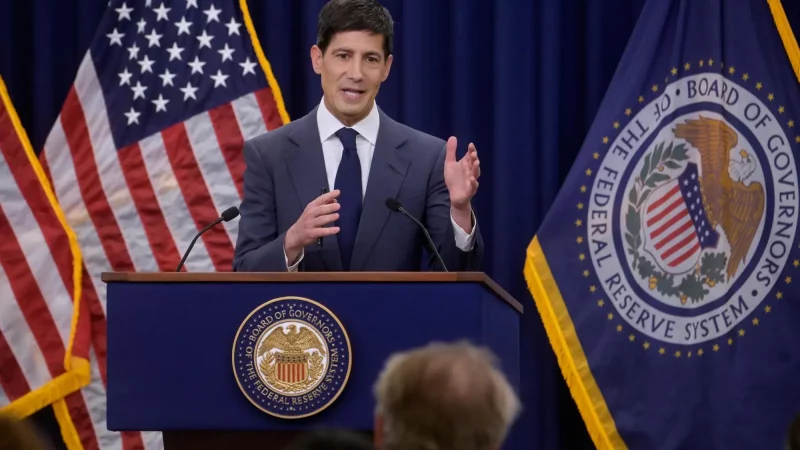
The Federal Reserve implemented a 25-basis-point interest rate increase this Wednesday, lifting the federal funds rate to a target range of 3.75% to 4%. This decisive policy shift marks the central bank’s return to a hawkish stance, ending a period of monetary easing that began in late 2024. Policymakers, acting through the Federal Open Market Committee (FOMC), reached a unanimous 12-0 decision, citing the necessity of curbing inflation that continues to hover stubbornly above the Fed’s established 2% long-term objective.
A Pivot in Monetary Strategy
This adjustment represents the first hike since July 2023, a period defined by significant volatility in both domestic and international markets. Following that previous peak, which saw rates reach 5.50%, the Fed shifted toward a series of reductions starting in September 2024 to support economic stability. By the conclusion of 2025, the target range had been successfully brought down to 3.50% to 3.75%. However, recent economic data indicating that price pressures remain entrenched forced a reversal of this downward trajectory.
The FOMC’s statement accompanying the announcement underscored that, while economic activity continues to expand at a "solid pace," the persistence of inflationary forces necessitates a more restrictive policy environment. The committee reiterated its "strong commitment" to returning inflation to its 2% target, suggesting that today’s hike is a calibrated response to data that has proven more resilient than early-year forecasts suggested.
Market Expectations and Pre-Announcement Volatility
The decision did not come as a surprise to institutional investors or retail traders. The CME FedWatch Tool had been signaling a high probability of such an outcome, with approximately 88% of market participants anticipating the 25-basis-point move in the hours leading up to the official release.
Despite the high level of preparedness, the anticipation of the hike induced significant turbulence across various asset classes. The 10-year Treasury yield, a benchmark for borrowing costs across the economy, spiked to levels not seen since 2007, touching 5% on Tuesday before retreating slightly to 4.95% on the day of the announcement. This yield movement created a "risk-off" environment, placing downward pressure on equities, with both the S&P 500 and the Nasdaq indices trading roughly 2% lower than their early September benchmarks.
Cryptocurrency Market Reactions
The digital asset sector, which has grown increasingly sensitive to macroeconomic indicators, experienced a notable period of instability leading into the FOMC meeting. The failure of the U.S. Senate to advance the CLARITY Act earlier in the week acted as a catalyst for a broader sell-off, compounding the jitters surrounding the interest rate outlook.
Bitcoin, the bellwether of the crypto market, was trading near $75,500 prior to the announcement, reflecting a 5% decline since the beginning of the week. Similarly, Ethereum faced a more pronounced downturn, shedding more than 8% of its value to trade near $2,380. Other major assets, including Solana and Ripple’s XRP, also saw significant double-digit percentage drops as liquidity flowed out of high-risk assets and toward the safety of the dollar and short-term debt.
However, the immediate aftermath of the announcement provided a relief rally for the sector. As the markets processed the news—essentially treating the hike as a "priced-in" event—Bitcoin surged past the $76,000 threshold. Ethereum, Solana, and XRP followed suit, each posting gains of over 1% in the minutes following the official communication from the Fed. This movement suggests that traders had been holding back in anticipation of the announcement and saw the lack of an "aggressive" (50 basis point) hike as a bullish signal.
Economic Resilience and the Path Ahead
Despite the focus on inflation, the Fed’s assessment of the underlying economy remains cautiously optimistic. The FOMC report characterized domestic spending as "resilient," while highlighting that productivity growth and capital investment have remained robust throughout the third quarter. The labor market, often a primary concern for the Fed, appears to be holding steady. Job gains are reportedly keeping pace with the growth of the workforce, and the unemployment rate has remained relatively static, showing no signs of an imminent spike despite the tighter monetary conditions.
The critical question for the remainder of the year is whether this 25-basis-point increase will be sufficient to cool the economy, or if further tightening is on the horizon. Current futures pricing indicates that the market is divided regarding the October meeting, with a roughly 54% probability that the Fed will maintain the current 3.75% to 4% range. Much will depend on the upcoming Consumer Price Index (CPI) and Personal Consumption Expenditures (PCE) reports.
Broader Implications for Global Markets
The ripple effects of the Federal Reserve’s decision extend far beyond Wall Street. Precious metals, which often serve as a hedge against inflation and a store of value, have struggled as yields have climbed. Gold, typically a beneficiary of loose monetary policy, was down roughly 3.5% from its early September peaks, while silver saw a 4% decline. As the Fed signals a willingness to keep rates elevated for longer to combat inflation, the opportunity cost of holding non-yielding assets like precious metals increases, forcing investors to rebalance their portfolios.
Furthermore, the strength of the U.S. dollar, supported by these higher interest rates, continues to place pressure on emerging market currencies and global trade balances. Multinational corporations, which have been navigating a challenging environment of increased borrowing costs and wage inflation, will now have to contend with even higher debt-servicing costs for floating-rate loans.
Chronology of Recent Monetary Shifts
To understand the current environment, one must look at the recent timeline of the central bank’s decision-making process:
- July 2023: The Federal Reserve pauses after a series of hikes, holding the federal funds rate at 5.25% to 5.50%.
- September 2024: The Fed initiates the first in a series of rate cuts, citing a cooling labor market and signs of moderating inflation.
- December 2025: The Fed concludes a period of gradual easing, successfully bringing the target range down to 3.50% to 3.75%.
- September 2026: Following data showing renewed inflationary pressure, the FOMC votes 12-0 to increase the federal funds rate by 25 basis points to a range of 3.75% to 4%.
Analytical Outlook
The Federal Reserve finds itself in a precarious position. The "soft landing" narrative—the hope that the central bank can tame inflation without triggering a recession—is being tested. By opting for a 25-basis-point increase rather than a more aggressive stance, the Fed is signaling that it intends to remain data-dependent. This measured approach allows the committee to avoid over-correcting, which could stifle the current robust productivity and capital investment growth.
However, the "higher for longer" narrative creates a complex environment for investors. If inflation does not trend toward the 2% target by the final quarter of the year, the Fed may be forced to abandon its neutral stance and consider additional hikes. For the cryptocurrency market, this suggests a continued correlation with macroeconomic policy, where liquidity remains the primary driver of price action.
As the financial community looks toward the October FOMC meeting, the focus will shift entirely to the Fed’s forward guidance. Whether the committee maintains this level or continues to tighten will determine the trajectory for both traditional equities and volatile digital assets for the remainder of the fiscal year.
Disclosure: This article was edited by Estefano Gomez. For more information on how we create and review content, please consult our official Editorial Policy.