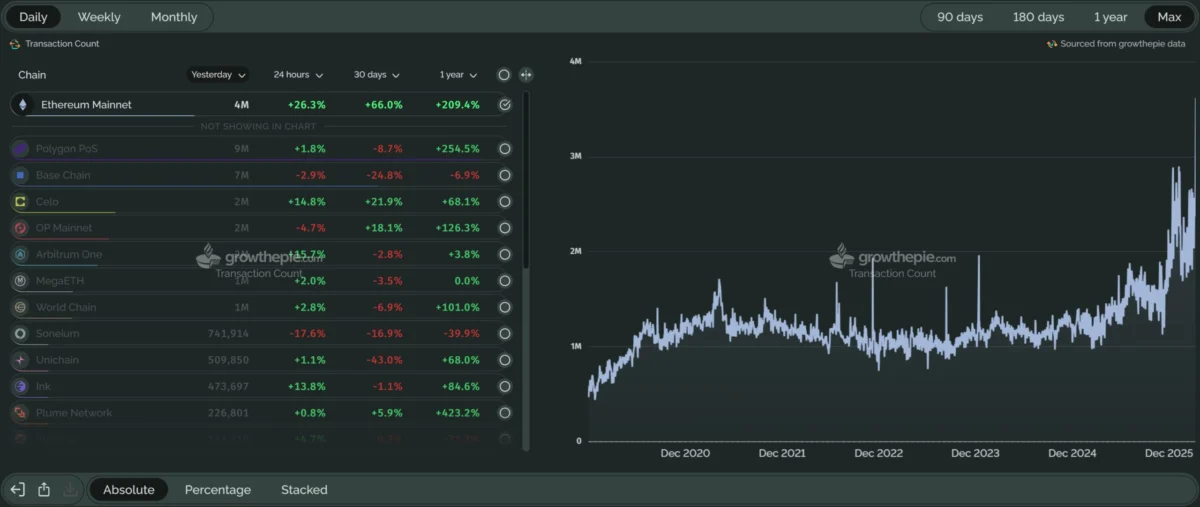
The Ethereum network is currently experiencing unprecedented levels of activity, with daily transaction counts reaching new historical peaks, a trend that starkly contrasts with the altcoin’s ongoing struggle against price volatility. Even as the price of ETH has seen a notable decline from its recent peaks, user engagement and operational volume on the leading smart contract blockchain are demonstrating robust, sustained growth. This divergence between fundamental network strength and market valuation has captivated analysts and investors alike, signaling a potentially healthier long-term outlook for the ecosystem.
Ethereum’s Resilient Growth Amidst Market Volatility
In a cryptocurrency landscape often characterized by rapid shifts and pronounced uncertainty, the Ethereum network has emerged as a beacon of sustained interest and engagement. This enduring strength is particularly evident in the escalating number of transactions processed on the blockchain each day. While the broader market sentiment around altcoins, including Ethereum, has been subject to significant fluctuations, daily transaction counts on the network have consistently climbed, reaching record levels. This distinct mismatch between market performance and underlying network fundamentals often serves as an indicator of inherent strength that may not yet be fully reflected in asset valuation.
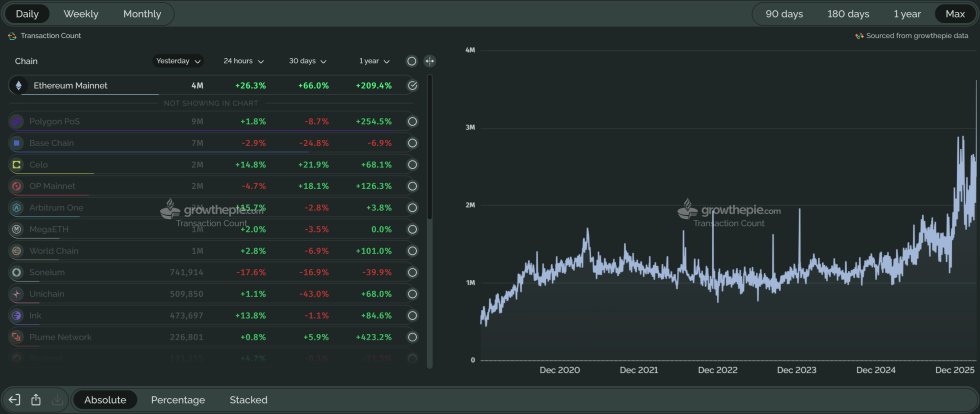
Reports compiled by Everstake, a prominent global non-custodial staking infrastructure provider, have highlighted Ethereum’s monumental achievement. On April 12, 2026, the network recorded an astonishing 3.6 million transactions, marking the highest daily activity ever witnessed since the inception of the Ethereum blockchain. This milestone underscores the increasing utility and adoption of the network, even as the price of ETH continues to trade approximately 55% below its all-time high. The persistent rise in on-chain activity, despite the absence of a corresponding bullish price surge, suggests that consumers and developers remain deeply committed to and actively engaged with the network, irrespective of immediate market movements. Historically, periods of intense network usage have often preceded significant price appreciation, leading many to interpret the current trend as a bullish signal for Ethereum’s future.
A Deep Dive into Transactional Milestones
To fully appreciate the magnitude of 3.6 million daily transactions, it is crucial to place this figure within historical context. Prior to this recent surge, Ethereum’s highest transaction volumes were typically observed during peak bull market cycles, such as the DeFi Summer of 2020 or the NFT boom of 2021, where daily transactions hovered between 1.2 million and 1.8 million. The current record, achieved during a period of price consolidation, represents an almost twofold increase over these previous highs, signaling a fundamentally different phase of adoption and utility. This consistent, high-volume usage is not merely speculative; it reflects genuine economic activity across various sectors of the decentralized ecosystem.
The types of transactions driving this volume are diverse, encompassing a wide array of activities from simple peer-to-peer ETH transfers to complex smart contract interactions within decentralized finance (DeFi) protocols, non-fungible token (NFT) marketplaces, and various decentralized applications (dApps). The sustained demand for block space, even in the absence of speculative fervor, indicates that Ethereum’s utility is expanding beyond purely investment-driven motives. Furthermore, while the average gas fees (transaction costs) during this period have remained manageable compared to the exorbitant spikes seen in previous bull runs, the consistent burning of ETH through the EIP-1559 mechanism means that increased network activity directly contributes to the deflationary pressure on ETH supply, reinforcing its "ultrasound money" narrative.
On-Chain Metrics Paint a Bullish Picture
Everstake’s analysis further emphasizes that this prevailing trend creates a significant divergence: network activity is peaking even as complete price strength remains elusive. Past market cycles have frequently demonstrated that such gaps tend to narrow over time, suggesting that market valuation eventually catches up to fundamental strength. This perspective posits that price typically follows fundamentals, rather than dictating them, and in Ethereum’s case, the foundational elements are now firmly in place.
Beyond raw transaction counts, other on-chain metrics corroborate this narrative of robust health. The number of daily active addresses, while fluctuating, has maintained a high baseline, indicating a broad and engaged user base. The volume of stablecoin transfers, often seen as a proxy for real economic activity and liquidity within the crypto space, has also seen substantial growth on Ethereum. This metric, in particular, highlights Ethereum’s pivotal role as a settlement layer for digital value.
The maturation of Ethereum’s staking ecosystem, especially following the successful Merge in September 2022 and subsequent upgrades like Shanghai/Capella, has also played a crucial role. The transition to a Proof-of-Stake (PoS) consensus mechanism has not only enhanced network security and energy efficiency but also opened up avenues for passive income through staking. This has attracted a growing number of participants, both individual and institutional, to secure the network. The rise of liquid staking derivatives (LSDs) has further increased capital efficiency for stakers, allowing them to earn yields while maintaining liquidity, thereby stimulating broader ecosystem engagement.
Moreover, the continuous progress in scaling and development, particularly with Layer 2 (L2) solutions such as Arbitrum, Optimism, zkSync, and StarkNet, contributes significantly to Ethereum’s overall strength. These L2s offload a substantial portion of transactional volume from the mainnet, making the ecosystem more scalable and cost-effective for everyday use. While L2s process transactions off-chain, they ultimately settle on the Ethereum mainnet, reinforcing its role as the ultimate security and data availability layer for the entire ecosystem. This synergistic relationship ensures that Ethereum can handle increasing demand without compromising its core principles of decentralization and security.
Ethereum: The Unrivaled Hub for On-Chain Finance
A significant driver of Ethereum’s burgeoning activity is its escalating role as the primary settlement layer for on-chain finance. The stablecoin supply managed on the network has been expanding at an extraordinary rate over recent years, solidifying Ethereum’s position at the forefront of digital asset settlement.
In an analysis shared via an X post by researcher and optimist Leon Waidmann, it was revealed that the stablecoin supply on Ethereum has reached an unprecedented all-time high. Data indicates that over $180 billion has been integrated into the network within the last three years alone, representing a staggering 150% increase during that period. This surge underscores Ethereum’s critical function as the primary rails for digital dollar transactions and other fiat-pegged cryptocurrencies.

Currently, Ethereum commands approximately 60% of the total stablecoin market share. This dominance is not merely a reflection of current trends but also a strong indicator of future potential. Projections suggest that an additional $1.7 trillion in assets is poised to transition onto blockchain networks within the next four years. Ethereum is exceptionally well-positioned to capture a substantial portion of this incoming capital. Even if Ethereum’s commanding market share were to modestly decrease from 60% to 50% by 2030, it would still imply that the ETH network would secure nearly $850 billion in new stablecoin supply. This forecast highlights Ethereum’s indispensable role in the evolving global financial infrastructure, attracting both retail users and institutional players seeking secure, transparent, and programmable financial instruments. The underlying drivers for this stablecoin growth include the burgeoning DeFi ecosystem, which relies heavily on stablecoins for lending, borrowing, and trading; the increasing demand for global remittances and cross-border payments; and the utility of stablecoins as a safe haven asset during periods of volatility within the broader cryptocurrency market. Furthermore, growing institutional interest in tokenized assets and real-world asset (RWA) integration is increasingly leveraging Ethereum’s robust infrastructure.
Industry Reactions and Expert Outlook
The record-breaking network activity on Ethereum has garnered significant attention from industry experts and analysts, who largely interpret these metrics as a testament to the network’s enduring value proposition. Everstake’s report, which initially brought these figures to light, explicitly stated that this divergence between price and fundamentals has historically indicated an eventual convergence, where price action catches up to underlying utility. This perspective is echoed across the blockchain analysis community.
"What we are witnessing on Ethereum is a clear signal of organic growth and utility, rather than speculative froth," commented a leading blockchain analyst at a prominent crypto research firm. "The fact that transaction volumes are reaching all-time highs while ETH price remains significantly below its peak suggests that the network is being utilized for real-world applications and financial settlements, building a robust foundation for future appreciation. This isn’t just about trading; it’s about building and transacting."
Developers within the Ethereum ecosystem also express optimism, pointing to the continuous improvements in scalability, security, and developer tooling. "The transition to Proof-of-Stake has made Ethereum more efficient and sustainable, attracting a new wave of innovation," stated a core developer. "Our focus on Layer 2 solutions ensures that the network can handle mass adoption without sacrificing decentralization. The current activity levels validate years of hard work and commitment to making Ethereum the world’s decentralized computer."
The "ultrasound money" narrative, which posits that ETH’s supply will become deflationary due to EIP-1559 transaction fee burning and increased staking, is also gaining traction. With higher network activity, more ETH is burned, further solidifying this long-term supply-side pressure. This inherent mechanism makes ETH a uniquely attractive asset for long-term holders who believe in the network’s fundamental growth.
Implications for the Broader Crypto Ecosystem and Beyond
The sustained surge in Ethereum network activity carries profound implications not only for ETH holders but also for the broader cryptocurrency ecosystem and the future of decentralized technology. It serves as a powerful validation of Ethereum’s foundational vision as a decentralized, global computer capable of hosting a vast array of applications.
For Decentralized Finance (DeFi), the robust activity signifies a healthy and expanding market. Increased transactions mean more liquidity flowing through decentralized exchanges, more capital locked in lending and borrowing protocols, and greater innovation in financial primitives. This sustained engagement ensures that DeFi remains a vibrant and evolving sector, continuously pushing the boundaries of what is possible with programmable money. The reliability and security of Ethereum as the backbone for these applications are paramount, and the current activity levels reinforce this trust.
While not explicitly detailed in the initial report, the thriving activity on Ethereum also indirectly benefits other segments like Non-Fungible Tokens (NFTs) and Web3 gaming. Many prominent NFT collections and blockchain games are built on Ethereum or its Layer 2 solutions. A healthy and active base layer provides a stable and secure environment for these nascent industries to grow, attracting new users and creators.
For investors, the current divergence between price and fundamentals presents a compelling case for long-term optimism. It suggests that despite short-term market fluctuations, Ethereum’s intrinsic value and utility are consistently increasing. This can foster greater investor confidence, attracting patient capital that recognizes the network’s foundational strengths rather than being swayed by immediate price swings. The accumulation of assets on the network, particularly stablecoins, indicates a growing base of committed users and significant economic weight.
Looking ahead, Ethereum’s growing importance as a financial settlement layer could also influence the regulatory landscape. As more traditional financial activities migrate on-chain, regulators may be compelled to develop clearer and more comprehensive frameworks for digital assets, potentially leading to increased institutional adoption and integration into mainstream finance. While regulatory scrutiny can bring challenges, it also signifies the maturation and mainstream acceptance of the technology.
Finally, while other Layer 1 blockchains continue to innovate and compete, Ethereum’s current activity levels and stablecoin dominance underscore its enduring network effect and established position. Its vast developer community, battle-tested security, and unparalleled composability create significant moats that are difficult for competitors to overcome, particularly in areas requiring high-value settlements and robust smart contract execution.
In conclusion, the record-breaking transaction volumes and surging stablecoin supply on the Ethereum network paint a clear picture of an ecosystem thriving on fundamental utility and organic growth. Despite the prevailing price volatility of ETH, the underlying network is stronger than ever, signaling a resilient and expanding platform that is steadily cementing its role as the backbone of the decentralized economy. This robust foundation, coupled with ongoing technological advancements and increasing adoption, suggests a promising trajectory for Ethereum, irrespective of immediate market sentiment.