After a brief period of trading below the crucial $2,000 threshold, the price of Ethereum (ETH) has successfully regained this significant level, reflecting a cautious return of bullish momentum to the broader cryptocurrency market. This resurgence occurs despite persistent volatility that has characterized the digital asset landscape. Underlying this price action is a profound and steadily intensifying interest in Ethereum from institutional investors, whose accumulation patterns have consistently spiked month over month, alongside a historic surge in network staking activity.
The Resurgence of Ethereum: A Market Overview
The cryptocurrency market, known for its dynamic and often unpredictable swings, recently witnessed Ethereum dip below the psychological $2,000 mark. This dip was largely influenced by macroeconomic uncertainties, evolving regulatory landscapes, and broader risk-off sentiment that has periodically gripped global financial markets. However, the asset’s swift recovery above this level underscores its inherent resilience and the robust demand that continues to underpin its value proposition. Ethereum, as the preeminent smart contract platform, serves as the foundational layer for a vast array of decentralized applications (dApps), decentralized finance (DeFi) protocols, and non-fungible tokens (NFTs), positioning it as a cornerstone of the burgeoning Web3 economy. Its utility extends beyond mere speculation, encompassing critical infrastructure for digital innovation and financial services.
Institutional Embrace: A Steadfast Bet on Ethereum’s Future
Despite the often-turbulent price movements and bearish conditions that have affected the crypto market, institutional investors have remained remarkably unfazed in their commitment to Ethereum. Instead of retreating in the face of market uncertainty, a steady and growing wave of institutional demand has been building around the leading altcoin, firmly placing it in the spotlight as a strategic long-term investment. This sustained interest highlights a fundamental shift in how traditional finance views digital assets, particularly Ethereum, moving beyond speculative trading to recognizing its potential as a core component of future economic infrastructure.
Over the past several months, public companies, asset management firms, and other institutional players have been accumulating Ethereum at a relentless pace. These entities are not merely dabbling in the asset; they are steadily increasing their holdings, indicating a profound and long-term conviction in Ethereum’s enduring role within the developing digital economy. Their investment strategies reflect a belief that Ethereum’s technological advancements, robust ecosystem, and transition to a more sustainable and scalable Proof-of-Stake (PoS) consensus mechanism position it for significant future growth.
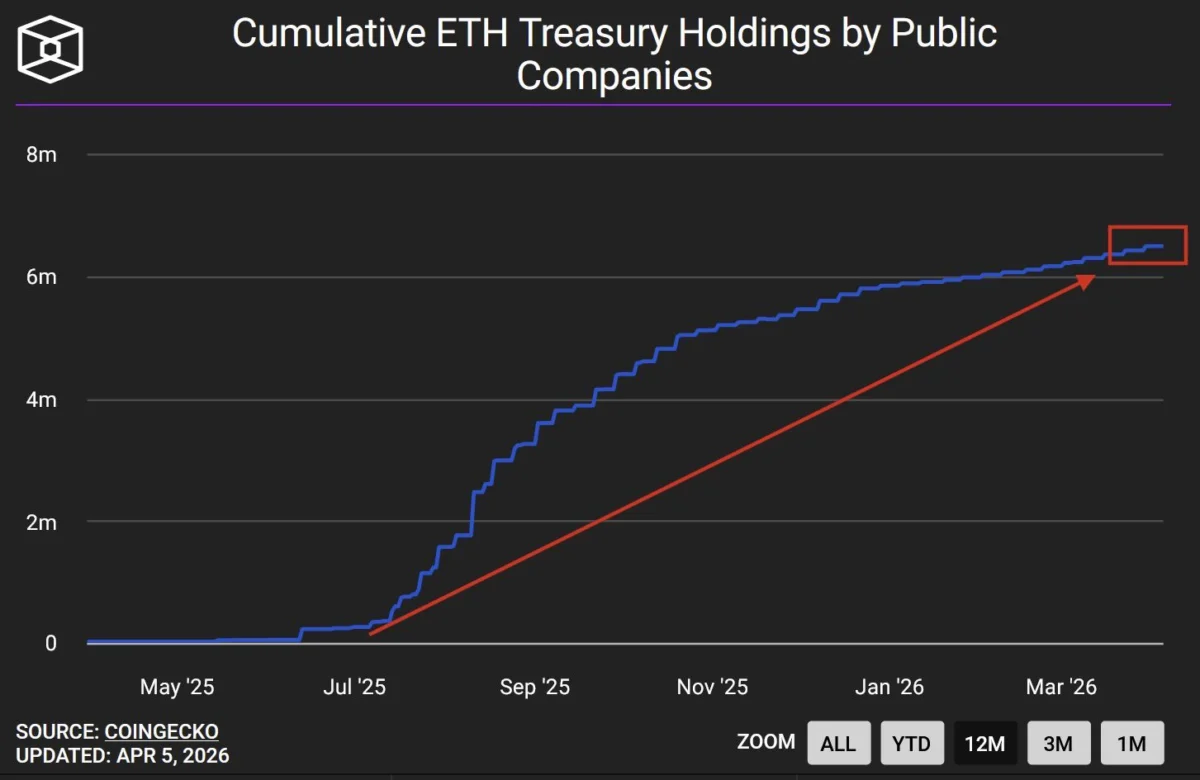
Leon Waidmann, a respected market expert and research head at Lisk, recently shed light on this trend through a post on the X platform. His analysis revealed that these public companies have collectively scooped up an astonishing approximately 7.4 million ETH over a 12-month period. To put this figure into perspective, this substantial accumulation represents roughly 6.1% of Ethereum’s total circulating supply. Such a significant portion being acquired by institutional hands underscores the profound impact these players are having on the market dynamics, particularly concerning the available supply of ETH. The strategic nature of these acquisitions differentiates them from retail trading, suggesting a calculated long-term investment rather than short-term speculative plays. This trend parallels the earlier institutional adoption of Bitcoin, where corporations began adding the cryptocurrency to their treasury reserves, signaling a broader acceptance of digital assets within corporate finance.

Chronology of Corporate Treasury Inflows
The journey of institutional Ethereum adoption has been marked by a significant acceleration. As recently as May 2025, the cumulative ETH treasury holdings of institutional and corporate players were reportedly near zero, indicating a nascent stage of corporate engagement. However, this landscape rapidly transformed. By April 2026, the data illustrates a dramatic shift, with over 6.5 million ETH having been strategically removed from the open market and secured in corporate treasuries. This rapid accumulation, building towards the 7.4 million ETH reported over a 12-month period, demonstrates a clear and aggressive strategy by these entities to build substantial positions in Ethereum.
A critical aspect of this institutional accumulation is the destination of these acquired ETH tokens. Unlike retail investors who might hold their assets on cryptocurrency exchanges for quick trading, these institutional holdings are being moved into dedicated treasury reserves. This strategic decision implies a strong holding sentiment, primarily focused on the long term. Crucially, these coins are not readily available for sale on exchanges without undergoing a rigorous process that typically involves board approval, shareholder disclosure, and compliance with various regulatory filings. This inherent illiquidity, by design, locks away a significant portion of the circulating supply, shielding it from short-term market fluctuations and potential panic sales. In a market often deep in bearish conditions, the persistent climb in public companies’ ETH holdings, with more coins being added every single month, serves as a powerful testament to their unwavering confidence in Ethereum’s intrinsic value and future potential. This deliberate act of holding rather than trading significantly reduces the immediate sell-side pressure on the asset.
Record Staking Activity: Bolstering Network Security and Scarcity
Beyond institutional accumulation, another fundamental shift reinforcing Ethereum’s long-term outlook is the unprecedented surge in staking activity. Following Ethereum’s monumental transition from a Proof-of-Work (PoW) consensus mechanism to Proof-of-Stake (PoS) with "The Merge" in September 2022, and subsequent upgrades like Shanghai/Capella which enabled withdrawals, participation in staking has experienced a sharp and consistent uptick. This persistent engagement has now propelled the number of staked ETH to a new all-time high, reflecting a burgeoning participation in and commitment to the network’s security and decentralization.
The Proof-of-Stake mechanism allows ETH holders to "stake" their tokens, effectively locking them up to help validate transactions and secure the network. In return, stakers earn rewards, creating an incentive structure that encourages long-term holding and active participation. This mechanism is significantly more energy-efficient than PoW and is a cornerstone of Ethereum’s vision for enhanced scalability and sustainability.
Detailed analysis provided by Leon Waidmann further illustrates the magnitude of this trend. As seen in the provided data, an astounding over 32% of Ethereum’s entire circulating supply is now locked away in staking contracts. This represents a dramatic increase from earlier periods. In May 2021, for instance, the total number of staked ETH stood at approximately 18 million, accounting for about 16% of its then-circulating supply. Fast forward to March 2026, and this figure had surged to a staggering 40 million ETH, representing a full 32% of its total supply. This nearly doubling of the proportion of staked ETH within a relatively short period underscores the profound confidence and active engagement of the community in securing and developing the Ethereum network.
Waidmann further emphasized that this 32% of ETH’s total supply is distinctly "not present on cryptocurrency exchanges or in wallets waiting to sell." Instead, these tokens are actively securing the Ethereum network, participating in its consensus mechanism. This distinction is crucial because it means these significant holdings are not immediately available to influence market liquidity or price discovery in the same way as exchange balances. The growth of liquid staking solutions, such as Lido and Rocket Pool, has also played a pivotal role in this surge, allowing smaller investors to participate in staking without needing to run a full validator node, thereby democratizing access to staking rewards and further deepening the pool of locked ETH.
The Dual Impact: Supply Shock and Enhanced Stability
The combined effect of aggressive institutional accumulation and unprecedented staking activity creates a powerful dual dynamic that has significant implications for Ethereum’s market trajectory. Firstly, both trends contribute directly to a substantial reduction in the readily available circulating supply of ETH. When millions of tokens are locked away in corporate treasuries or staking contracts, they are effectively removed from the immediate buying and selling pressure of the open market. This phenomenon, often referred to as a "supply shock," can lead to increased price sensitivity, where even moderate buying pressure can have a more pronounced upward effect on the asset’s value due to limited sell-side liquidity.
Secondly, this long-term holding sentiment, driven by both institutional conviction and network participation, contributes significantly to enhanced market stability. Institutions, bound by regulatory requirements and long-term investment mandates, are less likely to engage in speculative, short-term trading that can exacerbate volatility. Similarly, staked ETH is committed to the network for extended periods, reducing the potential for sudden large-scale sell-offs. This confluence of factors paints a picture of a more mature and fundamentally sound asset, increasingly insulated from the wild price swings that have historically characterized the crypto market. The deliberate choice by major players to hold and secure ETH reinforces its status as a foundational digital asset with strategic importance.
Broader Implications and Future Trajectory
The profound shifts observed in Ethereum’s institutional adoption and staking metrics carry broader implications for the entire cryptocurrency ecosystem and the future of decentralized technology. The increasing institutional confidence in Ethereum validates its technological prowess, its robust developer community, and its critical role in enabling the next generation of internet applications. This validation can pave the way for further mainstream adoption and integration of Ethereum-based solutions into traditional financial systems and enterprise operations.
From a regulatory standpoint, increasing institutional involvement often brings greater scrutiny but also a clearer path toward comprehensive regulatory frameworks. As more established entities hold and utilize ETH, governments and financial bodies are compelled to develop clearer guidelines, which can ultimately foster a more secure and predictable environment for all participants. The potential for spot Ethereum ETFs in major markets, mirroring the recent approval of Bitcoin ETFs, could further accelerate institutional capital inflows, providing regulated and accessible investment vehicles for a wider range of investors.
Ethereum’s evolving role in Web3 and enterprise solutions is also paramount. The network’s continuous upgrades, including anticipated advancements in scalability through sharding and the widespread adoption of Layer 2 solutions, are crucial for supporting a rapidly expanding ecosystem. As transactions become faster and cheaper, Ethereum’s utility for complex dApps, enterprise blockchain initiatives, and digital identity solutions will only grow. While challenges such as network congestion and high gas fees have historically been concerns, Layer 2 networks like Arbitrum, Optimism, and Polygon are already significantly mitigating these issues, enhancing Ethereum’s competitive edge against other Layer 1 blockchains.
In conclusion, Ethereum’s recent price recovery above $2,000 is more than a fleeting market rebound; it is a manifestation of deeper, fundamental shifts occurring within its ecosystem. The relentless accumulation by public companies and institutional investors, coupled with the unprecedented surge in ETH staking to historical highs, collectively signals a powerful long-term bullish outlook. These trends not only reduce the circulating supply, potentially leading to future price appreciation, but also significantly enhance the network’s security, stability, and decentralization. As Ethereum continues to mature and evolve, its foundational role in the digital economy is being solidified by the unwavering confidence of both its active community and the increasingly influential institutional players.