
The Resurgence of Ethereum Network Activity to Historic Highs
Despite the prevailing bearish sentiment that has seen Ethereum’s price struggle to maintain stability, the network itself has exhibited remarkable resilience and upward momentum in its operational metrics. Even as ETH grapples with key support levels, such as the $1,600 mark, the fundamental activity across the leading smart contract platform shows no signs of abatement. On the contrary, expert analysis points to a powerful resurgence.
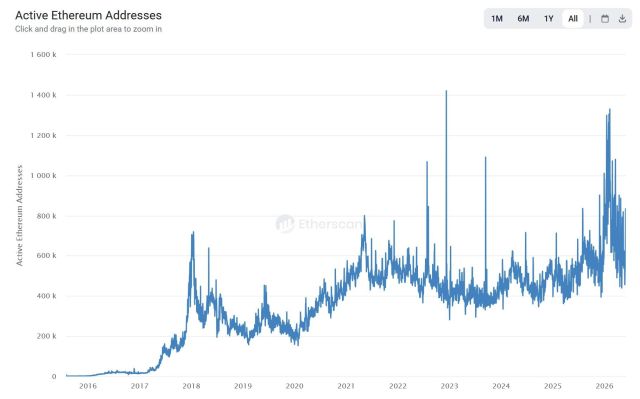
Leon Waidmann, Head of Research at Lisk and a recognized market expert, has highlighted through recent reports that Ethereum is experiencing an unprecedented surge in network activity. According to Waidmann’s observations, activity across the blockchain has climbed to all-time high levels, signaling a profound and growing engagement within the entire ecosystem. This isn’t merely a fleeting spike but a sustained trend indicative of increasing utility and adoption.
As Ethereum firmly entrenches its position as a foundational layer for a vast array of decentralized applications (dApps), decentralized finance (DeFi) protocols, non-fungible tokens (NFTs), and the broader movement towards asset tokenization, this spike in activity carries significant weight. It represents a tangible increase in demand from a diverse group of participants, including individual users, innovative developers building new solutions, and increasingly, institutional entities exploring blockchain-based applications. This robust growth unequivocally underscores Ethereum’s enduring status as one of the most active, influential, and critical networks within the expansive cryptocurrency sector.
Further substantiating this claim, on-chain data reveals that the number of daily active addresses on the Ethereum network is currently hovering near its highest range ever recorded. To put this into perspective, during the peak of the 2018 bull market cycle, active wallet addresses on the network reached approximately 720,000. This figure was surpassed in the subsequent 2021 bull market, where active addresses topped out around 800,000. However, in the current market cycle spanning 2025 and 2026, the daily active addresses have consistently pushed past the 1 million mark, frequently peaking above an impressive 1.3 million. This substantial increase implies that the Ethereum network is now processing a significantly higher volume of "real" economic activity and user interactions than it did even at the zenith of the previous bull market cycles, suggesting a deepening of its utility and adoption base.
The Paradox of Price Versus Utility: A Deeper Dive

The stark divergence between Ethereum’s struggling price performance and its booming network activity presents a compelling paradox for market observers. While the immediate price action suggests investor apprehension and selling pressure, the on-chain metrics paint a picture of a thriving, expanding ecosystem. This decoupling often occurs during market consolidation phases or "bearish" periods, where speculative fervor wanes, but fundamental development and user adoption continue unabated.
Several factors could contribute to this phenomenon. Macroeconomic headwinds, such as persistent inflation, rising interest rates, and broader global economic uncertainty, often drive investors away from riskier assets like cryptocurrencies, irrespective of their underlying technological advancements. Additionally, regulatory uncertainties surrounding digital assets in various jurisdictions can dampen investor confidence. However, for those deeply entrenched in the blockchain space, these periods often represent opportunities for builders and users to continue innovating and engaging with the network, unburdened by the intense speculative noise of a bull market. The consistent growth in active addresses suggests that a dedicated core of users and developers remains committed to the Ethereum ecosystem, leveraging its capabilities for practical applications rather than purely speculative gains. This enduring utility is a critical indicator of long-term value, even if it doesn’t immediately translate into price appreciation.
Historic Exchange Withdrawals Signal Strong Investor Conviction
Adding another layer to this intriguing market dynamic is the significant rate at which Ethereum coins are being withdrawn from cryptocurrency exchanges. This trend is typically interpreted as a bullish signal, as it indicates that investors are moving their assets into cold storage or self-custody solutions, implying a long-term holding strategy rather than an intent to sell in the near future.
As of recent data, the total number of ETH held on cryptocurrency exchanges has plummeted to approximately 14.5 million ETH, marking its lowest level in history. What makes this particularly noteworthy is that this historic low occurred during a period of market instability and potential price retests, rather than preceding a major market crash. This behavior stands in stark contrast to typical market dynamics, where periods of heightened volatility often lead to increased inflows of assets onto exchanges as investors prepare to sell or trade.
To contextualize this, in October 2023, the ETH exchange balance stood at a comparatively higher level of 21 million ETH. Over the past two and a half years, a staggering volume of over 6 million ETH has been systematically pulled off crypto exchanges. This consistent outflow, especially during a bearish or sideways market, strongly suggests a profound conviction among Ethereum holders. Leon Waidmann succinctly captured this sentiment, stating, "Whoever is buying here isn’t selling back." This implies that a significant portion of the ETH supply is being moved into long-term investment portfolios, reducing the immediate selling pressure on the market and potentially setting the stage for a supply shock should demand significantly increase in the future. The declining exchange reserves suggest that the available supply for immediate trading is shrinking, which could amplify price movements once positive sentiment returns.
Projecting Ethereum’s Price Bottom: The Delta Price Metric

While network activity and exchange balances paint a picture of underlying strength, the immediate price outlook remains a concern for many. In this context, seasoned crypto analyst Ali Charts has provided a critical perspective on Ethereum’s potential price bottom, utilizing a robust on-chain metric known as the Ethereum Delta Price. This metric has historically proven to be a reliable indicator for identifying market bottoms for the altcoin.
The Ethereum Delta Price metric is derived from the intricate connection between investors’ cost basis and what was traditionally understood as miner production cost. In a post-Merge (Proof-of-Stake) Ethereum, "production cost" can be broadly interpreted as the economic threshold for network participants (stakers, validators) to secure the network, though the original framing might harken back to Proof-of-Work era metrics or a generalized cost of participation. More precisely, Delta Price is often calculated as the Realized Price (the average price at which all coins in circulation last moved on-chain) minus the Average Price (which can be a long-term moving average or a weighted average of network operating costs). This metric effectively identifies deep accumulation zones where the market has historically found its floor.
After a thorough examination of the Delta Price metric, Ali Charts highlighted that Ethereum’s potential price bottom currently sits near the $700 mark. If historical patterns are to repeat, this projection suggests that ETH could experience a retest of this $700 level before the onset of the next sustained upward trend. The significance of this projection lies in its historical accuracy; the Delta Price has consistently identified the last two major market bottoms for Ethereum, serving as a reliable signal for long-term accumulation.
Such a retest, while potentially painful for short-term holders, would align with the cyclical nature of cryptocurrency markets, often characterized by significant corrections that "wash out" weaker hands before a new bull cycle commences. For strategic investors, a $700 retest would represent a substantial discount from current levels and a potential entry point for long-term positions, predicated on the network’s demonstrated fundamental growth and utility. It emphasizes the importance of a long-term perspective when navigating the volatility of the crypto market, especially for an asset with strong foundational elements like Ethereum.
Broader Market Implications and Future Outlook
The current state of Ethereum presents a fascinating dichotomy: a struggling market price juxtaposed against booming fundamental activity and strong holder conviction. This situation has several significant implications for the broader cryptocurrency market and Ethereum’s future trajectory.
Firstly, the surging network activity underscores Ethereum’s critical role as the backbone of the decentralized economy. Its sustained growth in active users and transactions, even during a bearish price environment, solidifies its position as a utility-driven asset. This suggests that the ecosystem is maturing beyond pure speculation, with real-world applications and genuine user demand driving its expansion. For developers, a robust and active network provides a stable foundation for innovation, attracting more talent and capital to build within the Ethereum ecosystem.
Secondly, the unprecedented withdrawal of ETH from exchanges highlights a growing trend of self-custody and long-term investment conviction among holders. This reduction in available supply on trading platforms could lead to increased price volatility and more pronounced upward movements once market sentiment shifts. A shrinking liquid supply, combined with increasing demand from a growing active user base, could create a powerful supply shock scenario in future bull markets.
Thirdly, the projection of a $700 price bottom, while daunting, offers a clear target for long-term accumulation for those who believe in Ethereum’s fundamental value proposition. It suggests that the market may still have further downside potential before a true capitulation event and subsequent reversal. This perspective encourages a disciplined, dollar-cost averaging strategy for investors looking to capitalize on potential deep value.
Looking ahead, Ethereum’s ongoing development, particularly with scalability solutions like sharding and Layer 2 networks, is expected to further enhance its capacity and reduce transaction costs, potentially attracting even more users and developers. The narrative around potential Ethereum ETFs in various jurisdictions could also introduce significant institutional capital, further validating its position as a mainstream asset.
In conclusion, while Ethereum’s price faces immediate challenges and the possibility of retesting lower support levels, the underlying health of its network tells a story of remarkable resilience and growth. The sustained surge in on-chain activity, coupled with historic exchange withdrawals, points to a strong fundamental basis and unwavering conviction among its long-term holders. The projected $700 bottom, informed by historically reliable metrics, offers a strategic viewpoint for navigating future market cycles. This confluence of factors suggests that while the short-term outlook may be volatile, Ethereum’s long-term prospects remain robust, driven by its unparalleled utility and an ever-expanding decentralized ecosystem.