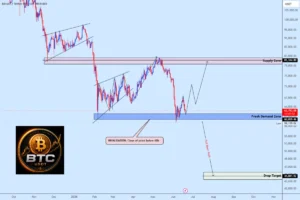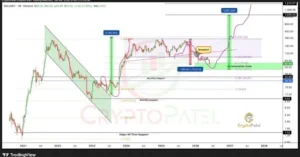
Bitcoin’s recent price action has signaled a pivotal moment in the cryptocurrency market’s current cycle, as the digital asset broke below a critical multi-month trendline, suggesting a potential exhaustion of its dominant rally. According to market analyst Justcryptopays, this technical breakdown serves as a primary indicator that market dynamics are undergoing a fundamental shift. For much of the previous year, Bitcoin has acted as the singular engine of market growth, but the recent failure to sustain momentum above key support levels suggests that capital is beginning to rotate into the broader altcoin market. As of early 2026, the digital asset landscape is witnessing a transition where investor interest is diversifying away from the flagship cryptocurrency and toward high-utility platforms and emerging digital assets.
The psychological threshold of $90,000 has become a focal point for traders and institutional observers alike. While Bitcoin recently traded at approximately $90,525, its inability to decisively clear and hold higher benchmarks has introduced a sense of caution across the trading floor. This hesitation is often the catalyst for "capital rotation," a phenomenon where profits generated from Bitcoin’s appreciation are reinvested into Ethereum, Solana, and other alternative coins (altcoins) that offer higher volatility and potential for percentage-based gains. The transition from a Bitcoin-led market to an "alt-season" is a historical pattern that has defined previous bull cycles, and current technical indicators suggest the market may be on the cusp of such a transformation.
Technical Analysis and the Significance of the Trendline Breach
The analysis provided by Justcryptopays highlights a specific breach of a diagonal support line that has guided Bitcoin’s trajectory through the latter half of 2025. In technical analysis, a trendline serves as a visual representation of market sentiment and momentum. When a price consistently stays above a rising trendline, it confirms a bullish bias. Conversely, a clean break below this line—especially on significant trading volume—often signals that the previous trend has ended or is entering a period of consolidation.
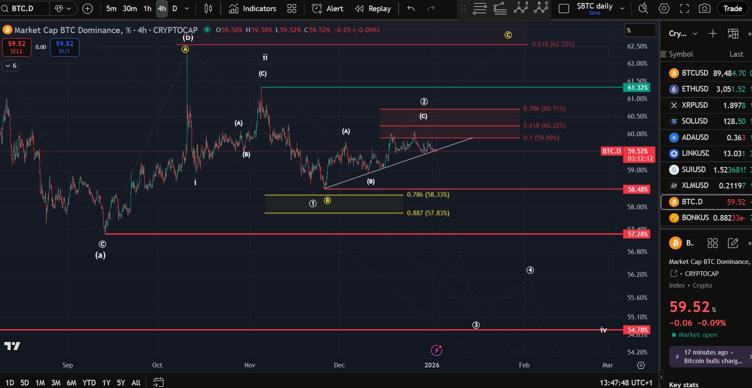
For Bitcoin, this break comes after a period of intense scrutiny regarding its valuation at the $90,000 level. This price point is more than just a numerical value; it represents a major psychological barrier where many long-term holders choose to take profits. The struggle to maintain this level indicates a temporary equilibrium between buying pressure and selling interest. When Bitcoin enters such a phase of stagnation or slight decline, the "dominance index"—which measures Bitcoin’s market cap relative to the total crypto market cap—typically begins to fall. This decline in dominance is the traditional green light for altcoin speculators to increase their exposure to assets like Ether (ETH), Solana (SOL), and Cardano (ADA).

Historical Context: Recovering from the 2025 Bearish Momentum
To understand the current market positioning, it is essential to look back at the performance of the digital asset market throughout 2025. While Bitcoin managed to achieve record highs fueled by institutional adoption and the continued integration of spot ETFs, the broader altcoin market faced a different reality. Much of 2025 was characterized by "bearish momentum" for secondary assets, as liquidity remained concentrated in Bitcoin. Many emerging DeFi (Decentralized Finance) and Web3 projects struggled to attract the same level of capital, leading to a valuation gap between the market leader and the rest of the industry.
The start of 2026 represents a critical juncture for these sidelined assets. Bulls are currently tasked with shaking off the lingering negativity of the previous year. The "altcoin awakening" is not merely a product of Bitcoin’s weakness but also a result of developmental milestones within these ecosystems. For instance, Ethereum’s continued transition toward more efficient scaling solutions and Solana’s increasing dominance in the retail transaction space have created a fundamental foundation that justifies a price recovery. The current shift in capital rotation suggests that investors are now looking past the safety of Bitcoin to find "alpha" in projects that were undervalued during the 2025 consolidation phase.
Capital Rotation and the Altcoin Hierarchy
As capital flows out of Bitcoin, it typically follows a specific hierarchy. This "waterfall effect" begins with large-cap assets before trickling down to mid-cap and eventually speculative small-cap tokens.
- The Large-Cap Leaders: Ethereum and Solana are the primary beneficiaries of this shift. As the two largest smart-contract platforms, they act as the "blue chips" of the altcoin world. Investors who find Bitcoin’s upside limited at $90,000 often move their capital into Ether, betting on its role as the backbone of decentralized finance, or Solana, which has gained traction due to its high throughput and lower transaction costs.
- Established Altcoins: Assets like XRP and Cardano (ADA) often see renewed interest during these periods. These tokens have established communities and regulatory histories that make them attractive to investors looking for "laggard" plays—assets that have not yet participated in the broader market rally but possess the liquidity to support large entries.
- The Speculative Tier: Memecoins and emerging Web3 tokens represent the final stage of capital rotation. While highly volatile, these assets attract retail interest and can see exponential gains when market sentiment is overwhelmingly positive. The current market structure suggests that if Bitcoin remains stable or enters a slow decline, these speculative assets may see a surge in trading volume.
Institutional and Macro-Economic Influence
The shift toward altcoins is also being influenced by the broader macroeconomic environment of early 2026. Institutional investors, who were previously focused almost exclusively on Bitcoin through ETF products, are beginning to expand their horizons. The potential for Ethereum-based financial products and the growing interest in "tokenization" of real-world assets (RWA) have made altcoins more palatable to traditional finance.
Furthermore, global interest rate policies and inflationary trends continue to play a role. If central banks pivot toward a more accommodative monetary policy in 2026, the resulting increase in global liquidity typically flows into "risk-on" assets. While Bitcoin is the primary recipient of such liquidity, the overflow invariably reaches the altcoin market. The current trendline break in Bitcoin may be interpreted by institutional desks as a signal to rebalance portfolios, moving a percentage of holdings from the "store of value" (Bitcoin) into "growth assets" (Altcoins).
Implications for the Near-Term Market Outlook
The transition into a more balanced market has several implications for traders and long-term holders. First, volatility in the altcoin sector is expected to increase. While Bitcoin’s movements have become more measured and "equitized" due to institutional involvement, altcoins still retain the capacity for rapid price swings. This presents both a risk and an opportunity for strategic positioning.
Second, the "Altcoin Season Index," a popular metric among crypto analysts, is currently trending toward a zone that historically precedes a massive rally in non-Bitcoin assets. If Bitcoin continues to trade sideways or slightly below its recent peaks, the lack of "Bitcoin volatility" will encourage traders to seek excitement elsewhere. The $90,000 level will remain a critical benchmark; if Bitcoin can transform this resistance into a solid floor of support, it could provide the stable environment necessary for altcoins to embark on a multi-month bull run.
Strategic Observations and Future Projections
As the market navigates the opening months of 2026, the focus will remain on whether altcoins can sustain their newfound momentum. The challenge for the "alt-bulls" is to prove that this is a structural shift rather than a temporary "dead cat bounce." Key indicators to watch include the total market capitalization excluding Bitcoin (TOTAL2) and the individual growth of ecosystem-specific metrics, such as Total Value Locked (TVL) in DeFi protocols and daily active users on Layer 1 blockchains.
The break below the Bitcoin trendline identified by Justcryptopays is a technical warning shot. It suggests that the period of Bitcoin-only gains may be concluding, making way for a more diverse and decentralized market expansion. For the vigilant investor, this period of rotation represents a window to capitalize on the "altcoin resurgence." Whether it is the established utility of Ether and Solana or the speculative fervor of the memecoin sector, the market appears ready to explore opportunities beyond the flagship cryptocurrency.
In conclusion, the current market dynamics indicate a maturing landscape. The struggle at the $90,000 mark and the subsequent breach of technical support lines are not necessarily signs of a market-wide crash, but rather a redistribution of wealth within the digital asset ecosystem. As 2026 progresses, the ability of altcoins to overcome the bearish pressures of the previous year will likely determine the overall health and longevity of the current crypto cycle. Investors and traders should remain observant of these shifting capital flows, as the "alt-season" often provides the most significant opportunities for portfolio growth in the digital age.