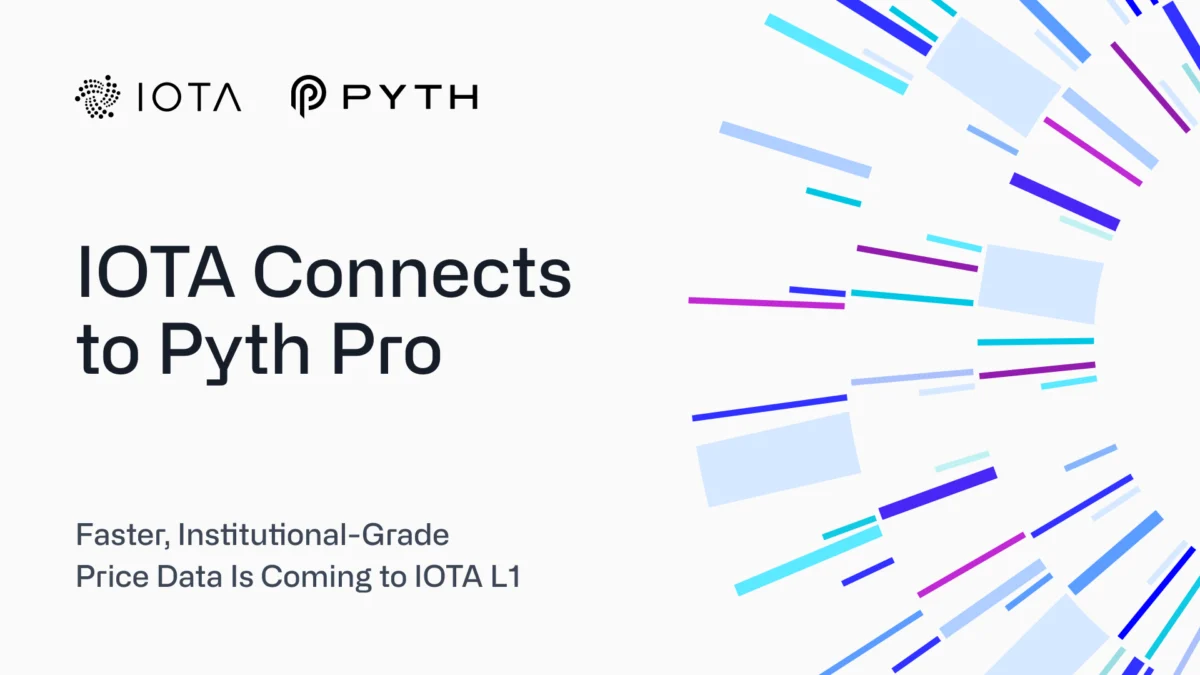
The decentralized oracle network Pyth has officially rolled out a major infrastructure upgrade for the IOTA Layer-1 ecosystem, integrating IOTA into Pyth Pro. This next-generation institutional-grade price feed infrastructure aims to provide developers with substantially lower latency, heightened reliability, and access to an expanded portfolio of more than 3,000 asset feeds spanning both decentralized and traditional financial markets.
The transition represents a critical evolution for developers building decentralized applications (dApps) on IOTA, moving the network from a legacy decentralized model to a commercialized, high-performance architecture. However, the upgrade also introduces strict compliance deadlines, requiring developers currently utilizing Pyth Core to migrate their smart contracts ahead of an upcoming network-wide deprecation schedule.
Understanding the Technical Shift: From Pythnet to Pyth Pro
For some time, smart contracts on IOTA have relied on Pyth to query live, cryptographically verified price feeds. Refreshed approximately every second, these feeds have historically enabled dApps to operate on trusted market data without resorting to centralized intermediaries or easily manipulated price sources.
However, this foundational service was built on Pythnet, Pyth’s original decentralized network of validator nodes that leveraged the Wormhole cross-chain bridge to relay data across various blockchain networks. While Pythnet successfully bootstrapped real-time oracle capabilities across multiple Layer-1 and Layer-2 ecosystems, its architecture faced scalability constraints when meeting the rigorous speed, data diversity, and security demands of institutional financial institutions.
Recognizing these limitations, the Pyth Network has initiated a sweeping, network-wide infrastructure overhaul, effectively retiring Pythnet and shifting its operational "center of gravity" to Pyth Pro. Designed specifically to bridge the gap between decentralized finance (DeFi) and traditional finance (TradFi), Pyth Pro consolidates thousands of institutional-grade price feeds into a unified distribution network.
According to official network documentation, Pyth Pro aggregates over 3,000 price feeds covering equities, futures, exchange-traded funds (ETFs), commodities, foreign exchange (FX), cryptocurrencies, and fixed-income products. These feeds are delivered to traditional financial institutions through standard Application Programming Interfaces (APIs) utilizing transparent, tiered subscription pricing models. By plugging into this ecosystem, the IOTA Layer-1 network gains direct access to institutional-quality data infrastructure, significantly enhancing the capability of its developer community.
The Chronology of the Transition and Developer Migration Deadlines
The integration of IOTA into Pyth Pro is not an isolated event tailored exclusively to the IOTA ecosystem, but rather part of a broader, synchronized migration strategy executed across the entire Pyth Network. As Pyth transitions its entire technological stack from the legacy Pythnet framework to Pyth Pro, it is simultaneously moving away from its historical free, community-subsidized model toward a sustainable, revenue-based commercial economic framework.
This architectural and economic pivot carries immediate operational consequences for builders. Developers currently utilizing Pyth Core price feeds on IOTA must actively migrate their smart contracts to the new Pyth Pro infrastructure. The Pyth Network has established a strict enforcement deadline: all legacy Pyth Core feeds will officially cease functioning after August 18. Smart contracts that fail to update their integration endpoints and data-fetching logic prior to this cutoff date will experience disruptions, halting any dApp functions dependent on real-time price feeds—such as lending liquidations, synthetic asset minting, and automated trading protocols.
The migration process requires developers to update their on-chain data consumer contracts, adjust to the new subscription-based data parameters, and align with the technical specifications mandated by the Pyth Pro API. While the transition demands immediate engineering resources from IOTA-based development teams, the long-term payoff includes guaranteed uptime, enterprise-grade service level agreements (SLAs), and access to a vastly superior tier of market intelligence.
Analyzing the Value Proposition: Why Institutional-Grade Data Matters for IOTA
The integration of Pyth Pro positions IOTA to better capture the next wave of blockchain adoption, characterized by the convergence of decentralized finance with real-world assets (RWAs) and institutional capital deployment. Historically, blockchain oracles faced challenges regarding latency and data manipulation vulnerabilities, which frequently deterred traditional financial institutions from launching institutional-grade products on public ledgers.
By leveraging Pyth Pro, IOTA developers gain access to data sourced directly from primary-market institutional participants, including major market makers, proprietary trading firms, and Tier-1 financial exchanges. This direct-from-source aggregation model bypasses secondary-market noise and reduces the attack surface for oracle manipulation, such as flash-loan exploits targeting decentralized lending markets.
Furthermore, the reduction in latency—down to sub-second updates—is a mandatory prerequisite for advanced financial dApps. Decentralized exchanges (DEXs), perpetual swap platforms, and algorithmic stablecoin issuers cannot function efficiently during periods of high market volatility without instantaneous price feeds. With Pyth Pro integrated into IOTA L1, developers building these high-frequency financial instruments can operate with the same data confidence found in traditional Wall Street trading terminals.
Broader Market Implications and the Commercialization of Oracle Networks
The shift from Pythnet to Pyth Pro highlights a broader economic maturation within the decentralized oracle sector. In the early stages of the DeFi boom, oracle services were heavily subsidized or provided free of charge to attract developer mindshare and secure Total Value Locked (TVL). However, as oracle networks expanded to cover thousands of complex assets across dozens of blockchains, maintaining high-throughput, highly secure validator networks proved financially unsustainable under pure public-good models.
By introducing transparent subscription pricing and institutional-tier distribution channels, Pyth is charting a sustainable path toward commercial viability. This model ensures that high-value, high-frequency users—such as institutional trading desks and advanced protocols—contribute economically to the infrastructure they rely upon, while retail-focused or less demanding dApps can select tiered options that match their operational budgets.
For IOTA, an ecosystem historically recognized for its focus on enterprise adoption, machine-to-machine economies, and real-world asset tokenization, the arrival of Pyth Pro aligns seamlessly with its core strategic objectives. As institutional players increasingly explore public distributed ledger technologies for asset settlement and tokenized securities, the presence of institutional-grade oracles on IOTA L1 removes a critical technical barrier to entry.
Conclusion and Next Steps for the IOTA Ecosystem
The integration of IOTA into Pyth Pro marks a definitive step forward in the network’s financial infrastructure capabilities. Offering lower latency, broader asset coverage, and TradFi-grade reliability, the upgrade equips IOTA developers with the necessary tools to build sophisticated, high-performance decentralized applications.
However, the immediate priority for the developer community remains clear: navigating the migration process ahead of the strict August 18 deadline. With legacy Pyth Core feeds soon to be deprecated, development teams operating within the IOTA ecosystem must prioritize updating their smart contract integrations to ensure uninterrupted service and to fully leverage the advantages of Pyth’s next-generation institutional tier.