
The Ethereum Foundation’s ongoing Trillion Dollar Security initiative has identified a critical vulnerability in the current Ethereum transaction model: the disconnect between user intent and on-chain execution outcomes. As the ecosystem matures, the Foundation is pivoting toward a novel architectural solution known as native transaction assertions, designed to enforce specific post-transaction states. This effort, which operates alongside the previously announced Clear Signing standard, seeks to mitigate the risks associated with blind signing and the inherent unpredictability of decentralized finance (DeFi) transaction results.
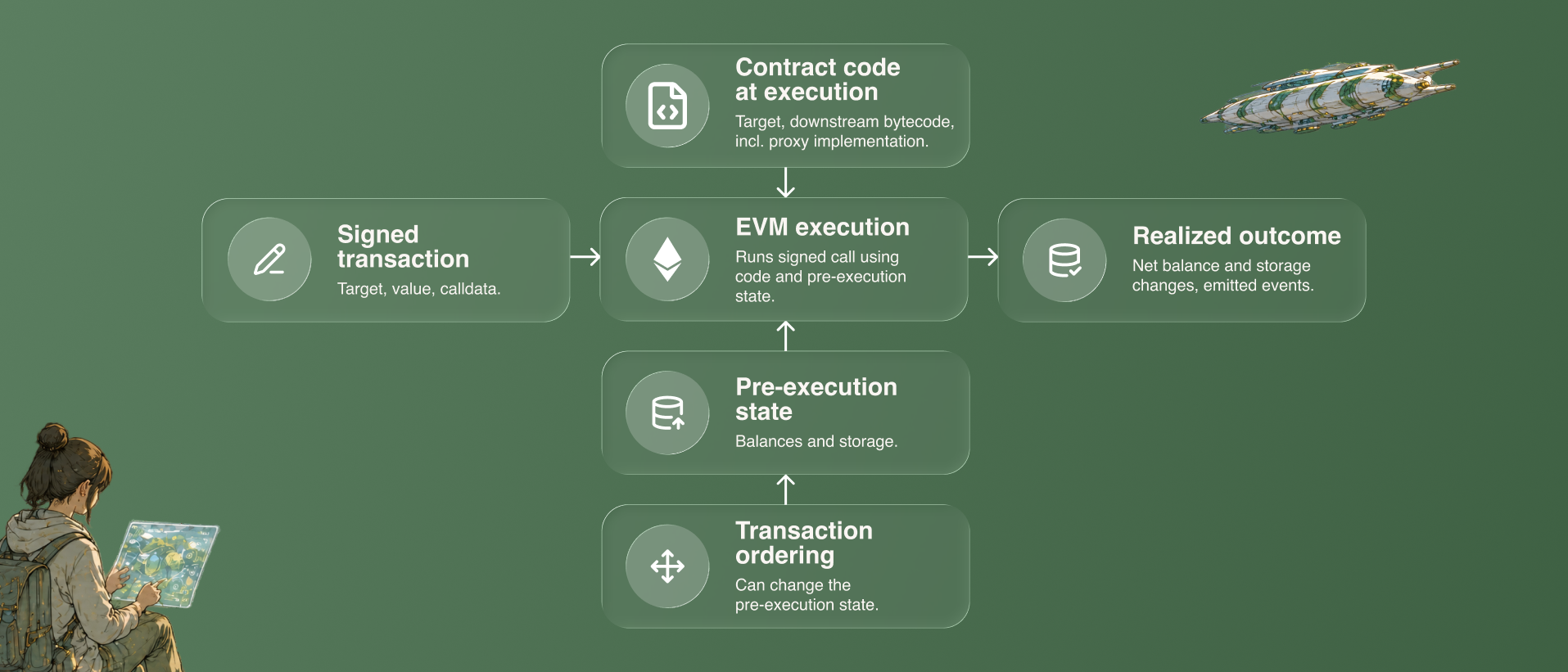
The current architecture of the Ethereum Virtual Machine (EVM) operates on a principle of literal execution. When a user signs a transaction, they are cryptographically authorizing a specific set of inputs—the target contract, the value, and the encoded data. However, the EVM does not verify if the resulting state aligns with the user’s economic or security goals. Consequently, the actual outcome is entirely dependent on the code and state conditions encountered at the moment of inclusion in a block. This ambiguity has left users vulnerable to both malicious front-end manipulation and unintentional economic loss.
A Chronology of Vulnerability and Economic Loss
The necessity for a more robust security framework is underscored by a history of high-profile incidents where valid signatures led to disastrous results.
In late 2021, the BadgerDAO protocol suffered a significant breach. In this instance, attackers compromised the project’s front-end interface, injecting malicious code that prompted users to sign transactions. While the users believed they were authorizing legitimate interactions with the protocol, they were actually granting an attacker broad permissions to drain their token balances.
Similarly, the Bybit-Safe wallet incident highlighted the dangers of intent mismatch. Users signed off-chain messages that they believed were standard transactions, only to inadvertently authorize the replacement of the Safe wallet’s underlying implementation contract. Because the signature was cryptographically valid, the network executed the change, demonstrating that a "valid" signature is not synonymous with a "secure" or "intended" action.
More recently, the Aave and CoW Swap incident illustrated the dangers of outcome mismatch. A user attempted to execute a massive collateral swap involving approximately $50.4 million of aEthUSDT for aEthAAVE. Due to thin liquidity and the limitations of the CoW Swap gas ceiling, the transaction resulted in a catastrophic price impact. Despite the interface displaying a 99.9% warning, the fundamental lack of an on-chain "assertion" meant that the protocol could not natively enforce a minimum acceptable output that would have prevented the trade from executing under such unfavorable conditions.

The Mechanics of Transaction Uncertainty
The core of the problem lies in the gap between the "intent" of the transaction and the "execution environment." When a user signs a transaction, they are essentially providing a set of instructions to the blockchain. However, the state of the network is fluid. Between the time a transaction is signed and the time it is mined, the target contract’s implementation could be upgraded, or the liquidity pool’s price could be manipulated via a sandwich attack.
Existing defenses have historically been limited in scope. Simulation services, which predict the outcome of a transaction before it is sent, are frequently bypassed by sophisticated malware that replaces the payload at the final moment of signing—a technique observed in the Radiant Capital post-mortem. While some protocols implement "guard" functions, such as Uniswap’s amountOutMinimum or Safe’s checkAfterExecution hook, these are fragmented and opt-in. Furthermore, these guards often struggle to inspect the "full" state, such as verifying that an implementation contract remains unchanged or that no unauthorized secondary effects occurred during the execution.
Introducing Native Transaction Assertions
To bridge this gap, the Ethereum Foundation is researching native transaction assertions, which would allow on-chain code to inspect the net state changes resulting from a transaction. Under this proposed model, an assertion acts as a set of immutable rules—a "contract" between the user and the blockchain—that must be satisfied for the transaction to finalize.
If the post-transaction state (including balance changes, storage updates, or emitted events) fails to meet the criteria defined in the assertion, the entire transaction reverts. This would effectively move the responsibility of verification from the wallet interface, which is susceptible to front-end compromises, to the consensus layer of the blockchain itself.
EIP-7906 and the Path to Implementation
A primary candidate for this functionality is EIP-7906, which expands upon the framework established by EIP-8141 regarding "frame transactions." EIP-7906 proposes the introduction of a read-only POST_TX frame. This frame would execute at the conclusion of a transaction, allowing the network to verify the outcome against the user’s pre-defined constraints.
To enable this, the proposal introduces three new EVM instructions:
TXTRACE: Allows the contract to enumerate net state changes and events.TXDIFF: Retrieves the specific starting and final values for addresses and storage slots.EVENTDATACOPY: Facilitates the extraction of event data into memory.
By isolating these operations in a POST_TX frame, the EVM ensures that the validation logic cannot inadvertently alter the state. If the assertion fails, the transaction is marked as failed, and the gas fee is deducted to prevent spam attacks, effectively creating a secure, high-integrity environment for complex financial interactions.
Implications and Broader Ecosystem Impact
The implementation of native transaction assertions carries profound implications for the future of decentralized finance. Beyond simple security, this technology could redefine how agents and automated solvers operate.
For instance, users could delegate authority to an agent to perform complex swaps or liquidity management with strict, hard-coded assertions on the final state. An investor could mandate that "no more than 2% of the portfolio value can be spent on gas and slippage," and the network would guarantee this constraint regardless of the path chosen by the executing agent.
Furthermore, it could solve the "proxy risk" dilemma. By requiring an assertion that the implementation address of a specific proxy contract must remain at a known, safe value, users can be protected against the silent upgrades that have historically facilitated significant exploits.
Strategic Roadmap and Industry Collaboration
The Ethereum Foundation acknowledges that this transition is a massive undertaking requiring coordination across the entire stack. Because EIP-7906 does not mandate assertions for all transactions, the success of the initiative depends on wallet providers and protocol developers adopting these standards voluntarily.
The Foundation is currently calling for feedback from developers, security auditors, and wallet teams to refine the design choices regarding data exposure and opcode efficiency. The goal is to strike a balance between security and the overhead placed on validators.
As the industry moves toward a future where user intent is treated as a first-class citizen, the transition from "what the code does" to "what the user intended" represents the next evolution in blockchain security. Stakeholders are encouraged to participate in the ongoing discourse on the Ethereum Magicians forum and contribute to the research via the Trillion Dollar Security initiative.
Ultimately, if successful, native transaction assertions will provide a foundational layer of protection that moves beyond reactive security measures, instead embedding the principle of "economic safety by design" into the very fabric of the Ethereum protocol. This evolution is not merely a technical upgrade but a necessary maturation for a network that increasingly underpins trillions of dollars in global digital asset value.