The official activation of the Starfish consensus mechanism on the IOTA Mainnet via the v1.21.1 protocol release marks a pivotal evolution in Directed Acyclic Graph (DAG) architecture for decentralized ledger technologies. Following the initial rollout of the Starfish mainnet framework, deeper technical analyses released by the IOTA Foundation’s research team have shed light on the core engineering choices, performance metrics, and underlying philosophy that differentiate Starfish from previous iterations like the Mysticeti protocol. While standard release notes document version updates and protocol flags—specifically protocol version 24—the research-level implications point to a fundamental shift in how distributed networks handle information dissemination, synchronization, and Byzantine fault tolerance (BFT).
At the heart of the Starfish architecture lies a radical rethinking of an often-overlooked component of distributed systems: network dissemination. In traditional Byzantine consensus framing, the problem is predominantly cast as an agreement puzzle. A disparate group of validators must reach a singular, immutable history of transactions despite network latency and malicious actors. However, this classic framing frequently masks a critical physical constraint: a validator cannot vote on a block it has never observed, nor can it certify data it cannot independently reconstruct. Consequently, synchronization precedes agreement. Starfish addresses this prerequisite by integrating data dissemination directly into the consensus mechanism itself, establishing a cleaner, more robust structure than prior uncertified DAG protocols.
Background Context and the Evolution of DAG-Based BFT
To understand the significance of the Starfish upgrade, it is necessary to examine the architectural trajectory of DAG-based distributed ledgers. Traditional blockchain structures organize transactions into a linear chain, which inherently limits throughput and creates bottlenecks as block generation intervals compete for a single path. DAGs, by contrast, allow multiple blocks to be proposed simultaneously, referencing prior blocks through directed edges. This structure transforms the ledger from a simple sequential log into a dynamic map of mutual knowledge, where each new block references predecessors observed by the validator.
Yet, early uncertified DAG protocols prioritized low latency by eliminating per-block quorum certificates, a design choice exemplified by protocols such as Mysticeti. While these systems achieved impressive median speeds, subsequent research revealed subtle vulnerabilities, including liveness failures and desynchronization attacks. Under these conditions, honest nodes could inadvertently advance consensus rounds without producing their own blocks, fracturing the DAG’s continuity. When structural holes accumulated, the network struggled to commit leaders even after stabilizing, exposing the fragility of treating information dissemination as a mere implementation detail rather than an core protocol requirement.
The Mechanics of Starfish: Decoupling and Cordial Dissemination
Starfish resolves these structural vulnerabilities by adopting principles from advanced distributed computing literature, most notably the concept of cordial dissemination formalized in the "Cordial Miners" research paper presented at DISC 2023 by Keidar, Naor, and Shapiro. In a cordial dissemination model, network participants do not merely gossip their own localized transactions; they actively forward information required by other honest nodes to maintain synchronization.
The network generally navigates a fundamental tension between two communication strategies: pull and push. The pull approach dictates that a validator requests missing blocks only after identifying a gap. While bandwidth-efficient under low-load conditions, pull mechanisms severely degrade latency because every missing piece mandates an additional request-response round trip. Under heavy network strain, pull mechanisms can trigger cascading failures, forcing slow validators to issue floods of recovery requests while fast nodes expend excessive bandwidth answering them. Conversely, the push strategy proactively distributes information that peers are likely to need, eliminating round-trip delays but risking severe bandwidth bloat if implemented naively.
Starfish resolves this dichotomy through two primary architectural innovations: the decoupling of metadata from payloads, and the implementation of Reed-Solomon data erasure coding.
By separating consensus-critical metadata—such as block headers, votes, timings, and topological references—from the bulky transaction payloads, Starfish maintains an exceptionally lightweight consensus path. Block headers carry the necessary ordering and causal references while committing to the payload data, allowing the network to aggressively push small headers without saturating communication channels with raw transaction data.
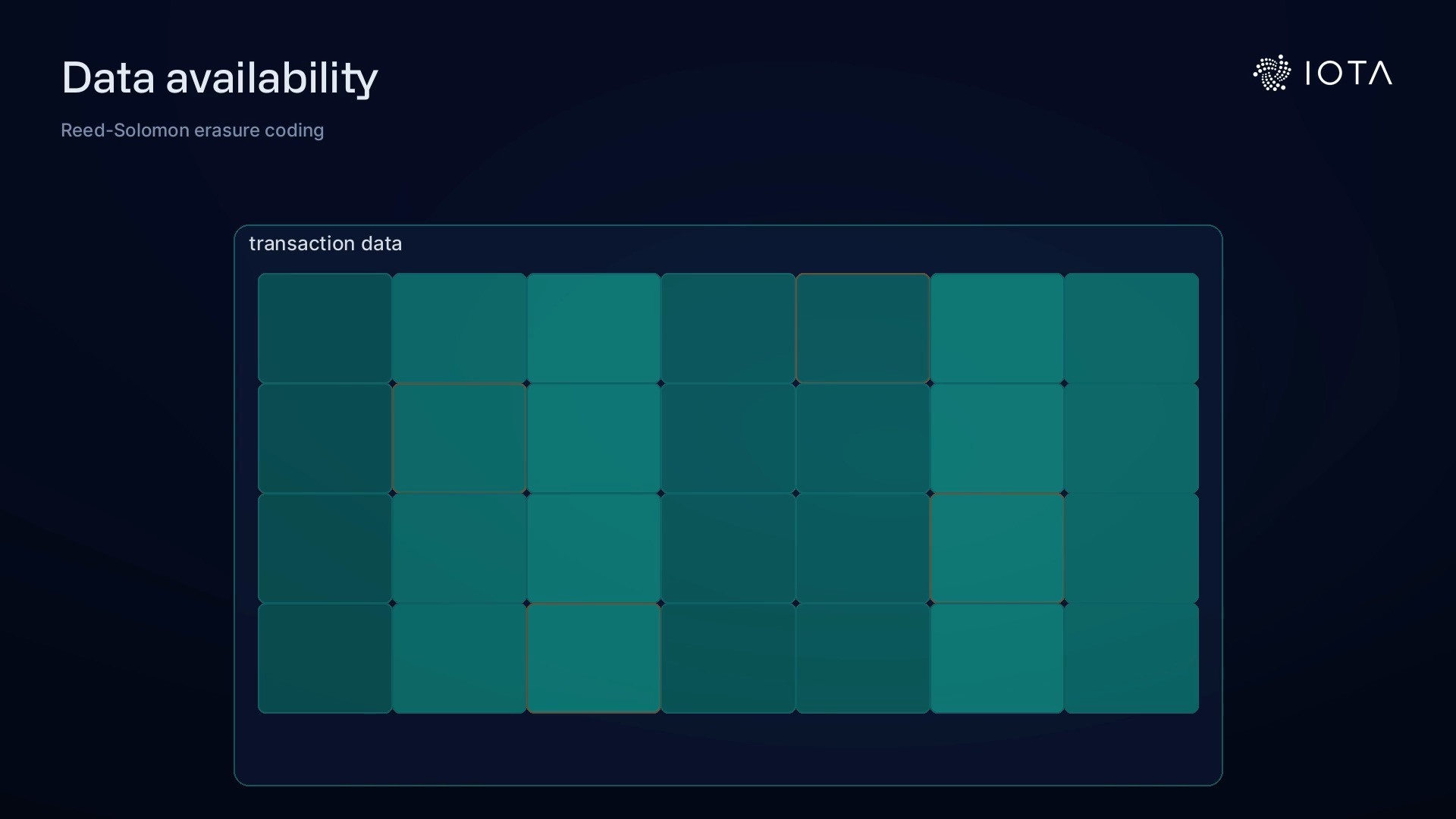
To manage the payloads efficiently, Starfish employs Reed-Solomon encoding, a mathematical data-recovery technique akin to error-correction mechanisms used in optical media and QR codes. Transaction data within a block is fragmented across validators with calculated redundancy. Crucially, the reconstruction threshold is engineered so that any valid subset of $f+1$ fragments is sufficient to completely reconstruct the original payload, even in the presence of up to $f$ Byzantine actors.
This mechanism powers the Data Availability Certificate (DAC) embedded directly into the DAG. Instead of executing a separate, computationally expensive availability round, validators acknowledge payload verification within their own block headers. Once $f+1$ such confirmations are reachable within the causal history of a subsequent committed block, the network establishes deterministic data availability without adding distinct messaging phases.
Chronology and Mainnet Implementation
The journey toward the Starfish consensus integration spans several years of theoretical research, protocol modeling, and rigorous testnet simulations conducted by the IOTA Foundation.
- May 2023: Theoretical foundations regarding cordial dissemination and robust DAG synchronization gain mainstream academic traction with foundational papers presented at distributed systems conferences.
- Late 2024 to 2025: IOTA researchers formulate the Starfish architecture, aiming to bridge the latency advantages of uncertified DAGs with the unyielding liveness guarantees required for enterprise-grade distributed ledgers. Testnet deployments validate the integration of Reed-Solomon payload sharding and push pacemakers.
- Early 2026: Protocol simulations demonstrate significant improvements in tail-latency distributions under simulated network degradation and Byzantine fault injection.
- May 2026: The IOTA Foundation officially deploys protocol version 24 via the v1.21.1 Mainnet release, successfully activating the Starfish consensus mechanism on the live IOTA Mainnet and superseding legacy execution models.
Performance Analysis: Prioritizing Variance Over Averages
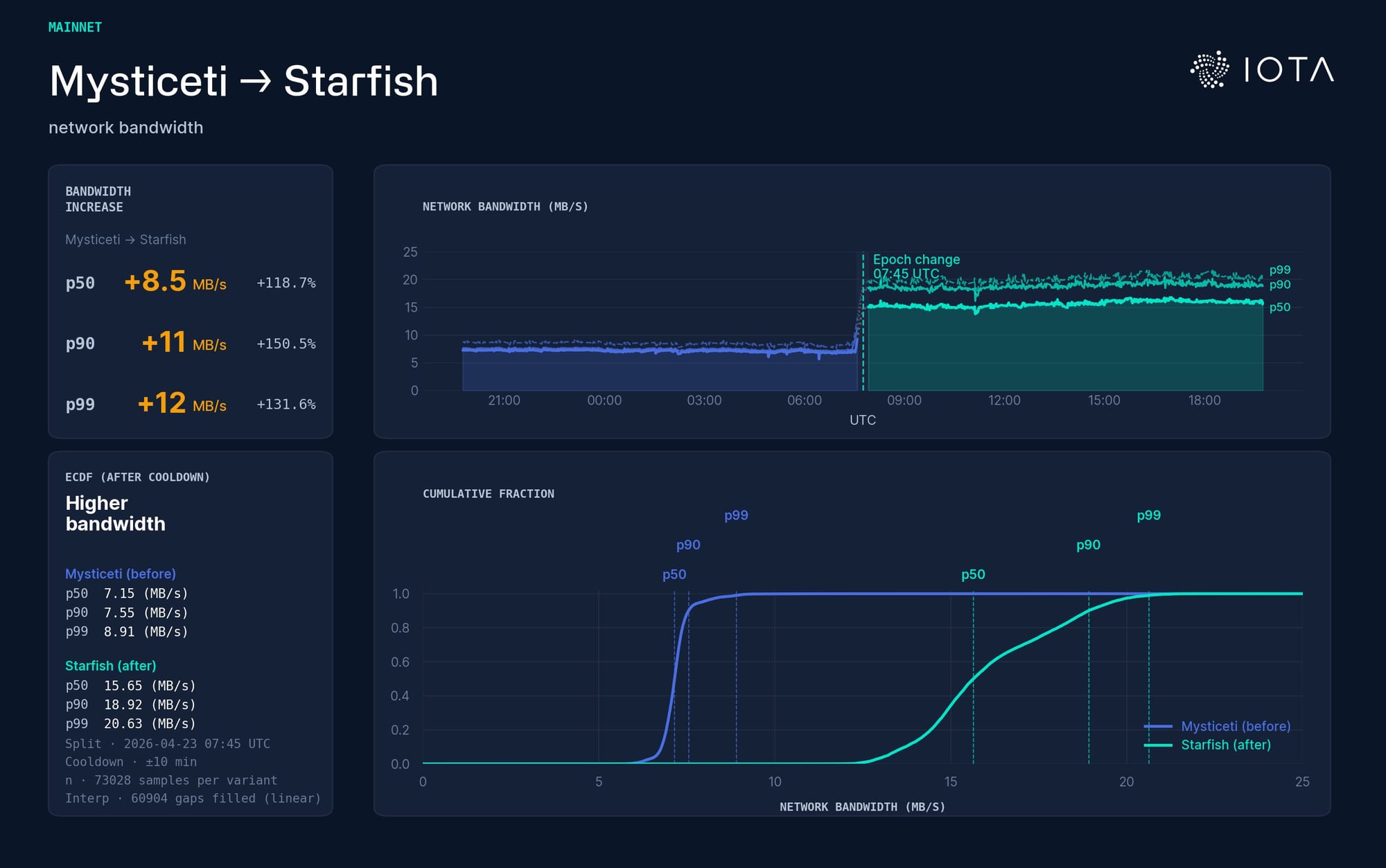
A critical takeaway from the initial mainnet telemetry data following the Starfish activation is the deliberate shift in engineering priorities: moving away from chasing illusory peak throughput metrics toward the systematic reduction of statistical variance.
Industrial engineering has long recognized that system reliability is defined by predictable output distributions rather than favorable arithmetic means. In distributed ledger benchmarking, however, networks are frequently marketed based on median latency and idealized peak transactions per second (TPS). These headline figures often obscure tail latency spikes, jitter under high network load, and erratic recovery times during transient disruptions.
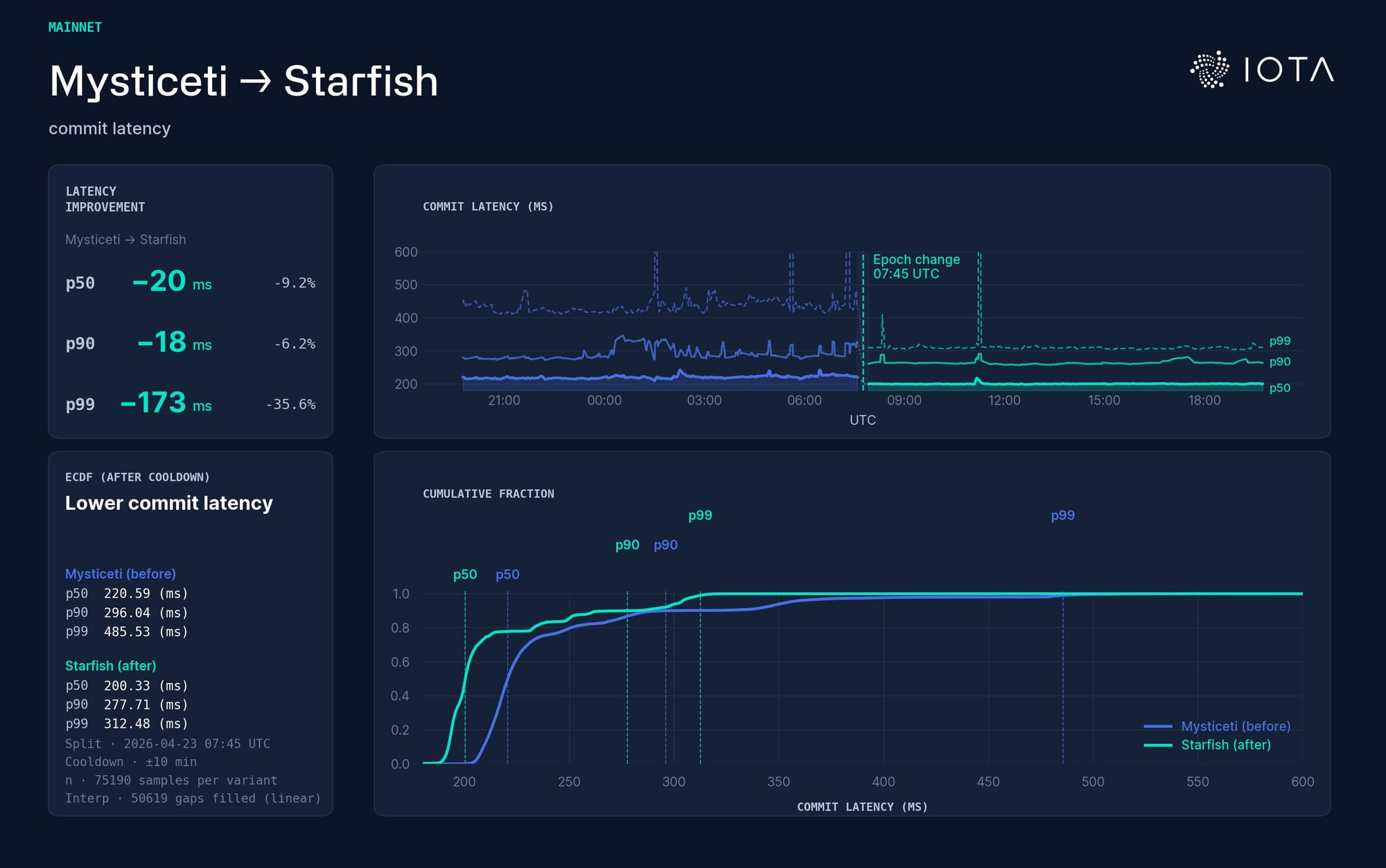
Comparative metrics between Mysticeti and Starfish vividly illustrate this design philosophy. While Starfish introduces a minor overhead in the nominal clean-case scenario—slightly adjusting baseline median transaction commit latency due to the structured availability verification step—it yields profound improvements in tail latency (p99 distributions).
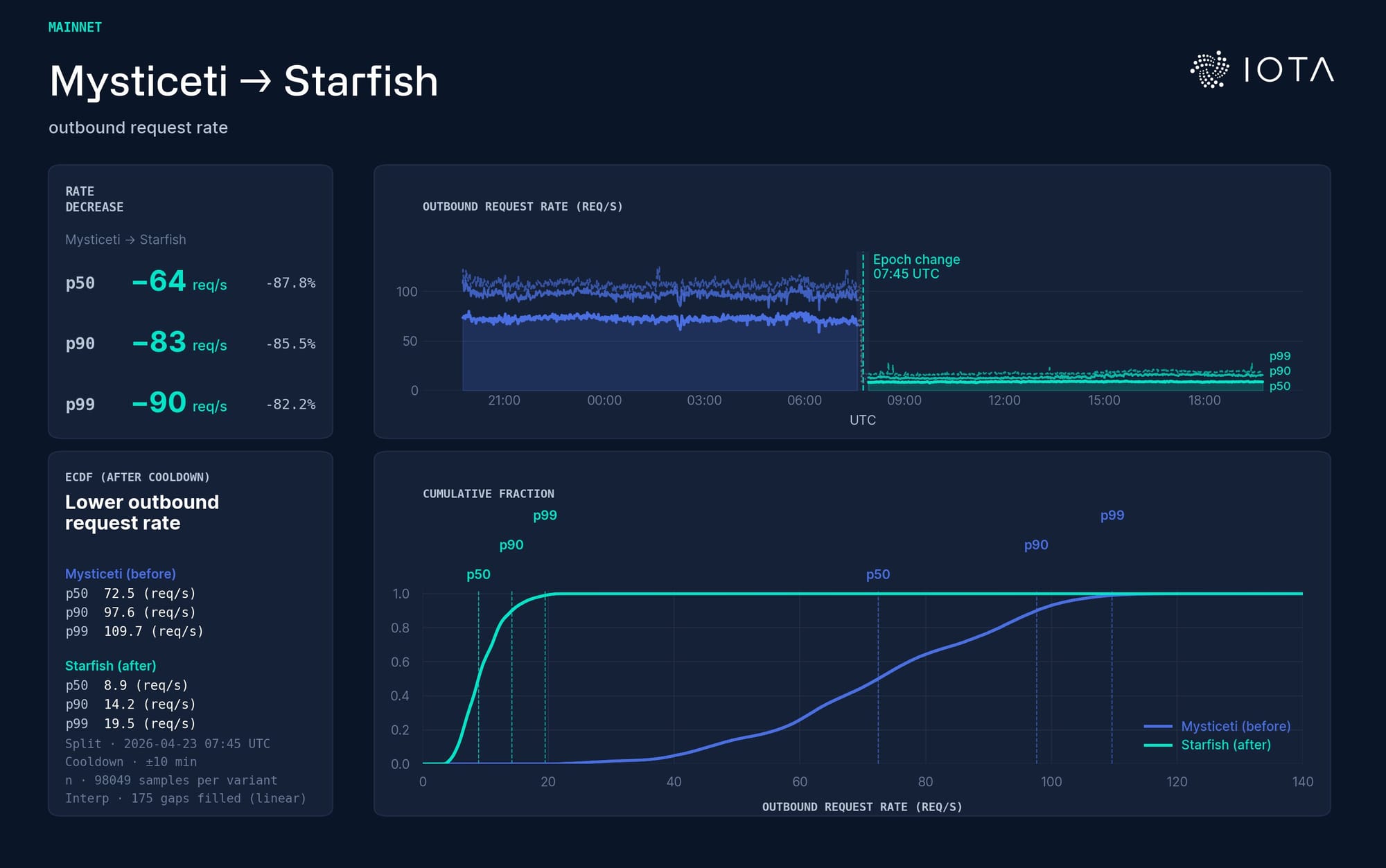
Telemetry data shows that outbound request rates—the primary indicator of the pull recovery path—drop by roughly an order of magnitude following the Starfish upgrade. Validators spend significantly less time executing costly recovery cycles on the critical path. Furthermore, commit latency distributions tighten noticeably; while Mysticeti exhibited wider dispersion during periods of stress, Starfish successfully suppresses variance, driving p99 commit latencies down from roughly 486 milliseconds to 312 milliseconds.
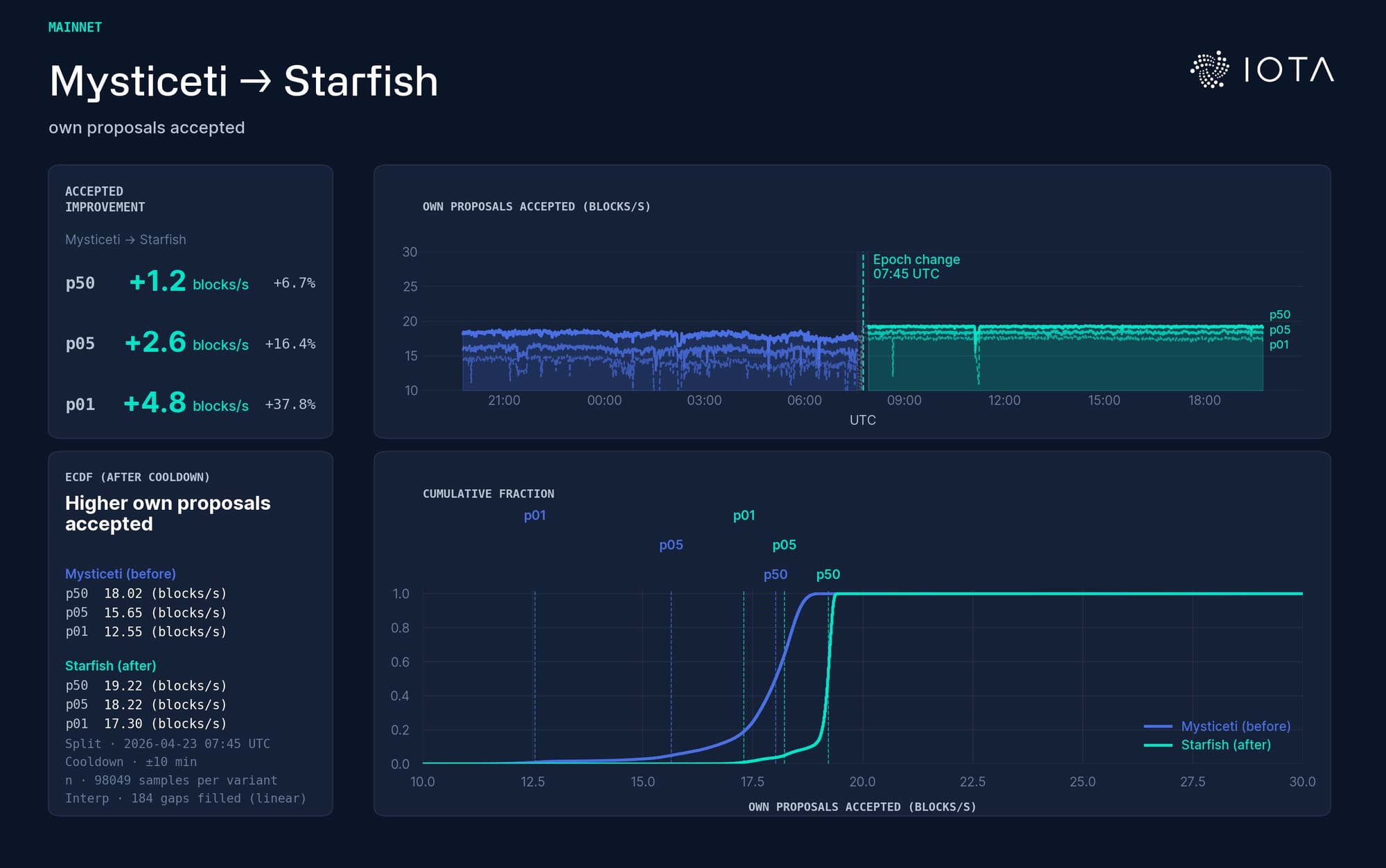
This stability is reinforced by the introduction of the Push pacemaker. By enforcing that network participants must generate local blocks before advancing consensus rounds, the protocol prevents lagging nodes from drifting forward and creating structural voids within the DAG. Consequently, validator proposal acceptance rates maintain high consistency, avoiding the desynchronization pitfalls that historically plagued uncertified consensus models.
Broader Implications and Industry Impact
The deployment of Starfish carries profound implications for the broader blockchain and distributed ledger technology sector. As enterprise applications, decentralized finance protocols, and institutional infrastructure demand higher resilience, consensus layer design must evolve to accommodate real-world network imperfections. Global validator topologies are inherently heterogeneous, characterized by disparate geographical distributions, variable bandwidth links, transient congestion, and occasional malicious or faulty participants.
By demonstrating that information dissemination and data availability can be natively unified within a DAG structure without sacrificing liveness or inflating latency variance, Starfish sets a new architectural benchmark. It proves that protocol designers do not need to choose between the raw speed of uncertified architectures and the safety guarantees of heavy quorum-certificate systems.
As the IOTA ecosystem operates under this new consensus paradigm, the success of Starfish validates a broader engineering thesis: that the true measure of a distributed protocol lies not in its performance under laboratory conditions, but in its grace under pressure, its predictability across distribution tails, and its unwavering commitment to structural integrity.